
Let's get straight to it: what exactly is TOIL leave?
At its core, Time Off In Lieu (or TOIL) is a pretty simple idea. Instead of paying an employee overtime for the extra hours they put in, you give them that time back as paid leave. Think of it as a 'work-life balance bank'. Every extra hour worked is a deposit, ready to be withdrawn later as a well-earned break.
Understanding TOIL Leave and Why It Matters

Here in the UK, TOIL is an arrangement where an employee gets paid time off that’s equivalent to the overtime hours they’ve worked beyond their contract. It’s not just a casual agreement; it’s a formal system that acknowledges and compensates people for their extra effort. The concept is really picking up steam as businesses look for more flexible ways to manage fluctuating workloads and reward dedication without constantly dipping into the payroll budget.
Unpaid overtime is a huge, persistent problem. A 2023 report revealed that a staggering 3.8 million UK workers regularly put in unpaid overtime, adding up to an average of 7.2 hours every week. This kind of unpaid slog is precisely why more UK employers are turning to TOIL policies. It’s a practical way to recognise those extra hours, tackle employee burnout, and genuinely support a healthier work-life balance. You can dig into more of the numbers on UK overtime in this detailed report from Avensure.
TOIL isn’t just another HR policy on a piece of paper. It's a real commitment to your team's wellbeing. It sends a clear message that you value their time and effort, which is fundamental to building a healthier, more sustainable work culture.
To give you a clearer picture, here’s a quick breakdown of what a TOIL system looks like in practice.
TOIL Leave At a Glance
| Concept | What It Means in Practice |
|---|---|
| The Basic Deal | An employee works extra hours and gets paid time off instead of overtime pay. |
| Agreement is Key | It must be mutually agreed upon, usually written into the employment contract. |
| Fair Exchange | The time off given is typically equal to the extra hours worked (a 1:1 ratio). |
| Tracking is Crucial | You need a clear system to log overtime hours worked and TOIL leave taken. |
This table shows just how straightforward the system can be when the foundations are right.
Key Principles of a TOIL System
For a TOIL system to work smoothly, it needs to be built on a few core principles that keep things fair and clear for everyone. Especially for small businesses, getting these fundamentals right from the start is the key to making it a success.
- Agreement: First and foremost, TOIL has to be agreed upon. It’s not an automatic right unless it’s clearly stated in the employment contract.
- Equivalence: The time off you grant should match the overtime hours worked. The standard is a simple 1:1 ratio, though some policies get a bit more creative, offering enhanced rates for working unsociable hours.
- Tracking: This one is non-negotiable. You absolutely must keep accurate, up-to-date records of extra hours worked and any TOIL taken. This isn't just for transparency; it's a must for legal compliance.
By formalising the process with these principles, you can sidestep potential misunderstandings and create a system that genuinely benefits both your business and your people.
Navigating the Legal Rules for TOIL in the UK

Many business owners wonder if TOIL is a legal requirement in the UK. The simple answer is no; it’s not a statutory right like your annual leave entitlement is. However, the moment you decide to offer it, your policy has to play by the rules of UK employment law.
The big one you need to keep in mind is the Working Time Regulations 1998. This legislation is all about protecting employees from working excessive hours. A key rule is that an employee can't work more than an average of 48 hours per week, which is usually calculated over a 17-week period.
This is exactly where a well-run TOIL system becomes your best friend for compliance. By letting an employee who worked 55 hours one week take a day off the next, you’re actively helping to keep their average weekly hours below that legal 48-hour limit. It’s a smart way to prevent your business from accidentally falling foul of the law.
Keeping TOIL and Annual Leave Separate
A common trap people fall into is lumping TOIL in with statutory holiday entitlement. These are two completely different beasts in the eyes of the law and they absolutely must be managed separately. An employee’s statutory annual leave is a protected right, whereas TOIL is simply a contractual agreement for making up for overtime.
Getting these mixed up can cause a world of confusion and even lead to legal headaches down the line. That’s why keeping accurate records is non-negotiable; you can find more details in our guide on what your paper-based leave management is costing you.
The golden rule of TOIL is clarity. Without a clear, written agreement in your employment contracts, you open the door to disputes. A formal policy protects both the business and your team by setting firm expectations from day one.
Ultimately, while offering TOIL isn't mandatory, it is governed by the terms of your contract and must always align with the Working Time Regulations. It’s a strategic way to manage workloads while staying compliant, but it needs to be recorded separately from annual leave and handled fairly for everyone.
How to Calculate and Track TOIL Accurately
A TOIL system is only as good as your ability to calculate and track it fairly and consistently. So, let's move from the theory to the practical side of things. How do you manage this process without creating an administrative nightmare, all while making sure your approach is transparent and builds trust with your team?
Most businesses start with a straightforward way of calculating TOIL.
- Standard Rate (1:1): This is the most common approach by far. For every extra hour an employee works, they get one hour of TOIL. It’s simple, easy for everyone to understand, and feels fair.
- Enhanced Rates (1.5:1 or 2:1): Some companies sweeten the deal by offering a higher rate for overtime worked during unsociable hours, like weekends or bank holidays. For instance, working one hour on a Sunday might earn an employee 1.5 hours of TOIL instead of just one.
Choosing Your Tracking Method
Once you've settled on the maths, the next crucial step is tracking it all. The method you choose should fit your business size and culture, but above all, it must be accurate.
A common approach for UK employers is to set up a formal policy that spells out not just the accrual rates but also the exact recording system. To manage TOIL properly, you need a clear audit trail. For example, if an employee contracted for 40 hours ends up working 50, they’ve earned 10 hours of TOIL, which has to be logged correctly. This is often handled with timesheets or dedicated electronic records to keep everything transparent. You can find more insights on effective TOIL management at factorialhr.com.
This simple process flow shows how a request moves from start to finish.
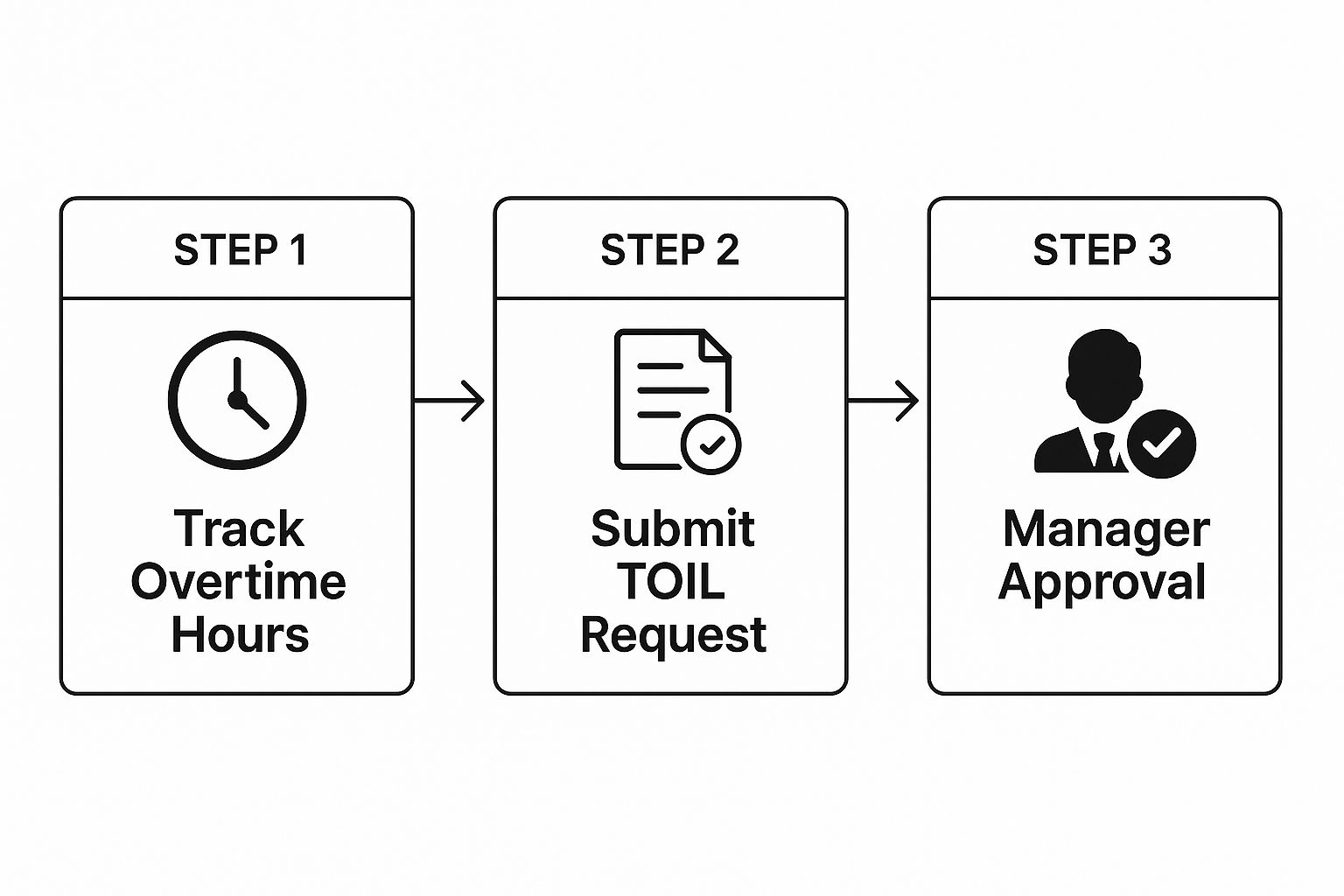
As the diagram shows, a successful TOIL system relies on clear, sequential steps that involve both the employee and their manager. This structure is key to preventing any informal, unrecorded arrangements that can cause confusion down the line.
The best tracking systems are the ones that everyone understands and can access easily. Whether it’s a shared spreadsheet or proper HR software, transparency is what matters most. It gets rid of the guesswork and shows your team that the system is fair for everyone involved.
Designing a Fair and Effective TOIL Policy

Trying to manage Time Off In Lieu with an informal, unwritten approach is a recipe for disaster. It almost always leads to confusion, frustration, and disputes down the line. To make TOIL work as a genuine benefit, you absolutely need a formal, transparent policy that clearly sets expectations for everyone.
Think of this document as your single source of truth. It outlines exactly how the system works, protecting your business from operational chaos and your employees from unfair treatment. A well-structured policy transforms a vague arrangement into a professional system that builds trust.
Key Policy Components
When you sit down to draft your TOIL policy, there are a few non-negotiable elements you have to include. These are the building blocks of a system that is both robust and fair.
-
Eligibility Criteria: Be crystal clear about who can earn TOIL. Is it just for salaried staff, or do your hourly workers qualify too? Defining this upfront prevents any misunderstandings.
-
Overtime Authorisation: This is critical. Your policy must state that all overtime needs to be pre-approved by a line manager. This simple step stops employees from racking up TOIL without a genuine business need.
-
Accrual Caps: You need to set a sensible limit on how much TOIL an employee can build up. An unlimited cap can quickly spiral out of control, leaving you with huge leave balances that are impossible to manage.
These three rules create the foundation for a controlled and predictable TOIL system. For a deeper dive into the nuts and bolts, you can find more detail on the best practices for managing https://www.leavewizard.com/days-off-in-lieu/.
Your TOIL policy isn't just another HR document; it's a commitment to fairness and clarity. A clear policy ensures that TOIL remains a valued perk, not a source of conflict or administrative chaos.
To help you get started, here’s a checklist of the essential elements your policy should cover, with specific points for UK businesses.
Essential Elements of a UK TOIL Policy
| Policy Component | Key Considerations for UK Businesses |
|---|---|
| Eligibility | Specify which job roles or contract types (e.g., salaried, hourly) are included. |
| Overtime Authorisation | Mandate pre-approval from a line manager for all overtime worked. |
| Accrual Rate | Define how TOIL is earned (e.g., hour-for-hour, or at an enhanced rate). |
| Accrual Cap | Set a maximum limit on the hours of TOIL an employee can accumulate. |
| Usage Timeframe | State the expiry period for accrued TOIL (e.g., within 3 months of being earned). |
| Booking Procedure | Outline how employees should request to use their TOIL leave. |
| Blackout Periods | Define any peak business times when TOIL cannot be taken. |
| Payment in Lieu | Clarify if unused TOIL will be paid out upon employment termination. |
Having these components clearly documented will save you countless headaches.
Setting Time Limits and Usage Rules
Beyond how TOIL is earned, your policy must govern how and when it can be used. Without clear deadlines, you risk employees hoarding leave, which can lead to long, disruptive absences that are a nightmare to plan around.
A common and effective practice is to set an expiry date. Many UK businesses require TOIL to be used within three to six months of it being earned. This encourages a steady, manageable pattern of usage. It’s also wise to specify any blackout periods, like your busiest season, when taking TOIL isn't practical.
Integrating your TOIL policy with broader strategies for managing remote teams is also a smart move, ensuring consistency and fairness for everyone, no matter where they work.
Weighing the Benefits and Drawbacks of TOIL
Offering Time Off In Lieu can seem like the perfect answer to managing overtime. It's a handy tool, for sure, but like any tool, it has its strengths and weaknesses. Before you jump in, it’s crucial to understand both sides of the coin to see if TOIL really fits your business culture and day-to-day operations.
A well-run TOIL system can be a genuine game-changer. But get it wrong, and you could create more headaches than you solve.
For many businesses, though, the benefits are hard to ignore. Giving team members their time back instead of paying cash for overtime can be a huge help for the budget, especially during those unexpectedly hectic periods. Plus, that flexibility can do wonders for team morale.
The Upsides of Offering TOIL
When you get it right, TOIL brings real, tangible benefits that can make your team stronger and your finances healthier. Think of it as more than just a cost-cutting trick; it's a smart way to build a better workplace.
Here are the key advantages:
- Improved Work-Life Balance: Handing employees their time back is a direct investment in their well-being. It helps them recharge and stave off the burnout that often creeps in after a massive project push.
- Enhanced Employee Morale: When you acknowledge that extra effort with paid time off, it sends a clear message: "We see your hard work, and we appreciate it." That recognition goes a long way in building loyalty and job satisfaction.
- Significant Cost Savings: You get to reward your team's extra hours without an immediate hit to the payroll. This is a lifesaver for managing your budget when workloads ebb and flow.
- Increased Flexibility: It’s a practical way to handle staffing through both busy spells and quiet times. You can ensure you've got all hands on deck when it's chaos, without being overstaffed when things calm down.
These points really drive home the advantages of offering Time Off In Lieu, making it a compelling option for any modern employer.
The Potential Downsides to Consider
However, it's not all smooth sailing. The biggest hurdle is often the admin. Without a solid system to track everything, managing accrued hours can quickly spiral into a complicated, time-sucking mess that's ripe for mistakes and disagreements.
One of the most common traps is when employees start hoarding their TOIL. If people bank too many hours without taking the time off, you could be facing long, disruptive absences down the line. It's tough to plan around that, and you might see productivity dip just when you need a key person.
Finally, if your TOIL system isn't managed with crystal-clear rules and open communication, it can start to feel inconsistent or even unfair. A fuzzy policy can cause more confusion than clarity, undermining the very trust you were trying to build in the first place.
Common Questions About TOIL Leave Answered
Even with a solid policy in your back pocket, questions about Time Off In Lieu are bound to pop up in practice. Getting to grips with the finer points helps prevent crossed wires and keeps the system fair for everyone. Let’s tackle some of the most common queries we see from both managers and employees.
Clearing up these common questions sets clear expectations from the start. This makes sure TOIL stays a welcome perk, not a source of confusion.
Can an Employer Force an Employee to Take TOIL?
This is a big point of confusion for many. The short answer? No. An employer can't just decide you're getting TOIL instead of overtime pay unless it's already a specific, agreed-upon term in your employment contract.
If it’s not written into the contract, the arrangement has to be a mutual decision every single time overtime comes up. The whole point of TOIL is that it’s a flexible arrangement that benefits both sides, not something to be enforced.
What Happens to Accrued TOIL When an Employee Leaves?
This exact scenario is why having a formal, written policy is non-negotiable. Your employment contract needs to spell out precisely what happens to any unused TOIL when someone’s time with the company ends.
Generally, there are two fair and common ways to handle this:
- Pay it out: The company calculates the value of the banked TOIL hours at the employee's standard pay rate and adds it to their final paycheque.
- Use it up: The employee is required to take their accrued TOIL as leave during their notice period, ensuring the time is used before they officially depart.
Leaving this detail up in the air is just asking for a dispute down the line, so get it documented.
A clear policy on what happens at termination is vital. It protects the business from surprise payout costs and gives the departing employee clarity on what they're entitled to.
Is There a Legal Time Limit for Using TOIL?
In the UK, there’s no law that sets a deadline for an employee to use their accrued TOIL. This is exactly why your company policy needs to step in and fill that gap.
It's widely considered best practice for employers to set a reasonable timeframe, like requiring TOIL to be used within three or six months of it being earned. This simple step prevents employees from stockpiling huge amounts of leave, which can cause a real headache for scheduling and operations when they finally decide to take it all at once.
Does TOIL Apply to Part-Time Employees?
Yes, absolutely, but the rules work a little differently. If a part-time employee works extra hours that still fall below your company's standard full-time hours (say, 37.5 hours a week), those hours are usually just paid at their normal hourly rate.
TOIL typically only enters the picture when a part-time employee works more than the standard full-time hours. For instance, if your full-time week is 40 hours and an employee contracted for 20 hours works a 45-hour week, the first 20 extra hours are paid normally. It's only the final 5 hours that went beyond the full-time threshold that would be eligible for TOIL, according to your policy.


