
Days off in lieu, often shortened to TOIL, is a pretty straightforward concept. It’s a system where an employee takes paid time off as compensation for working extra hours, rather than getting paid for overtime.
Think of it like a time bank. When your team members work beyond their contracted hours, they deposit that time into their bank. Later on, they can withdraw those hours as fully-paid leave. It's a simple, fair exchange.
What Are Days Off in Lieu, Really?

Let's put it into a real-world context. Imagine your business is up against a tight project deadline. One of your salaried employees, Alex, volunteers to work all day Saturday to get everything over the line. Now, you could go through the hassle of calculating overtime pay, but their contract might not even cover that.
Instead, you offer Alex a future weekday off, with full pay. That day off is a day in lieu.
What this does is formalise a common workplace practice, turning a simple 'thank you' into a structured and fair system. It’s a fantastic way to acknowledge an employee's extra effort without adding pressure to your payroll, giving both you and your team more flexibility. The guiding principle is beautifully simple: time for time. One hour of overtime earns one hour of leave.
Common Scenarios for Earning Days Off in Lieu
It’s important to be clear that TOIL isn’t just a reward for staying late without good reason. It’s designed for specific, usually pre-approved, situations where extra work is genuinely needed. Here in the UK, it’s a popular way to handle work on public holidays or to manage unexpected peaks in workload.
By law, UK employers must give most workers 5.6 weeks' paid annual leave each year. For someone working full-time, that's 28 days. Whether this statutory holiday entitlement includes bank holidays depends entirely on the employment contract.
So, if you need your staff to work on one of the eight bank holidays in England and Wales, offering a day off in lieu is a common—and fair—way to make up for it. If you want to dive deeper, you can learn more about how UK businesses handle annual leave policies.
To illustrate when TOIL might be granted, let's look at some typical situations. The table below breaks down a few common scenarios.
Common Scenarios for Earning Days Off in Lieu
| Work Scenario | Reason for TOIL | Typical Compensation |
|---|---|---|
| Working on a Public Holiday | An employee works on a bank holiday to provide essential cover. | A full day off in lieu, taken at a later date. |
| Weekend Project Work | A team comes in on a Saturday to finalise a critical client project. | The exact number of hours worked is credited as TOIL. |
| Attending a Conference | An employee travels and attends a work conference outside of their standard hours. | Time spent on conference activities or travel on a non-workday is given back as leave. |
| Covering Staff Shortages | A manager stays several hours late to cover for a sick colleague. | The extra hours are recorded and can be taken back as time off. |
These examples show how a clear TOIL policy creates a transparent process for everyone.
By formalising these arrangements, a TOIL policy moves beyond informal 'favours' and establishes a clear, equitable process. This transparency builds trust and helps prevent potential disputes over uncompensated work.
Navigating UK Legal Requirements for TOIL

Trying to get your head around the legal side of days off in lieu (TOIL) can feel like a bit of a maze, but it’s more straightforward than you might think. The main piece of the puzzle you need to be familiar with is the Working Time Regulations 1998. This is the framework that lays down the law on working hours, rest breaks, and annual leave here in the UK.
One of the headline rules is that an employee can’t work more than an average of 48 hours per week. This average is usually worked out over a 17-week reference period. This is where offering TOIL becomes a really practical tool. By giving that time back, you help keep your team’s average hours safely within the legal limit, which is great for their well-being and keeps your business on the right side of the law.
While the law doesn't strictly force you to offer TOIL for overtime, it’s widely seen as a best practice. If you haven't specified how overtime is handled in an employment contract, having a clear TOIL system is a fair and organised way to recognise that extra effort.
The Role of Employment Contracts
Think of your employment contracts as the bedrock of your TOIL arrangement. What you put in writing really matters.
- If your contract promises TOIL for overtime, that’s a binding agreement. You're committed to giving that time off as you've said you will.
- If it says overtime will be paid, you're generally obliged to pay for those extra hours unless an employee specifically agrees to take TOIL instead.
- If the contract is silent on the matter, you’ve got more wiggle room. However, your best move is always to create a clear, written TOIL policy to sidestep any confusion or disputes down the line.
Without a documented policy, you're leaving the door open to misunderstandings that could easily escalate into formal grievances or even an employment tribunal.
Clarifying Bank Holidays and Leave
A common trip-up for many businesses is figuring out how bank holidays fit into all this. In the UK, there's no automatic legal right for staff to have bank holidays off. It all comes down to what's in their contract.
If you need someone to work on a bank holiday and their contract counts bank holidays as part of their paid leave, you absolutely have to compensate them. Giving a day off in lieu is the typical way to do this.
This ensures they don't lose out and still receive their full statutory holiday entitlement, which stands at a minimum of 5.6 weeks per year. The rules around holiday entitlement can be tricky, especially with recent changes, and you can explore how factors like Brexit have impacted these rules.
Having a transparent policy for bank holiday work is vital for staying compliant and keeping your team happy. Making these rules clear from day one protects your business and shows your staff that you value their time.
Why a Formal TOIL Policy Is a Business Asset

Moving from informal 'handshake' agreements to a documented days off in lieu (TOIL) policy is one of the smartest things a growing business can do. This isn't about wrapping your team in red tape; it's about building a stronger, more resilient company where everyone knows where they stand. Think of a formal policy as your first line of defence against burnout and misunderstandings.
Without clear, written rules, you’re leaving the door wide open for inconsistency. One person might get a day off for working a Saturday, while another gets a vague promise that never quite materialises. This sort of confusion quickly breeds resentment, poisoning your team culture and paving the way for disputes over what was actually agreed.
A proper TOIL policy changes all of that by setting crystal-clear expectations for everyone involved.
Protecting Your Business and Your People
A well-defined policy is a powerful risk management tool. It creates a transparent framework for handling those extra hours, which is essential for nipping potential disputes in the bud before they can escalate into costly employment tribunals. Protecting your company from legal headaches is a core responsibility, just like understanding the basics of business insurance is for safeguarding your wider operations.
But it goes beyond just legal protection. A transparent approach to days off in lieu has a direct, positive impact on your team’s well-being. It ensures fairness across the board and formally acknowledges the hard work your employees put in, which is fundamental for keeping morale high and reducing friction in the workplace.
Labour disputes can be incredibly disruptive. In 2018 alone, 273,000 working days were lost in the UK due to such conflicts. A fair TOIL system helps maintain morale and minimises the risk of disputes related to overtime, as detailed in reports from the Office for National Statistics.
Fostering a Culture of Fairness and Trust
Ultimately, a formal TOIL policy becomes a strategic asset for keeping your best people and attracting new talent. It sends a clear signal that you value your employees' time and are genuinely committed to treating them equitably. This fosters a culture built on trust and mutual respect, where people feel truly appreciated for going the extra mile.
This structured approach brings a host of benefits that strengthen your business from the inside out:
- Enhanced Employee Morale: Recognising that extra effort with time off shows you're serious about work-life balance.
- Improved Retention Rates: People are far more likely to stick with an employer they see as fair and supportive.
- Clearer Financial Planning: TOIL helps you avoid unexpected overtime bills, making your budgeting far more predictable.
By putting a clear system in place, you're not just managing leave—you're investing in a more stable, positive, and productive work environment. If you want to dive deeper, you can learn more about the advantages of offering time off in lieu in our detailed guide.
How to Build Your Company TOIL Policy
Switching from informal chats to a formal, written policy for days off in lieu is one of the most important things you can do. Without one, you're opening the door to confusion, misunderstandings, and claims of unfairness. A good policy sets clear boundaries and expectations right from the start.
Think of it like the rulebook for your company’s 'time bank'. Without clear rules, nobody knows how to earn time, when they can cash it in, or if the system is even fair for everyone. A solid policy ensures the whole team understands the process, from earning the time to taking that well-deserved day off.
Define Eligibility and Accrual Rates
First things first: who can actually earn TOIL? You need to be crystal clear about this. Is it available to every employee, or only for certain roles or those below a specific salary level? Being explicit here is your best defence against any feelings of unfair treatment down the line.
Next, you have to define exactly how that time is earned. The simplest and most common method is a straight swap: one hour of pre-approved overtime equals one hour of TOIL. It’s easy to understand and manage. However, you might want to incentivise work during unsociable hours by offering a better rate, like 1.5 hours of TOIL for every hour worked on a bank holiday or weekend. Whatever you decide, spell it out in black and white.
This infographic shows how a simple hour-for-hour system works in practice, translating extra hours into a full day off.
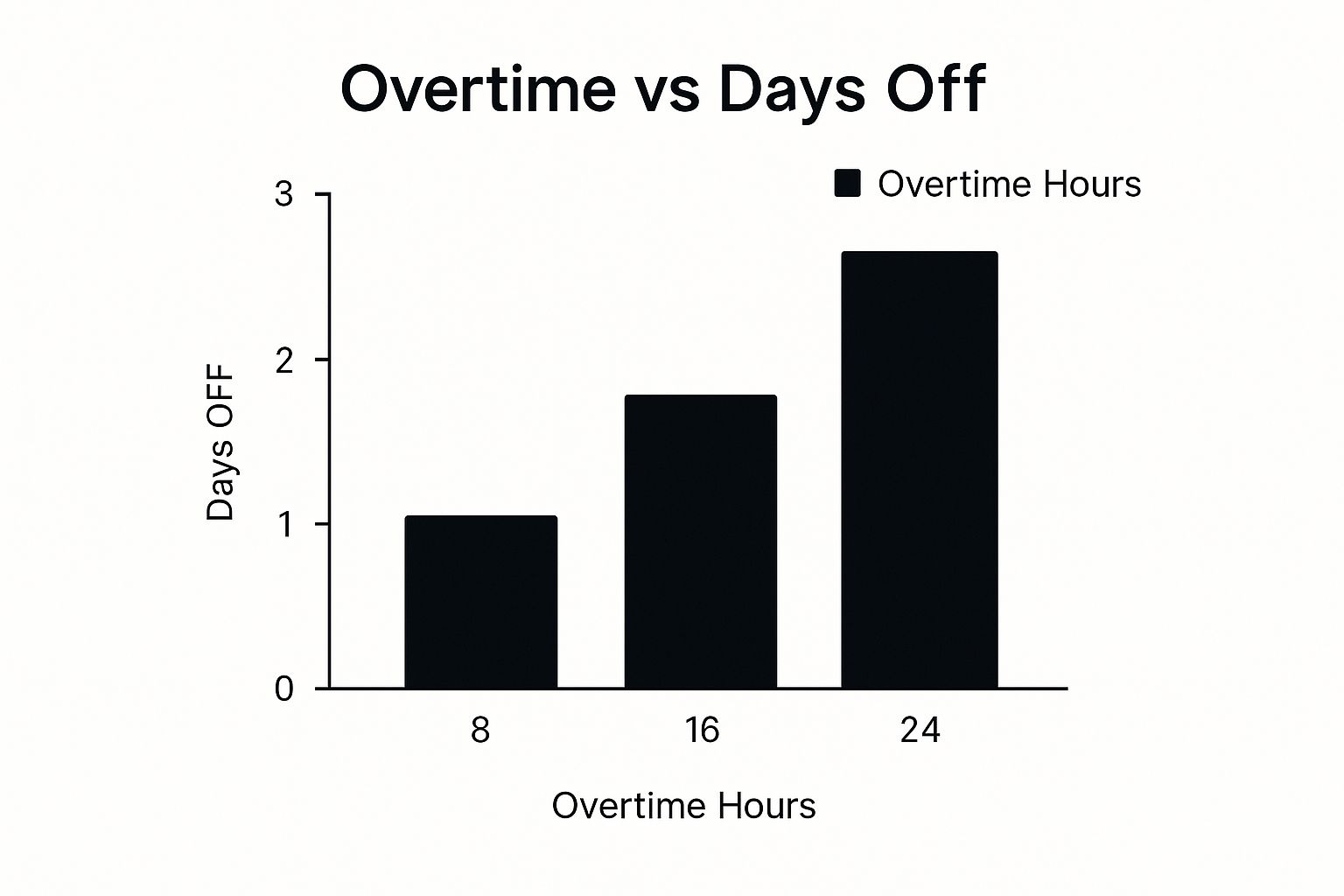
As you can see, under this standard approach, an employee needs to clock up a full eight hours of overtime before they can book a full day off.
Establish Clear Procedures for Authorisation and Booking
A reliable TOIL system needs tight controls. Without them, you risk operational chaos. Your policy must lay out the approval process for overtime before anyone stays late.
No employee should ever assume they can just work late and bank the hours for later. All overtime that qualifies for TOIL must be pre-approved in writing by a direct line manager. This simple step stops people from racking up huge balances without a genuine business need.
Just as critical is the process for booking the time off. You should treat requests for lieu days exactly as you would any other annual leave request. That means including:
- A Formal Request Process: Staff should submit requests through your official leave management system, not via a quick chat in the corridor.
- Notice Periods: Be clear on how much notice an employee needs to give before taking a lieu day.
- Managerial Approval: All requests must be approved by a manager, who will consider team capacity and business needs.
- Blackout Periods: You have the right to specify busy times, like the run-up to a project deadline, when taking lieu days might be restricted.
To ensure your policy covers all the essential bases, a checklist can be incredibly helpful. It makes sure you've thought through every angle, leaving no room for ambiguity.
Essential Elements of a TOIL Policy
| Policy Component | Key Question to Answer | Example Wording Snippet |
|---|---|---|
| Eligibility | Which employees or roles can earn TOIL? | "This policy applies to all full-time and part-time employees in non-exempt roles. Senior management roles are not eligible for TOIL." |
| Accrual Rate | How is TOIL calculated? Is it a 1:1 ratio? | "TOIL is accrued on an hour-for-hour basis for pre-approved overtime. Work on official UK bank holidays will accrue at 1.5x the standard rate." |
| Authorisation | How must overtime be approved before it's worked? | "All overtime must be requested and approved in writing by your line manager via the company's HR portal at least 24 hours in advance." |
| Booking Time Off | How do employees request to use their accrued TOIL? | "Requests to use accrued TOIL must be submitted through the LeaveWizard platform with a minimum of one week's notice and are subject to managerial approval." |
| Expiry Rules | When does unused TOIL expire? | "Accrued TOIL must be used within three (3) months of the date it was earned. Any unused time will expire after this period." |
| Balance Cap | Is there a maximum amount of TOIL an employee can hold? | "Employees may not accrue more than 20 hours of TOIL at any given time. No further overtime for TOIL can be approved until the balance is below this cap." |
| Leaving the Company | What happens to unused TOIL upon termination of employment? | "Accrued TOIL cannot be paid out in lieu. Employees are expected to use any outstanding balance before their final day of employment." |
This table acts as a framework to build a policy that is not only fair and transparent but also protects your business from potential liabilities.
Set Sensible Expiry Dates
One of the biggest pitfalls of a TOIL system is letting a massive balance of leave build up on the books. An employee with dozens of banked lieu days can become a real headache, both operationally and financially, especially if they try to take them all at once or when they decide to leave.
To sidestep this problem, your policy needs a firm expiry clause. There are a few common ways to handle this:
- Require all TOIL to be used within three months of being earned.
- Set a hard deadline at the end of your leave or financial year.
- Put a cap on the total number of lieu days someone can have in their "bank" at one time.
This makes sure TOIL is used for its intended purpose—as a timely reward for going the extra mile—instead of turning into a long-term leave headache you have to manage.
Of course, here is the rewritten section, crafted to sound like an experienced human expert, following all the provided guidelines and examples.


