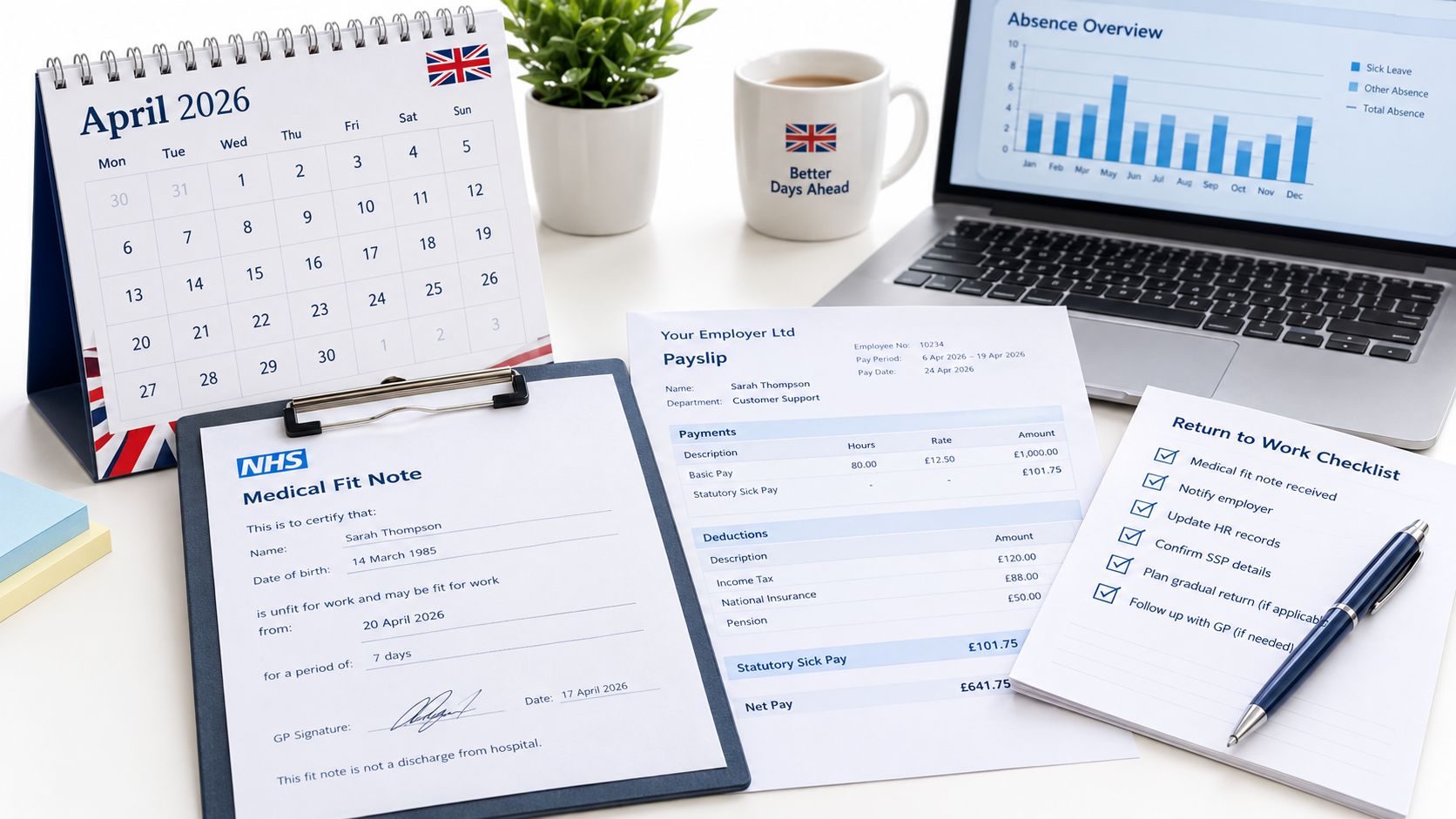
Let's clear up the biggest question right away: do part-time workers get sick pay?
The answer is a resounding yes. In the UK, your right to Statutory Sick Pay (SSP) isn’t decided by how many hours you work, but whether you tick a specific set of boxes that apply to everyone.
Your SSP Rights as a Part Time Worker Explained
It’s a common myth that going part-time means giving up key workplace rights. But when it comes to Statutory Sick Pay, the rulebook is the same for all. Whether you work 15 hours a week or 40, your eligibility comes down to a few core factors, not your contracted hours.
Think of it as a universal safety net, put in place to give you a baseline of support if you're too ill to work.
This guide is here to help you understand how the system works for you. We'll break down the essentials without the jargon, so you can feel confident about what you’re entitled to.
The Core Eligibility Pillars
To qualify for SSP, every employee has to meet the same fundamental criteria. Your part-time status doesn't change these pillars, but it can affect how they apply in your situation.
The main requirements are:
- Employee Status: You must be legally classed as an employee and have done some work for your employer under your contract.
- Sickness Duration: You need to be off sick for at least four days in a row. This is known as a 'period of incapacity for work'.
- Earnings Threshold: This is often the trickiest part for part-time staff. You must earn, on average, at least the Lower Earnings Limit (LEL).
For many part-time workers, hitting that earnings threshold is the biggest hurdle. The actual rate of SSP can change, but to qualify, your average weekly earnings (usually calculated over an eight-week period) must be at or above this government-set minimum. If your hours fluctuate or are very low, you might find you don't meet the threshold.
To make it crystal clear, we’ve put together a quick checklist.
SSP Eligibility Checklist for Part Time Workers
This table breaks down the key requirements and what they mean specifically for someone not working full-time.
| Eligibility Criterion | Requirement | Key Consideration for Part Time Staff |
|---|---|---|
| Employment Status | Must be classified as an employee and have started work. | This includes most part-time contracts, including fixed-term. Agency and zero-hours workers can also qualify. |
| Sickness Duration | Must be sick for 4 or more consecutive days (including non-working days). | SSP isn't paid for the first 3 days (waiting days). This rule applies regardless of your work schedule. |
| Earnings Threshold | Average weekly earnings must be at least the Lower Earnings Limit (LEL). | This is the most critical point. Earnings are typically averaged over the 8 weeks before your sickness began. Irregular hours can make this harder to meet. |
| Proper Notification | Must have notified your employer of your sickness within their required timeframe (or 7 days if they don't have one). | Your company's sickness reporting policy applies to you just as it does to full-time staff. |
As you can see, the rules themselves don't change, but how they apply to your specific work pattern is what really matters.
The key takeaway is simple: your employment contract type does not automatically disqualify you from receiving SSP. The law focuses on your earnings and sickness duration, applying the same legal framework to both full-time and part-time workers. For a detailed breakdown of the basics, you can check out our guide on what Statutory Sick Pay is.
Meeting the Lower Earnings Limit on a Part Time Schedule
For many part-time workers, the biggest hurdle to getting Statutory Sick Pay is something called the Lower Earnings Limit (LEL). It’s best to think of this not as some random number, but as the financial gateway to SSP. You have to earn a certain minimum average amount each week to unlock government-mandated sick pay.
If your average pay packet dips below this threshold, you won't qualify for SSP, even if you tick every other box. This rule exists to connect SSP entitlement with National Insurance contributions, but it can unfortunately leave those on lower incomes or with unpredictable hours out in the cold.
This earnings rule is the main reason why some part-time workers get nothing when they're off ill. In fact, it’s estimated that around 1 million UK employees—many of them working part-time—are shut out from SSP simply because their earnings don't meet the LEL. A GOV.UK equality analysis shows just how much these rules affect different groups of workers.
How Your Average Weekly Earnings Are Calculated
So, how do you know if you meet the LEL? Your employer has to calculate your average weekly earnings. This isn't just about what's on your contract; it's a real-world snapshot of your gross earnings (that’s before tax and National Insurance) over a specific timeframe known as the ‘relevant period’.
The relevant period is usually the eight weeks right before you became sick. It's designed to create a fair average, smoothing out any peaks and troughs in your pay, which is common in part-time work.
Crucially, this calculation must include all your earnings that are subject to National Insurance contributions.
So, what actually counts towards your earnings?
- Your regular wages or salary for the hours you put in.
- Any overtime pay you earned during that eight-week stretch.
- Commission payments that landed in your bank account during that time.
- Bonuses that were paid out within that specific window.
Basically, if it was money you received from your employer as part of your pay during those eight weeks, it gets added to the pot.
A Step-by-Step Calculation Example
Let's walk through how this works in practice. Imagine Sarah, who works part-time in a shop, falls ill on 1st June. Her employer needs to crunch the numbers to see if she qualifies for SSP.
- Identify the Relevant Period: First, they look at the 8 weeks leading up to Sarah's first day of sickness. In this case, that period runs from 6th April to 31st May.
- Total Gross Earnings: Next, they add up all the gross pay Sarah received during this time. Let's say with a bit of overtime, she earned a total of £1,120 over these eight weeks.
- Calculate the Average: Finally, they divide her total earnings by the number of weeks in the period.
The calculation looks like this: £1,120 (Total Earnings) ÷ 8 (Weeks) = £140 (Average Weekly Earnings)
Sarah’s average weekly earnings come out to £140. If the LEL for that tax year is £123, then Sarah is comfortably over the threshold. As long as she meets the other conditions, she is eligible for Statutory Sick Pay.
How Your Part Time SSP Is Actually Calculated
Figuring out Statutory Sick Pay (SSP) for part-time workers isn't as simple as just dividing the weekly rate by five. The whole calculation really boils down to one key idea: Qualifying Days.
Put simply, Qualifying Days are just the days an employee is normally scheduled to work. For your part-time team members, this changes everything.
SSP is only paid for these specific days. So, if someone is contracted to work on Tuesdays and Thursdays, those are their only Qualifying Days. They can't get SSP for being sick on a Monday or a Friday, because they wouldn't have been at work anyway.
This system is designed to make sure sick pay lines up with an employee's actual working pattern, not a standard Monday-to-Friday week that just doesn't apply to them.
The first step is always to work out their average earnings to see if they qualify. This involves gathering their pay data over a set period, adding it all up, and finding the average. This diagram gives a quick overview of how that works.
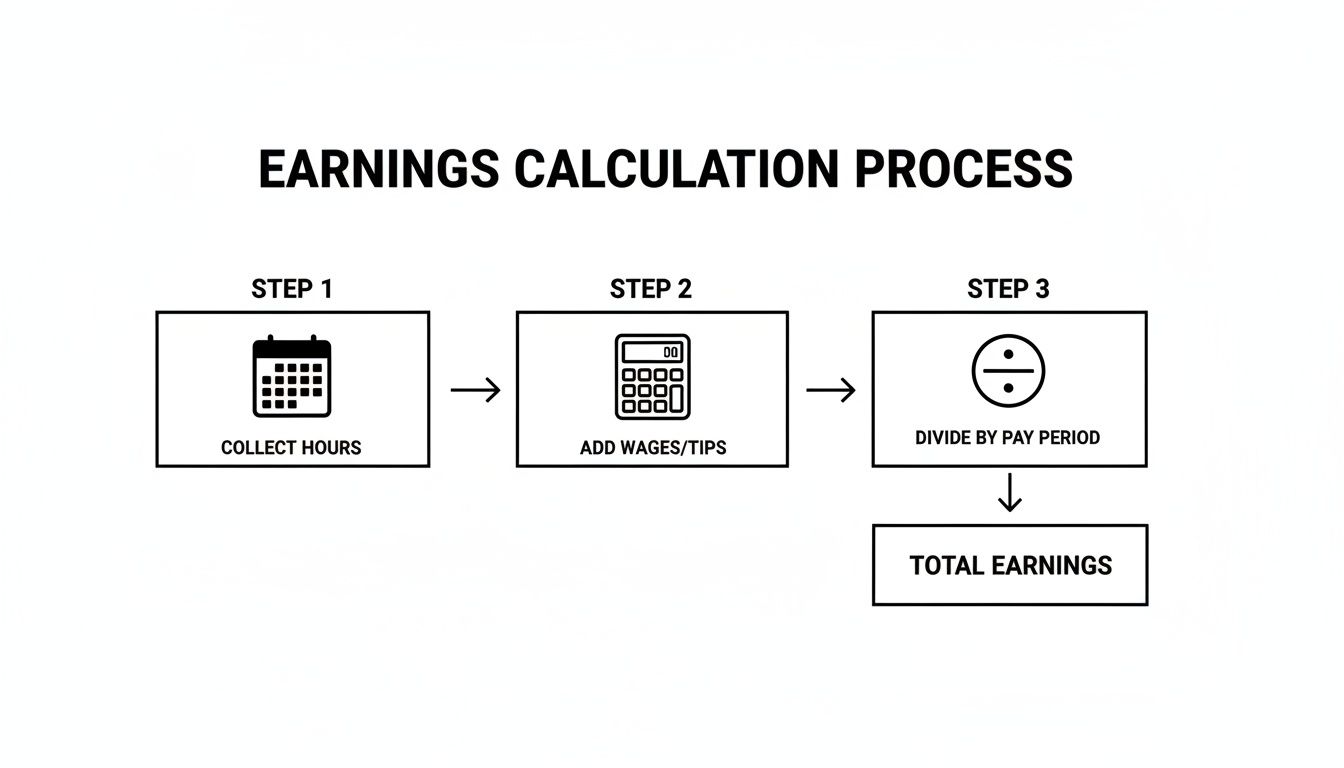
This method ensures you get a fair average, which is crucial for determining SSP eligibility, especially for staff with fluctuating hours.
Finding the Daily SSP Rate
Once you've nailed down the Qualifying Days, the next piece of the puzzle is the daily SSP rate. To find it, you take the standard weekly SSP rate and divide it by the number of Qualifying Days in that week.
Here’s how that looks in practice:
-
Example 1: Fixed Part-Time Schedule
An employee works three days a week (Monday, Wednesday, Friday). With the weekly SSP rate at £116.75, their daily rate is £116.75 ÷ 3 = £38.92. They'd get this amount for each Qualifying Day they're sick, once they're past the waiting period. -
Example 2: Irregular Rota
Another employee is on a shifting two-week rota, working four days in week one and just two days in week two. Their daily SSP rate will actually change from one week to the next. In week one, it's £116.75 ÷ 4 = £29.19. But in week two, it jumps to £116.75 ÷ 2 = £58.38.
This flexibility is what makes sure statutory sick pay for part time workers is calculated fairly, reflecting their genuine work schedule. For a deeper dive with more scenarios, you can learn more about how to calculate Statutory Sick Pay in our main guide.
Accounting for Waiting Days
Now for a crucial rule: no SSP is paid out right away. There's a mandatory waiting period.
The first three Qualifying Days of any sickness absence are completely unpaid. These are known as ‘waiting days’.
An employee only starts receiving SSP from the fourth Qualifying Day they are off sick. This rule applies to everyone, regardless of their work pattern. It’s a universal part of the SSP system.
Let's see how this all comes together with a real-world example.
Worked Example: Putting It All Together
Tom works part-time on Tuesdays, Wednesdays, and Thursdays. He falls ill on a Monday and is signed off for the entire week.
- Identify Qualifying Days: Tom’s Qualifying Days are Tuesday, Wednesday, and Thursday.
- Apply Waiting Days: The first three Qualifying Days of his absence (Tuesday, Wednesday, and Thursday) are his unpaid waiting days.
- Calculate Payment: Because his sickness only covered three Qualifying Days, Tom actually receives no SSP for this first week off. If he were still sick the following Tuesday—his next scheduled workday—that would become his first payable day.
Sample SSP Calculations for Part Time Schedules
To make this even clearer, let's compare how a one-week (7-day) sickness absence would play out for employees with different part-time schedules. In each case, we assume the sickness starts on their first working day of the week.
| Working Pattern | Qualifying Days | Waiting Days | Payable Days | Total SSP Paid |
|---|---|---|---|---|
| 5 days/week (Mon-Fri) | Mon, Tue, Wed, Thu, Fri | Mon, Tue, Wed | Thu, Fri (2 days) | £46.70 (£116.75 / 5 * 2) |
| 3 days/week (Mon, Wed, Fri) | Mon, Wed, Fri | Mon, Wed, Fri | 0 days | £0.00 |
| 2 days/week (Tue, Thu) | Tue, Thu | Tue, Thu | 0 days | £0.00 |
| 4 days/week (Mon, Tue, Thu, Fri) | Mon, Tue, Thu | Mon, Tue, Thu | Fri (1 day) | £29.19 (£116.75 / 4 * 1) |
As you can see, the number of days someone works per week has a massive impact on whether they receive any SSP at all for a short absence, all because of those three waiting days. It's a detail that's easy to miss but critical for accurate payroll.
Navigating Employer Duties for Part Time Staff
When it comes to Statutory Sick Pay (SSP), getting it right isn't just good practice—it's a legal requirement. This is especially true when you’re dealing with statutory sick pay for part time workers, as their varied schedules can sometimes make things feel a bit more complicated.
But don’t worry, it doesn’t have to be. Think of your responsibilities as a straightforward checklist. Your core duties are to pay eligible employees the correct amount of SSP, make sure it lands in their bank account on their usual payday, and keep clear, detailed records of the whole process.
Getting this wrong can cause real headaches. HMRC has the power to issue penalties if you don't pay SSP, pay an incorrect amount, or fail to keep proper records. Putting a simple, reliable system in place isn’t just about ticking boxes; it's about protecting your business and treating your team fairly.
Your Core Compliance Checklist
To stay on the right side of the law, there are a few non-negotiable tasks you need to handle every time an employee—full-time or part-time—is off sick.
Here are your fundamental responsibilities:
- Timely Payments: Any SSP owed must be paid on the employee’s regular payday.
- Accurate Record-Keeping: You must keep detailed records for at least three years after the end of the tax year they relate to.
- Issuing Form SSP1: If an employee doesn’t qualify for SSP, you must give them form SSP1, which clearly explains why they aren't eligible.
Keeping meticulous records is your best defence in case of a dispute or an HMRC inspection. Your records should document the dates of sickness, the 'waiting days' for each absence, and a clear breakdown of all SSP payments made to each employee.
The Financial Realities of SSP for Staff
It’s also incredibly helpful for employers to understand what SSP actually feels like for their staff. While the rate has risen over the years, its real-world value can be quite small, particularly for part-timers.
The current SSP rate for 2024/25 is £116.75 per week. For a part-time employee working a three-day week, this breaks down to just over £38 per day they're off sick—often a tiny fraction of their usual income. You can learn more about the government's thinking behind this in its equality analysis for Statutory Sick Pay reform measures.
Understanding this context helps you manage employee expectations and handle conversations about sick pay with the empathy and clarity they deserve.
Handling Complex Scenarios Like Multiple Jobs and Company Sick Pay
The modern workplace isn't always a simple nine-to-five. Part-time employees often find themselves juggling multiple roles or working for companies with their own sick pay policies, which can muddy the waters around their rights. Getting to grips with how these different elements interact is the key to making sure you're paid correctly when you're unwell.
Many employers offer a company sick pay scheme, often called 'contractual' or 'occupational' sick pay. This is a company benefit that’s usually a good deal more generous than the government-mandated minimum of Statutory Sick Pay (SSP).
Think of SSP as the legal floor for sick pay—the absolute minimum an eligible employee must receive. Contractual sick pay is the ceiling your employer decides to set, and it can be much higher.
Understanding Contractual Sick Pay vs SSP
A company’s own sick pay policy can never be less than what you’re owed through SSP. If your employer provides a contractual scheme, it will typically pay your normal wages for a set number of weeks. This amount is almost always higher than the weekly SSP rate.
This brings up a common question: do you get both? The short answer is no.
Your employer can use their contractual sick pay payment to cover their SSP obligation. This means the company pay you receive already includes the SSP amount. You won't see two separate payments on your payslip; the more generous company scheme simply replaces the smaller SSP payment.
For anyone wanting to dig into the details of these employer-led schemes, you can learn more about what occupational sick pay is and how it stacks up against the statutory minimum.
Can You Claim SSP from Multiple Part Time Jobs?
Another frequent scenario for part-time workers is holding down more than one job. If you fall ill and can't work at either of them, can you claim SSP from both employers?
The answer is yes, you absolutely can.
Eligibility for SSP is assessed on a per-employer basis. It’s not a single pot of money you draw from. Instead, you build up an entitlement with each individual employer.
This means you must meet the qualifying criteria for each job independently. To receive SSP from both employers, you must:
- Be classed as an employee at both companies.
- Meet the Lower Earnings Limit (LEL) at both jobs, based on your average earnings from each.
- Notify both employers correctly about your sickness.
If you earn enough to qualify with Employer A but not with Employer B, you would only receive SSP from Employer A. This is a crucial detail for anyone managing statutory sick pay for part time workers with multiple income streams, as it directly impacts their financial stability during an illness.
How LeaveWizard Takes the Headaches Out of SSP and Absence Management
Let's be honest: manually calculating statutory sick pay for part-time workers is a minefield. You're juggling different schedules, trying to track qualifying days, and remembering the fiddly rules for linked sickness periods. It can quickly become an administrative nightmare, and one slip-up can lead to incorrect payments and compliance risks.
This is exactly where the right tools can turn a complex legal duty into a simple, automated workflow. Instead of wading through spreadsheets and calendars, you can let technology do the heavy lifting, ensuring every calculation is spot-on and every employee is paid correctly according to UK law.
Ditching the Spreadsheets for Smart Automation
Using a dedicated system like LeaveWizard takes the burden of manual tracking completely off your plate. Forget the spreadsheets and paper forms. You get a single, central hub that handles the entire process from start to finish.
The system automatically figures out an employee's qualifying days based on their unique work pattern. From there, it calculates the correct daily SSP rate, applies the three unpaid waiting days where necessary, and logs every single detail for payroll. Simple.
Dashboards like the one below give managers a clear, at-a-glance overview of team absences, which makes planning and resource management much easier.
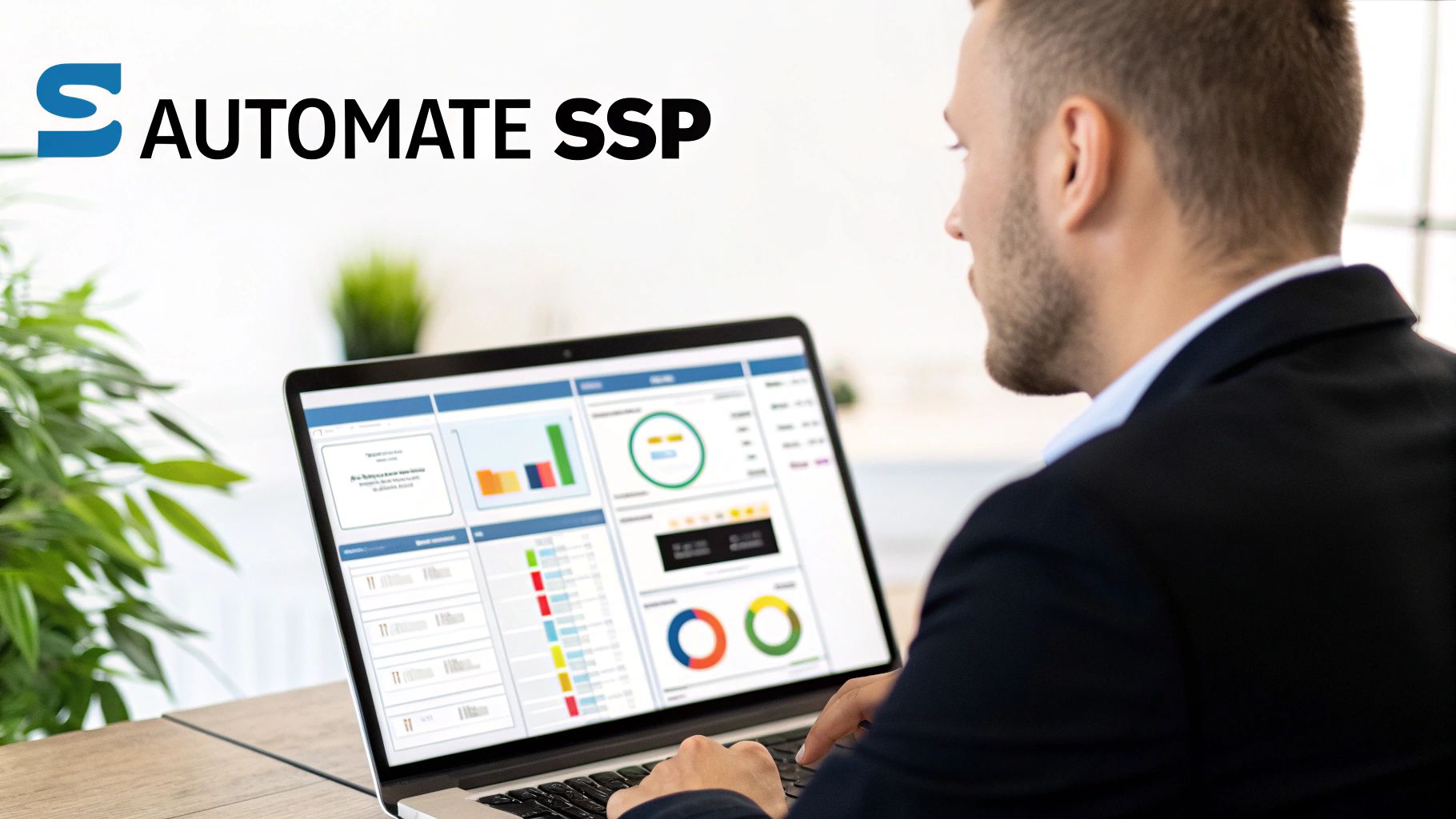
This kind of visibility means you can spot absence trends and support your teams more effectively, all while the system crunches the complex numbers quietly in the background.
Automation is a lifesaver when it comes to managing linked periods of sickness. If an employee is off sick again within eight weeks, the system remembers not to apply the waiting days again—a crucial detail that’s incredibly easy to miss when you're doing it all by hand.
Better yet, these platforms generate detailed reports that create an audit-proof trail for HMRC. This gives you peace of mind, knowing you can always demonstrate compliance. It protects your business while making absolutely certain your part-time staff receive the exact statutory sick pay they are entitled to. It transforms a stressful obligation into a seamless, reliable process.
Got Questions About Part-Time SSP? We’ve Got Answers
Even when you think you’ve got a handle on the rules, Statutory Sick Pay for part-time workers can throw up some tricky questions. Let's tackle some of the most common head-scratchers so you can feel confident you’re getting it right.
What Happens If My Hours Are Irregular or I'm on a Zero-Hours Contract?
This is a classic point of confusion, but the answer is straightforward: you can absolutely still qualify for SSP. Your eligibility isn't about the type of contract you have, but whether you meet the specific earnings and sickness criteria.
For staff with fluctuating hours, HMRC looks at your average weekly earnings over the eight weeks right before your sickness began. If that average is above the Lower Earnings Limit (LEL), and you're off sick for four or more days in a row, you're entitled to SSP for the days you were scheduled to work.
Am I Entitled to SSP During My Probationary Period?
Yes, you are. Your right to SSP kicks in from day one of your employment, as long as you meet all the other conditions. A probationary period doesn't suspend your statutory rights to sick pay.
The law is clear on this: if you are an employee who meets the earnings threshold and sickness duration rules, you qualify for SSP. Your length of service or being on probation doesn't change this fundamental right.
Can My Employer Force Me to Take Annual Leave When I'm Sick?
In a word, no. An employer can't make you use your holiday entitlement when you're off sick. If you're eligible, you have the right to take SSP.
However, you can choose to take paid holiday while you're sick. Some people do this to top up their sick pay to their normal wage, but the key thing to remember is that it must be your decision.
What if I Am Sick Again Shortly After Returning to Work?
This is where the concept of 'linked' sickness periods comes in. If you have another spell of sickness within eight weeks of a previous one, the two are linked together.
This is a crucial detail for statutory sick pay for part time workers. It means you don’t have to go through the three unpaid 'waiting days' all over again. You'd start receiving SSP from the very first qualifying day of your new absence.