
Figuring out Statutory Sick Pay (SSP) for your part-time staff can sometimes feel like you're trying to solve a puzzle. Let's clear up one of the biggest points of confusion right away: yes, part-time employees are absolutely entitled to SSP, as long as they meet the right criteria. This isn't a grey area, but a common myth that can trip up even the most seasoned managers.
This guide is here to walk you through the rules, debunk the myths, and show you exactly how to manage sick pay for your part-time team members correctly.
Your Guide to Part Time Employee Sick Pay

It’s a surprisingly common belief that working fewer hours automatically disqualifies an employee from receiving SSP. This is a potentially costly mistake to make. The rules that govern statutory sick pay for part time employees don't actually look at the number of hours someone works. Instead, they focus on a set of universal criteria that apply to everyone.
Think of SSP eligibility like a height requirement for a theme park ride. It doesn’t matter if you visit the park every single day (like a full-timer) or just on weekends (part-time). What gets you on the ride is meeting that minimum height. For SSP, that "height requirement" is something called the Lower Earnings Limit (LEL).
The Core Principle of SSP Eligibility
At its heart, the rule is simple. If your part-time employee earns, on average, at least the LEL—which is currently £123 per week—and meets all the other conditions, they have the same right to SSP as a full-time colleague. It’s a principle designed to ensure fairness across your entire workforce, no matter their working pattern.
A key takeaway for any manager is this: eligibility for SSP hinges on earnings, not on contracted hours. Focusing on the LEL calculation is the first step toward accurate and fair sick pay management for every team member.
Throughout this guide, we'll break down exactly what you need to do to get this right every time. We'll cover all the essentials, including:
- Calculating Earnings: How to properly work out an employee's average weekly earnings over the crucial eight-week period.
- Qualifying Days: Figuring out which days of the week part-time staff are actually paid SSP for.
- Practical Examples: We'll run through step-by-step calculations for different scenarios, from fixed part-time schedules to zero-hours contracts.
Getting a handle on these components will give you the confidence to manage SSP properly, ensuring you’re supporting your employees correctly while staying fully compliant with UK employment law.
Who Qualifies for Statutory Sick Pay
Before you can even think about calculating sick pay, you need to work out if your part-time employee is actually eligible. The rules for Statutory Sick Pay (SSP) are exactly the same for part-time staff as they are for full-timers, but the reality of part-time work means you often have to look a little closer.
First off, the person has to be legally considered an employee and have done some work for you under their contract. This isn't just for salaried staff; it also covers agency workers, people on fixed-term contracts, and even those on casual or zero-hours agreements, as long as they tick the other boxes.
Next comes the big one, and it's where part-time workers are most likely to stumble. It all comes down to their earnings.
The Lower Earnings Limit Hurdle
To get SSP, an employee's average weekly earnings have to hit the Lower Earnings Limit (LEL). For the current tax year, that magic number is £123 per week. Crucially, this isn't about their contracted hours – it's based on their actual gross pay over a set period.
We figure this out by looking at a "relevant period," which is almost always the eight weeks right before they went off sick. You simply add up everything they were paid in that window and divide by eight to get their average weekly pay.
The LEL is the key reason why eligibility for part-time staff needs careful checking. Their variable hours or lower weekly pay can mean their average earnings fluctuate around this critical £123 threshold from one period to the next.
This isn't a small issue. It’s a major factor in the UK workforce, with estimates suggesting up to 1.3 million low-paid employees are currently ineligible for SSP because they fall below this line. This group is disproportionately made up of part-timers and people on flexible contracts.
Additional Eligibility Checks
Once you've cleared the earnings hurdle, there are a few more boxes to tick. These are universal rules that apply to every single employee, no matter their work schedule.
The employee must:
- Have a Period of Incapacity for Work (PIW): This is just a formal way of saying they need to be sick for at least four days in a row. This includes non-working days, like weekends or their scheduled days off. If they're only sick for three days, SSP doesn't kick in.
- Provide Correct Notification: They need to let you know they're off sick, following your company's policy. If you don’t have one (you should!), they must tell you within seven days.
- Submit Proof of Sickness: If the absence drags on for more than seven days, they'll need to get a doctor's fit note to you.
Getting a handle on these foundational rules is the first step. You can explore the core principles in more detail in our complete guide on what is Statutory Sick Pay. After you’ve confirmed they're eligible, you're ready to work out what they’re owed.
How to Calculate SSP for Part Time Workers
Figuring out the actual numbers for Statutory Sick Pay (SSP) is often where things get tricky, especially when you're dealing with statutory sick pay for part time employees. Let's unpack the calculation process step-by-step so it all makes sense.
First, you need to get your head around the idea of Qualifying Days. These are just the employee’s normal working days. Simple as that. SSP can only be paid for these specific days. So, if someone works on Mondays and Wednesdays, those are their Qualifying Days.
Next up are Waiting Days. An employee doesn't get paid SSP for the first three Qualifying Days they're off sick. These are known as Waiting Days, and they are completely unpaid. The payments only kick in from the fourth Qualifying Day.
This flowchart maps out the initial checks you need to make before you even start thinking about calculations.
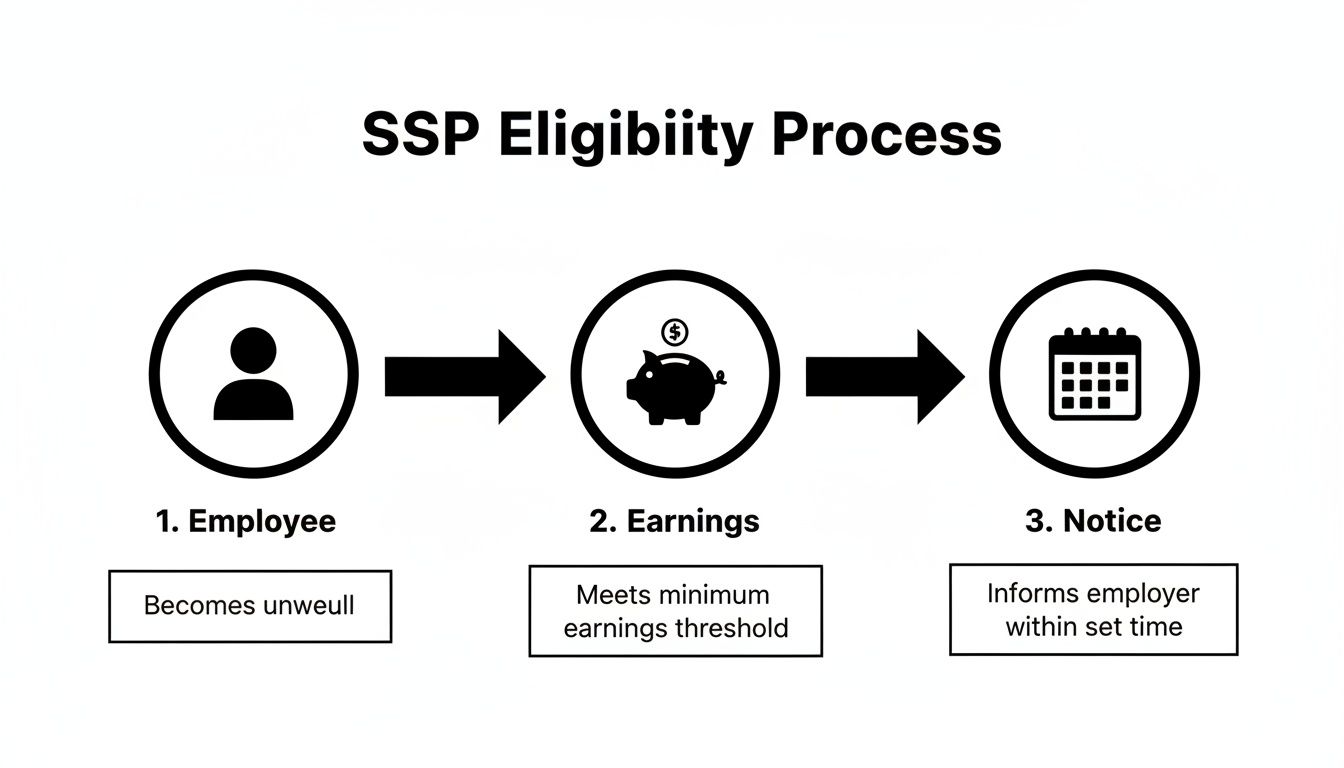
It always starts with the basics: confirming their employee status, making sure they earn enough to qualify, and checking they've followed the right notification procedure.
Calculating the Daily SSP Rate
Before jumping into examples, you first need to work out the daily SSP rate for that specific employee. You do this by taking the weekly SSP rate and dividing it by the number of Qualifying Days they work each week.
For the 2025/26 tax year, the flat weekly rate for SSP is £118.75. Remember, this is only payable for Qualifying Days after the three Waiting Days have been served. This is why part-time workers often receive much less than the full weekly amount—their smaller number of Qualifying Days directly impacts the total payout.
Let's walk through a few real-world examples to see how this plays out.
Example 1: Fixed Part-Time Schedule
Imagine your employee, David, has a fixed schedule, working just two days a week: Tuesday and Thursday. He calls in sick and is off for a full week, from Monday through to Friday.
- Identify Qualifying Days: David’s Qualifying Days are Tuesday and Thursday.
- Identify Waiting Days: His first three sick Qualifying Days are unpaid. In this case, that's the Tuesday and Thursday of the first week, plus the Tuesday of the following week.
- Calculate Payment: SSP only becomes payable from the fourth Qualifying Day. So, for this first week of sickness, David would receive no SSP at all.
Example 2: Fluctuating Hours
Now let's look at Aisha. She works variable hours but is contracted for three days per week. She's off sick for two full weeks.
- Week 1: Her Qualifying Days are Monday, Wednesday, and Friday. These three days count as her Waiting Days, so no SSP is paid for this week.
- Week 2: Her Qualifying Days are again Monday, Wednesday, and Friday. Since she's already served her Waiting Days, she gets paid for all three of these days.
Here’s the maths:
£118.75 (weekly rate) ÷ 3 (Qualifying Days) = £39.58 per day.
Total SSP for Week 2 = 3 days x £39.58 = £118.74.
Example 3: Zero-Hours Contract Worker
Calculating SSP for a zero-hours worker follows a similar logic. The Qualifying Days are the days they were actually scheduled to work. If no days were scheduled during their sickness, you would typically look back at the average number of days they worked over the previous eight weeks to determine their Qualifying Days.
A common mistake is to just pay out the full weekly SSP rate without considering the employee's work pattern. The key is to always divide the weekly rate by their specific number of Qualifying Days to get the correct daily amount.
These scenarios show just how much the final payment can vary from one person to the next. For an even deeper dive into the mechanics, have a look at our detailed guide on how to calculate Statutory Sick Pay.
Managing Payroll and Record Keeping Obligations
Getting the Statutory Sick Pay (SSP) calculation right for your part-time staff is a huge step, but your admin duties are just as critical for staying compliant. Think of it this way: the calculation is the work, but the records are the proof. UK law is very clear on this – you must keep detailed SSP records for every employee for at least three years.
This isn't just about ticking a box. It's about having a clear, accessible paper trail that shows you've handled everything by the book. These records need to detail the dates of each sickness period, pinpoint the exact dates SSP was paid for, and show the total amount. Just as importantly, you need to document why an employee wasn’t paid SSP if that was the case.
Handling Payroll and Non-Payment
When it comes to your payroll run, SSP should be treated just like regular wages. That means it’s subject to the usual PAYE tax and National Insurance deductions. For businesses that prefer to have an expert eye on compensation and compliance, looking into professional payroll services can be a smart move, ensuring that even non-standard payments like SSP are managed correctly every single time.
But what if an employee doesn't qualify for SSP, or they've reached the 28-week maximum? You can't just stop payments and leave them in the dark.
You are legally required to give the employee a specific form, SSP1, within seven days of making that decision. This form clearly explains why they can't get SSP from you and points them towards applying for government support, like the Employment and Support Allowance (ESA).
To keep everything organised and above board, here’s a simple checklist your HR and finance teams can follow:
- Record Sickness: Log all employee sickness absence dates the moment they're reported.
- Verify Eligibility: Always check an employee's earnings against the Lower Earnings Limit (LEL) for every period of absence.
- Track SSP Payments: Keep a crystal-clear log of all SSP paid, making sure it's linked to the specific sickness period it covers.
- Document Non-Payment: If you don't pay SSP, record the reason why and issue the SSP1 form without delay.
- Retain Records: Securely store all your SSP records for a minimum of three years from the end of the relevant tax year.
A solid internal process, backed up by a clear and well-communicated sickness and absence policy, is the best way to foster a workplace that is transparent, supportive, and completely compliant.
Navigating SSP Alongside Other Types of Leave
Employee absence is rarely a simple, one-dimensional event. More often than not, you'll find Statutory Sick Pay (SSP) overlapping with other types of leave, creating a tricky web of rules that demands careful management. Getting a handle on how these different entitlements interact is absolutely vital for preventing payment errors and keeping employee relations smooth.
The most common overlap is with your own company sick pay scheme, often called contractual sick pay. This is simply a more generous benefit offered by an employer as part of the employment contract. The golden rule here is that your company scheme can include SSP, but it must never, ever fall below that statutory minimum.
Think of SSP as the legal floor. Your company sick pay is the rest of the room you build on top of it. You can pay an employee their full salary while they are sick, and this amount is considered to include their SSP entitlement – you don't pay both on top of each other. However, if your more generous company pay runs out after a set period, you must continue paying SSP as long as the employee is still eligible.
Annual Leave and Sickness
Another frequent challenge is the crossover between sickness and annual leave. What happens when an employee falls ill just before or during their pre-booked holiday? Can they swap that holiday time for sick leave?
The short answer is yes, they can.
Employees have the right to cancel their annual leave and take the time as sick leave instead. If they choose this route, you should pay them SSP for their Qualifying Days (assuming they meet the criteria), and they can then reschedule their annual leave for a later date. They can also decide to carry on with their annual leave and receive their normal holiday pay, even if they're unwell.
The critical point to remember is that an employee cannot receive both holiday pay and SSP for the same day. The choice is theirs, and your role is to administer the correct payment based on their decision.
This is where clear communication with your employees becomes key. You need to know what they've decided to do with their leave so you can process payroll correctly. Let's look at how these pay types differ.
SSP vs Contractual Sick Pay vs Holiday Pay
| Pay Type | When It Applies | Key Rule |
|---|---|---|
| Statutory Sick Pay (SSP) | Employee is too ill to work and meets all eligibility criteria. | A legal minimum payment. It can be topped up but never replaced by a lesser amount. |
| Contractual Sick Pay | Employee is too ill to work and their contract offers a company scheme. | An employer's own, more generous sick pay policy. This payment includes the SSP amount. |
| Holiday Pay | Employee is on pre-booked annual leave. | Paid at the employee's normal rate of pay. An employee can choose to take holiday pay even if sick. |
As the table shows, each payment is triggered by a different circumstance, and it's essential not to confuse them. An employee on sick leave gets sick pay; an employee on annual leave gets holiday pay. The only complication is when sickness interrupts a holiday, which gives the employee a choice to make.
Interactions with Other Statutory Payments
SSP also has to play nicely with other statutory payments, most notably Statutory Maternity Pay (SMP). Thankfully, the rules here are straightforward: an employee cannot receive SSP and SMP at the same time.
- If an employee gets sick during their maternity leave, their SMP payments simply continue as normal. They aren't eligible to claim SSP on top of it.
- The only real exception is if a pregnant employee has a sickness absence within the four weeks before their baby is due. This specific situation can trigger the early start of their maternity leave and SMP.
Managing these overlapping leave types – especially when dealing with the variable schedules that come with statutory sick pay for part time employees – demands precision. You need a clear understanding of which payment takes precedence in every single scenario to stay compliant and fair.
Automating SSP Compliance with LeaveWizard
After wading through the complexities of managing statutory sick pay for part time employees, it’s probably quite clear that a spreadsheet just isn’t going to cut it. The sheer administrative weight of tracking earnings, qualifying days, and fluctuating hours can quickly bog down even the most organised teams.
This is where a dedicated system like LeaveWizard steps in, turning what feels like a major headache into a smooth, automated process. It takes the most error-prone tasks right off your plate. Forget wrestling with calculators to figure out average weekly earnings for LEL eligibility, or manually counting waiting days for someone on a non-standard work pattern. Good software handles it all, taking the guesswork out of the equation.
Streamlining Your Absence Management
An automated system gives you a single, reliable source of truth for all absences. This real-time view is a massive help when you’re managing a part-time workforce, where schedules can often change.
The benefits really stack up:
- Accurate Calculations: The system automatically works out the right pro-rated SSP amount for your part-timers, based on their specific qualifying days.
- Effortless Tracking: Waiting days and the 28-week SSP limit are tracked for every single employee, preventing accidental overpayments or compliance slip-ups.
- Simplified Record-Keeping: It generates and stores compliant records for you, ready for any audit without you having to lift a finger.
For small businesses, where 25% of staff sickness spells mean pure SSP reliance, this level of automation is a game-changer. LeaveWizard gives teams a clear, real-time view of absences and handles tricky pro-rated SSP calculations on any device. This supports employee well-being while cutting down on expensive mistakes. Learn more about the impact of SSP on UK workers from GOV.UK.
Ultimately, the right technology shifts SSP compliance from a time-consuming, reactive chore into a proactive and efficient strategy. Beyond just leave management, you might also find that other automation tools, like HR chatbot solutions, can further lighten the load by handling common employee questions. By embracing automation, you’re not just saving countless admin hours—you’re giving your business the confidence to manage absences correctly, every single time.
Got Questions About Part-Time SSP?
Even when you think you’ve got the rules down, real-life scenarios can throw a spanner in the works. Managing statutory sick pay for part time employees often brings up some tricky edge cases. Let's clear up a few of the most common questions we hear from employers.
What If a Part-Time Employee Has More Than One Job?
This one’s a classic. SSP eligibility is looked at on a job-by-job basis. To qualify for SSP from your company, an employee has to hit the Lower Earnings Limit (LEL) with you and you alone.
Crucially, their earnings from different jobs are not combined for the calculation. This means someone could be eligible for sick pay in one role but not another, all depending on what they earn at each place.
Do We Pay SSP During a Probationary Period?
Yes, absolutely. Entitlement to SSP is a statutory right from day one. It doesn't matter if an employee is still in their probationary period.
As long as they tick all the usual boxes—they’re classed as an employee, they meet the earnings threshold, and they've been off sick for four or more days in a row—they are fully entitled to SSP right from the start.
The key takeaway here is simple: an employee’s contractual status, like being on probation, doesn’t touch their statutory rights. SSP rules apply to everyone from their first day.
Can Someone on a Zero-Hours Contract Get SSP?
They certainly can, but the devil is in the detail of their earnings. For workers on zero-hours contracts, you’ll need to calculate their average weekly earnings over the eight-week period just before their sickness started.
If that average is at or above the LEL and they meet all the other conditions, they're entitled to SSP. When it comes to figuring out their 'Qualifying Days' for payment, you'd typically use the days they were actually scheduled to work while they were off sick.


