
A solid sickness and absence policy isn't just another piece of HR paperwork. It's your essential playbook for managing employee time off, turning potential chaos into a clear, fair, and manageable process. Getting this right protects your business from disruption and legal headaches while giving your entire team a supportive, predictable framework to rely on.
Why Your Business Needs a Clear Absence Policy

We’ve all been there. Staring at an empty rota on a Monday morning is a business owner's nightmare. Without a formal sickness and absence policy, you're left reacting to problems as they happen, often leading to inconsistent decisions, operational headaches, and frustrated employees. This ad-hoc approach can feel deeply unfair and leaves your business vulnerable.
A well-crafted policy isn’t about penalising people for being unwell; it's about creating a structured and predictable environment for everyone. Think of it as the 'rules of the road' for your company. It sets clear expectations, ensuring every team member is treated the same way when they need to take time off.
This structure is what shifts you from reactive, firefighting mode to proactive management, which ultimately builds a more stable and trusting workplace for everyone involved.
The Financial and Operational Impact of Absence
Employee absence is far more than just a minor inconvenience; it carries a significant financial weight that can seriously dent your bottom line. Recent data reveals the hidden cost of employee sickness in the UK ballooned to approximately £103 billion in 2023, a staggering jump of £30 billion since 2018.
Last year, the average employee took 7.8 sickness days, a noticeable rise from the pre-pandemic figure of 5.8 days. This trend highlights a growing challenge for employers. You can explore a complete analysis of how absenteeism affects UK employers to really dig into these numbers.
Beyond direct costs like sick pay, absenteeism creates a ripple effect across your entire operation:
- Reduced Productivity: Tasks get left undone or are shifted to other employees who may already be at full capacity. This often leads to missed deadlines and lower overall output.
- Lower Team Morale: When colleagues have to consistently pick up the slack for absent team members, it can quickly lead to burnout, resentment, and a drop in morale across the board.
- Increased Administrative Burden: Instead of focusing on strategic goals, managers spend valuable time rearranging schedules, reallocating work, and processing absence-related paperwork.
To understand its role better, let's break down the core functions of an effective policy.
Core Functions of an Effective Absence Policy
| Function | Benefit for the Business | Benefit for the Employee |
|---|---|---|
| Set Clear Expectations | Standardises the process for reporting absences, reducing confusion and saving management time. | Knows exactly what to do and who to contact when they are unwell, removing stress. |
| Ensure Consistency & Fairness | Provides a framework for treating all employees equally, minimising claims of favouritism or discrimination. | Feels confident they are being treated fairly and in line with company-wide standards. |
| Protect Legally | Demonstrates compliance with UK employment law (e.g., Equality Act 2010, SSP rules). | Has their statutory rights protected and understands the legal framework for their absence. |
| Support Employee Wellbeing | Creates a supportive process for returning to work and managing long-term health issues. | Feels supported by their employer during periods of illness, aiding recovery and engagement. |
| Manage Operations | Allows for better planning and resource allocation to cover absences, minimising disruption to workflow. | Understands how their absence impacts the team, fostering a sense of shared responsibility. |
As you can see, a good policy serves both sides, creating a balanced and predictable environment.
Establishing Fairness and Legal Protection
A documented sickness and absence policy is one of your most powerful tools for guaranteeing fairness and protecting your business from legal risks. It acts as a clear, impartial guide for both managers and employees, removing the ambiguity and potential for perceived favouritism that can poison a workplace.
By standardising procedures for reporting, certification, and return-to-work discussions, you create a transparent process that applies to everyone equally. This consistency is your best defence against claims of discrimination or unfair treatment.
Furthermore, a robust policy shows a clear commitment to complying with UK employment law, such as the Equality Act 2010 and regulations concerning Statutory Sick Pay (SSP). It provides a framework for handling sensitive situations, like long-term illness or disability-related absences, in a way that is both legally sound and compassionate. At the end of the day, it builds a foundation of trust and security for your whole organisation.
Navigating Your UK Legal Obligations

Putting together a sickness and absence policy isn't just good practice; it's a legal must-have. For any UK employer, getting a handle on your duties is the first step. It helps you build a policy that’s not only fair but also keeps your business safe from the headache of costly employment tribunals.
Think of the legal framework as the non-negotiable foundation you build your company-specific rules on. Get this foundation right, and every decision you make about employee absence will be legally sound, creating a secure environment for your staff and your business.
Understanding Statutory Sick Pay
One of your most basic legal duties is managing Statutory Sick Pay (SSP). This is the minimum amount the government says you have to pay eligible employees who are off sick for four or more consecutive days. It's a safety net, designed to offer a basic level of financial support.
Your sickness and absence policy needs to spell out exactly how SSP works, covering who's eligible and what the current payment rate is. Even if your company offers a more generous contractual sick pay scheme, you must always meet the SSP requirements as an absolute baseline. Dropping the ball on this can lead to legal action and penalties from HMRC.
The UK sickness absence rate has been a bit of a moving target lately. The Office for National Statistics noted a drop to 2.0% of working hours lost in 2024, down from 2.3% in 2023. That said, it’s still higher than the pre-pandemic rate of 1.9%. It's also interesting to see that public sector rates (2.9%) were quite a bit higher than the private sector's (1.8%), which is partly down to different sick pay arrangements.
The Equality Act 2010 and Disability
The Equality Act 2010 is another massive piece of legislation that directly shapes your sickness and absence policy. This Act is all about protecting employees from discrimination, and that protection absolutely extends to disabilities. A disability is defined as a physical or mental impairment that has a ‘substantial’ and ‘long-term’ negative effect on someone's ability to do normal daily activities.
What does this mean for you? You can't treat an employee unfairly because of an absence that's linked to their disability. For instance, penalising someone for taking time off for cancer treatment or a scheduled hospital visit for a long-term condition could easily be seen as discriminatory.
A "no-fault" attendance policy, where every absence gets treated the same regardless of the reason, can be a legal minefield. If a policy like this doesn't make exceptions for disability-related absences, it's at high risk of breaching the Equality Act 2010.
Your policy has to be flexible enough to handle these situations. This leads us straight to your legal duty to make "reasonable adjustments."
The Duty to Make Reasonable Adjustments
When an employee has a disability, you are legally required to make reasonable adjustments to help them stay in work or get back to it. This duty is a real cornerstone of the Equality Act and is absolutely central to managing absence fairly.
What counts as 'reasonable' really depends on the situation, including the size and resources of your business. Some common examples include:
- Altering Working Hours: This could mean a phased return to work or tweaking start and finish times to fit around medical appointments.
- Modifying Premises: Something as simple as providing an ergonomic chair or adjusting a workstation can make all the difference.
- Reallocating Duties: You might temporarily or permanently change minor parts of their role that they struggle with due to their condition.
- Allowing More Absences: Permitting a higher level of absence than you normally would, specifically for disability-related reasons.
Your sickness and absence policy should clearly state your commitment to making reasonable adjustments. A solid policy is just one part of a bigger picture, and using effective sick absence management software can help you track these adjustments consistently. By weaving these legal duties right into the fabric of your policy, you don't just stay compliant—you build a culture of support and inclusivity.
Building Your Sickness and Absence Policy Clause by Clause
Alright, let's get down to the nuts and bolts. We’ve covered the why, now let’s tackle the how. Think of your sickness and absence policy like building a house – you need a solid foundation and sturdy walls. Each clause is a building block, and when put together correctly, they create a structure that's fair, legally sound, and simple for everyone to follow.
We're going to walk through the essential pieces every solid policy needs. By the end, you'll have a clear blueprint to draft a comprehensive and effective document from scratch.
Defining Absence and Reporting Procedures
First things first: you need to be crystal clear about what counts as an absence and exactly how someone should report it. Any grey area here is a recipe for disaster, leading to confusion, missed messages, and inconsistency. Your goal is to remove all the guesswork.
Your policy must spell out the specifics:
- Who to Contact: Does the employee call their line manager? A central HR number? Maybe they use a specific app? Name the person or role directly.
- How to Contact Them: Is a phone call the only way? Or are texts and emails okay? A phone call is usually best because it allows for a proper conversation.
- When to Contact Them: Be precise. For example, "You must call at least one hour before your shift is due to start."
Getting this right ensures managers know what's happening straight away, so they can juggle workloads and keep things running smoothly. It also sets a clear, professional standard for communication right from the start.
This simple diagram breaks down the core steps of a typical reporting procedure.
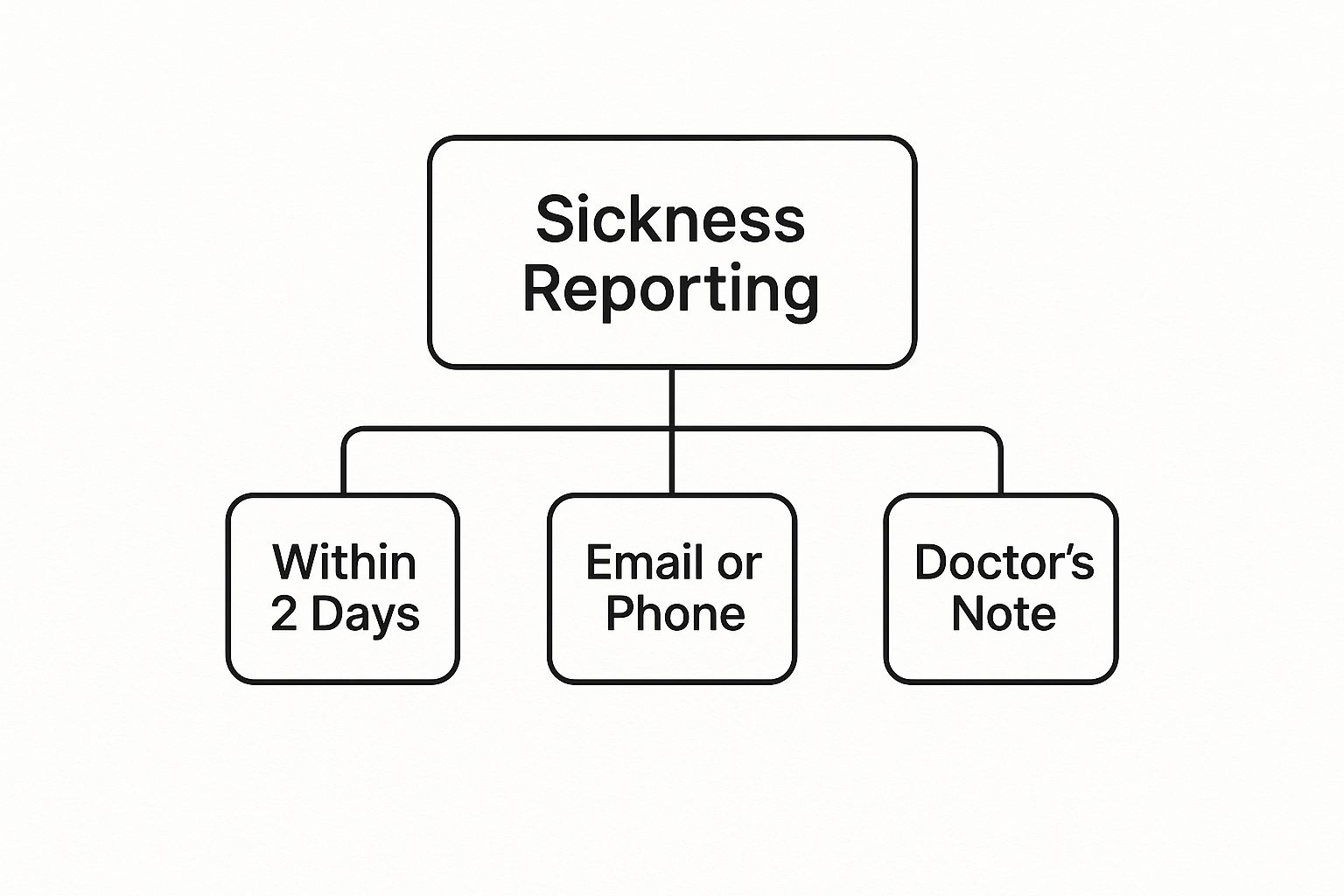
As you can see, the initial contact, the method used, and what happens next with certification are the three pillars of a bulletproof process.
Outlining Sick Pay Entitlements
Once the reporting rules are set, the next big question is about pay. Let's be honest, this is usually the first thing on an employee's mind when they're unwell. Your policy has to clearly explain the two main types of sick pay available in the UK.
First up is Statutory Sick Pay (SSP). This is the legal minimum you must pay eligible employees who are off sick for four or more consecutive days. It's not a choice; it's the law.
Then you might offer Company or Contractual Sick Pay. This is your own, more generous benefit, where you might pay an employee their full salary for a certain number of sick days each year. If you do this, your policy must detail:
- How long someone needs to have worked with you to qualify.
- The number of days covered by your company scheme.
- What happens when they've used up their entitlement (they'll usually switch over to SSP).
Being completely transparent about pay takes a huge weight off your team's shoulders and makes sure you're handling payroll correctly and fairly every single time.
Explaining Certification Requirements
What kind of proof do you need when someone is off sick? This part of the policy lays down the rules for medical evidence, which helps confirm that absences are genuine. The requirements usually depend on how long the person has been away.
For a day or two off, a self-certification form is usually enough. This is just a form the employee fills in when they get back, confirming their dates of absence and the reason.
For longer absences, you'll need something more official.
In the UK, the standard practice is to ask for a doctor's 'fit note' for any absence that lasts more than seven calendar days in a row. Your policy must state this requirement clearly.
The fit note is a key document. It will state if the employee is "not fit for work" or "may be fit for work" with some suggested adjustments. This information is invaluable for managing their return in a supportive and practical way.
To help you build a comprehensive policy, we've created a table outlining the most important clauses you'll need to include. Think of it as a checklist to make sure you've covered all the bases.
Key Clauses for Your Sickness and Absence Policy
| Policy Section | What to Include | Why It's Important |
|---|---|---|
| Policy Aim | A brief statement on promoting wellbeing and managing absence fairly. | Sets a positive and supportive tone from the outset. |
| Reporting Procedure | Who to call, when to call, and how. | Ensures prompt and consistent communication, minimising disruption. |
| Certification | Rules for self-certification and when a doctor's fit note is required. | Verifies absences are genuine and provides information for managing returns. |
| Sick Pay | Details of Statutory Sick Pay (SSP) and any company sick pay scheme. | Provides clarity on pay, reducing employee anxiety and ensuring legal compliance. |
| Return to Work | The process for return-to-work interviews after any absence. | A supportive tool to check on wellbeing, discuss adjustments, and spot patterns. |
| Long-Term Absence | Procedures for managing extended periods of sickness. | Outlines the support available, including occupational health referrals. |
| Unauthorised Absence | Definition and consequences of failing to follow the reporting procedure. | Makes the rules clear and explains the disciplinary process if they aren't followed. |
Having these sections clearly defined in your policy document leaves no room for doubt and ensures both managers and employees know exactly where they stand.
Structuring Return to Work Interviews
A return-to-work interview sounds formal, but it’s really just a short, informal chat with an employee on their first day back. It's not an interrogation. Instead, it’s one of the most powerful tools you have for supportive and effective communication.
This clause should explain what these interviews are for:
- To Welcome Them Back: It’s a simple human touch that shows you care and helps them settle back in.
- To Check They’re Fit to Work: It’s a chance to make sure they’ve recovered and discuss any ongoing health issues.
- To Discuss Any Support Needed: This is the perfect time to talk through adjustments suggested on a fit note.
- To Give Them a Quick Update: You can fill them in on anything important they missed while they were away.
Doing these interviews consistently helps you spot absence patterns, identify any workplace issues that might be affecting people's health, and prove to your team that you're invested in their wellbeing. It transforms absence management from a box-ticking exercise into a genuinely supportive process.
Managing Absence with Fairness and Empathy
A well-written sickness and absence policy is a fantastic starting point, but its real power is in how you bring it to life day-to-day. After all, a document on its own can't build trust or show support; that comes from the human touch. This is where you shift from a rigid, box-ticking exercise to a compassionate and truly effective strategy.
The whole process really hinges on three things: fairness, consistency, and genuine empathy. When managers handle absences with these principles at their core, they’re doing much more than just following a procedure. They’re building a culture where people feel safe, understood, and valued, which is the bedrock of long-term engagement and wellbeing.
Training Managers as the First Line of Support
Think about it: your line managers are the face of your sickness policy. They’re the first person an employee speaks to when they call in sick, and they’re the one who welcomes them back. How they handle these conversations sets the tone for the entire experience and can make or break an employee's morale and trust.
Untrained managers can easily make costly mistakes, like asking overly intrusive questions about medical conditions or applying the policy differently from one person to the next. This is why targeted training isn’t just a nice-to-have—it’s absolutely essential.
Good training should give your managers the tools to:
- Listen with Empathy: Learn how to have supportive, non-judgemental conversations.
- Know the Boundaries: Understand what they can and can't ask about someone's health to respect privacy and avoid any hint of discrimination.
- Apply the Policy Fairly: Make sure every single team member is treated consistently, just as the policy lays out.
- Recognise When to Escalate: Know when a situation needs HR's expertise, such as a long-term absence or an issue related to a disability.
By investing in your managers, you empower them to be a source of support, turning what could be a negative interaction into a genuinely positive one.
Conducting Supportive Return to Work Interviews
The return-to-work interview is probably the single most important part of your absence management process. If you get the tone wrong, it can feel like an interrogation, leaving employees feeling distrusted. But get it right, and it becomes a powerful way to show you care and to spot potential issues before they escalate.
The main goal isn't to challenge the absence. It's to make sure the employee is truly well enough to be back and to see if they need any support.
A supportive return-to-work chat is a cornerstone of proactive wellbeing management. It’s an opportunity to check in, offer help, and show that you see your employees as people first and foremost. This simple conversation can be the difference between a successful return and a recurring absence.
These chats create a space to discuss any adjustments that might make their return smoother, reinforcing that supportive culture. To dig deeper into the practicalities of overseeing staff time off, our guide on managing employee absences offers more valuable insights.
Using Absence Data to Support, Not Punish
Your sickness policy will naturally generate a lot of useful data. While tracking absence rates is important for planning, its real value is in helping you identify where support is needed most. Instead of just using data to trigger disciplinary action, a more empathetic approach is to use it to spot trends.
For instance, does one department have a much higher absence rate than others? This could flag issues with workload, a particular management style, or team dynamics. Is one person having frequent, short-term absences? This might signal an underlying health condition or personal struggles they could use help with.
This proactive mindset is becoming more important. While the overall UK sickness absence rate fell slightly to 2.0% of working hours lost in 2024, some experts think this figure could be misleading. The average of 4.4 days lost per worker suggests many people might feel pressured to work while unwell because they don't have enough support, which just goes to show why better policies are needed.
By looking at this data through a supportive lens, you can step in early with offers of help, like occupational health referrals or flexible working arrangements. This approach doesn't just help the individual; it tackles the root causes, which can reduce your overall absence rates over time. To really get a handle on your policy, it's worth exploring general approaches to effective employee absence management.
Common Mistakes to Avoid When Handling Absence

Even with the best intentions and a solid policy document, it’s surprisingly easy to trip up when managing employee sickness. A policy is only as good as how you apply it, and a few common pitfalls can quickly undermine its fairness, expose your business to legal risks, and seriously damage team morale.
Knowing what these traps look like is half the battle. This is about moving beyond the words on the page and making sure your actions are consistent, compassionate, and legally sound every single time. By sidestepping these errors, you can maintain a process that’s both effective and ethical.
Applying the Policy Inconsistently
One of the quickest ways to erode trust is to play favourites with your sickness and absence policy. If one manager lets an employee’s late call-in slide but writes up another for the exact same thing, it screams favouritism.
This inconsistency doesn't just breed resentment; it can also render your policy legally toothless. Should you ever need to take formal action, an employee could easily argue they were treated unfairly compared to their colleagues, paving the way for a successful grievance claim.
The rule is simple: the policy must apply to everyone, every time. That means from the newest hire right up to the most senior manager. This predictability is the bedrock of a fair and transparent workplace.
Breaching Employee Confidentiality
Conversations about health are deeply personal and need to be handled with total discretion. A manager casually mentioning an employee's reason for being off to other team members is a massive breach of trust and privacy.
This kind of gossip is incredibly damaging. It creates an environment where people feel their private information isn't safe, which discourages them from being open about their health in the future. That, in turn, can stop you from offering the right support when it's genuinely needed.
Always treat health-related information on a strict 'need-to-know' basis. Make sure records are stored securely and that every manager understands confidentiality is non-negotiable. Breaching it not only hurts morale but can also violate data protection laws.
Relying on Punitive Measures
Some businesses take a purely punitive approach, leaning on strict point systems or disciplinary action as their main tool for managing absence. These "no-fault" attendance policies, which penalise all absences equally, often fail to account for legally protected time off, like disability-related leave.
While the goal is to discourage unnecessary sick days, this approach often backfires. It can lead to a culture of presenteeism, where sick employees drag themselves into work just to avoid getting "points," spreading illness and performing poorly. Research from bodies like the EEOC in the US has led to significant legal action against companies with overly rigid policies, showing just how risky this can be.
Instead of only punishing, try to understand the root causes of absence. This is a core part of building effective absence management strategies that support wellbeing rather than just penalising sickness. In the long run, a supportive framework will always win.
Making Assumptions About Health
Never, ever assume you know the reason for an employee's absence or how serious their condition is. A manager who dismisses frequent short-term absences as a poor attitude might be missing the signs of a serious underlying health issue or a protected disability.
Jumping to conclusions without having a proper, supportive conversation is a fast track to a grievance or even a discrimination claim. Always stick to the process laid out in your policy:
- Hold a return-to-work interview: Use this as a chance to listen and understand the situation from the employee’s point of view.
- Refer to occupational health if needed: For long-term or complex issues, bring in professional medical advice.
- Discuss reasonable adjustments: Explore ways you can support the employee at work, as required by the Equality Act 2010.
By dodging these common mistakes, you can make sure your sickness and absence policy does what it’s supposed to—act as a guide for fair, consistent, and supportive management.
Sickness and Absence Policy Frequently Asked Questions
Even with the most detailed policy, real-life situations are bound to pop up that leave you scratching your head. This section is your go-to guide for those tricky "what if" moments that can cause headaches for managers and business owners alike.
We'll tackle some of the most common questions we hear, giving you clear, direct answers. The aim is to build your confidence so you can apply your sickness and absence policy fairly and consistently, no matter what comes your way.
What Is the Difference Between Statutory and Contractual Sick Pay?
This is probably one of the biggest points of confusion in absence management, but it's crucial to get it right. The two types of sick pay are worlds apart, and your policy needs to be crystal clear on which is which.
Statutory Sick Pay (SSP) is the legal minimum you have to pay an eligible employee. Think of it as the government-mandated safety net. It kicks in when someone is off sick for four or more consecutive days, and the payment rate is set by law.
Contractual Sick Pay, on the other hand, is an enhanced benefit you choose to offer your team, making you a more attractive employer. It’s entirely up to you and might mean paying an employee their full salary for a certain number of sick days each year. If you offer this, your policy must spell out:
- Who qualifies for it (e.g., only after passing their probation period).
- How many days of full pay they get.
- What happens when they've used it all up (they'll typically move onto SSP if they're still eligible).
Getting this distinction right is non-negotiable for managing expectations and making sure payroll is always accurate.
How Long Can an Employee Be Off Sick Before I Can Take Action?
There’s no magic number here, and jumping the gun is a classic mistake that can land you in hot water. How you respond depends entirely on whether you’re dealing with short-term or long-term absence, and you absolutely must follow a fair process.
For those frequent, short-term absences, you should let your policy's triggers guide you. This usually means scheduling a formal attendance review meeting once an employee hits a certain number of absences in a given timeframe.
Long-term sickness—generally meaning an absence of four weeks or more—requires a completely different, more supportive approach. Before you even think about formal action like dismissal for capability, you have to:
- Stay in regular, supportive contact.
- Get medical advice, usually by referring them to an occupational health specialist, to understand their prognosis.
- Sit down with the employee to discuss the medical report.
- Explore every single reasonable adjustment that could help them get back to work.
Trying to shortcut this process is a fast track to an unfair dismissal claim.
Do I Have to Pay an Employee Who Is Off Sick During Their Notice Period?
Yes, almost always. An employee who is off sick during their notice period is still entitled to be paid. What they get depends on their contract and the length of their notice.
If the notice period your company is required to give them is at least one week longer than the statutory minimum, you just need to pay them their usual sick pay (be it SSP or your contractual rate).
However, if their notice period is the statutory minimum (or less than a week longer), they are usually entitled to their full normal pay for any sick days they take during that time. The rules around this can be a bit fiddly, so it's often a good time to get some specific HR advice.
Can I Contact an Employee While They Are Off Sick?
Not only can you, you absolutely should. Keeping in reasonable and regular contact is a cornerstone of good absence management. It shows you’re concerned about their wellbeing and helps you plan for their return.
The key word here is 'reasonable'. The point of the contact is to check in on them, offer support, and gently ask about their recovery and potential return. It should never feel like you're pressuring them or checking up on them.
A solid sickness and absence policy will set expectations for this. The best approach is to agree on how and when you'll stay in touch (like a quick weekly phone call) with the employee early on. This keeps the communication supportive and welcome, not intrusive.


