Let’s start with the basics of statutory holiday entitlement in the UK. It boils down to one simple rule: nearly every worker gets a minimum of 5.6 weeks of paid holiday each year. This isn't just a nice-to-have perk or an optional bonus; it's a fundamental legal right designed to give your team a proper break and prevent burnout.
Understanding Your Core Holiday Entitlement Obligations
Getting UK holiday entitlement right is about much more than just ticking a legal box. It’s a cornerstone of running a compliant business and maintaining a healthy, productive workforce. This core principle applies almost universally, forming the bedrock of how you should manage leave.
Think of it like a "leave bank account" for each employee. From their very first day on the job, they start building up this paid time off. The law protects this entitlement, making sure everyone has the chance to rest and recharge away from their work.
The Legal Foundation of Paid Leave
The right to paid annual leave isn't just good practice—it's the law. In the UK, almost every worker is legally entitled to 5.6 weeks of paid holiday a year. For someone working a standard five-day week, that works out to 28 days.
This statutory minimum is set out in the Working Time Regulations 1998 and it applies across the board. Whether you employ a full-time manager, a part-time retail assistant, an agency worker, or someone on a zero-hours contract, they are all covered. You can find the full government guidelines on the official page for holiday entitlement rights.
The calculation method might change depending on their working pattern, but that underlying right to 5.6 weeks' worth of paid leave is non-negotiable.
A common mistake is thinking this entitlement is discretionary. It’s not. It’s a hard-and-fast legal baseline. You can always offer more holiday time—often called contractual holiday—but you can never, ever provide less than the statutory minimum.
What Does 5.6 Weeks Mean in Practice?
So, how do you translate "5.6 weeks" into actual days off? It all depends on an employee's specific work schedule. The figure is designed to be proportional, ensuring fairness no matter how many days a week someone works.
For a full-time employee on a five-day week, the calculation is straightforward. But the principle scales neatly for part-timers. For instance, an employee who works three days a week is still entitled to 5.6 weeks of holiday. The only difference is that their "week" is three days long.
To work out their total entitlement, you'd calculate: 3 days × 5.6 weeks = 16.8 days per year.
To make this even clearer, here is a quick reference table showing the minimum entitlement based on days worked per week.
Statutory Minimum Holiday Entitlement At a Glance
| Days Worked Per Week | Calculation (5.6 Weeks x Days Worked) | Total Statutory Holiday Days Per Year |
|---|---|---|
| 1 day | 5.6 x 1 | 5.6 days |
| 2 days | 5.6 x 2 | 11.2 days |
| 3 days | 5.6 x 3 | 16.8 days |
| 4 days | 5.6 x 4 | 22.4 days |
| 5 days | 5.6 x 5 | 28 days |
| 6 days | 5.6 x 6 | 28 days (capped) |
| 7 days | 5.6 x 7 | 28 days (capped) |
Note: The statutory entitlement is capped at a maximum of 28 days per year. If an employee works more than five days a week, their entitlement does not exceed this cap.
Once you get your head around this core concept—that every single worker has this fundamental right—you can start building compliant and effective processes for managing leave across your entire organisation. It's the first and most critical step.
How to Calculate Holiday for Different Worker Types
Figuring out the theory behind statutory holiday entitlement is one thing, but applying it to your actual workforce is where the rubber meets the road. The sums change depending on how someone works, but the core principle is always about being fair and proportional. Getting this right isn't just a box-ticking exercise; it's vital for keeping on the right side of the law and for team morale.
Let's break down the calculations for the most common types of workers you'll have on your payroll.
Calculating for Full-Time Employees
Let's start with the easy one. A full-time employee working a standard five-day week gets the full 5.6 weeks of statutory paid leave. No fuss, no complications.
To get the actual number of days, you just multiply the weeks by their working days:
5.6 weeks × 5 days per week = 28 days of paid holiday per year.
This 28-day figure is the absolute legal minimum. It can include bank holidays, but only if that's clearly stated in their employment contract. Many employers offer more than this, but you can never, ever offer less.
Calculating Pro-Rata for Part-Time Workers
For your part-time staff, the entitlement is worked out on a pro-rata basis. It's a fancy way of saying they still get 5.6 weeks of leave, but it's scaled down to match the hours they actually work. The goal here is simple: they should get an equivalent amount of time off relative to their full-time colleagues.
Let's say you have someone on your team who works three days a week. The calculation is straightforward:
5.6 weeks × 3 days per week = 16.8 days of paid holiday per year.
In practice, dealing with 0.8 of a day can be messy. It's common sense (and good practice) to round this up to the nearest half or full day, so you'd likely just give them 17 days. For a deeper dive, our guide on calculating holidays for part-time workers has you covered.
This simple decision tree illustrates the basic entitlement for any UK worker.
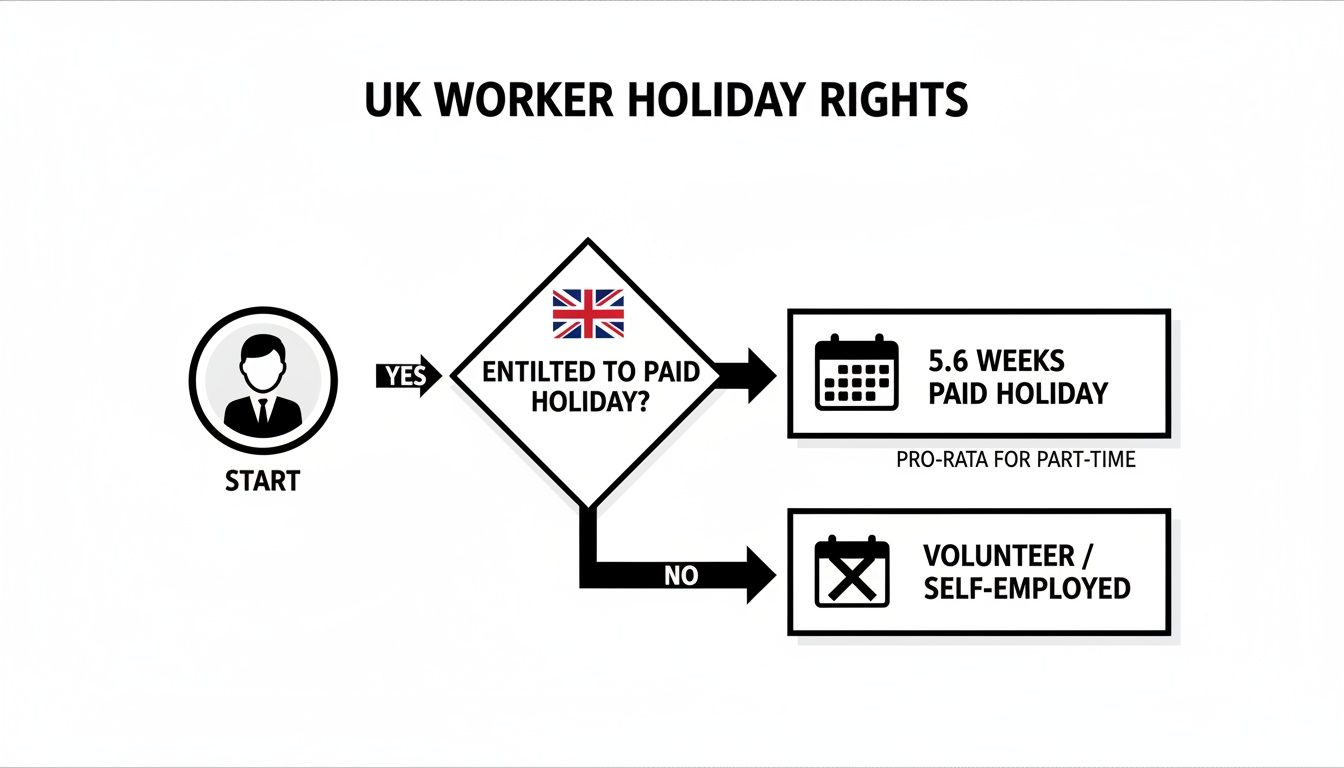
The flowchart confirms that nearly all workers in the UK are entitled to paid holiday, establishing a clear baseline for employers.
Navigating Irregular Hours and Part-Year Work
Things get a bit trickier when you have workers with no set hours, like those on zero-hours contracts or people who only work for part of the year. Thankfully, for leave years starting on or after 1 April 2024, the government has tidied up the rules. They've standardised a simple accrual method based on the hours someone has worked.
For these workers, their holiday entitlement builds up at 12.07% of the hours they clock in.
Why 12.07%? It might seem like a random number, but there's a simple logic behind it. You take the statutory 5.6 weeks of holiday and divide it by the remaining 46.4 working weeks in the year (52 weeks – 5.6 weeks). That gives you 12.07%.
Let's put it into practice. A zero-hours worker puts in 80 hours over a month. To figure out how much holiday they've earned, you just do the maths:
80 hours × 12.07% = 9.66 hours of paid holiday.
This approach ensures their holiday time directly mirrors their work pattern, no matter how unpredictable it might be. This is a far cry from the old, confusing methods and brings much-needed clarity for both employers and employees.
Managing Holiday Pay, Bank Holidays, and Leave Requests

Getting the holiday calculations right is a huge step, but it’s only half the battle. The real test of your policies comes in the day-to-day juggling of leave requests, pay, and bank holidays. It’s an area full of common tripwires and operational headaches, but nailing it with a clear and fair system is vital for keeping your team happy and your business compliant.
One of the biggest points of confusion for both employers and employees is bank holidays. There's a persistent myth that these days off are an automatic, paid extra on top of the statutory 5.6 weeks. That’s simply not true.
As the employer, you can absolutely include the 8 (or 9 in Scotland) bank holidays within the minimum 28-day entitlement for a full-timer. The catch? You must spell this out clearly in the employment contract. If you don't, an employee could rightly argue they are owed 28 days plus paid bank holidays on top.
Clarifying Your Bank Holiday Policy
Clarity is your best friend when it comes to preventing disputes. A well-worded clause in your contract can eliminate any grey areas from the very start.
Example Contract Clause
"Your annual holiday entitlement is 28 days, inclusive of all public and bank holidays. If you are required to work on a bank holiday, you will be entitled to a day off in lieu, to be taken at a time mutually agreed with your line manager."
A simple statement like this makes your position crystal clear. You also need a process for staff who don't normally work on the day a bank holiday falls—like a part-timer who works Tuesday to Thursday. They are still entitled to a pro-rata share of the bank holidays, which you can just add to their overall leave allowance. This ensures everyone is treated fairly, no matter their working pattern. Our article on requiring staff to work on public holidays dives deeper into this topic.
Establishing a Fair Leave Request System
Beyond bank holidays, having a solid system for managing leave requests is crucial for keeping the business running smoothly. Without clear rules, you're inviting staffing shortages during busy periods and opening the door to feelings of unfairness among your team.
A good system really boils down to two things: giving enough notice and having a transparent approval process. The legal minimum notice an employee must give is twice the length of the leave they want to take (so, two weeks' notice for a one-week holiday). Frankly, it's better to set your own, more practical notice periods in your company policy.
Your policy should lay out:
- Minimum Notice Period: How far in advance do people need to ask for time off?
- Peak Period Rules: Are there any blackout dates when leave is off-limits?
- Handling Clashes: How do you decide between conflicting requests? Is it first-come, first-served?
- Approval Process: Who signs off on requests, and how long will it take to get an answer?
Getting this right has become even more important lately. Recent UK stats show that unused holiday days have plummeted 71%, from 18.5 days per person in 2019 to just 5.3 in 2024. This shows people are being much more strategic with their time off, often targeting popular periods like school holidays and Christmas.
By setting clear expectations and applying them consistently, you create a system that just feels fair. This transparency helps manage everyone's expectations and lets you plan your staffing properly, ensuring the business is covered while your team gets their well-deserved breaks.
Of course, here is the rewritten section, crafted to sound like it was written by an experienced human expert.