
Of course. It's often a bit of a grey area, so let's clear it up.
Yes, your part-time staff are absolutely entitled to sickness pay in the UK, as long as they meet the specific criteria for Statutory Sick Pay (SSP). The catch is that the amount they get and whether they qualify at all depends on their earnings and work schedule. This is where things often get more complex compared to handling pay for your full-time employees.
The Reality of Part-Time Sickness Pay in the UK

For many business owners, managing sickness pay for part-time workers feels like navigating a maze. But it doesn't have to be. The simple truth is this: your part-time staff have rights to sick pay, but you can't just apply the same logic you use for full-timers. That one-size-fits-all approach is a recipe for errors and non-compliance.
The main headache is that calculating Statutory Sick Pay (SSP) for someone with variable hours is an admin-heavy task. It demands real attention to detail to make sure everything is handled fairly and legally. Think of this guide as your roadmap—we'll start with the basics and build up to the practical, real-world application.
Understanding the Two Pillars of Sick Pay
In the UK, sickness pay rests on two distinct pillars, and both can apply to your part-time team members. It’s crucial to know the difference.
- Statutory Sick Pay (SSP): This is the legal minimum you must pay to eligible employees when they're off sick. It’s the government-mandated safety net that everyone is entitled to, provided they meet the criteria.
- Company Sick Pay (Occupational Sick Pay): This is an enhanced, contractual benefit your business might offer. It's more generous than SSP and could involve paying an employee their full salary for a certain number of sick days.
Getting these two confused is a common tripwire because the rules for eligibility and how you calculate payments are completely different. For a deeper dive into the government scheme, check out our detailed guide on what is Statutory Sick Pay.
Key Hurdles for Part-Time Staff
So, what makes managing sick pay for part-timers so tricky? A major factor is the Lower Earnings Limit (LEL). This is the minimum average amount an employee must earn to even qualify for SSP. Because part-time schedules can be all over the place, figuring out if they hit this threshold requires a specific calculation over what’s known as a "relevant period."
The data tells a story here, too. Part-timers often run into unique problems when claiming SSP. It's not just the LEL; their irregular schedules can mean they get little to no payment for short illnesses. ONS data actually shows that part-time workers have a higher sickness absence rate at 2.6%, compared to 1.9% for full-time staff.
This puts a huge strain on small businesses, where over 47% don’t offer any sick pay above the statutory minimum. It often forces part-time employees into a tough spot, having to choose between their health and their income.
So, before you can even start crunching the numbers on sick pay for a part-time worker, you first need to figure out if they’re actually eligible for Statutory Sick Pay (SSP).
Think of it like a series of checkpoints. An employee has to pass every single one to qualify. If they miss even one, they won’t get this government-mandated payment, no matter how genuinely unwell they are.
While the rules are the same for everyone, the very nature of part-time work can throw a spanner in the works at each stage. Getting these criteria right is the absolute foundation for keeping your payroll accurate and compliant.
The Four Main SSP Eligibility Tests
To get SSP, an employee has to clear four key hurdles. These aren't just administrative hoops to jump through; they are strict legal requirements set out by the government.
-
They Must Be an Employee: This seems obvious, but the person must be legally classed as an employee and have actually done some work for you under their contract. This covers people on fixed-term or agency contracts too.
-
They Must Be Genuinely Sick: The employee needs to be off sick for at least four days in a row. This stretch is officially known as a 'Period of Incapacity for Work' (PIW).
-
They Must Notify You Correctly: They have to tell you they're sick within your company's time limit. If you don’t have one specified, they have up to seven days.
-
Their Earnings Must Be High Enough: This is often where things get tricky for part-time staff. They must earn, on average, at least the Lower Earnings Limit (LEL).
The LEL is a threshold set by the government each tax year, which for 2024/25 is £123 per week. If a part-time worker's average weekly earnings dip below this amount, they simply aren't entitled to SSP.
Demystifying the Lower Earnings Limit for Part-Time Staff
Working out average earnings for a full-timer on a fixed salary is a piece of cake. But for a part-time worker with hours that chop and change, you need to do a specific calculation over what HMRC calls the 'relevant period'.
Usually, this 'relevant period' is the eight weeks right before their first day of sickness. You have to tot up everything they were paid in that window and then divide by eight to get their average weekly earnings. This is precisely why having meticulous payroll records is non-negotiable when managing sickness pay for part time workers.
Key Insight: The LEL is the gatekeeper for SSP. An employee who only works a handful of hours each week might consistently earn less than this, which means they’ll never qualify for statutory sick pay, even if they tick every other box.
The Role of Qualifying Days and Waiting Days
Now, even if an employee passes all four tests, it doesn't mean the money starts flowing immediately. SSP is only paid for the days an employee is actually scheduled to work, which are known as Qualifying Days (QDs). It’s important that you and your employee agree on what these days are ahead of time.
On top of that, the first three Qualifying Days of any sick period are unpaid waiting days. SSP only kicks in from the fourth qualifying day. You can see how this rule massively affects part-time staff who might only work one or two days a week.
Recent data paints a stark picture, showing the UK part-time sickness absence rate is 2.6%. Let's be honest, the current SSP rate of £116.75 per week doesn't go far, covering just a fraction of minimum wage earnings. Part-timers who fall below the LEL get nothing at all, and because of the three-day waiting rule, an employee working two days a week could be sick on both their workdays and receive precisely £0 in SSP. To grasp the full scale of the issue, it's worth exploring more details on these health and pay concerns.
Calculating SSP for Part Time Employees with Real Examples
Knowing the rules is one thing, but putting them into practice is where you really get to grips with it. Calculating Statutory Sick Pay (SSP) for your part-time staff isn’t as scary as it sounds. It’s not about advanced maths; it's about following a few logical steps in the right order. Getting this wrong, however, can lead to underpayments, overpayments, and a whole lot of compliance stress nobody needs.
First up, you have to understand the concept of 'waiting days'. These are the first three scheduled workdays—what the government calls Qualifying Days (QDs)—in a period of sickness. No SSP is paid for these days. It’s a bit like the excess on an insurance policy; the payout only begins after you’ve covered that initial bit yourself. This rule can have a big impact on the sickness pay for part time workers, especially for those who only work a couple of days a week.
Once you’ve sorted the waiting days, the next job is figuring out the daily rate of SSP. You can't just take the weekly rate and divide it by seven. Instead, you divide the current weekly SSP rate (which is £116.75 for the 2024/25 tax year) by the number of Qualifying Days that particular employee works in a week. This gives you a daily SSP amount that’s tailored to their specific working pattern.
The whole process of checking if someone is even eligible for SSP can be broken down into a simple sequence of checks.
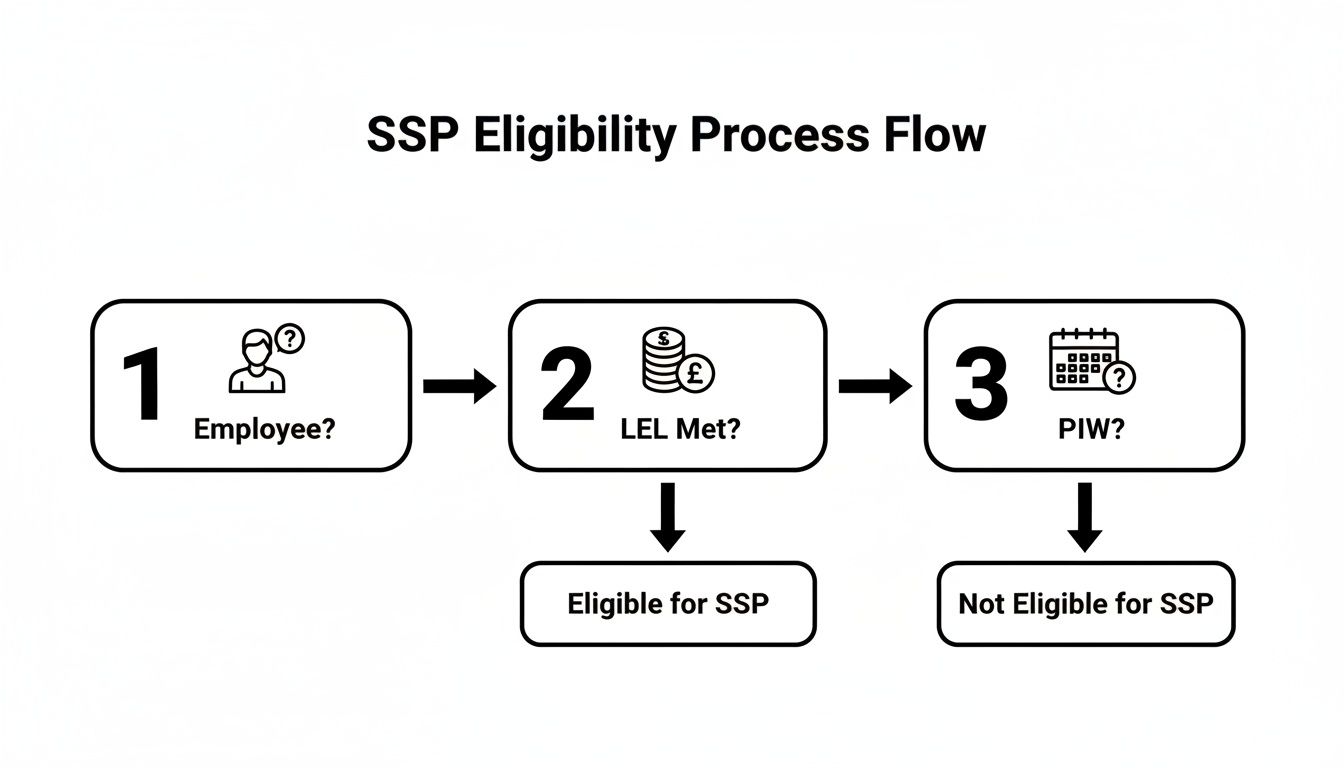
This flowchart walks you through the key checkpoints: confirming they are an employee, checking their earnings are above the Lower Earnings Limit, and making sure there’s a valid Period of Incapacity for Work.
Worked Example 1: A Fixed Part-Time Schedule
Let's make this real with a common scenario. Meet Sarah, who has a fixed schedule, working every Tuesday and Thursday. These are her agreed Qualifying Days.
- Scenario: Sarah gets sick on a Monday and is signed off for the whole week.
- Qualifying Days: Tuesday and Thursday.
- Waiting Days: Her first two QDs (Tuesday and Thursday) count as her unpaid waiting days.
- SSP Payable: Because she only works two days a week, both of her scheduled workdays fall under the three-waiting-day rule.
The result? Sarah gets £0 in SSP for this week of sickness, even though she was genuinely ill and met all the other criteria. This is a perfect example of how the waiting day rule can really affect staff who work fewer days. For a deeper dive into the mechanics, you can learn more about how to calculate Statutory Sick Pay in our complete guide.
Worked Example 2: A Different Work Pattern
Now, let’s look at David. He works three days a week: Monday, Wednesday, and Friday. His pattern is consistent, but when he gets sick makes all the difference.
- Scenario: David is off sick from Wednesday for five consecutive days (Wednesday, Thursday, Friday, Saturday, Sunday).
- Qualifying Days: His QDs are Monday, Wednesday, and Friday.
- Waiting Days: The first three QDs of his sick spell are Wednesday and Friday of the first week, and Monday of the second week. These are his unpaid waiting days.
- SSP Payable: SSP only kicks in from his fourth qualifying day of sickness.
If David comes back to work after this period, he won’t get any SSP. But if his illness continued to include the Wednesday of week two (his fourth QD), he would then get paid for that day.
Key Takeaway: The timing of an employee's illness in relation to their specific work schedule is the single most important factor in determining the final SSP amount. Two employees with identical illnesses can receive vastly different payments based solely on when their sickness starts and which days they are scheduled to work.
Calculating the Daily SSP Rate
Let's stick with David's example and say his sickness does continue, making him eligible for payment. The first thing we need is his daily SSP rate.
- Weekly SSP Rate: £116.75
- David's Qualifying Days per Week: 3 (Monday, Wednesday, Friday)
- Daily SSP Rate Calculation: £116.75 ÷ 3 = £38.92
So, if David's sickness covers his fourth qualifying day (the Wednesday in week two), he would be paid £38.92 for that day. This method makes sure part-time workers get a fair, pro-rated amount of SSP relative to their schedule. It stops them from getting a daily rate that’s way out of proportion compared to their full-time colleagues.
SSP Calculation Scenarios for Part Time Workers
To see how much working patterns and waiting days can change the outcome, let’s compare a few common situations. The table below shows just how different the SSP payout can be.
| Scenario | Working Days | Sick Days | Waiting Days Used | Payable SSP Days | Total SSP Payable |
|---|---|---|---|---|---|
| Sarah (2 days/week) | Tue, Thu | Sick for a full week (5 days) | Tue, Thu (2 days) | 0 | £0.00 |
| David (3 days/week) | Mon, Wed, Fri | Sick Wed – Sun (5 days) | Wed, Fri (2 days) | 0 | £0.00 |
| Maria (4 days/week) | Mon, Tue, Wed, Thu | Sick Mon – Fri (5 days) | Mon, Tue, Wed (3 days) | 1 (Thursday) | £29.19 (£116.75 / 4) |
| Tom (5 days/week) | Mon – Fri | Sick Mon – Fri (5 days) | Mon, Tue, Wed (3 days) | 2 (Thu, Fri) | £46.70 (£116.75 / 5 x 2) |
As you can see, the number of days an employee works each week directly influences how quickly they get past the three waiting days and start receiving SSP. These real-world examples show that getting the calculations right means paying close attention to each person's individual schedule.
Creating a Fair Company Sick Pay Policy
Statutory Sick Pay is the legal minimum, a basic safety net for when your staff are unwell. But let’s be honest, it’s rarely enough to live on. This is where a company sick pay scheme—sometimes called occupational sick pay—comes in. Offering more than the bare minimum isn't just a nice perk; it’s a smart move that shows you value your team. It builds loyalty, boosts morale, and helps you stand out as an employer who genuinely cares.
When you're putting your own policy together, one word should be your guiding star: fairness. This is especially true when figuring out sickness pay for part time workers. The goal is simple: make sure your part-time team members are treated just as well as their full-time colleagues. Getting this wrong isn't just bad for morale; it can lead to discrimination claims under UK employment law.
The gold standard is to offer benefits on a pro-rata basis. It’s a straightforward concept: if a full-time employee gets a certain benefit, a part-timer working half the hours should get half of that same benefit. This approach keeps things equitable and transparent for everyone.
Key Decisions for Your Policy
Building a great company sick pay policy means making a few fundamental decisions. Each choice you make will define how the scheme works on the ground and shape your company culture. You need to think carefully about what the business can realistically offer and the message you want to send.
Here are the main things you’ll need to decide:
- Payment Level: Will you offer full pay when someone is off sick, or a percentage? A popular approach is to offer a period of full pay, which then drops to half-pay for a further period.
- Entitlement Period: How long will an employee receive company sick pay? Many businesses tie this to loyalty, with entitlement increasing with length of service. For example, passing the one-year mark might unlock four weeks of sick pay.
- Waiting Period: Will new starters need to complete a probationary period before they can access the company scheme? This is a pretty standard way to manage the initial costs of the benefit.
- Notification Rules: How should an employee report their absence? Be specific. Who do they need to contact? How should they do it (a phone call is often better than a text)? And by what time on the first day of sickness?
Getting these points crystal clear in your policy is vital. For a deeper dive into what makes a solid policy, our guide on creating a sickness and absence policy has a complete checklist to walk you through it.
Pro-Rating Entitlement for Part-Time Staff
Applying your policy fairly to part-time staff is all about a simple pro-rata calculation. Let’s walk through an example.
Imagine your policy gives full-time employees (working 5 days a week) 20 days of full sick pay each year.
What about an employee who works 3 days a week? To work out their entitlement, you'd use this simple formula:
(Part-Timer's Days per Week ÷ Full-Timer's Days per Week) × Full-Time Sick Pay Entitlement
Plugging in the numbers, it looks like this: (3 ÷ 5) × 20 days = 12 days of full company sick pay. It’s a transparent, fair, and legally sound way to make sure everyone gets a proportional benefit.
Sample Policy Language to Adapt
When you sit down to write your policy, use plain, straightforward language. Steer clear of HR jargon that might confuse people. The aim is to create a document that anyone can pick up, read, and understand, so everyone knows exactly where they stand.
Here are a few snippets you can adapt for your own policy:
On Eligibility:
"All employees who successfully complete their three-month probationary period are eligible for company sick pay. Entitlement is based on your length of service, as detailed in the schedule below."
On Pro-Rata Entitlement:
"For part-time employees, company sick pay entitlement is calculated on a pro-rata basis. This is worked out in proportion to your contracted hours compared to a full-time equivalent."
On Payment:
"Company sick pay includes any Statutory Sick Pay (SSP) you are entitled to. Payments will be made through payroll and are subject to the usual deductions for tax and National Insurance."
Remember, writing the policy is only half the battle. You also need to make sure everyone knows it exists and can easily find it, whether that’s in an employee handbook or on the company intranet. Clear communication is just as important as the policy itself.
Improving Payroll and Absence Management
Getting sickness pay right for your part-time workers is about so much more than just crunching the numbers. It’s about building a robust process that guarantees compliance, accuracy, and fairness every single time. Get this wrong, and you’re looking at payroll errors, unhappy employees, and maybe even legal trouble down the line.
The absolute bedrock of a good system is compliant record-keeping. Trying to manually track sick days, calculate Periods of Incapacity for Work (PIW), and document every penny for both SSP and company schemes on a spreadsheet is a risky game. It's not just a drain on your time; it's wide open to human error that can cause major headaches.
And let's not forget that every sick pay transaction has tax and National Insurance implications. Both SSP and most company sick pay schemes are treated as normal earnings, so they're subject to standard PAYE deductions. Without accurate records, you're flying blind when it comes to your HMRC obligations and ensuring your employees' payslips are correct.
Moving Beyond Spreadsheets
Sure, a spreadsheet might feel like enough when you only have a handful of people. But as your business grows, that same spreadsheet quickly becomes a liability. It simply doesn't have the smarts to handle the varied schedules of part-time staff, turning the correct application of waiting days and pro-rata entitlements into a painful, manual chore.
This is exactly where modern absence management tools come into their own. Platforms like LeaveWizard are built to automate these tricky calculations, taking the guesswork and the risk of costly mistakes out of the equation. Once you set up an employee's work pattern, the system automatically figures out qualifying days, applies waiting days, and calculates the correct SSP.
Key Insight: Automating absence management isn’t about replacing people; it’s about giving them their time back. When you’re not stuck doing manual data entry and wrestling with complex calculations, you can focus on what really matters: supporting your team’s well-being and managing the business.
The Power of Automated Tracking and Reporting
Automated systems give you a single, reliable source of truth for all your absence data. No more digging through old emails and messy spreadsheets. Instead, you have a clear, auditable trail for every single instance of sickness, which is invaluable for internal reviews or if HMRC ever comes knocking.
These platforms also provide fantastic tools for spotting absence trends across the company. A manager's dashboard can offer an at-a-glance view of team sickness levels, helping you identify patterns or underlying issues that might need a conversation. After all, a great absence management strategy goes beyond just processing sick pay; it's about supporting employee well-being by offering resources for things like managing stress and anxiety effectively.
With visualisations, managers can quickly spot trends, compare absence rates between departments, and make informed decisions to support their people.
Switching to this kind of tech moves your admin function from being reactive to proactive. You can generate reports, track how much company sick pay has been used, and be confident that all calculations related to sickness pay for part time workers are spot-on. What's more, self-service portals let employees report absences and check their own records, lifting a huge administrative weight from HR and line managers. It just creates a more transparent, efficient, and compliant process for everyone.
Common Questions About Part-Time Sick Pay
Even when you've got a decent handle on the rules, some real-world situations can still leave you scratching your head. Managing sickness pay for part-time workers often throws up those tricky "what if" scenarios that don't have a simple, textbook answer. This section is all about tackling the most common questions we see from business owners and HR managers, giving you clear, direct guidance to navigate those tricky spots.
Think of this as your go-to guide for those specific questions that pop up right when you're running payroll or just after an employee has called in sick. Getting these details right isn't just about being compliant; it's about being fair and consistent with your entire team.
Do Part-Time Workers on Zero-Hour Contracts Get Sick Pay?
Yes, they absolutely do. This is a big point of confusion, but workers on zero-hour contracts are entitled to Statutory Sick Pay (SSP) just like any other employee, as long as they meet the standard eligibility criteria. Their contract type doesn't automatically rule them out.
To qualify, they still need to pass the four main tests. For zero-hour workers, the toughest one is usually the earnings requirement.
- They must be legally classified as an employee.
- They need to have been sick for four or more days in a row to trigger a ‘Period of Incapacity for Work’ (PIW).
- Their average earnings must be at least the Lower Earnings Limit, which is £123 per week for the 2024/25 tax year.
The crucial step is calculating their average earnings. You typically need to look at the 8-week period right before their sickness started to figure out their average weekly pay. This is exactly why keeping precise, detailed records of every hour worked and every payment made is non-negotiable for anyone on a zero-hour contract.
What Happens If a Part-Time Employee Is Sick on a Non-Working Day?
This is a great question, and it really gets into the nitty-gritty of how SSP works. A non-working day can still count towards the four consecutive days of sickness needed to establish a Period of Incapacity for Work (PIW).
Let's walk through an example. Imagine you have an employee, Chloe, who works Mondays, Tuesdays, and Wednesdays. If she gets sick on a Tuesday and stays ill through to Friday, that four-day stretch (Tuesday, Wednesday, Thursday, Friday) successfully forms a PIW. Her non-working day, Thursday, helps her meet that initial four-day threshold.
But here’s the key bit: SSP is only paid for the days an employee is actually scheduled to work, which are known as 'Qualifying Days' (QDs). So even though her non-working day helped form the PIW, she can’t be paid SSP for it.
In Chloe's case, Tuesday and Wednesday are her first two sick Qualifying Days, so they count as her unpaid 'waiting days'. Since she recovers before her next scheduled shift on Monday, no SSP would actually be paid for this particular bout of illness.
How Should We Handle Pay for a Phased Return to Work?
A phased return is a brilliant way to help an employee ease back into their role after a long illness. During this period, it's vital the pay structure is crystal clear to avoid any mix-ups or payroll headaches.
The rule is quite straightforward: you pay the employee their normal wage for the hours they actually work. For the days they are contracted to work but are still off sick as part of the agreed plan, they might still be eligible for sick pay.
Whether they receive SSP or company sick pay depends on whether they've used up their entitlement. If they are still within the 28-week SSP limit and the phased return falls within an existing PIW, they could continue getting SSP for those rostered-but-not-worked days. It is absolutely essential to have a clear, written agreement outlining the schedule, duration, and pay structure for the phased return.
Can I Have a Different Sick Pay Policy for Part-Time Staff?
Technically, yes, but you have to be incredibly careful not to treat your part-time workers less favourably than comparable full-time colleagues. If you do this without a very strong, objective reason, you could easily find yourself facing a discrimination claim under UK employment law.
The established best practice is to offer any enhanced company sick pay benefits on a pro-rata basis. This is the simplest way to ensure fairness and equity across your entire workforce.
Here’s how that looks in practice:
- Full-Time Policy: An employee working 40 hours per week gets 20 days of full company sick pay.
- Part-Time Equivalent: An employee working 20 hours per week (50% of a full-timer) should be entitled to 10 days (50% of 20 days) of full company sick pay.
A blanket policy that simply shuts part-timers out of a benefit that full-timers enjoy is almost certain to be seen as discriminatory. The pro-rata principle should be the bedrock of your approach, ensuring your company sick pay scheme is both generous and legally sound.


