
A well-written requesting annual leave email is more than just a quick note to your boss. It's a short, professional message that clearly states the dates you’d like to take off, giving your manager enough notice to keep things running smoothly while you’re away.
Why Your Annual Leave Email Is a Professional Statement
Sending an email to request time off might seem like a simple box-ticking exercise, but it’s so much more. It’s a direct reflection of your professionalism, your planning skills, and your respect for the team's workload. Think about it: every professional email you send helps shape your personal brand within the company. This one is no different.
This email is your chance to show you can think ahead—not just about your own holiday plans, but about the needs of the business. A vague or poorly timed request can cause a lot of unnecessary stress and disruption for your colleagues. On the flip side, a thoughtful, well-organised email proves you're both considerate and reliable.
The Importance of Taking Your Leave
Even with all the benefits of taking a proper break, many people feel hesitant to book time off. It's a real issue. Recent UK workforce data revealed that around 65% of employees don't use their full holiday entitlement. Many point to heavy workloads or a fear of being seen in a negative light as the main reasons.
This is precisely why crafting a confident and professional request is so important. Your email should frame your leave not as an inconvenience, but as a planned, manageable part of your work-life balance. It sets the tone for a smooth handover and helps you truly switch off, knowing everything is under control back at the office.
A well-crafted leave request isn't just asking for time off; it's demonstrating your ability to manage your responsibilities effectively, even in your absence. It builds trust with your manager and shows respect for your team.
This guide goes beyond generic templates. We'll show you how every part of your annual leave request email can work in your favour. For a deeper dive into crafting impactful messages in any professional setting, it’s worth exploring the principles behind unlocking the true effectiveness of email.
Checking Your Company Policy Before You Write
Before you even start typing out your annual leave request, it's smart to do a little homework first. Firing off an email without knowing the official rules is a bit like trying to navigate a new city without a map—you might get where you’re going eventually, but you’re likely to hit a few dead ends along the way. A quick check beforehand can be the difference between a swift approval and an immediate "no."
Your first stop should be the employee handbook or your company's internal HR portal. These documents are the official source for all things leave-related. It's best not to rely on what a colleague did last year or general office chatter; policies can and do change. Getting it right from the start shows you're on the ball.
Finding the Key Details
When you find the annual leave policy, you're looking for more than just the total number of days you’re entitled to. There are a few crucial details that will shape your request.
Keep an eye out for these specifics:
- Minimum Notice Period: How much of a heads-up does your employer need? Many companies follow a simple rule of thumb: provide notice that is at least twice the length of the leave you want to take (e.g., two weeks' notice for a one-week holiday).
- Blackout Dates: Are there any no-go periods for taking time off? This is pretty common in retail during the Christmas rush or in finance at the end of a quarter.
- Approval Process: Who do you send the request to? Does it go straight to your line manager, or is there a specific HR platform or system you must use? Following the correct procedure is a must.
Knowing these rules makes it far easier for your manager to give you the green light.
Your Statutory Leave Rights in the UK
It also pays to understand your basic rights. In the UK, full-time employees have a statutory right to a minimum of 28 days of paid annual leave each year. This is equivalent to 5.6 weeks.
Often, this 28-day total includes the standard 8 bank holidays. Some companies, however, offer bank holidays on top of this allowance, which is a fantastic perk. You can find more detail on UK annual leave entitlements on day-off.app.
Always remember that your company's policy can be more generous than the statutory minimum, but it cannot offer less. Knowing this baseline empowers you and provides context for your company’s specific rules.
If you’re ever unsure how your personal allowance works out, especially if you work part-time or have recently changed your hours, it's worth double-checking. For a precise figure, you can use our simple tool to calculate your annual leave entitlement. Taking these few preparatory steps shows foresight and respect for the process, setting your request up for success.
Building Your Annual Leave Request Email

Alright, you’ve checked the company policy and you're ready to book some time off. Now it's time to actually put that request together.
Crafting a clear, professional requesting annual leave email isn't about following strict, stuffy rules. It’s about making it ridiculously easy for your manager to say "yes." Let’s walk through the bits and pieces that make an email work.
The whole point is to give them all the necessary info upfront. It shows you’ve actually thought through what your absence means for the team. This small step not only respects your manager's time but also cements your reputation as a reliable, considerate colleague.
Nailing the Subject Line
Let's be honest, your manager's inbox is probably chaos. Your subject line is the first—and best—chance you have to get your request noticed and understood in a split second. Something vague like "Time off" or "Holiday" is just asking to be missed.
The best subject lines are direct, scannable, and have all the key info at a glance. Think of it like a mini-headline for your request.
Here are a few solid examples that just work:
- Annual Leave Request – [Your Name] – [Start Date] to [End Date]
- Time Off Request – [Your Name] – [Dates]
- Leave Request: [Your Name] for [Dates of Leave]
See the pattern? It’s a simple formula: your purpose, your name, and your dates. This lets your manager know exactly what's inside without even needing to click open. It’s a small detail, but it screams professionalism.
Crafting the Body of Your Email
With a strong subject line sorted, the email body is where you lay out the details. It doesn’t need to be an essay, but it absolutely must be precise. You're aiming for a balance between a polite, friendly tone and direct, unambiguous information.
Kick things off with a simple, friendly opening, then get straight to the point. Clearly state the exact dates you plan to take off. It’s always best practice to specify both the first and last day of your holiday.
For instance, instead of a vague "I'd like to take a week off in July," be specific: "I would like to request annual leave from Monday, 15th July to Friday, 19th July, and I'll be back in the office on Monday, 22nd July." This completely removes any room for error or confusion.
The single most important part of your email is the clarity of your dates. Including your return date helps your manager and team visualise the full duration of your absence and plan accordingly.
After you've listed your dates, adding a quick note about the total number of working days is a nice touch. For example, "This comes to a total of five working days." It shows you've done the maths and saves your manager a job.
Mentioning Your Handover Plan
Now for the part that really sets a great request apart from an average one. Proactively mentioning how your work will be handled shows genuine foresight and a real commitment to the team. You don't need to attach a multi-page handover document here, but a brief mention can make all the difference.
Just saying that you’ve thought about your responsibilities provides powerful reassurance. It sends a clear signal to your manager: your absence won't throw a spanner in the works or disrupt deadlines.
Here are a couple of ways you could phrase it, depending on your workplace culture:
- More formally: "Before I leave, I will ensure all my current projects are up to date and prepare a comprehensive handover note for the team."
- More informally: "I've already had a quick chat with Alex, and she's happy to cover any urgent client queries while I'm away. I'll make sure everything is in a good place before I sign off."
This simple act transforms your request. It’s no longer a potential problem for your manager to solve; it's a well-managed plan they can easily approve. It shows you’re not just thinking about your holiday, but about the team's success, too.
Email Templates for Common Leave Scenarios
A generic template for a requesting annual leave email is a great place to start, but life rarely fits neatly into a one-size-fits-all box. You’re bound to run into situations that need a slightly different approach, a more delicate tone, or a bit more detail.
Knowing how to tweak your message for these common scenarios is key to keeping things professional and getting your time off approved without any fuss. The goal isn't just to inform your manager, but to reassure them. Each template below is built to be easily adapted for real-world situations—whether you're planning a standard week away, a much longer trip, or asking for time off during a crazy-busy period at work.
The Standard Holiday Request
This is your bread-and-butter leave request. It’s for a straightforward, planned holiday of about a week or so. Here, the focus is on being crystal clear, concise, and giving your manager everything they need upfront to approve it with a single click.
Here’s an example that gets straight to the point:
Subject: Annual Leave Request – Your Name – 12th Aug to 16th Aug
Hi [Manager's Name],
I would like to request annual leave from Monday, 12th August to Friday, 16th August. I will be back in the office on Monday, 19th August.
I will ensure all my urgent tasks are completed and a handover note is prepared before I leave.
Please let me know if these dates work for the team.
Thanks,
[Your Name]
Why it works: This email is a masterclass in efficiency. It clearly states the dates, includes the return date to avoid any confusion, and proactively mentions a handover plan. It gives your manager everything they need and nothing they don’t.
The Extended Leave Request
Planning a honeymoon, a big overseas adventure, or just need a longer break to recharge? A request for extended leave—anything two weeks or more—needs a little more finesse. Your manager will want extra reassurance that your longer absence won't throw a spanner in the works, so your email should reflect that extra layer of planning.
Subject: Extended Leave Request – Your Name – 1st Sept to 15th Sept
Hi [Manager's Name],
I would like to formally request two weeks of annual leave for my honeymoon, from Monday, 1st September to Friday, 13th September. My plan is to return to work on Monday, 16th September.
Given the longer duration, I have already started preparing a detailed handover document. I've also had a brief chat with [Colleague's Name], who has kindly agreed to be the point of contact for my key projects. I am committed to ensuring a completely smooth transition before I depart.
I'm happy to discuss the handover plan with you in more detail. Please let me know if these dates are suitable.
Best regards,
[Your Name]
Why it works: This request immediately shows you understand the impact of a longer absence. By mentioning specific steps like talking to a colleague, you're demonstrating initiative and respect for your team's workload.
This simple infographic highlights the essential final touches for any leave request email.
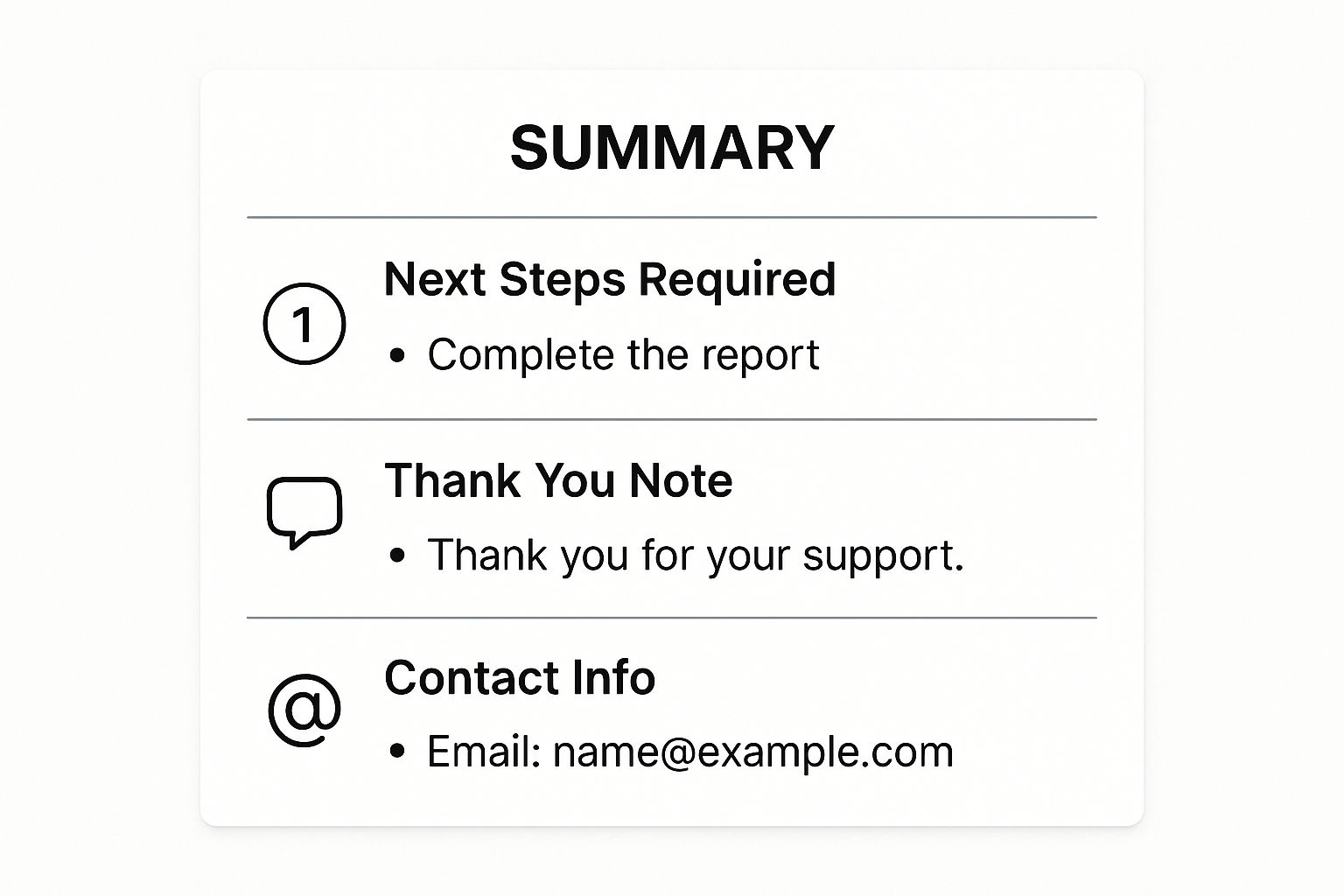
It’s a great reminder that expressing gratitude and outlining clear next steps are just as crucial as the initial request itself.
Requesting Time Off During a Busy Period
This is the tricky one. Asking for leave during a critical project launch or a notoriously hectic season requires a more strategic and thoughtful approach. Your email needs to show that you're well aware of the pressure the team is under and that you've got a rock-solid plan to mitigate any disruption.
When requesting leave during a busy time, your focus should shift from simply asking to proposing a solution. Frame your request around how your absence can be managed without adding stress to the team.
Here's how you might phrase it:
Subject: Leave Request – Your Name – 5th Nov to 7th Nov
Hi [Manager's Name],
I would like to request three days of annual leave from Tuesday, 5th November to Thursday, 7th November.
I am fully aware that this falls during the final stages of the [Project Name] launch, and I would not ask if it weren't important. To ensure my absence causes zero disruption, I plan to work ahead to complete all my project deliverables by the end of October. I will also be available for a handover meeting and will prepare a detailed guide for the team to follow.
Please let me know if this is feasible.
Thanks,
[Your Name]
Email Template Customisation Guide
While the examples above cover common ground, your specific circumstances will always be unique. A quick chat with your manager is often best, but a well-crafted email is essential for the formal record. This table breaks down how you can adapt a basic template for different professional situations.
| Scenario | Key Information to Add | Suggested Tone | Example Snippet |
|---|---|---|---|
| Last-Minute Request (Urgent) | A brief, non-specific reason for the urgency (e.g., "due to unforeseen personal circumstances"). | Apologetic, concise, and direct. | "I sincerely apologise for the short notice, but I need to request…" |
| Request for a Single Day | Specify the exact date clearly. | Professional but slightly less formal. | "I'd like to request next Friday, the 21st, as a day of annual leave." |
| Team Project Mid-Flow | Explicitly name the colleague covering for you and confirm they've agreed. | Reassuring and proactive. | "I've spoken with Sarah, and she has kindly agreed to monitor the project inbox." |
| Using Last Days of Leave | Mention that you're using up your remaining allowance for the year. | Informative and straightforward. | "I'm writing to request leave to use my remaining 3 days of annual leave before the end of the year." |
Ultimately, customising your email shows you respect your manager's time and your team's workload. It’s a small step that makes a big difference in getting that "Approved" response you're looking for.
Pro Tips to Ensure Your Request Is Approved
Sending a perfectly worded requesting annual leave email is a great start, but it's often the strategic moves you make before hitting send that truly matter. A solid request isn't just about what you write; it’s about the when and the how. Getting these details right can turn your request from a potential scheduling headache into an easy yes for your manager.
Think of it this way: your manager’s main job is to keep the team’s workflow smooth and uninterrupted. Your job is to show them you’ve planned your time off with that exact goal in mind. When you show you've already thought through the potential disruption, you make their decision a simple one.
The Art of Perfect Timing
Timing is everything. Firing off an email asking for a fortnight off right in the middle of a critical project launch is a surefire way to get a no. Before you even think about drafting your email, pause and take a proper look at the team’s workload and any upcoming deadlines.
A few things to check:
- Project Cycles: Are you in the final push for a big project? Is a major product launch just around the corner? These are not the times to ask for leave.
- Team Availability: Is anyone else on the team already booked off? Sending your request just after a key colleague has had a long holiday approved is likely to cause coverage issues.
- Company Calendar: Every business has its seasonal peaks. If you work in finance, the end of the financial year is sacred. In retail, the run-up to Christmas is usually all hands on deck.
A quick glance at the shared team calendar can save you from making a poorly timed request.
Have a Quiet Word First
This is a simple step, but it’s a game-changer. Before you formalise your request in an email, have a quick, informal chat with your immediate colleagues. It’s a courtesy that shows you’re a team player and that you're considering how your absence might affect them. More importantly, it helps you spot any potential clashes before they become a problem.
For instance, a quick, "Just a heads-up, I'm thinking of booking the last week of August off. Does that clash with any of your plans?" can prevent that awkward situation where two essential team members request the same popular week.
Proactively coordinating with your team before submitting a formal request shows initiative and a collaborative spirit, making your manager's approval process much simpler.
Prepare Your Handover Plan in Advance
Want to make your request almost impossible to deny? Mention your handover plan in the initial email. Don’t wait for your manager to ask about it. Having a concise handover document ready—and saying so—shows incredible foresight and professionalism. This simple act reassures your boss that you’re not about to leave them in the lurch.
You can include a simple line like, "I have already prepared a handover document detailing the status of my projects to ensure a smooth workflow while I'm away." This single sentence tells your manager you've already solved the biggest problem your absence creates. It makes saying "yes" to your requesting annual leave email an incredibly easy decision.
Common Questions About Requesting Annual Leave
Even with the best templates, you're bound to run into some tricky situations when you email a request for annual leave. Knowing how to handle these common queries can be the difference between a smooth approval and a seriously awkward conversation.
What If My Manager Denies My Request?
First off, don't panic. It’s rarely personal. The best first step is to politely ask for the reason behind the decision. More often than not, it's down to a business-critical deadline or a scheduling clash with another team member that you simply weren't aware of.
Once you understand the 'why', you can respond constructively. Could you offer to shift your dates by a week? Or maybe you can help with extra preparations before you go to lighten the load for everyone else. This kind of collaborative approach shows you respect the business's needs and often paves the way for a compromise that works for everyone.
A manager's primary goal is ensuring the business runs without a hitch. By showing you've already thought about team coverage and project deadlines, you make your request much, much harder to refuse. It's about presenting your leave as a manageable event, not a massive disruption.
How Far in Advance Should I Ask?
A good rule of thumb is to give notice that’s at least twice the length of the leave you're actually requesting.
So, for a one-week holiday, you should be aiming for a minimum of two weeks' notice. If you're planning a bigger trip of two weeks or more, giving a month's notice—or even more—is both courteous and professional.
This heads-up gives your manager plenty of time to sort out resource planning and allows your colleagues to plan around your absence. It's all part of effective absence management, which you can learn more about in our guide to managing employee absences to better understand things from your manager's point of view.
Do I Need to Explain Why I Need the Leave?
In short, no. You are under no obligation to provide a detailed reason for taking your annual leave. A simple, professional request is all that's needed. Your holiday entitlement is a part of your employment contract, and what you do with that time is your own business.
That said, if you feel comfortable sharing and think it might help your case (like for a once-in-a-lifetime family wedding), you could briefly mention it. Just keep it concise. For most standard holiday requests, simply stating the dates is perfectly fine.


