
To figure out annual leave calculations, you first need a solid grasp of the legal basics. Here in the UK, the starting point for everything is the statutory minimum entitlement: almost all workers are legally owed 5.6 weeks of paid holiday each year.
This one principle is the bedrock of all leave calculations.
Understanding UK Annual Leave Entitlement

Navigating the rules around UK holidays can feel a bit tangled at first, but it always comes back to that core legal requirement. This entitlement is there for a reason—it makes sure employees get proper rest, which helps foster a healthier work-life balance and heads off burnout.
For a typical full-time employee on a five-day week, that 5.6-week allowance simply translates to 28 days of paid time off every year.
It’s a straightforward conversion, but where things often get confusing for both employers and staff is how bank holidays fit into this equation.
Bank Holidays and Company Policies
Do the eight annual bank holidays in England and Wales count towards those 28 days, or are they an extra perk? The law actually gives employers the final say on this.
It's very common for company policy to state that the 28 days are inclusive of bank holidays. On the other hand, some businesses offer the 28 days plus bank holidays as a more generous package, often using it to attract and keep great people.
The employment contract is king here—it must clearly spell out which approach the company takes. For a deeper dive into the mechanics, our complete guide on how to calculate annual leave breaks down the essential details.
To put the minimums in perspective, here's a quick reference for a standard full-time role.
UK Statutory Annual Leave Entitlement At a Glance
| Working Pattern | Weeks per Year | Equivalent Days per Year |
|---|---|---|
| 5-day week | 5.6 weeks | 28 days |
This table shows the absolute baseline. Any holiday offered above and beyond this is down to company policy.
Modern Trends in Leave Policies
Many companies are now looking beyond the legal minimum, realising that more generous and flexible leave policies are a huge competitive advantage. It's no longer unusual to find companies offering 30 days or more of annual leave, including bank holidays. This shift shows a growing recognition of just how vital employee wellbeing is to a successful business.
We're also seeing a move towards more adaptable leave structures. For instance, some forward-thinking employers now let staff buy or sell a few holiday days, while others are more flexible about carrying unused leave into the next holiday year.
These kinds of policies give employees real control over their work-life integration. Understanding this legal and cultural context is the first crucial step. Once you've got this down, you can start accurately calculating leave for all your different types of employees, which we'll get into next.
Calculating Holiday for Part-Time Employees
Figuring out holiday for part-time staff can feel like a headache, but it doesn't have to be. The whole game is about fairness. You need a consistent way to calculate their leave on a pro-rata basis, which simply means they get a holiday allowance that’s proportional to the hours or days they actually work.
Getting this right keeps everything above board with UK law and ensures your part-timers aren't at a disadvantage compared to their full-time colleagues.
The most straightforward way to work out annual leave for part-timers on a set schedule is with a simple formula. Just multiply the number of days they work each week by the statutory minimum of 5.6 weeks.
Here’s the formula: (Days worked per week) x 5.6 = Total holiday days per year
This approach guarantees that someone working three days a week gets the same proportional holiday time off as a colleague working a full five days. Simple, fair, and clear.
Putting the Formula into Practice
Let's walk through a real-world scenario. Say you've just brought on a new marketing assistant, Sarah, who works three days a week—Monday, Tuesday, and Wednesday.
- Calculation: 3 days per week x 5.6 weeks = 16.8 days of annual leave.
Now, that 0.8 of a day can be awkward. It’s common practice to round these figures up to the nearest half or even full day. In Sarah's case, you might decide to round her entitlement up to 17 days for the year. It's a small touch, but gestures like this really help in building goodwill.
What if someone works half-days? The principle is exactly the same. Let's say David works five half-days a week. That's the equivalent of 2.5 full days.
- Calculation: 2.5 days per week x 5.6 weeks = 14 days of annual leave.
Using a clear, repeatable formula like this removes any guesswork and makes sure every team member knows they're getting their fair share.
A Common Sticking Point: Bank Holidays
Bank holidays are where things often get confusing for part-time staff. What happens if a bank holiday falls on a day your part-timer doesn’t usually work?
The guiding principle here is always fairness. A part-time employee should never be penalised just because a bank holiday falls on their normal day off. Likewise, they shouldn't get an unfair advantage if all the bank holidays happen to land on their workdays.
To manage this properly, you can follow a pretty simple process:
- Calculate the full pro-rata entitlement: First, work out their total allowance, including bank holidays. For Sarah, that was 16.8 days.
- Deduct bank holidays that fall on their working days: If a bank holiday Monday comes up, and Sarah works Mondays, one day is simply deducted from her 16.8-day total. She then has 15.8 days left to book whenever she likes.
- If a bank holiday falls on their non-working day: Nothing changes. Nothing gets deducted from her total. Sarah still has her full 16.8 days to use, ensuring she isn't left worse off just because a public holiday landed on her Thursday off.
This method treats everyone equitably, no matter what their working pattern looks like. Of course, manually tracking all these deductions can quickly become a chore. This is exactly where a system like LeaveWizard becomes invaluable, as it automates these calculations, preventing mistakes and freeing up your admin time.
How to Handle Holiday for Irregular and Zero-Hour Contracts
Calculating holiday pay for workers on zero-hour contracts or with fluctuating schedules can feel a bit tricky. You can't just use a standard pro-rata system when their hours change week by week, but they absolutely still have a legal right to paid holiday.
The key is to use a specific percentage-based method. This approach ensures you're being fair and, crucially, legally compliant, making sure your flexible workers get the holiday time they've rightfully earned.
For these employees, holiday entitlement accrues at a rate of 12.07% of the hours they've worked. This isn't just a number plucked from thin air; it’s derived directly from the UK's statutory leave entitlement.
Here’s the logic behind it: a standard working year has 52 weeks. If you take away the statutory 5.6 weeks of holiday, you're left with 46.4 working weeks. The 12.07% figure comes from dividing the 5.6 weeks of holiday by those 46.4 working weeks.
Key Takeaway: The 12.07% method ensures that leave is earned in direct proportion to the hours an employee works. It’s the most accurate and accepted way to handle holiday calculations for staff without fixed hours.
The Calculation in Action
Let's walk through a real-world example. Imagine you have a team member, Alex, who is on a zero-hour contract. Over one pay period, his hours have varied quite a bit.
- Week 1: Alex works 20 hours.
- Week 2: He picks up more shifts and works 40 hours.
- Week 3: It’s a quiet week, so he only works 10 hours.
- Week 4: He covers for a colleague and works 35 hours.
First, you need to total up all the hours he worked during this pay period: 20 + 40 + 10 + 35 = 105 hours.
Now, apply the 12.07% calculation: 105 hours x 12.07% = 12.67 hours of paid holiday accrued.
You’ll want to repeat this process for every pay period to keep your holiday tracking accurate and up-to-date. For a deeper dive into this topic, check out our complete guide to zero-hour contract holiday entitlement.
This whole process is about turning the work someone does directly into the leave they've earned.
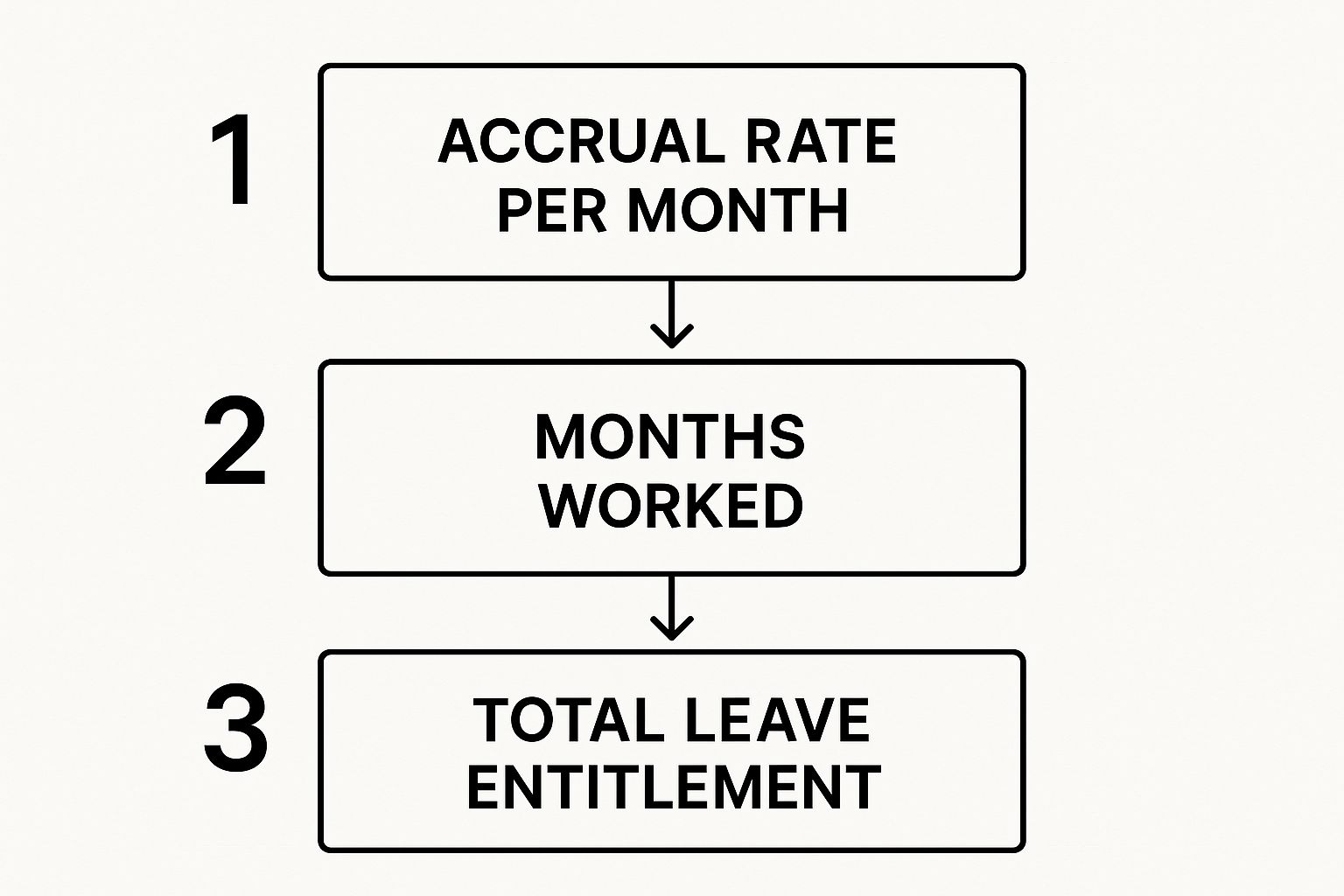
As the visual shows, it's a straightforward formula: the hours an employee has worked, multiplied by the accrual rate, gives you their final holiday entitlement.
Managing Leave for New Starters and Leavers

It’s a fact of life in any business: people come and go. When an employee joins or leaves your company partway through the holiday year, you can’t just give them the standard annual allowance. Their entitlement needs a precise pro-rata calculation to reflect their actual time with the business.
Getting this right is crucial for a smooth onboarding or offboarding process. More importantly, it ensures your final payslips are accurate and compliant.
For new team members, their holiday entitlement starts accruing from their very first day. You’ll need to calculate annual leave for them based on what they are owed from their start date until the end of your company's leave year. This gives them a fair portion of leave for the time they'll actually be working.
Similarly, when someone leaves, you must calculate the leave they've accrued right up to their final day. This figure is a key part of their final settlement, which can go one of two ways.
Calculating Entitlement for a New Starter
Let's walk through a real-world scenario. Imagine your leave year runs from January to December and a new full-time employee, Ben, starts on 1st April. His full annual entitlement is the standard 28 days.
Since he's joining three months into the year, he'll work for nine of the 12 months. The calculation itself is quite straightforward:
- (Total Annual Leave ÷ 12) x Months Remaining
- (28 days ÷ 12) x 9 months = 21 days of leave for the remainder of the year.
This simple formula ensures Ben gets a fair, pro-rata entitlement. Of course, keeping these calculations organised is just one piece of the puzzle. To really stay on top of things, many businesses rely on a comprehensive guide to managing employee vacation calendars to visualise and track all these individual adjustments.
Handling Final Pay for a Leaver
The process for a departing employee is very similar, but this time you’re focused on what they’ve earned up to their leaving date. Let’s say another employee, Chloe, leaves on 30th June. She has worked for six full months of the year.
Her accrued holiday entitlement would be:
- (28 days ÷ 12) x 6 months = 14 days.
Now, you need to check this figure against the leave she has already taken.
Key Takeaway: If Chloe has only used 10 of her 14 accrued days, you owe her payment for the remaining four days in her final salary. However, if she used 16 days, she has taken two more days than she earned. In this situation, you are entitled to recover the cost of those two days from her final pay, as long as this is clearly stated in her employment contract.
This final calculation is vital for preventing disputes and ensuring fairness for both the business and the departing employee. Complicated carry-over rules can also come into play, especially in unique situations. For more information on that, you can read about the UK government changes to annual leave carry-over rules.
Fostering a Healthy Leave Culture in Your Business

Getting the numbers right on annual leave calculation is one thing. But the real challenge for any business owner or manager is building a culture where your team feels they can actually use their time off. A generous leave policy is just words on a page if your people are too stressed or feel too much pressure to ever take a proper break.
Understanding why this happens is key to creating a healthy, sustainable workplace. This isn't just about ticking compliance boxes; it's about tackling burnout head-on, holding onto your best talent, and keeping the entire organisation productive for the long haul.
Why UK Workers Are Not Taking Their Full Leave
There’s a worrying trend emerging in the UK: people are taking less and less of their allocated annual leave. Recent data shows that in 2023, employees took an average of 33.9 days off (including bank holidays). That's a drop of about 7.7% from the year before.
So, what's going on? It often comes down to a perfect storm of heavy workloads, financial anxiety from the cost-of-living crisis, and even the rise of so-called "unlimited holiday" policies. These can paradoxically discourage time off because they lack a clear, formal structure. You can explore the full UK annual leave report for more detail on this trend.
When your team doesn't switch off, the consequences are very real. Creativity dries up, problem-solving skills dull, and overall engagement takes a nosedive. Ultimately, that hits your bottom line.
How to Encourage a Healthy Work-Life Balance
Actively encouraging your team to take their leave is one of the most powerful things you can do to support their wellbeing. It all starts at the top. When leaders take their own holidays and genuinely disconnect, it sends a clear message to everyone else that rest is not just allowed, but valued.
A culture where holidays are seen as essential, not a luxury, is key. When managers proactively discuss leave plans with their teams and help them schedule breaks, it removes the guilt and pressure that often stops people from booking time off.
Here are a few practical steps you can put into action straight away:
- Communicate Clearly: Don't just let leave balances sit there. Regularly remind your staff how much entitlement they have left and reinforce the importance of using it.
- Plan Ahead: Encourage teams to map out their holiday plans well in advance. This ensures you have proper cover sorted and avoids any last-minute scramble or stress.
- Lead by Example: When you, as a manager, take your full holiday allowance, it signals to your entire team that it's okay—and even expected—for them to do the same.
Creating this kind of supportive environment isn’t just a ‘nice-to-have’. It’s a business strategy. It ensures that all your careful annual leave calculations translate into genuine rest and rejuvenation for your team. And as we all know, a well-rested team is a productive and loyal one.
Got Questions About Annual Leave Calculations?
Even when you’ve got your formulas down pat, unique situations will inevitably pop up and make you second-guess your process. When you need to calculate annual leave, scenarios like sick leave, tricky holiday requests, and bank holiday pay can throw a spanner in the works.
Think of this section as your go-to guide for those fiddly edge cases. We'll help you make sure your holiday policies aren't just compliant, but fair and consistent for everyone.
Can I Refuse an Employee's Holiday Request?
Yes, you can. As an employer, you're legally allowed to refuse an employee's holiday request, but you can't just say no without a good reason. Your refusal needs to be based on legitimate business grounds, like ensuring you have enough cover during a peak period or preventing too many team members from being off at once.
You also have to give proper notice. The rule of thumb is to provide at least as much notice as the length of the leave requested. So, if you need to turn down a one-week holiday request, you must give a minimum of one week's notice.
Your best defence against disputes is a crystal-clear, written holiday policy. It should spell out everything: notice periods for requests, any blackout dates, and how you'll handle competing requests. A bit of transparency goes a long way in managing expectations and keeping things fair.
What Happens to Holiday During Sick Leave?
An employee's annual leave entitlement keeps on building up, even while they're off on sick leave. This applies whether it’s a short-term bug or a long-term illness.
Someone on sick leave can also choose to take their paid annual leave during their sickness period if they want to. What’s more, if an employee can't take their holiday because of a long-term illness, they are usually allowed to carry over a portion of that unused leave into the next holiday year.
How Should I Handle Bank Holidays?
There's no statutory rule that forces you to give extra pay, like 'time and a half,' for working on a bank holiday. Whether an employee gets enhanced pay for these days comes down entirely to what’s written in their contract of employment.
Your statutory minimum of 5.6 weeks can legally include bank holidays. It’s absolutely vital that your employment contracts clearly state whether the holiday entitlement is inclusive or exclusive of public holidays. Getting this clear from the start avoids a world of confusion later on.
A little strategic planning around bank holidays can be a massive win for your team's morale. For example, a full-time employee with 28 days' leave could bag 18 consecutive days off by using just nine days of their allowance around the Easter 2025 period. You can discover more about maximising holiday time and see how it can give your employees a real boost.


