Let's be honest, paternity leave for new dads isn't just a nice-to-have perk anymore. It’s a core part of any modern, competitive business strategy. Think of it as an investment in your people, one that clearly signals your commitment to equality, wellbeing, and a forward-thinking company culture.
Why Paternity Leave Is a Modern Business Necessity

The entire conversation around parental leave has changed. What might have been seen as a fringe benefit a decade ago is now a fundamental expectation for employees, especially the high-calibre talent you want to attract. Today's workforce looks for employers who get it – who understand and support modern family life, where both parents are deeply involved in raising their children.
For a small business, this shift is a golden opportunity. Offering thoughtful paternity leave for dads is a powerful way to stand out in a crowded job market. It tells potential hires that you see them as whole people with important lives outside the office walls. This isn't just about being nice; it's smart business.
Attracting and Retaining Top Talent
In competitive fields, a solid family-leave policy can be a deal-maker. When a skilled candidate is weighing up offers, benefits that support a healthy work-life balance often tip the scales in your favour. A company that only offers the bare statutory minimum will struggle to compete with one that provides genuine support for new fathers.
The impact goes way beyond recruitment, though. When your team members feel supported during huge life moments, like welcoming a new child, they become more loyal, more engaged, and ultimately, more productive. The research is clear: paid paternity leave boosts morale and performance across the board.
A supportive paternity leave policy isn't an expense; it's an investment in your most valuable asset—your people. It builds loyalty that reduces costly employee turnover and strengthens your entire organisational culture.
Fostering a Culture of Equality and Support
When fathers are actively encouraged to take leave, it helps to normalise caregiving as a shared responsibility. This chips away at outdated workplace norms and helps tackle the "motherhood penalty" that can unfortunately stall women's careers. An inclusive policy lifts everyone up by creating a more level playing field.
By putting a clear and supportive paternity leave policy in place, your small business can unlock some serious wins:
- Boost Employee Morale: Showing you care about your team's family life creates a positive and loyal atmosphere.
- Reduce Turnover Costs: Happy, supported employees are far less likely to look elsewhere, saving you thousands in recruitment and training.
- Strengthen Your Employer Brand: A progressive policy makes your company a magnet for the next generation of talent.
Ultimately, progressive paternity leave policies are a crucial tool for helping new fathers balance work and family life, which leads to happier employees and healthier families. This guide will walk you through exactly how to design and roll out a policy that works for your small business.
Understanding Your Legal Obligations in the UK
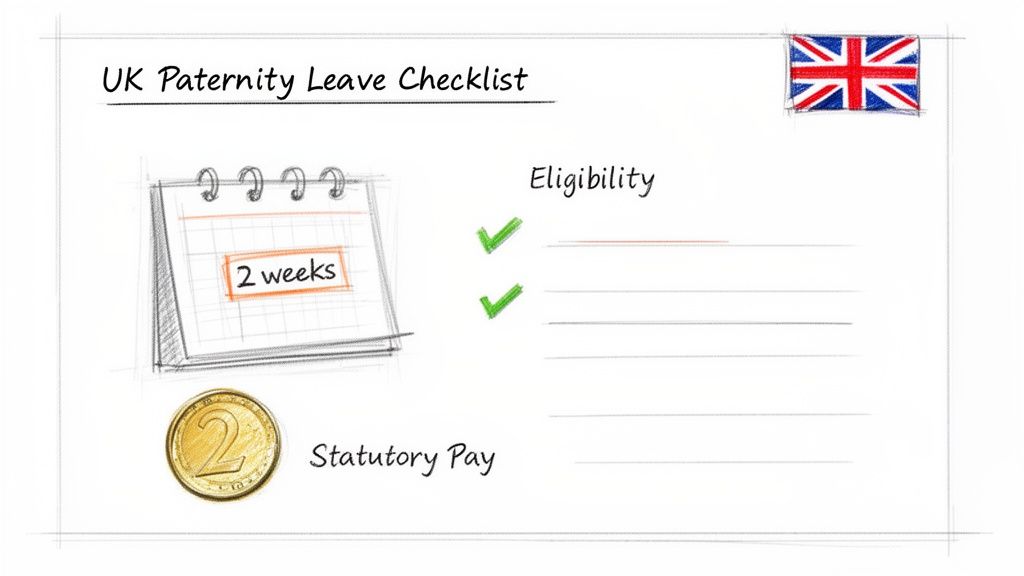
Before you can craft a policy that makes your business stand out, you’ve got to get a firm handle on the legal baseline. In the UK, the government lays down the minimum requirements for paternity leave and pay that every single employer must follow, no matter how small their business is.
Think of these statutory rules as the foundation. They're the non-negotiable starting point. Getting this right is crucial for compliance, but as we’ll soon see, just meeting the bare minimum isn't going to cut it in today's world. First, let’s break down exactly what the law expects from you.
What Is Statutory Paternity Leave?
At its core, Statutory Paternity Leave is the legal right for an eligible employee to take time off work. It’s specifically for caring for their new child and supporting the mother. This is a standalone entitlement, completely separate from things like annual holidays or the more complex Shared Parental Leave.
The key thing to remember is that this is a right, not some optional perk. If your employee meets the criteria, you are legally bound to grant them this time off.
Eligibility Criteria for Employees
Not every new dad will automatically qualify for statutory leave and pay. To be eligible, an employee has to tick a few specific boxes set by the government. It's vital you get your head around these rules to manage requests properly and fairly.
An employee is generally eligible if they:
- Are the child's biological father, the mother's husband or partner, or the child's adopter or intended parent.
- Have been working for you continuously for at least 26 weeks by the end of the 15th week before the baby is due.
- Are still on your payroll right up to the day the child is born.
- Give you the correct notice (usually by the end of that same 15th week before the due date).
Applying these criteria correctly is a massive part of complying with employment laws. One wrong move here, and you could easily find yourself in a dispute.
Leave Duration and Pay Entitlement
The UK's current statutory paternity leave entitlement is just two weeks. That's it. Employees can choose to take either one whole week or two consecutive weeks, and this leave must be finished within 56 days of the birth. This short duration is often the biggest motivation for businesses to offer something more generous.
During this time, the pay is also pretty modest. The statutory rate is £187.18 per week or 90% of their average weekly earnings, whichever is lower. For many growing families, this low figure can be a significant financial hurdle.
A recent report found that a shocking 76% of fathers and non-birthing parents were only offered the two-week statutory minimum by their employers. This simply isn't enough, and it has real-world consequences, with many dads feeling they can't afford to take their full entitlement. You can dig into more of these insights in the full report from UNISON.
This gap—between what the law demands and what families actually need—is exactly where your small business has an opportunity to shine. When you understand that the legal minimum often falls short, you start to see why an enhanced policy isn’t just a nice-to-have. It’s a strategic move that supports your people’s wellbeing and, ultimately, your company’s long-term success.
The Business Case for Enhanced Paternity Leave
Going beyond your legal obligations is where the real magic happens. Just meeting the statutory minimum for paternity leave is a bit like offering dial-up internet in a fibre-optic world—sure, it works, but it sends a clear message that your business isn't quite keeping up with the times. When you start treating enhanced paternity leave for dads as a strategic investment, rather than a cost, you unlock real returns that strengthen your entire business.
Think of it as future-proofing your company. A generous policy does more than just support a new father; it helps you build a resilient, loyal, and motivated team. By stepping up and going beyond the baseline, you cultivate a company culture that attracts and keeps the very best people.
From Cost Centre to Strategic Investment
The most common pushback I hear from small businesses is affordability. But that view often misses the hidden, and much larger, costs of not offering a competitive policy. Think about it: the expense of recruiting, hiring, and training someone new to replace a great employee who left for better benefits can easily eclipse the cost of a few extra weeks of paid leave.
Enhanced leave is an investment in loyalty. When an employee feels genuinely supported during one of the biggest moments of their life, their commitment to the company deepens. That loyalty translates directly into higher retention rates, breaking the expensive and disruptive cycle of hiring and training.
Think of it this way: a well-supported employee becomes a powerful advocate for your brand. They come back to work more engaged, more productive, and contribute to a positive workplace for everyone around them.
This shift in perspective is crucial. Instead of asking, "Can we afford to do this?", the real question is, "Can we afford not to?" In today’s competitive market, the answer is becoming clearer every day.
Attracting the Next Generation of Talent
Today’s top talent doesn’t just glance at the salary; they scrutinise the entire benefits package and what it says about the company's culture. A weak paternity leave policy can be a major red flag, suggesting an outdated approach to work-life balance and employee wellbeing.
Offering a strong policy gives you a serious competitive edge. It helps you stand out to candidates who are not only skilled but are actively looking for an employer that aligns with their modern values. This is especially true for younger generations, who consistently prioritise family-friendly workplaces.
A robust paternity leave policy sends several powerful messages about your business:
- You are forward-thinking: It shows you understand the needs of the modern workforce.
- You value your people: It proves you're committed to your employees' wellbeing beyond just their output at work.
- You support equality: It fosters a culture where caregiving is seen as a shared, and valued, responsibility.
Boosting Morale and Productivity Across the Board
The positive effects of a great paternity leave policy ripple out far beyond the new father. When people see their colleagues being treated with respect and compassion, it boosts morale for the entire team. It reinforces the idea that the company genuinely cares, which helps create a more positive and collaborative atmosphere.
What's more, a father who has had proper time to bond with his new child and support his partner comes back to work less stressed, more focused, and more motivated. Research consistently links supportive family policies with better employee performance and productivity. A well-rested, engaged father is a more effective team member. This ripple effect strengthens the whole organisation, proving that investing in one employee’s family life pays dividends for everyone.
How Better Paternity Leave Boosts Your Bottom Line
It’s time we moved the conversation about paternity leave from a nice-to-have cultural perk to what it really is: a financial imperative. While things like improved morale and attracting top talent are huge wins, the hard data shows that properly supporting new fathers isn't just good practice—it's a powerful driver for your business's bottom line.
When your team feels secure and supported at home, they bring a better version of themselves to work. That’s not a theory; it’s a proven reality. Reducing stress and increasing family stability naturally leads to better focus, more innovation, and a deeper commitment to their job. This translates directly into higher-quality work and a more resilient, productive team.
The Big Picture and Your Business
Looking at the national level can really clarify the direct benefits for your own company. When paternity leave is well-paid and long enough, it creates a positive ripple effect through the economy. It strengthens families, and in turn, the very workforce that powers our businesses. This national benefit trickles down to individual companies in very real, tangible ways.
A groundbreaking report from the Institute for Policy Research at the University of Bath makes a compelling case for extending paternity leave to six weeks, paid at 90% of average earnings. Their analysis predicts staggering net social benefits of up to £12.8 billion every year, driven by an expected 74% uptake rate among eligible fathers.
As the research points out, businesses stand to gain significantly from these policies through better staff retention, increased employee wellbeing, and improved productivity. You can dive into the full findings on the Working Families website.
This kind of data reframes the entire discussion. An enhanced policy is no longer just an expense; it's a high-return investment in your people.
Driving Retention and Slashing Recruitment Costs
One of the most immediate financial wins you'll see is in staff retention. Let’s be honest, replacing an employee is expensive. It's often estimated to cost anywhere from six to nine months of their salary when you factor in recruitment fees, advertising, interview time, and training for the new hire.
A supportive paternity leave policy is a powerful retention tool. A father who gets the time he needs to bond with his child and support his partner is far less likely to start scrolling through job boards. This loyalty directly saves your business thousands of pounds in turnover costs.
By investing a few weeks of pay upfront, you are effectively securing a long-term, committed, and grateful employee, protecting your business from the disruptive and costly cycle of recruitment.
When you run the numbers, the cost of a better policy is often dwarfed by the savings it generates. It’s that simple.
The Productivity Pay-Off
The link between employee wellbeing and productivity is undeniable. A new dad who is sleep-deprived and stressed about his partner’s recovery or the family finances is not going to be performing at his peak. It's just not realistic.
Providing adequate, well-paid leave lets him manage these early challenges so he can return to work focused, energised, and ready to contribute properly.
This productivity boost isn't a one-off, either. It helps build a sustained, high-performance culture. When your team knows you have their back during life's most critical moments, their engagement soars. This leads to very real business outcomes:
- Higher Quality Work: Focused employees make fewer mistakes and produce better results.
- Increased Innovation: A positive, supportive environment is fertile ground for creative problem-solving.
- Improved Team Cohesion: Seeing colleagues being properly supported builds trust and strengthens the entire team.
Ultimately, the data is clear. A strong paternity leave policy is a strategic financial decision that pays for itself through increased loyalty, lower costs, and a more productive workforce. It’s an investment in your people that delivers a powerful, measurable return.
Designing Your Small Business Paternity Leave Policy
Okay, let's move from theory to practice. This is the most important step in actually supporting the new fathers on your team. Crafting a clear, fair, and competitive paternity leave policy doesn't have to be a monumental task. The real goal is to build a framework that works for your business financially while giving genuine, meaningful support to your employees.
Think of your policy as a blueprint for how your company handles one of the most significant moments in an employee's life. A well-thought-out policy cuts through any confusion, sets clear expectations for everyone, and shows you're serious about being a family-friendly employer. It’s a practical document that truly brings your company values to life.
Key Components of a Strong Policy
To create a policy on paternity leave for dads that actually works, you need to clearly spell out a few core components. These elements fit together to provide a complete guide for both managers and employees, making sure everyone understands the process from start to finish.
A solid policy should always define:
- Eligibility Criteria: Be specific about who qualifies. This usually involves a minimum length of service, like having been with the company for six months or a year.
- Leave Duration: State exactly how many weeks of leave the employee is entitled to. This is your chance to go beyond the statutory minimum of two weeks.
- Pay Structure: Detail what the employee will be paid during their time off. For instance, you might offer four weeks at full pay, followed by two at the statutory rate.
- Notification Process: Lay out the steps an employee needs to take to request leave, including how much notice they need to give before the baby's due date.
Documenting these points clearly prevents any guesswork and ensures your policy is applied consistently and fairly across the business. If you need a great starting point, you can find a comprehensive UK employee leave policy template for success to adapt for your own needs.
Building a Policy That Fits Your Budget
Let's be realistic—not every small business can afford to match the massive policies of a huge corporation, and that's perfectly okay. The key is to make a meaningful improvement on the statutory minimum. You can structure your enhanced paternity leave in tiers, finding a model that aligns with what you can afford right now.
Here’s a quick look at a few examples of how you could structure this.
Sample Paternity Leave Policy Tiers for Small Businesses
A tiered approach lets you choose a starting point that makes sense for your budget and business goals.
| Policy Tier | Leave Duration | Pay Structure | Best For |
|---|---|---|---|
| Budget-Friendly Boost | 2 Weeks | 2 Weeks at Full Pay | Businesses new to enhanced leave looking for a low-cost, high-impact starting point. |
| Competitive Step-Up | 4 Weeks | 4 Weeks at Full Pay | Growing businesses aiming to attract skilled talent by offering a more substantial benefit. |
| Market-Leading Offer | 6 Weeks | 6 Weeks at Full Pay | Companies in competitive sectors aiming to be recognised as a top employer for working parents. |
Even a small step, like offering the statutory two weeks at full pay instead of the minimal government rate, makes a huge financial difference to a new family. It shows you care and can be a powerful tool for building employee loyalty without breaking the bank.
This summary highlights the significant social and business benefits of offering robust paternity leave.
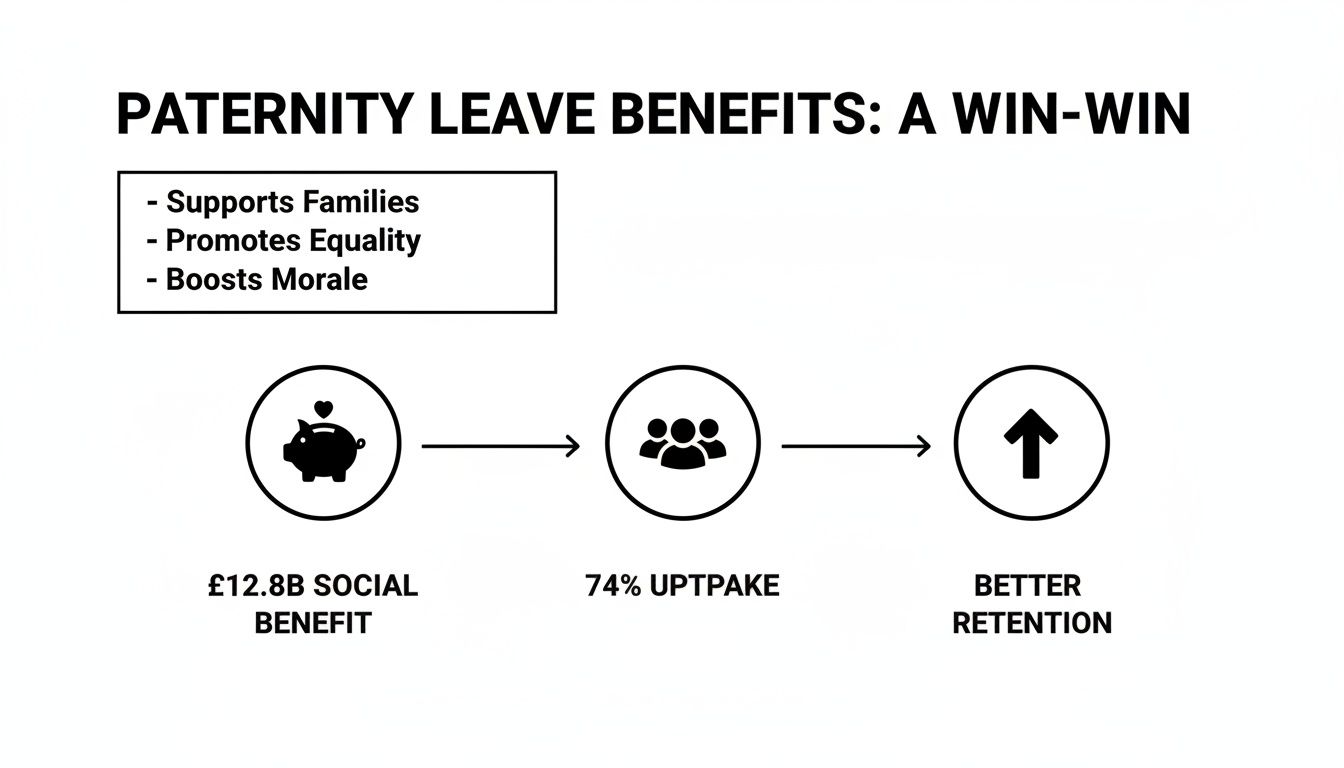
The data clearly illustrates that investing in paternity leave generates widespread economic advantages and leads to better staff retention.
Integrating with Other Leave Policies
Your paternity leave policy doesn't exist in a vacuum. It’s crucial to think about how it works alongside other types of leave, especially Shared Parental Leave (SPL). While SPL was created with good intentions, it has a notoriously low uptake rate, often because it's complicated and financially less viable for many families.
By offering a longer, dedicated period of well-paid paternity leave, you provide a simpler, more attractive alternative that fathers are more likely to use. This clarity benefits everyone.
Your policy should briefly mention its relationship to SPL, making it clear that paternity leave is a separate, distinct entitlement. For comprehensive HR policy management, a small business might seek guidance from a dedicated Hubdrive HR solution partner to ensure everything is implemented correctly and remains compliant. This helps ensure all your policies work together harmoniously, creating a supportive and legally sound framework for your team.
Learning From the Leaders and Sidestepping Common Pitfalls
If you want to create a policy that really stands out, it pays to see what other businesses are doing. By looking at industry benchmarks, you can figure out where you want your small business to sit – do you want to meet the standard, or are you aiming to set a new one? The landscape for paternity leave for dads can look wildly different from one sector to another, and there are some valuable lessons in that.
Some industries are just far more generous. The Annual Paternity League Report from Koru Kids, for instance, shows that finance and investment firms are way ahead of the pack, offering an impressive average of 11.6 weeks of paternity leave. On the flip side, even some of the big-name tech companies can fall surprisingly short, sometimes offering as little as six weeks. Knowing these trends helps you position your own policy thoughtfully. You can dig into more of these insights in the full Koru Kids report.
But here’s the thing: just having a policy written down isn't enough. Its real value comes from how it's implemented and the culture you build around it. Too many well-intentioned policies end up failing because they miss the human element completely.
Three Common Pitfalls to Avoid
Even a brilliantly drafted policy can fall flat if you stumble into a few common traps. Steering clear of these is crucial to making sure your investment in your team actually pays off.
Poor Communication: Sticking a policy on the company intranet and calling it a day is a recipe for failure. If your team doesn't know the policy exists, what it offers, or how to use it, it might as well be invisible. Communication has to be clear, proactive, and regular.
Lack of Cover Planning: One of the biggest sources of stress—for both the dad heading off on leave and the team left behind—is the big question mark over how his work will be handled. When you fail to plan for cover, it creates anxiety and can even stir up resentment, completely undermining the goodwill you were trying to build.
An Unsupportive Culture: This is the most damaging mistake of all. If fathers feel that taking their full leave will be seen as a lack of commitment or a black mark on their career prospects, they simply won't use it. The subtle (and not-so-subtle) cues from managers and leadership are everything here.
A policy's value isn't measured by the words on the page, but by the number of fathers who feel genuinely supported enough to take their full entitlement without fear of career penalty.
The real goal is to create an environment where taking paternity leave isn't just accepted, it's celebrated. That’s how you turn a document into a genuine success story.
Creating a Supportive Environment
So, how do you actually build a culture where dads feel completely comfortable taking that precious time with their families? It boils down to a few practical steps that help normalise paternity leave and weave it into the fabric of your company.
Leadership Must Lead by Example: Nothing sends a stronger message than a senior leader taking their full paternity leave and talking openly about what a positive experience it was. It's probably the single most powerful way to show your company is all in on supporting working parents.
Celebrate the News: When someone on your team shares that they're expecting a child, treat it like the great news it is. That simple act of celebration helps strip away any stigma and frames the upcoming leave as a happy, normal part of life and work.
Structure Clear Handover Plans: Before the leave starts, sit down with the employee and map out a detailed handover document. Create a solid plan for who will cover their responsibilities. This gives peace of mind to the father, his colleagues, and your clients, ensuring things run smoothly while he's away and when he returns.
When you combine a well-thought-out policy with a genuinely supportive culture, your approach to paternity leave for dads becomes more than just a benefit. It becomes a powerful tool for building a loyal, engaged, and thriving team.
Common Questions About Paternity Leave Policies
When you decide to introduce a new policy on paternity leave for dads, a whole host of practical questions are bound to pop up. Nailing down these details is the key to managing your new policy with confidence and fairness. Let’s tackle some of the most common queries we hear from small business owners and HR managers.
Think of this as your go-to guide for navigating those real-world scenarios that aren't always clear-cut. Getting straight answers on everything from fairness to different leave types helps you stay compliant while supporting your team.
Can We Offer Different Paternity Benefits to Different Employees?
The short answer is no, not in a way that could be seen as discriminatory. Your policy has to be applied consistently across the board. While you can absolutely offer an enhanced package that goes above and beyond the statutory minimum, the rules of your scheme must be fair for everyone.
This means that any eligibility criteria you set, like a minimum length of service, must be clearly written down and applied equally to all employees in similar situations. It's unlawful to offer different terms based on things like age, gender, or any other protected characteristic. Keep it simple and keep it fair.
What Is the Difference Between Paternity Leave and Shared Parental Leave?
This one trips a lot of people up. Paternity Leave is a specific, separate entitlement just for the father or partner to take time off. In the UK, the statutory amount is a block of one or two weeks.
Shared Parental Leave (SPL), on the other hand, is a completely different system. It allows the mother or primary adopter to cut their maternity or adoption leave short and share the leftover balance with their partner. The uptake for SPL is notoriously low, often because it's complex to arrange and can be less financially attractive. Many experts now argue that longer, dedicated paternity leave is a far more effective way to support new families.
For a deeper look into the financial side, learn more about whether paternity leave is paid and how the pay structures compare.
How Can a Small Business Afford Enhanced Paternity Pay?
This is the big question for many small businesses. It’s helpful to reframe enhanced pay as an investment, not just a cost.
First, calculate the actual expense of giving an employee, say, a few extra weeks of full pay. Now, weigh that number against the massive cost of recruiting, hiring, and training a replacement if that same employee leaves for a competitor with a more family-friendly outlook.
The return on investment you get from loyalty, higher retention, and a boost in team morale often far outweighs the initial cash outlay. You don't have to go all-in at once. You could start small—by offering four weeks at full pay, for instance—and build on that as your business grows.