
When you're trying to figure out an employee's maternity leave, you're really looking at two separate things: their right to take time off and their eligibility for pay. It's a common point of confusion. The headline is that pretty much every employee is entitled to take 52 weeks of maternity leave, but only those who meet certain criteria will get Statutory Maternity Pay.
Understanding UK Maternity Leave and Pay Essentials
Navigating the rules around maternity leave can feel like wading through alphabet soup—SML, SMP, the 'qualifying week'. But it all boils down to a few core principles. As a small business owner or manager, getting these basics right from the outset is crucial. It stops any confusion down the line and makes sure everyone knows where they stand.
The two terms you'll hear most are Statutory Maternity Leave (SML) and Statutory Maternity Pay (SMP). They might sound the same, but they're two very different entitlements with their own set of rules.
The Two Pillars: Leave and Pay
First up, let's talk about the leave itself. Statutory Maternity Leave (SML) is the total time off an employee can take. In the UK, this is a pretty generous 52 weeks, which is broken down into two halves:
- Ordinary Maternity Leave: The first 26 weeks.
- Additional Maternity Leave: The final 26 weeks.
It's vital to remember that every single one of your employees has the right to take this full 52-week period, no matter how long they've worked for you or what they earn. It’s a day-one employment right.
Then there's the money. Statutory Maternity Pay (SMP) is the payment an employee receives for up to 39 of those 52 weeks. This is where it gets a bit more complex, as SMP isn't an automatic right. An employee has to tick a few boxes to qualify, and this is where many businesses can trip up. For a more detailed look into how the pay is structured, you can learn more about what Statutory Maternity Pay is in our dedicated guide.
Who Is Eligible for Leave and Pay?
So, who actually qualifies? For SML, the rule is straightforward: if someone is your employee and they give you the proper notice, they get the full 52 weeks of leave. Simple.
The real legwork comes with figuring out SMP eligibility. To qualify, an employee needs to meet two key conditions:
- The Continuous Employment Rule: They must have worked for you, without a break, for at least 26 weeks leading up to the 'qualifying week'.
- The Earnings Rule: In the period before the qualifying week, their average earnings must be at least the Lower Earnings Limit for National Insurance.
That 'qualifying week' is the anchor for all your calculations—it's the 15th week before the baby's expected due date. Getting this date right is absolutely critical. If an employee doesn't meet these criteria, they won't get SMP from you, but they aren't left high and dry. They can usually claim Maternity Allowance directly from the government instead.
Key Takeaway: Think of it this way: leave is a right for all employees, but pay is an earned benefit based on length of service and earnings. Your primary responsibility is to determine SMP eligibility accurately based on the qualifying week.
To make this even clearer, I've put together a quick summary table. It breaks down the essentials for both leave and pay, helping you see at a glance what's required.
Quick Guide to UK Maternity Leave and Pay Eligibility
| Requirement | Statutory Maternity Leave (SML) | Statutory Maternity Pay (SMP) |
|---|---|---|
| Employment Status | Must be an 'employee' | Must be an 'employee' |
| Length of Service | No minimum service required | At least 26 weeks continuous service by the qualifying week |
| Minimum Earnings | No earnings threshold | Must earn on average at least the Lower Earnings Limit (£123 per week for 2024/25) |
| Notice Period | Must give at least 15 weeks' notice before the due date | Must give at least 28 days' notice for pay (usually given with leave notice) |
| Proof of Pregnancy | Not legally required but can be requested | Must provide proof of pregnancy (e.g., MATB1 form) |
This table should serve as a handy reference, but always remember to assess each employee's situation based on their specific dates and earnings.
How to Accurately Calculate Statutory Maternity Pay
Once you’ve ticked the eligibility box for Statutory Maternity Pay (SMP), the next piece of the puzzle is working out the actual numbers. While a good maternity leave calculator uk is a lifesaver, really getting to grips with the mechanics behind it gives you the confidence to handle any questions that come your way.
The calculation itself isn’t a single formula; it’s split into two distinct phases with different payment rates.
UK maternity rights have come a long way. What started as a basic provision under the 1975 Employment Protection Act has thankfully grown into a much more supportive framework. Today’s 52-week leave is a world away from the couple of weeks offered back in the 90s, and the pay structure has evolved right alongside it. You can actually dive deeper into the history and global context of maternity leave on Moorepay.co.uk.
This quick overview shows the whole journey at a glance, from the initial checks right through to getting paid.
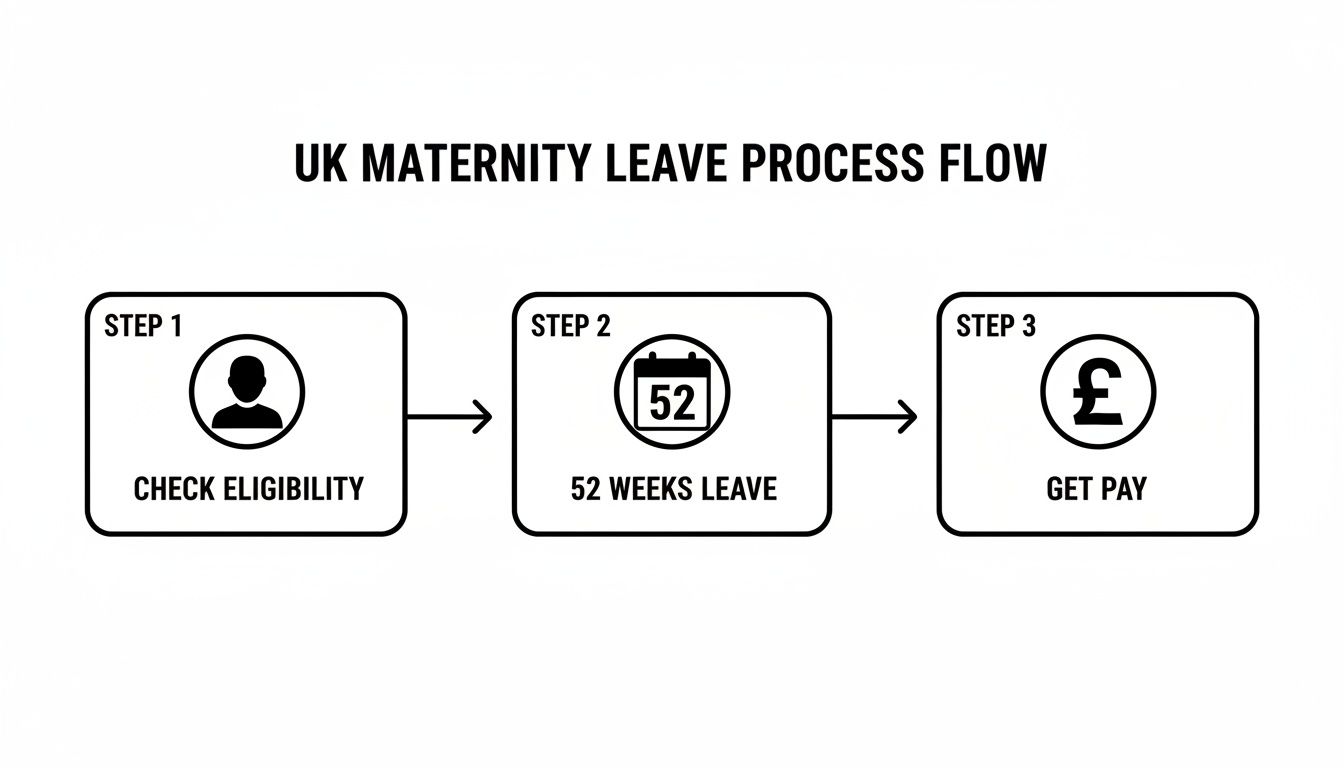
It’s a great reminder that calculating the pay is just one part of a structured, compliant process.
Calculating the First Six Weeks of SMP
The initial chunk of SMP is the most generous. For the first six weeks, your employee gets 90% of their Average Weekly Earnings (AWE). Critically, there's no upper limit on this amount, so it’s a direct reflection of what they normally earn.
To figure this out, you first need to pinpoint their AWE. This isn’t as simple as dividing their annual salary by 52. It’s calculated over a very specific eight-week "relevant period," which ends on the last normal payday just before the ‘qualifying week’ (that’s the 15th week before the baby is due).
Let’s run through a real-world example:
- Employee: Sarah, paid monthly.
- Paydays in relevant period: 31st August and 30th September.
- Gross Pay: £2,500 in August and £2,500 in September.
- Total Gross Pay: £5,000.
- Calculation: (£5,000 ÷ 2 months) x 12 months ÷ 52 weeks = £576.92 AWE.
- SMP for first 6 weeks: 90% of £576.92 = £519.23 per week.
While this is pretty straightforward for salaried staff, it can get a bit more fiddly with variable pay or bonuses, which we’ll tackle next.
Calculating the Remaining 33 Weeks
After that initial six-week period, the rate drops for the next 33 weeks. For this longer phase, the employee receives the lower of two figures:
- The statutory flat rate set by the government each year.
- 90% of their Average Weekly Earnings (AWE).
For the 2024/2025 tax year, the statutory flat rate for SMP is £184.03 per week. This figure usually changes every April, so it's always worth checking the current rate on the GOV.UK website to be sure.
Let's stick with Sarah's example. We know her AWE is £576.92, and 90% of that is £519.23. The statutory rate of £184.03 is clearly lower, so she will get £184.03 per week for weeks 7 through 39 of her maternity leave.
Handling Fluctuating Pay and Bonuses
But what if someone’s pay isn’t the same every month? For employees who work variable hours or earn commission, you still calculate their AWE using the gross earnings from that same eight-week relevant period. The principle is exactly the same: add up all the earnings and find the weekly average.
Bonuses can really change the maths. If a bonus happens to be paid during that crucial relevant period, it absolutely must be included in the AWE calculation. This can give an employee's SMP a significant boost for the entire 39 weeks, especially those first six.
Let's see it in action with a bonus:
- Employee: Aisha, paid £3,000 per month.
- Relevant Period Pay: £6,000 (from 2 months' salary) + a £1,000 bonus.
- Total Gross Pay: £7,000.
- AWE Calculation: (£7,000 ÷ 2) x 12 ÷ 52 = £807.69 AWE.
- First 6 weeks SMP: 90% of £807.69 = £726.92 per week.
As you can see, that one-off bonus has made a huge difference to her initial SMP payments.
Don't Forget Tax and National Insurance
One final, but absolutely crucial point: SMP is treated as normal earnings.
This means it is subject to both income tax and National Insurance contributions, just like a regular payslip. These deductions need to be processed through your payroll system as usual. It’s a detail that’s easy to overlook but is vital for staying on the right side of HMRC. Getting this right from the start ensures there are no nasty surprises for you or your employee down the line.
Figuring out the maternity pay is a huge step, but honestly, it’s only half the battle. Getting the dates and deadlines right is just as crucial for keeping everything above board and ensuring a smooth handover for both your employee and the business.
Think of this as your timeline playbook – it’s here to help you sidestep any administrative headaches.
It all starts with the employee. They need to let you know about their pregnancy and when they plan to start their maternity leave. This has to happen by the end of the 15th week before the baby's expected due date, a point often called the 'qualifying week'. This single date pretty much sets the entire timeline in motion.
If you want to dig deeper into the timing from an employee's perspective, our guide on when to go on maternity leave is a great resource for them to plan this big step.
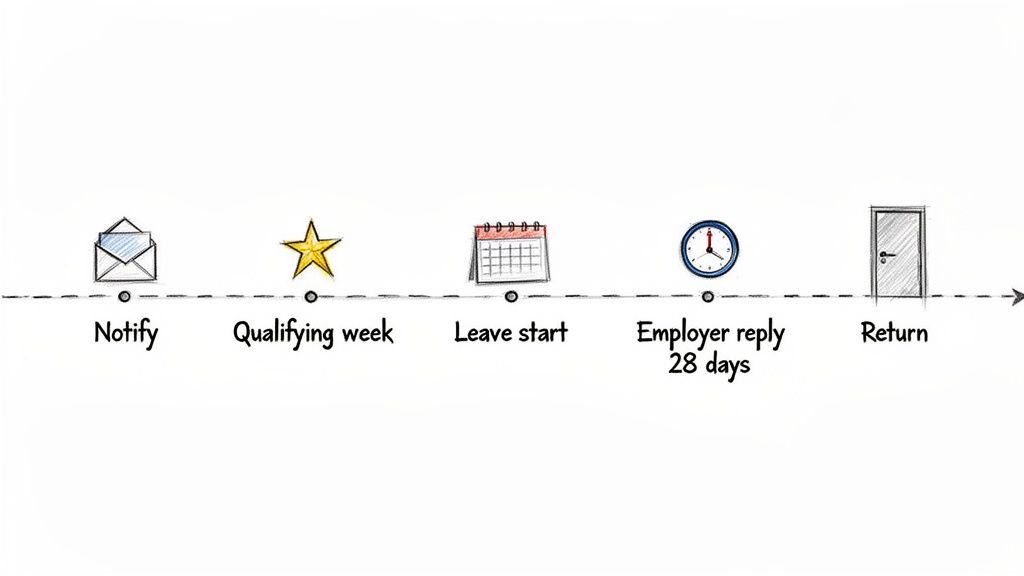
Your Legal Responsibility to Respond
Once your employee has officially told you, the clock starts ticking for you. You are legally required to respond in writing within 28 days. This isn't just good manners; it's a compliance must-do.
Your written reply must clearly state the end date of their full 52-week maternity leave entitlement. This date becomes the default for their return to work. If they aren't eligible for Statutory Maternity Pay (SMP), you'll need to give them a specific form (SMP1), but if they are, a simple confirmation letter will do.
Pro Tip: Don't just aim for the 28-day deadline – try to beat it. A quick response shows you’re on top of things and gives your employee the clarity they need to plan. It’s a small gesture that builds a lot of goodwill and cuts down on uncertainty for everyone.
What if They Want to Change Their Return Date?
Life is unpredictable, and it’s not uncommon for an employee to decide they want to come back to work earlier or later than originally planned. The key here is all about communication and notice periods.
If an employee wants to change their return date, they have to give you at least eight weeks' notice in writing. This isn't an arbitrary number; it’s designed to give you enough time to manage workflows, sort out cover, and properly prepare for their return.
Let’s walk through a quick example:
- Scenario: An employee’s 52-week leave is set to end on 1st December. She decides she’s ready to come back a month earlier, on 1st November.
- Action: She must give you written notice of this change by the first week of September at the latest.
- Outcome: This gives you almost two full months to adjust schedules and organise a smooth handover from whoever was covering her role.
If they don't provide this notice, you can, in some situations, postpone their return until the eight-week period is fulfilled, preventing disruption to your operations.
Why Keeping Meticulous Records is Non-Negotiable
Missed deadlines can snowball into big problems. Forgetting to send that confirmation letter within 28 days could weaken your position if a dispute ever comes up. Likewise, if an employee springs an early return on you without proper notice, it can cause chaos, especially in a small team where every person counts.
This is where having a solid system for tracking these dates becomes absolutely essential. Relying on scattered calendar alerts and spreadsheets is a risky game; one little human error can lead straight to a compliance breach. Using a dedicated maternity leave calculator uk or an automated system creates a single, reliable source of truth for everyone.
Managing maternity leave well is a shared responsibility. The table below breaks down who needs to do what, and when, to keep the process clear and stress-free for everyone involved.
Maternity Leave Responsibilities: Employee vs Employer
| Milestone | Employee Responsibility | Employer Responsibility |
|---|---|---|
| Initial Notification | Inform employer of pregnancy and intended leave start date by the end of the 15th week before the due date. | Acknowledge the notification and prepare to calculate eligibility. |
| Written Confirmation | Provide a MATB1 certificate (usually after 20 weeks of pregnancy) as proof of pregnancy. | Respond in writing within 28 days, confirming start/end dates and SMP details (or provide SMP1 form if ineligible). |
| Changing Return Date | Provide a minimum of eight weeks' written notice if they wish to return earlier or later than the confirmed end date. | Acknowledge the new return date and make necessary arrangements for their return (e.g., coordinate with maternity cover). |
| Keeping in Touch | Can work up to 10 'Keeping in Touch' (KIT) days during leave by mutual agreement, without losing SMP. | Agree on and pay for any KIT days worked. Keep lines of communication open regarding important workplace updates. |
Ultimately, a proactive approach and solid record-keeping are the cornerstones of managing maternity leave. They prevent misunderstandings, protect your employee's rights, and keep your business running smoothly without any nasty compliance surprises.
Maternity leave rarely runs like clockwork. Life happens, and as a small business owner, you need to be ready for the curveballs. Getting your head around these less common situations is the key to managing the whole process fairly, legally, and without a load of unnecessary stress.
These are the tricky 'what if' scenarios that I see causing the most confusion. Handling them correctly isn't just about staying compliant; it shows your employee you’re a supportive and organised employer during a massive life event for them.
What Happens if a Pregnancy-Related Sickness Starts Before Leave?
One of the most common complications is when an employee goes on sick leave for a pregnancy-related illness just before their maternity leave was supposed to start. This scenario has very specific rules you need to get right.
If an employee is off work with a pregnancy-related illness within the four weeks before the week their baby is due, their maternity leave and Statutory Maternity Pay (SMP) will automatically begin. The trigger date is the day after the first full day they are off sick within that four-week window.
It doesn’t matter what date they originally told you they wanted to start. This rule is in place to protect the employee's health and make sure they officially begin their maternity leave period.
Let's look at a real-world example:
- The Plan: Your employee tells you she wants to start her maternity leave on 1st March.
- The Sickness: She gets signed off with a pregnancy-related illness on 15th February.
- The Timing: The 15th of February falls within the four-week window before her due date.
- The Outcome: Her maternity leave and pay automatically kick in on 16th February.
It's your job to spot this trigger and get the payroll and leave dates updated. Clear communication is absolutely vital here so your employee understands exactly why their leave has started earlier than planned.
Making the Most of Keeping in Touch Days
During maternity leave, an employee can work for you for up to 10 days without it messing with their maternity leave or pay. These are called 'Keeping in Touch' (KIT) days, and they have to be mutually agreed upon.
KIT days are a brilliant tool for helping someone stay connected, attend important training, or just ease their transition back into the workplace. But they are completely optional for both of you – you can't force them to work, and they can't demand you provide it.
Key Insight: Payment for a KIT day needs to be agreed upon in advance. You must pay at least the National Minimum Wage, but it’s good practice to pay their normal daily rate. You offset any SMP payment for that week against their earnings, so they effectively get their normal day's pay plus whatever is left of their weekly SMP.
When an Employee Decides Not to Return
It’s a tough reality, but sometimes an employee on maternity leave decides not to come back. How you handle this all comes down to your own company policies, especially if you offer any enhanced or contractual maternity pay.
First things first: an employee never has to repay their Statutory Maternity Pay, even if they don't return. SMP is a legal entitlement they’ve already qualified for.
However, if you offer a more generous package (often called Occupational Maternity Pay), your company policy might have a clause that requires them to repay it if they don't return for a set period. This must be written crystal clear in their contract or your maternity policy. If you're thinking about this, our guide on understanding occupational maternity pay is a great resource for setting up these kinds of benefits properly.
If an employee does resign, they still have to give you their normal contractual notice. It's quite common for this notice period to be served during the last part of their maternity leave. This often means you might not see them back in the office, but all the official paperwork for their employment ending is handled correctly.
The Hidden Risks of Manual Pay Calculations
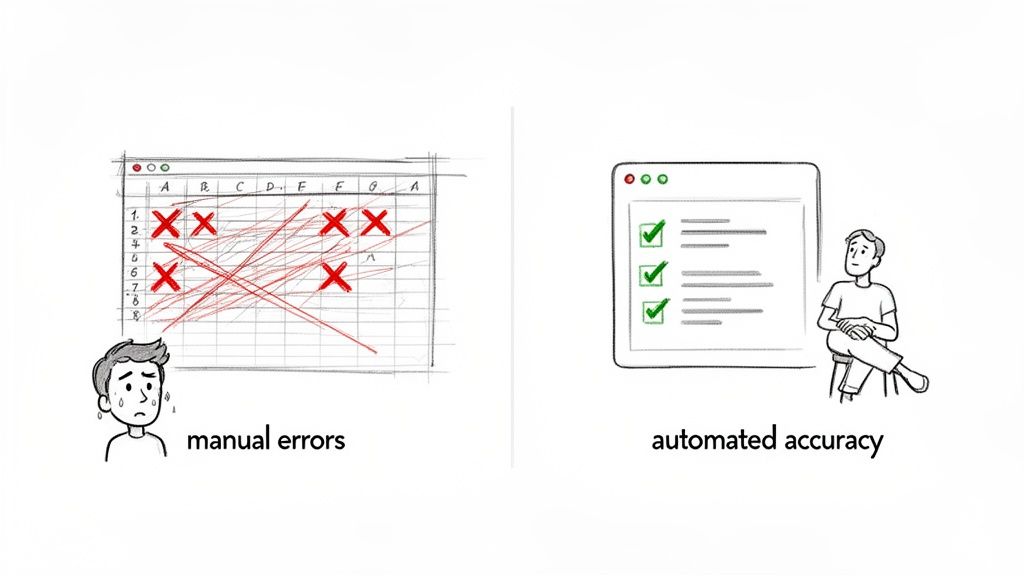
When you shift from the theory of maternity pay to the day-to-day reality of running a business, you’ll find a significant risk many small businesses take without even realising it. Relying on spreadsheets to manage Statutory Maternity Pay (SMP) is incredibly common, but it's a gamble with surprisingly high stakes. The whole process is an open invitation for human error, eats up valuable admin hours, and carries serious compliance risks if you get it wrong.
This isn’t just about administrative headaches. It's about the very real impact these calculations have on your employees during a pivotal time in their lives.
The True Cost of Human Error
Let's be honest, manual data entry is a minefield. A single misplaced decimal point, an incorrect date pulled from a calendar, or a forgotten bonus when calculating Average Weekly Earnings can have a domino effect. These aren't just minor clerical mistakes; they can lead to underpaying an employee during a financially vulnerable time or overpaying them, which creates awkward conversations and messy payroll corrections later on.
The complexity of the rules just makes things worse. For example:
- Variable Pay: Figuring out the AWE for an employee with fluctuating hours or commissions demands meticulous record-keeping over that specific eight-week qualifying period. One slip-up throws the whole calculation off.
- Automatic Triggers: It’s easy to miss the fact that an employee's pregnancy-related sick leave has automatically triggered the start of their maternity leave. This one mistake can disrupt the entire payment schedule.
Every manual step is a fresh opportunity for an error to creep in, creating a chain of risk that is both stressful and entirely avoidable.
Financial Strain and Employee Wellbeing
The accuracy of SMP payments is absolutely critical to your employees. Research paints a stark picture of the financial pressures new parents face here in the UK. A UNISON survey revealed that a staggering 50% of parents on maternity leave went back to work earlier than they wanted to because of financial strain. Even more telling, 93% said they would have taken longer if their pay was better. You can find more details in the full UNISON Parental Leave Survey Report 2025.
When SMP is miscalculated or delayed, it feeds directly into this stress. Getting payments precise and on time isn't just a legal duty; it’s a fundamental part of supporting your team's wellbeing and fostering a positive, loyal work environment.
Inaccurate pay calculations can erode trust and add significant financial anxiety to what is already a challenging time for new parents. Getting it right every time is a powerful demonstration of your duty of care as an employer.
The Compliance Tightrope
Beyond the immediate financial impact on your employee, manual errors expose your business to some serious compliance risks. HMRC has strict rules for SMP, and getting it wrong can lead to penalties and formal disputes. A simple spreadsheet offers no audit trail, no built-in checks, and no automated reminders for critical deadlines.
If an employee raises a query or a formal complaint, a disorganised folder of spreadsheets is a pretty weak defence. To mitigate this kind of financial exposure, solid financial controls are essential, starting with understanding all cash disbursements. A clear, transparent, and accurate record is always your best protection.
This is where an automated maternity leave calculator uk system stops being a "nice-to-have" and becomes an essential business tool. It removes the guesswork and the risk by:
- Automatically calculating eligibility based on employment dates.
- Accurately working out SMP, even in complex scenarios with bonuses.
- Tracking key dates and sending automated reminders for deadlines.
- Creating a permanent, transparent record that protects both you and your employee.
By automating the process, you aren't just saving time. You're building a smarter, safer, and more supportive framework for managing one of the most important periods in your employees' lives.
Your UK Maternity Leave Questions Answered
Let's dive into some of the most common questions that pop up when you're navigating maternity leave and pay. I hear these queries all the time from small business owners, so think of this as your go-to reference for quick, clear answers.
What Happens If An Employee's Earnings Vary Each Month?
This is a classic headache. For employees whose pay isn't fixed, you can't just use their last payslip. Instead, you need to calculate their Average Weekly Earnings (AWE).
You do this over a specific eight-week 'relevant period' leading up to their qualifying week. Just add up the gross earnings from that period and divide by eight to get the average. This ensures their Statutory Maternity Pay (SMP) is a fair reflection of what they normally earn. It's an area where manual errors are rife, which is exactly why automated systems are so helpful—they get the figures right every time.
Can My Business Reclaim The Statutory Maternity Pay We Pay Out?
Yes, you absolutely can, and you should! Most businesses can reclaim 92% of the SMP they pay to an employee. It's a significant financial relief that, believe it or not, many small business owners don't realise is available.
The deal gets even better if your business qualifies for Small Employers' Relief. You'll qualify if you paid £45,000 or less in Class 1 National Insurance during the last tax year.
If that's you, you can reclaim:
- 100% of the SMP you've paid out.
- An additional 3% on top of that.
This isn't a complicated rebate process. You simply deduct the amount from the PAYE you owe to HMRC each month. This directly helps your cash flow while your employee is on leave.
Expert Tip: Don't let this slip through the cracks. This isn't a bonus; it's a support mechanism built into the system for businesses like yours. Make sure your payroll process is set up to correctly offset these amounts against your HMRC liability each month.
Do Employees Still Accrue Holidays While On Maternity Leave?
They certainly do. This is a non-negotiable legal right. An employee’s full statutory and contractual holiday entitlement continues to build up throughout their entire 52-week maternity leave period, just as if they were in the office every day.
It's very common for employees to tack this accrued holiday onto the beginning or end of their maternity leave, so it’s something you need to plan for. Having a conversation about this with your employee well in advance helps manage everyone's expectations and allows you to sort out cover arrangements without any last-minute surprises.
What Is The Difference Between SMP and Maternity Allowance?
This is a key distinction that often trips people up. In simple terms:
-
SMP (Statutory Maternity Pay) is what you, the employer, pay directly to an eligible employee.
-
Maternity Allowance (MA) is a benefit paid by the government to people who don't qualify for SMP. This might be because they're self-employed, haven't been with your company for the required 26 weeks, or their average earnings fall below the threshold.
If you work out that an employee isn't eligible for SMP, you have a legal duty to give them form SMP1. This official form explains exactly why they don't qualify and is the key they need to apply for Maternity Allowance from the government.


