
Figuring out holiday pay can feel like a headache, especially with all the different rules. While a leave entitlements calculator can do the heavy lifting, it's really important for UK employers to get to grips with the basics first. The cornerstone of it all is the statutory minimum of 5.6 weeks of paid annual leave. This isn't just a guideline; it's a legal requirement and the starting point for every employee's holiday rights.
Once you have that foundation in place, everything else becomes much clearer.
Understanding Your Core Holiday Pay Obligations

Before you jump into any calculations, you need to be solid on the legal framework for annual leave in the UK. This isn't about becoming a lawyer overnight. It's about knowing your responsibilities so every calculation you make is both accurate and lawful.
The absolute baseline for all employers comes from the Working Time Regulations 1998. This sets the entitlement at 5.6 weeks of paid annual leave per year for almost all workers. For a typical employee working a five-day week, that's a straightforward 28 days.
Things get a little more complex when staff work fewer days, as their entitlement is calculated on a pro-rata basis. Someone working three days a week, for instance, is entitled to 16.8 days of paid holiday.
Full-Time vs Part-Time Entitlements
The way you apply this entitlement changes depending on an employee's work pattern. A full-time employee's 28 days is easy enough to manage, but part-time calculations need a bit more care to ensure everyone is treated fairly. The golden rule is to always apply the 5.6-week entitlement proportionally.
Key Takeaway: The 5.6-week entitlement is a universal minimum. It's not just for full-time staff; it has to be applied fairly to every single worker, no matter their hours. This includes part-time, irregular-hour, and even zero-hours contract staff.
To get a fuller picture of your responsibilities, it's helpful to have a broader grasp of understanding employer and employee obligations.
Statutory Annual Leave Entitlement by Work Pattern
To make things a bit simpler, here’s a quick reference table showing how the statutory minimum breaks down for the most common work patterns.
| Days Worked Per Week | Statutory Weeks Entitlement | Total Minimum Days |
|---|---|---|
| 5 days | 5.6 weeks | 28 days |
| 4 days | 5.6 weeks | 22.4 days |
| 3 days | 5.6 weeks | 16.8 days |
| 2 days | 5.6 weeks | 11.2 days |
| 1 day | 5.6 weeks | 5.6 days |
As you can see, the calculation itself is simple multiplication (days worked per week × 5.6). Mastering these fundamentals is the key to building a leave management system that’s built on a solid, compliant foundation.
Getting Leave Calculations Right for Full-Time and Part-Time Staff
Figuring out holiday pay for your team might seem simple, especially for those on consistent hours, but it’s surprisingly easy to get wrong. Making a mistake can lead to some serious compliance headaches, so getting it right every single time is vital for being fair and staying on the right side of the law.
For a standard full-time employee working a five-day week, it's pretty straightforward: they are entitled to the statutory minimum of 28 days holiday.
Things get a bit more interesting with setups like compressed hours. If someone works their full-time hours over four days instead of five, they’re still entitled to 5.6 weeks of leave. The maths just looks a little different. In this scenario, their holiday entitlement works out to 22.4 days (that's 4 days × 5.6 weeks), making sure they receive the exact same amount of time off.
The Part-Time Calculation
This is where the real complexity often creeps in. With part-time staff, you've got to use pro-rata calculations to keep things fair. It’s not just about getting the number of days right; you also have to manage bank holidays in a way that doesn't penalise them.
Let's imagine you have an employee who works three set days a week—say, Tuesday, Wednesday, and Thursday. You'll need to calculate their entitlement proportionally.
- Here's the formula: (3 days / 5 days) × 28 days = 16.8 days of annual leave.
This calculation ensures their holiday time is fair compared to their full-time colleagues. For a much deeper dive into these calculations, you can explore our guide on how holiday pay is calculated.
A Note on Bank Holidays: This is a common trip-up. If your business closes for a bank holiday that falls on one of the part-time employee's non-working days (like a Bank Holiday Monday), you can't deduct it from their leave. But if it falls on one of their normal working days (like Good Friday), then it is deducted from their 16.8-day total. This system ensures they aren't short-changed for bank holidays they wouldn't have worked anyway. Using a leave entitlements calculator is a great way to automate this and sidestep any accidental unfairness.
Handling Leave for Irregular Hours and Part-Year Workers

Let’s be honest, managing holiday for staff with non-standard work patterns has always been a bit of a headache for employers. Recent rule changes have tried to simplify things, but you need a clear grasp of them to get it right. The big shift is moving away from confusing pro-rata maths to a much more direct accrual system for these workers.
For any leave year that starts on or after 1st April 2024, the government has laid out a clear path forward. If you have irregular-hour or part-year workers, their holiday entitlement is now calculated as 12.07% of the total hours they’ve worked in a pay period.
Where does that number come from? It’s simply the statutory 5.6 weeks of holiday divided by the remaining 46.4 weeks of the year. This change means you can finally stop doing complex forecasts or worrying about the fallout from old court rulings. The focus is now squarely on hours actually worked, which makes the whole process more transparent for everyone involved.
Putting The Accrual System Into Practice
So, what does this look like day-to-day? Imagine you have a team member on a zero-hours contract who you pay every week.
- Week 1: They work 25 hours.
- Week 2: They work 40 hours.
- Week 3: They work 15 hours.
To figure out their holiday, you just apply the 12.07% rate to the hours they worked in each of those weeks. It keeps the calculation timely and directly tied to their real work, completely removing the guesswork. Of course, a dedicated leave entitlements calculator can make this automatic.
Key Takeaway: The 12.07% accrual system creates a direct and fair link between hours worked and holiday earned. It's now the standard for irregular-hour and part-year workers, ensuring they get their statutory entitlement in a way that truly reflects their flexible working pattern.
Making this work requires diligent tracking and crystal-clear communication. Your payroll or HR software needs to be set up to handle these specific calculations. It's also vital to show employees exactly how much leave they’ve accrued on each payslip—this transparency is key to building trust and heading off any potential disputes.
To make sure you have all the pieces of the puzzle in place, take a look at our complete guide on how to calculate annual leave.
Using a Leave Entitleaments Calculator Effectively
Doing the maths yourself is a great way to get your head around the rules, but let’s be honest—a dedicated leave entitlements calculator is an absolute lifesaver. It saves a huge amount of time and, more importantly, prevents the kind of costly errors that can easily happen. These tools are built to handle all the tricky scenarios automatically, making sure your business stays compliant without accidentally overpaying or underpaying your staff.
Of course, to get the most out of any calculator, you need to feed it the right information. The old saying ‘garbage in, garbage out’ definitely applies here. The accuracy of what comes out is directly tied to the quality of what you put in.
- Employee Start/Leave Date: This is non-negotiable for getting pro-rata calculations right when someone joins or leaves part-way through your holiday year.
- Working Pattern: You need to be specific about the days or hours worked. Is it a standard 5-day week? A 3-day part-time schedule? Or completely irregular hours? The tool needs to know.
- Contractual Hours: For anyone paid by the hour, this figure is the foundation of the entire calculation.
This infographic gives a nice, simple overview of how a typical calculator takes this data and turns it into a clear summary.
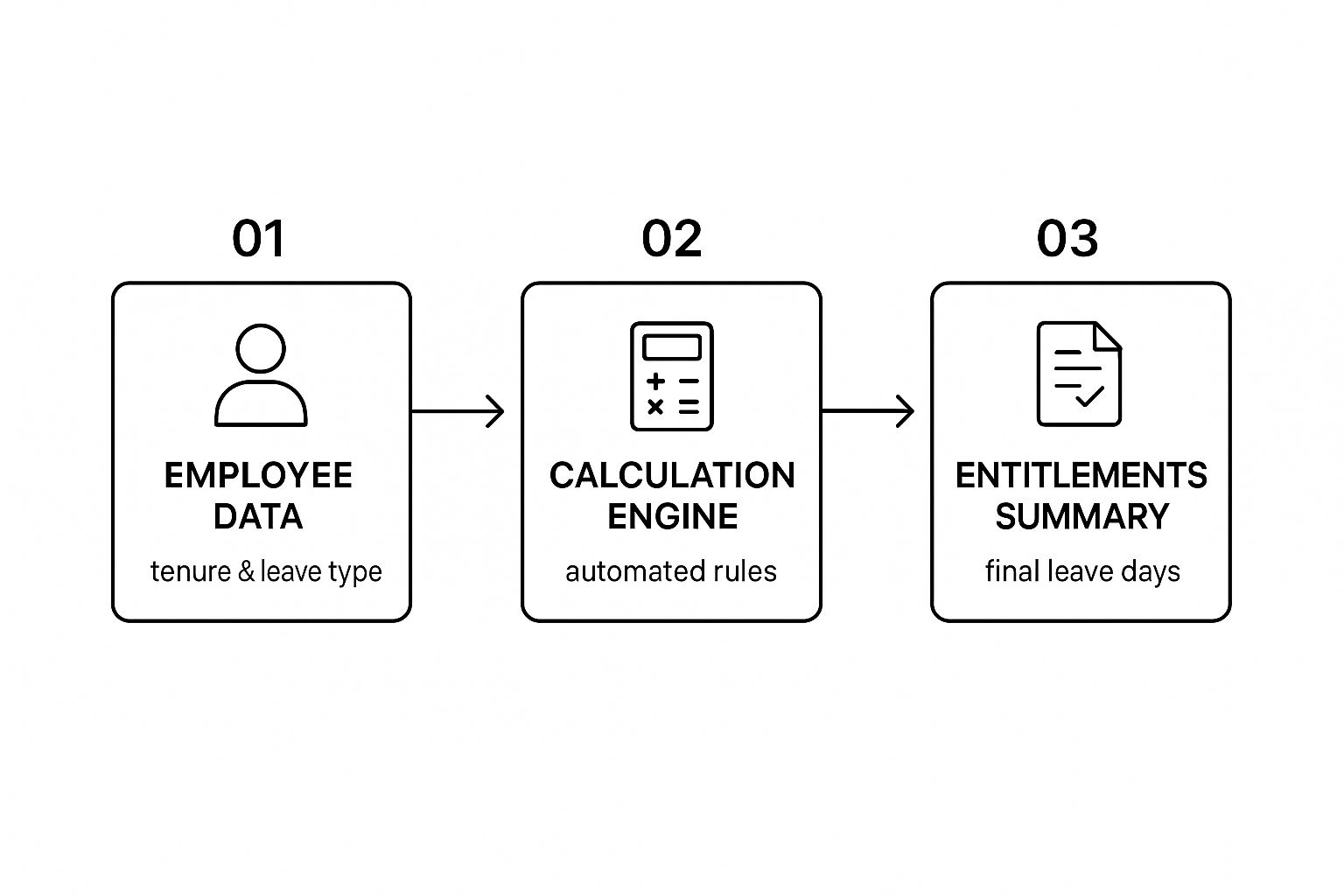
The flow is straightforward: provide the core employee data, let the tool apply the automated rules, and you get back an accurate summary of their entitlements. Simple.
Interpreting the Results
Getting the numbers is one thing; understanding what they actually mean for your employee is another. For instance, the GOV.UK calculator is particularly good at providing a clear breakdown for different, often complex, scenarios.
Employers can use digital tools just like this one to pin down the correct annual leave for employees on variable hours or for those who start or leave mid-year. It just removes all the guesswork. These tools ensure you’re compliant and simplify headaches like figuring out leave carry-over rules.
Expert Tip: I always recommend double-checking the results against a simple, known case. For example, run a quick calculation for a standard full-time employee. If the result comes back as 28 days (the statutory minimum), you can feel much more confident that the tool is configured correctly for your company's leave year.
Ultimately, using a leave entitlements calculator effectively is about more than just typing in numbers. It’s about being precise with your inputs and knowing how to read the output to ensure you’re being fair and, crucially, legally compliant.
Want to see one in action? You can try our own holiday entitlement calculator to make your life a whole lot easier.
Figuring out holiday pay for people joining or leaving your company part-way through the year can feel like a classic HR headache. Getting it right is crucial, though. It ensures a smooth start or finish for the employee, keeps your payroll accurate, and helps you sidestep any potential disagreements down the line.
Most businesses I've worked with handle this using a monthly accrual system. It's pretty standard practice and aligns with UK government guidance. Essentially, an employee starts building up their holiday entitlement from their very first day on the job.
For a full-time employee on regular hours, this works out as one-twelfth of their annual entitlement for each full month they're with you. So, if someone gets the standard 28 days a year, they're earning about 2.33 days of leave each month. You can dig into the finer points of the monthly accrual system and its nuances here.
Calculating Final Holiday Pay for Leavers
When someone hands in their notice, you need to work out their final holiday pay. The first step is to calculate the total amount of leave they’ve earned up to their leaving date. Once you have that figure, you just subtract the number of holiday days they've already taken.
- If they've earned more holiday than they’ve taken, you’ll need to pay them for those unused days. This is often called payment in lieu of holiday.
- On the flip side, if they’ve used more holiday than they’ve actually accrued, you can usually deduct the difference from their final pay packet. Just make sure this is clearly spelled out in their employment contract – it's a must!
Let's see it in action:
Imagine Sarah is leaving on 30th June. Your company's leave year runs from January to December, so she's worked exactly half the year. Her full entitlement is 28 days. By her leaving date, she has accrued half of this: 14 days. If her records show she’s only taken 10 days off, you owe her payment for the remaining 4 days in her final salary.
Pro-Rating for New Starters
The logic is exactly the same when someone joins your team. You calculate their holiday entitlement on a pro-rata basis for the rest of the leave year.
While you can do the maths yourself, using a leave entitlements calculator is genuinely the easiest way to handle this. It's a lifesaver, especially for those tricky situations where someone joins part-way through a month. The tool does all the heavy lifting, dealing with the awkward fractions and making sure your calculation is spot-on and compliant from day one.
Common Holiday Entitlement Questions Answered

Even when you've got a great tool like a leave entitlements calculator, you’ll inevitably run into some tricky real-world scenarios. Let's face it, navigating the finer points of UK holiday rules can be confusing. From my experience, understanding the common edge cases is what gives you the confidence to handle any situation fairly and compliantly. We hear the same questions time and time again, so let’s clear them up.
One of the biggest headaches I see is managing bank holidays for part-time staff. The key principle here is simple: always pro-rata their entire entitlement, including bank holidays. If your business closes on a bank holiday, you only deduct that day from a part-timer's leave if it falls on one of their normal working days. This approach is crucial to avoid penalising them for a public holiday on a day they wouldn't have been working anyway.
Another area that has seen recent changes is rolled-up holiday pay. This practice, where you add a bit extra to a worker's regular pay instead of paying them for time off they take, is now legally permitted for irregular-hour and part-year workers. This must be calculated at 12.07% of their pay and, importantly, must be shown as a separate, clear item on their payslip.
What if an Employee's Hours Change?
This is a really frequent challenge. When an employee's working hours change part-way through the holiday year, you have to recalculate their entitlement. It's a two-step process.
First, you need to work out the leave they earned on their old contract. Then, calculate the leave they will accrue for the rest of the year based on their new contract. Add those two figures together, and you have their new total entitlement for the year.
Can I make employees take leave?
In short, yes. You can require staff to take their holiday on specific dates, which is common for things like a Christmas shutdown. The rule you must follow, however, is that you have to give them at least twice as much notice as the length of the leave you're enforcing. So, for a one-week shutdown, you must provide a minimum of two weeks' notice.
Getting these specific situations right isn't just about being nice; it's vital for maintaining a fair, positive, and legally compliant workplace.


