
Figuring out holiday pay can feel like a minefield, but the basics are actually quite straightforward. For most full-time UK employees, the legal minimum you're entitled to is 5.6 weeks of paid holiday a year. If you work a standard 5-day week, that translates to a solid 28 days off.
This statutory minimum is the foundation for everyone. However, things can get a bit more complex depending on your contract and how you work, so let's dig into the details.
Understanding Your Core Holiday Entitlement

Before you can work out your specific holiday allowance, you need to get to grips with the legal baseline. Every full-time worker in the UK has a right to this paid time off. The confusion usually kicks in when we start talking about bank holidays and how the rules adapt for different types of workers.
Under UK employment law, that 5.6 weeks (or 28 days) of paid annual leave is the absolute minimum. This figure is made up of 20 days of standard paid leave plus 8 days that typically cover UK public holidays like Christmas or Easter.
Here’s the catch: an employer can decide whether to include bank holidays within that 28-day minimum or give them to you on top of it. If they do the latter, your total holiday could jump to 36 days. It's always worth checking the latest holiday pay reforms to see how any new rules might affect you.
Entitlement for Different Working Patterns
Naturally, your personal situation will change how this base entitlement is calculated. A part-time employee, for instance, will get a pro-rata (or proportional) amount of the full-time allowance. Someone on a zero-hours contract will build up their holiday based on the hours they actually work.
To give you a quick overview, here's how the statutory minimums look for common scenarios:
- Full-Time (5 days/week): You get the full 28 days. Simple as that.
- Part-Time (e.g., 3 days/week): Your entitlement is calculated proportionally.
- Irregular or Zero-Hours: You accrue leave based on hours worked, usually at a rate of 12.07%.
To make this even clearer, the table below provides a quick summary of the statutory minimum holiday entitlement for various working patterns in the UK.
Holiday Entitlement at a Glance
| Working Pattern | Statutory Minimum Entitlement | Calculation Method |
|---|---|---|
| Full-Time (5 days/week) | 28 days | 5 days × 5.6 weeks |
| Part-Time (3 days/week) | 16.8 days (often rounded up to 17) | 3 days × 5.6 weeks |
| Part-Time (2 days/week) | 11.2 days (often rounded up to 11.5) | 2 days × 5.6 weeks |
| Irregular Hours | 12.07% of hours worked | (Hours worked / 100) x 12.07 |
This table serves as a handy reference, but remember that individual contracts can offer more generous terms.
Key Takeaway: The 28-day figure is your legal floor, not a ceiling. Your employment contract is the ultimate source of truth and could offer you more. Always start there.
In the next sections, we'll walk through the precise calculations for each of these working patterns, so you can confidently figure out exactly what you're owed.
Calculating Leave for Full-Time and Part-Time Staff

When it comes to holiday entitlement, the maths is usually quite simple for employees with a consistent work schedule. Let's start with the most common scenario—a full-time employee working a standard five-day week—before diving into part-time calculations, which need a little more attention.
It's important to remember that these calculations apply to employees who are entitled to statutory leave. The rules can be quite different for a contractor vs full time employee, so this section is focused squarely on employees.
The Full-Time Calculation
If you work a full-time, five-day week, UK law gives you a statutory minimum entitlement of 28 days of paid leave per year. This figure comes from a simple formula: the number of days you work per week multiplied by the statutory leave period of 5.6 weeks.
- The formula: 5 days × 5.6 weeks = 28 days
This 28-day total is the absolute minimum, and it can include bank holidays, depending on what your employment contract says. Many employers offer more generous allowances, so always check your contract first.
Expert Tip: Not sure about your numbers? Don't leave it to guesswork. Your HR department can give you a clear breakdown of your entitlement. It's always a good idea to keep an eye on your used and remaining days to avoid any surprises at the end of the year.
Working Out Part-Time Holiday Pro-Rata
For part-time staff, the same principle applies, but the entitlement is scaled down to match the hours or days they work. This is called a pro-rata calculation, and it’s all about making sure part-timers get a fair amount of holiday compared to their full-time colleagues.
Let's take a real-world example. Imagine a retail assistant who works a set pattern of three days every week.
- Their calculation: 3 days × 5.6 weeks = 16.8 days
You can't really take 0.8 of a day off, can you? To keep things simple, most employers will round this up to the nearest half or full day, meaning this person would likely get 17 days of paid leave.
Now, what if the hours are different? Consider a marketing assistant who is contracted for 20 hours per week, while full-time staff in the same company work 40 hours. In this case, it makes more sense to calculate their holiday in hours.
- First, figure out the full-time entitlement in hours. A full-timer gets 28 days. If a standard day is 8 hours, that equals 224 hours of annual leave (28 × 8).
- Next, determine the part-timer's working percentage. The assistant works 50% of the full-time hours (20 ÷ 40).
- Finally, apply that percentage to the full-time hour allowance: 224 hours × 50% = 112 hours of holiday.
As you can see, manually working this out for every part-time employee can quickly become a headache. It's why many businesses use a dedicated tool to calculate holiday entitlement accurately, saving a huge amount of admin time and preventing mistakes.
Navigating Holiday for Irregular Hours and Zero-Hours Contracts
Working out holiday entitlement for someone on a zero-hours contract or with irregular working patterns can feel like a real headache. If your shifts change from one week to the next, like they often do in hospitality or for delivery drivers, your holiday isn't a fixed number of days. Instead, it’s something you earn as you work, using what’s known as an accrual system.
This approach keeps things fair, calculating your leave based on the hours you actually put in. The key figure you'll hear thrown around is 12.07%. It might seem like a strangely specific number, but there's a good reason for it, and getting your head around it is the first step to feeling confident about your entitlement.
The infographic below breaks down how this pro-rata leave is calculated based on the days an employee actually works.
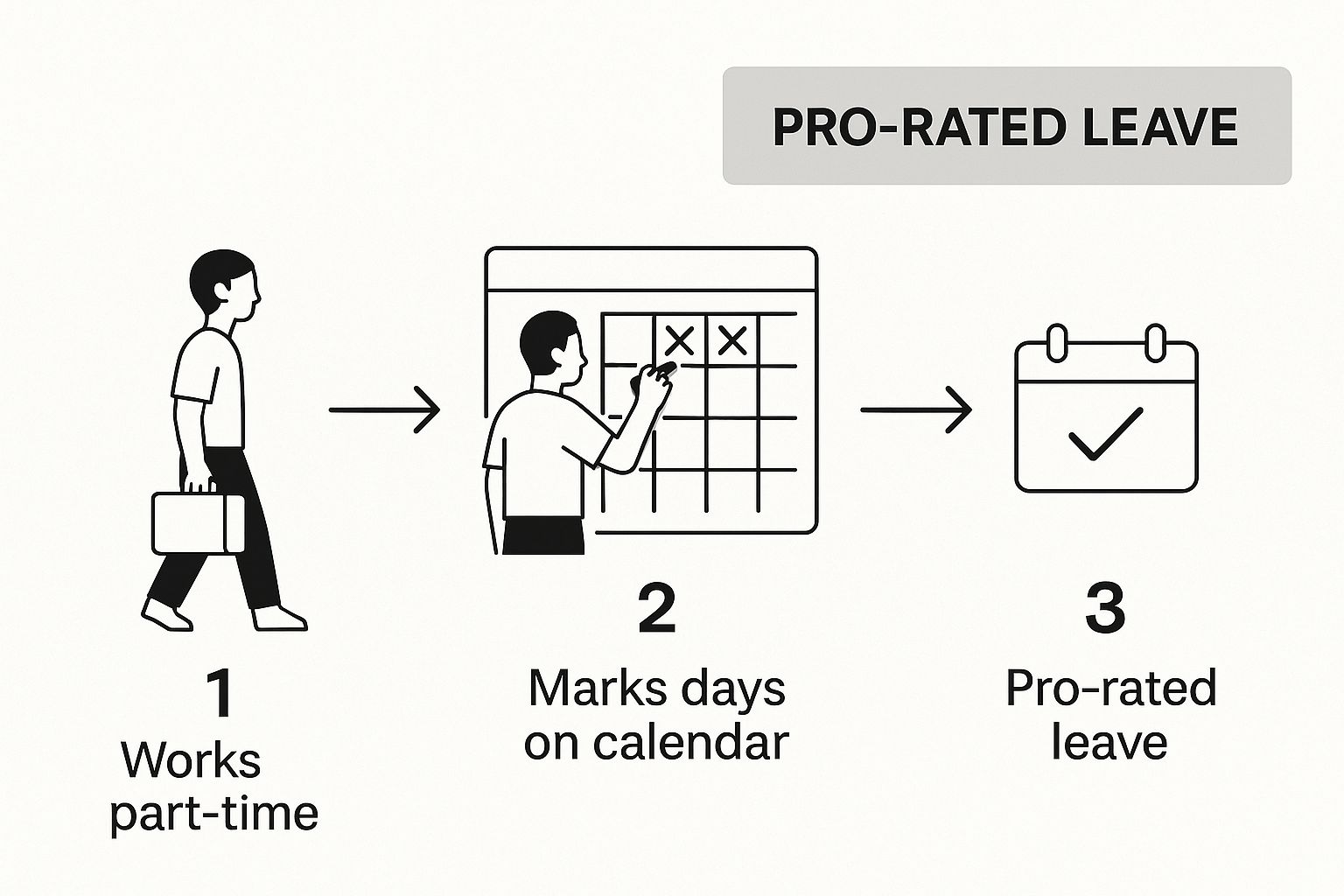
As you can see, as working days are logged, a proportional amount of leave is earned. This makes sure part-time and casual staff receive their fair share.
The 12.07 Percent Method Explained
So, where on earth does 12.07% come from? It's simpler than it looks.
A standard working year has 52 weeks. The statutory holiday entitlement is 5.6 weeks. This means the remaining part of the year you are actually working is 46.4 weeks (that’s 52 minus 5.6).
To get the percentage, you just divide the holiday weeks by the working weeks:
- 5.6 weeks ÷ 46.4 weeks = 0.12068…
When you round that up, you get 12.07%. For every hour you work, you earn just over seven minutes of paid holiday.
Let's put this into a real-world scenario. Imagine you're a delivery driver on a zero-hours contract and you worked 80 hours last month.
- Calculation: 80 hours × 12.07% = 9.65 hours of paid holiday accrued.
This method gives you a clear and consistent way to work out your holiday entitlement, no matter how much your hours might fluctuate from one month to the next.
What About Rolled-Up Holiday Pay?
You might also come across something called rolled-up holiday pay. This is where your holiday pay is included in your hourly rate instead of being paid out when you actually take time off.
Historically, this practice was a bit of a grey area and generally discouraged. However, recent legal updates have made it permissible for irregular-hours and part-year workers, but only under specific conditions.
If your employer uses this method, your payslip must clearly show the holiday pay element as a separate figure from your basic pay. If it doesn't, they might not be compliant. Understanding the specific rules around your holiday entitlement on a zero-hours contract is crucial to making sure you're being paid correctly.
Key Takeaway: For irregular hours, your holiday entitlement isn't a fixed number of days—it's something you earn as you work. The 12.07% accrual rate is the standard method for calculating this fairly. Always check your payslip to understand how your holiday pay is being handled.
Common Holiday Pay Mistakes and How to Avoid Them
Getting your head around holiday entitlement rules is the first hurdle, but even with the best intentions, mistakes can happen. It’s surprisingly easy to get it wrong. We often see slip-ups with common situations, like figuring out leave for new starters or leavers, or when contracts are a bit fuzzy about bank holidays.
These miscalculations can mean staff are accidentally short-changed, which is a compliance headache no employer wants. A classic error is getting the pro-rata leave wrong for someone who joins or leaves part-way through the year. Another regular tripwire is assuming bank holidays are automatically paid days off on top of the statutory minimum, especially when the contract doesn't explicitly say so.
The Bank Holiday Contract Trap
One of the biggest areas where things go wrong is how employment contracts handle bank holidays. This gets particularly messy when a company’s holiday year doesn't run from January to December. A contract that simply states entitlement as '20 days plus bank holidays' can be a real minefield.
Take 2024, for example. Employers with a holiday year starting between late March and mid-April faced a tricky situation. Because of how Easter fell, there were fewer than the usual eight bank holidays in that specific 12-month window. This meant employees on those contracts might have only received 26 or 27 days of total leave, dipping below the legal minimum of 28 days. You can find more detail on these specific bank holiday entitlement rules on brabners.com.
Key Takeaway: Vague wording in a contract is a massive risk. To stay compliant and avoid accidental underpayment, always specify a total number of days, like "28 days, inclusive of bank holidays." This simple change guarantees you’re covered, no matter how the dates fall.
If you think there might be a mistake in your own holiday pay, the first thing to do is grab your employment contract and read it carefully. Compare what it says with your payslips and the calculations we've walked through.
Still feel like something isn't adding up? The next step is to raise it with your manager or HR. It really helps to have your own calculations written down clearly—it makes explaining your concerns much more straightforward.
Right, so you know how to calculate your team's holiday entitlement. That's the first hurdle cleared. But honestly, the real challenge is managing it effectively throughout the year.
Without a crystal-clear company policy, you're setting yourself up for headaches. It's the only way to avoid confusion and make sure everyone knows the drill for booking time off. If you don't have one, things can get chaotic and frankly, a bit unfair, very quickly.
For smaller teams, a shared spreadsheet can do the job. It’s basic, but it gives everyone a bit of visibility. The problem is, as soon as you grow or things get busy, manual errors creep in. That’s why dedicated HR software like LeaveWizard is a game-changer. It handles all the fiddly calculations and approvals automatically, giving you a live, accurate picture of who's off and when.
Prioritise Taking Your Breaks
It's so easy for employees to let their holiday days pile up, but we all know that taking regular time off is absolutely vital for preventing burnout and keeping everyone on their A-game. Unfortunately, it seems like UK workers are taking less and less leave.
Data from over 3,000 companies paints a pretty stark picture: there was a 7.67% drop in total leave taken from 2022 to 2023. Look back to 2020, and the decline is even steeper, showing an almost 12% decrease in holidays taken. You can dig into more of these insights in the UK annual leave report on peoplehr.com.
This isn't just a statistic; it's a warning sign. It really underscores the need to proactively schedule breaks throughout the year. Don't wait until you're running on empty. Planning holidays well in advance ensures you get that much-needed restorative rest you've earned. By managing time off properly, you're not just ticking a box—you're building a healthier work-life balance and a more positive culture for the whole team.
For a deeper dive into the specific rules and regulations, check out our complete guide on annual leave entitlement. It’s a great resource for clearing up any lingering questions about allowances and how to manage them.
Your Holiday Entitlement Questions Answered
Once you've got the basic calculations down, you'll probably find a few specific "what if" scenarios pop into your head. It's completely normal. Let's tackle some of the most common questions we hear about annual leave to help you handle those unique situations with confidence.
What Happens if I Leave My Job?
When an employee moves on, you're legally required to pay them for any statutory holiday they've built up but haven't used. This is calculated right up to their very last day.
The usual method is to take their total annual entitlement, divide it by 12, and then multiply that figure by the number of full months they've worked in that holiday year.
On the flip side, what if they've taken more leave than they've actually earned? You might be able to deduct this from their final pay packet. But, and this is a big but, you can only do this if it’s clearly stated as a possibility in their employment contract. Always check the contract first.
Can My Employer Tell Me When to Take Holiday?
In short, yes. An employer has the right to dictate when an employee takes their leave. This is most common during company-wide shutdowns, like the period between Christmas and New Year.
However, they can't just drop it on you at the last minute. The law is clear: they must give you proper notice. The rule of thumb is that the notice period must be double the length of the leave they're asking you to take. So, for a week of mandatory leave, they need to let you know at least two weeks beforehand.
Key Insight: Don't forget that statutory holiday entitlement continues to build up (accrue) as normal throughout any maternity, paternity, adoption, or shared parental leave. Many people find it useful to take this accrued holiday either right before their parental leave starts or by tacking it onto the end before they officially return to work.
Are Bank Holidays Always Paid Extra?
This is a common point of confusion, but there’s actually no automatic legal right for employees to get paid leave specifically for bank holidays. It all comes down to what's in the employment contract.
Your contract should spell out whether bank holidays are included as part of your statutory 5.6 weeks of annual leave, or if they are given as extra paid days off on top of that. If the wording is a bit vague, the best thing to do is get clarification from your HR department to avoid any misunderstandings.


