
Calculating a prorated salary is actually pretty straightforward. You just figure out an employee's daily or hourly pay rate based on their full-time salary, then multiply that by the number of days or hours they were actually on the clock during that pay period. This simple calculation is all about ensuring fair pay for partial work periods, like when someone joins the team mid-month.
Why Prorated Salary Matters in the UK

Ever started a new job on the 10th of the month, or maybe switched from full-time to part-time hours and wondered how your first payslip would be worked out? If so, you've come face-to-face with a prorated salary. The term 'pro rata' is just a fancy way of saying 'in proportion,' and it's the standard method here in the UK for making sure people are paid fairly for the exact time they've worked.
This isn't just about being a good employer; it's a crucial part of keeping your payroll accurate and helping your team make sense of their payslips. Having a clear, consistent way of handling these calculations is vital for complying with UK employment standards and, just as importantly, for building trust with your people.
Common Scenarios Requiring Proration
Knowing when to prorate a salary is the first step. This calculation pops up in a few very common situations, and getting it right from the start saves a lot of payroll headaches and keeps everything transparent.
You'll typically need to get the calculator out in these cases:
- New hires starting mid-way through a pay period. It makes sense, right? An employee who begins on the 15th of the month shouldn't receive a full month's salary.
- Employees leaving before the end of a pay period. Much like new starters, their final pay packet needs to reflect only the days they actually worked.
- A change in working hours. When a full-time employee transitions to a part-time schedule, their salary is adjusted proportionally to match their new hours.
- Periods of unpaid leave. If an employee takes some unpaid time off, their salary for that particular month needs to be reduced to account for it.
A transparent prorating policy is fundamental to fair pay. It demonstrates to employees that their compensation is directly and accurately tied to their contribution, which is a cornerstone of a healthy employer-employee relationship.
Ultimately, mastering how to calculate a prorated salary is a non-negotiable skill for any HR manager or small business owner. It ensures fairness, keeps you compliant with employment expectations, and supports clean financial management. Without a reliable method, you're opening the door to payment disputes and a whole lot of admin confusion.
Calculating Pay Using the Hourly Rate Method
When you're dealing with roles that have fluctuating hours, or you need to sort out a final payslip, the hourly rate method is your best friend for getting the numbers spot on.
The whole idea is to take an annual salary and boil it down to a simple hourly figure. This makes sure that an employee's pay is tied directly to the time they've actually been on the clock. It's a straightforward approach that fits perfectly with UK payroll practices and keeps things fair for everyone.
Working Out the Hourly Rate
First things first, you need to figure out the employee's total annual working hours. Let's say you have someone on a standard full-time contract of 37.5 hours per week. To get the annual total, you just need to multiply this by the 52 weeks in a year.
- Calculation: 37.5 hours/week × 52 weeks = 1,950 annual hours
This number, 1,950 hours, is the bedrock of all your subsequent calculations for that employee.
With the total annual hours sorted, calculating the specific hourly rate is simple. Just divide their gross annual salary by the total annual hours you've just worked out.
Let's run through a quick, real-world scenario. Imagine an employee has an annual salary of £30,000 and works the 1,950 hours we established above.
- Formula: Annual Salary ÷ Annual Hours = Hourly Rate
- Example: £30,000 ÷ 1,950 hours = £15.38 per hour (rounded)
This hourly rate is the key to accurately prorating their pay for any given period, no matter how irregular.
Once you have the hourly rate, you can confidently calculate pay for any partial period. Whether it’s for a new starter's first week or a leaver's final few days, you just multiply the rate by the exact number of hours they worked. Simple.
This method is so common in the UK because it creates a transparent link between an annual salary figure and the actual work someone puts in.
For example, if an employee contracted for 35 hours a week earns £30,000 annually (working 1,820 hours a year), their hourly rate is about £16.48. If they work 130 hours in a particular month, their prorated salary would be £2,142.40 before tax. It's an essential tool for ensuring fairness when dealing with part-time schedules, leave, or partial months. You can find more practical insights on pro rata salary calculations on Indeed UK.
Using the Daily Rate Method for Partial Months
When someone joins or leaves the team partway through a month, you need a fair and straightforward way to calculate their pay. This is where the daily rate method comes in. It’s a really clear approach that focuses on the actual number of working days in that specific month to figure out what they’re owed.
The logic is simple. You start with the employee's standard monthly salary. Then, divide that figure by the total number of working days in that particular month to get a daily pay rate. All that's left is to multiply this daily rate by the number of days the person actually worked.
This handy visual breaks down how an annual salary gets converted into shorter pay periods.
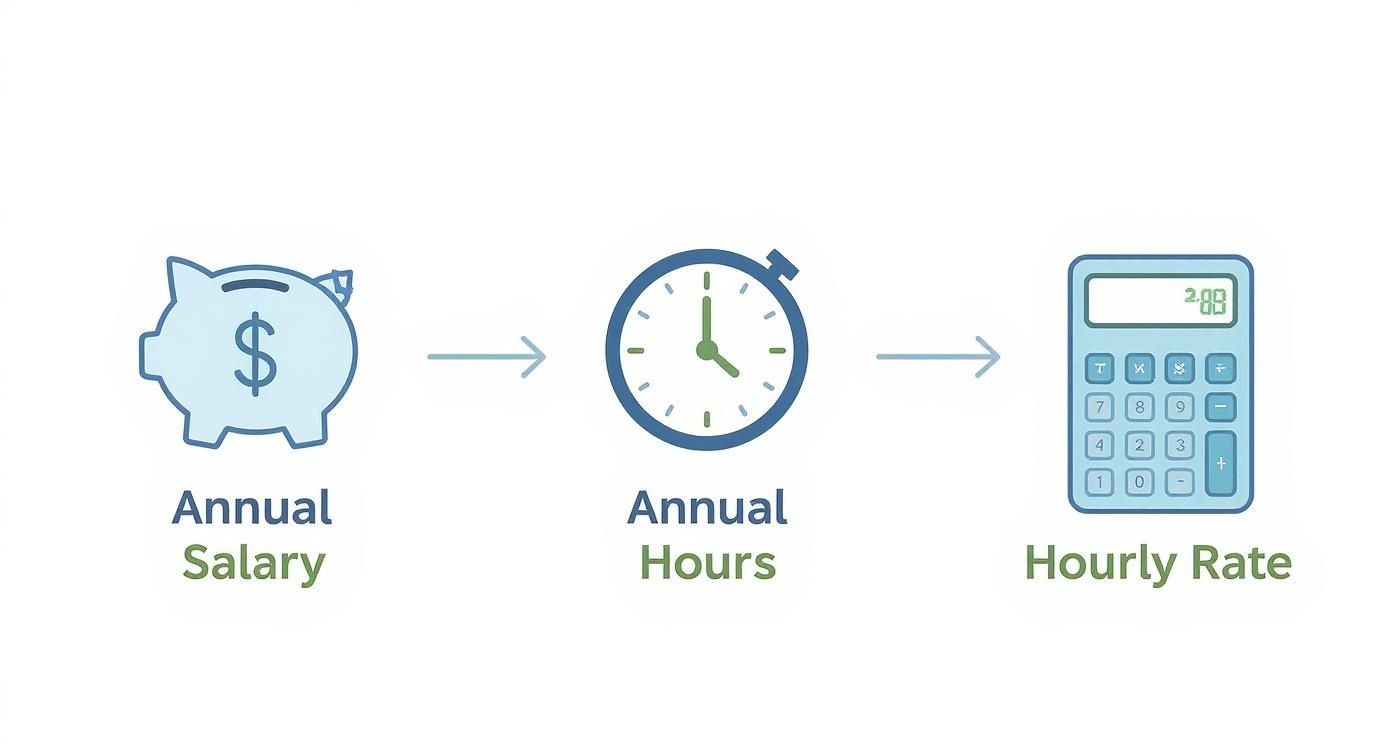
Understanding how to move from an annual salary down to a daily or even hourly rate is the bedrock of getting these partial-period payments right every time.
Putting the Daily Rate Method into Practice
Let’s walk through a common scenario. Imagine a new full-time employee joins with an annual salary of £48,000, which works out to be £4,000 a month.
They start mid-way through their first month. In this particular month, there are 20 possible working days, but because of their start date, they only end up working for 10 of them.
The calculation here is just a simple fraction of their monthly pay. They worked 10 out of the 20 available days, which is exactly half the month. So, their prorated salary for that first month would be £2,000 (10/20 × £4,000).
This fraction-based approach is one of the most common ways to handle these calculations in the UK. It’s seen as fair, accurate, and easy to understand.
One of the biggest questions that comes up is whether to use calendar days or working days. Most UK employers lean towards working days, as it more accurately reflects the employee's contract. The most important thing is to pick a method and stick with it. Consistency is key.
Having a clear, documented company policy on this prevents any confusion or disputes down the line and keeps everything transparent. If you need a hand figuring out the precise number of workdays in any given month, this guide on how many working days are in a month can be a real lifesaver.
How To Calculate Salary For Part-Time Employees

Working out salaries for part-time staff is a bread-and-butter task for any UK business, and getting it right is all about proportionality. The trick is to benchmark their role against its full-time equivalent to ensure the pay is fair and equitable. This is where the concept of Full-Time Equivalent (FTE) comes into play.
Essentially, an FTE represents the hours of one full-time employee. By comparing a part-timer's hours to this benchmark, you can accurately figure out their prorated salary. It’s a straightforward way to make sure they're paid at the same rate as a full-time colleague for the hours they put in.
A Practical Part-Time Salary Calculation
Let's walk through this with a real-world example. Imagine a full-time role at your company has a standard work week of 37.5 hours and an annual salary of £35,000. You then hire a new team member to fill this role on a part-time basis, working 20 hours per week.
Here’s how you’d calculate their pay:
-
First, you need to find out what percentage of the full-time hours they're working.
- (Part-Time Hours ÷ Full-Time Hours) × 100
- (20 ÷ 37.5) × 100 = 53.33%
-
Next, just apply this percentage to the full-time salary to find the prorated amount.
- Full-Time Salary × FTE Percentage
- £35,000 × 0.5333 = £18,665.50
And there you have it. The employee's correct prorated annual salary is £18,665.50.
This method guarantees you’re in line with UK laws on part-time worker rights, which clearly state they must not be treated less favourably than their full-time counterparts. It all comes down to fairness, transparency, and consistency.
This approach is so widely used across the UK because it transparently links a part-time salary to its full-time benchmark. As the team at PurpleCV UK points out, this method makes it much simpler to convert full-time salaries into part-time equivalents, which is vital for managing different work schedules while maintaining pay equity.
Of course, when setting pay for any employee, it's also crucial to consider the latest new minimum wage regulations to ensure you're fully compliant. And remember, prorating a salary also affects things like holiday entitlement. Our handy holiday calculator for part-time workers can help simplify those calculations for you.
Common Mistakes to Avoid in Salary Calculations
Prorated salary calculations seem straightforward at first glance, but it's surprising how easily small slip-ups can lead to payroll errors and confused employees. One of the most common mistakes I've seen is simply miscounting the number of working days in a particular month. For example, a daily rate calculation for February will be quite different from one for August, and getting this wrong throws everything else off.
Another frequent pitfall is forgetting to factor in bank holidays when you're tallying up the total working days. If a bank holiday falls within an employee's partial work period, you should almost always treat it as a paid day. Overlooking this is a quick way to underpay someone and damage trust.
Inconsistent Policies and Calculation Methods
Applying the wrong Full-Time Equivalent (FTE) percentage for part-time staff is another slip-up that can have serious financial knock-on effects. Always take a moment to double-check that the hours used for the FTE calculation are spot on and match the employee’s contract. It’s the only way to ensure their pay is both fair and compliant.
The real key to dodging these headaches is to establish a clear, company-wide policy for proration. Get it down in writing whether you use working days or calendar days, and then apply that method consistently for every single employee, every single time. Consistency is your best defence against payroll disputes.
If you’re finding all this a bit complex, especially as a smaller business, it might be worth exploring the many payroll outsourcing benefits to take these calculations off your plate.
Finally, never underestimate the power of good communication. A simple calculation can quickly escalate into a major issue if you can't explain it clearly. Always be ready to walk an employee through how their pay was worked out. A transparent, open approach shows you're being fair and gives your team confidence that their pay is being handled professionally and correctly.
Answering Your Questions About Prorated Pay
Digging into prorated pay often brings up a few tricky questions, especially when you throw real-world curveballs like bank holidays and pension contributions into the mix. Getting these details right is key for everyone involved—it gives employers and employees confidence that pay is being handled fairly.
Let's walk through some of the most common queries that pop up.
How Do Bank Holidays Affect Prorated Pay?
This is a big one. For part-time staff, bank holiday entitlement is almost always worked out on a pro rata basis. Simple enough. If a bank holiday lands on a day you'd normally work, you're entitled to that day off with pay. If it falls on a non-working day, it's down to company policy whether you get a day off in lieu.
For anyone starting or leaving part-way through a month, any bank holidays that fall within your employment period are typically counted as paid working days when calculating your salary.
The guiding principle here is that an employee shouldn't lose out because of a public holiday. The absolute key is to be consistent in how you handle these days for everyone across the business.
Pensions and Prorated Earnings
Another vital area is how all this affects pension contributions. It's actually quite straightforward: your contributions, and your employer's, are based on your actual earnings for that pay period—not what your full-time salary would have been.
This means if your salary is prorated for a particular month, your pension contributions will be proportionally lower too. It’s a direct link:
- Prorated Salary: The actual gross pay you receive.
- Pension Contribution: A set percentage of that prorated salary.
This system ensures your contributions always line up perfectly with what you’ve actually earned.
So, is there one single, legally correct way to calculate prorated pay in the UK? In short, no. There isn't a government-mandated formula. The most important things are fairness and consistency. As long as the method you choose is logical, applied the same way for everyone, and clearly documented, it's generally considered perfectly acceptable. Using one of the best payroll software for small business is a great way to lock in that consistency.


