
On average, you're looking at between 20 and 22 working days in a typical UK month, assuming a standard Monday-to-Friday workweek. Of course, this number isn't set in stone; it shifts around depending on the length of the month, how many weekend days fall within it, and any pesky bank holidays.
Your Quick Guide to UK Monthly Working Days

Getting a firm handle on the exact number of working days in any given month is crucial. It’s the bedrock of accurate payroll, sensible project planning, and fair holiday entitlement management.
In the UK, this figure can vary quite a bit. It’s not just about the number of days in the month; it’s also about where the public holidays land. And remember, bank holidays aren't the same across England, Scotland, Wales, and Northern Ireland, which adds another layer to the calculation.
Think of this as your starting point—a baseline for setting realistic project deadlines and making sure your team is paid correctly. If you want to zoom out for a bigger picture, you can also check out our guide on how many working days are in a year.
To give you a head start, I've put together a simple table that breaks down the average working days for each month in the UK.
Average UK Working Days Per Month At a Glance
Here’s a quick reference table showing the typical number of working days for each month, after accounting for weekends and UK bank holidays.
| Month | Total Days | Average Weekends | UK Bank Holidays | Average Working Days |
|---|---|---|---|---|
| January | 31 | 8-9 | 1 | 21-22 |
| February | 28/29 | 8 | 0 | 20 (21 in a leap year) |
| March | 31 | 8-9 | 0-1 | 22-23 |
| April | 30 | 8-9 | 1-2 | 20-21 |
| May | 31 | 8-9 | 2 | 20-21 |
| June | 30 | 8-9 | 0 | 21-22 |
| July | 31 | 8-9 | 0-1 | 22-23 |
| August | 31 | 8-9 | 1 | 21-22 |
| September | 30 | 8-9 | 0 | 21-22 |
| October | 31 | 8-9 | 0 | 22-23 |
| November | 30 | 8-9 | 0-1 | 21-22 |
| December | 31 | 8-9 | 2 | 20-21 |
Keep in mind these are averages. The exact number can shift slightly year to year based on which day of the week a month starts and where the bank holidays fall. It's always best to check the specific calendar for the year you're planning for.
Why Accurate Working Day Counts Matter

It might seem like a small admin task, but getting the number of working days in a month spot-on is the bedrock of good business management. This simple figure has a surprising ripple effect across your entire organisation, touching everything from your financial health to your team's morale.
Getting the count right is absolutely crucial for running payroll correctly. A slight miscalculation can easily lead to staff being underpaid or overpaid, causing frustration and opening the door to serious compliance issues. The legal ramifications can be severe; for a sense of how seriously this is taken elsewhere, look at the recent wage theft legislation in New Zealand.
More Than Just Payroll
But this isn't just about paying your people fairly. The number of working days directly impacts your resource planning and project management. An incorrect estimate can spawn unrealistic deadlines, overburdened teams, and projects that are doomed to fall behind schedule. When you know exactly what your available workdays are, you can set achievable goals and allocate your resources much more effectively.
An accurate working day count prevents costly errors and ensures projects stay on track. It is a small calculation with a massive impact on your business's financial health and operational efficiency.
Finally, this number is a lynchpin for managing holiday entitlement and other types of leave. Without a solid baseline, it's impossible to accurately track annual leave allowances. This can easily spiral into disputes and administrative headaches down the line. It really is a foundational piece of the workforce management puzzle.
The Manual Method for Calculating Working Days
While spreadsheets and software are fantastic tools, sometimes you just need a quick, no-fuss answer. Getting the hang of the manual method is a great skill to have. It not only helps you understand the logic behind the numbers but is also perfect for those one-off calculations where firing up a new file feels like overkill.
The process itself is pretty straightforward, really. All you need is a calendar and some simple subtraction. You just start with the total number of days in the month you’re looking at and then work your way backwards, removing the days that aren't typical workdays.
Identifying Non-Working Days
First up, you need to pull out all the weekend days—the Saturdays and Sundays. An easy way to do this is to count how many full weeks are in the month, multiply that by two, and then add on any extra weekend days that might fall at the beginning or end of the month.
The next step is to account for any public holidays. This is where having a UK-specific calendar comes in handy, as bank holidays can shift around. For instance, May often has two bank holidays here in the UK—the Early May Bank Holiday and the Spring Bank Holiday—which will definitely knock a couple of days off the month's working day total.
This simple process flow visualises how to calculate the number of working days in a month.
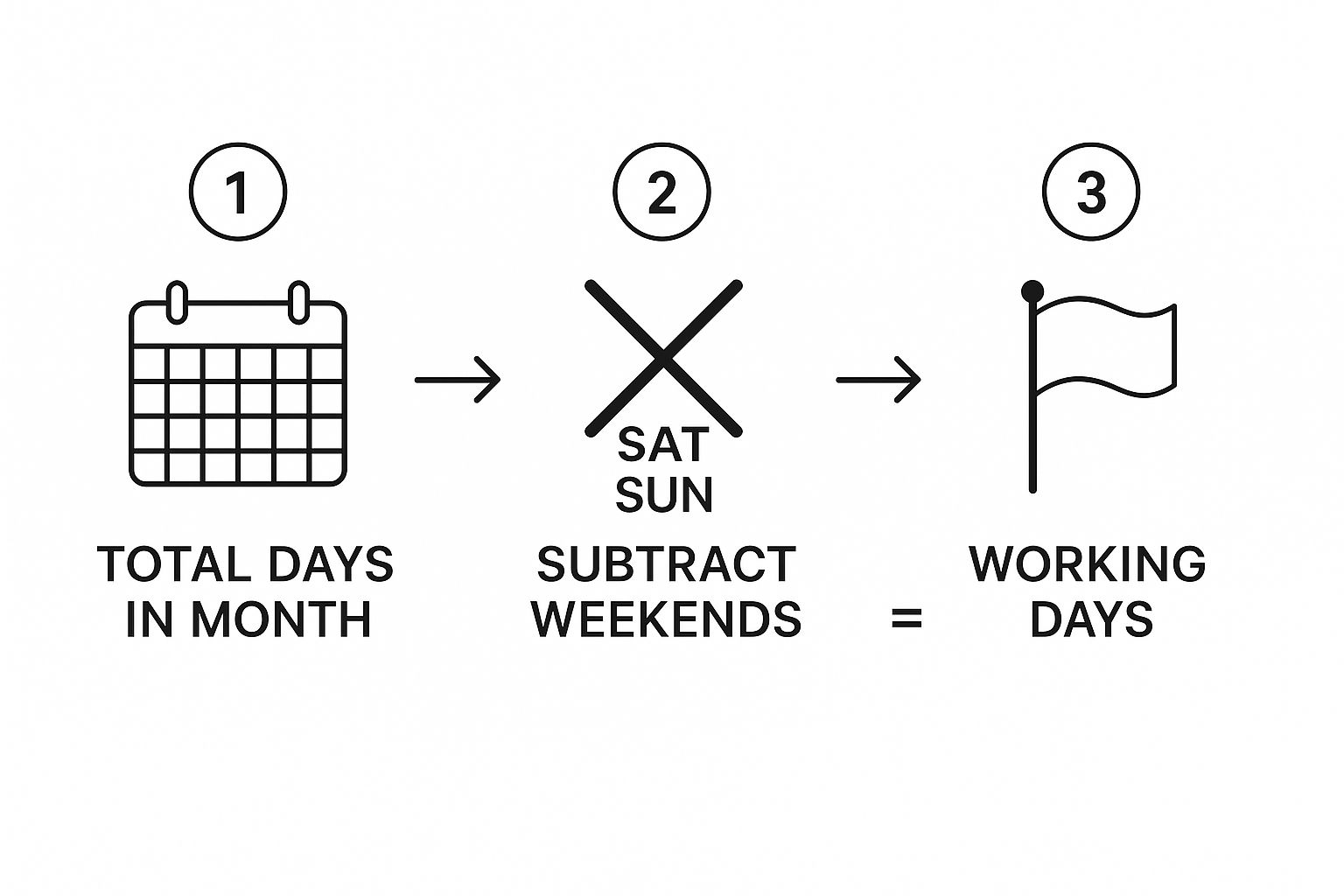
As the infographic shows, it’s basically a three-stage filtering process: start with the total number of days, take away the weekends, and then subtract any holidays to get your final count.
A Practical Example for May
Let's walk through a real-world scenario. Say we’re looking at May, which has 31 days.
- Total Days: You start with the full 31.
- Subtract Weekends: A quick glance at the calendar will show you there are usually nine weekend days (four full weekends plus an extra Saturday or Sunday). So, that’s 31 – 9 = 22.
- Subtract UK Bank Holidays: May typically includes two bank holidays. This brings the count down again: 22 – 2 = 20 working days.
This hands-on approach is more than just a party trick for quick checks. It builds a solid understanding that makes it much easier to spot potential errors in automated systems. It also means you can confidently answer the question of how many working days are in a month, no matter the situation.
Automating Calculations with Excel Formulas
Counting days on a calendar is fine for a quick, one-off check. But when you're deep in project planning or sorting out payroll, you need something more reliable and repeatable. This is exactly where a simple spreadsheet programme like Excel comes into its own, turning a tedious manual task into a formula that works in seconds.
Excel has two powerhouse functions built for this very job: NETWORKDAYS and NETWORKDAYS.INTL. They might sound almost identical, but they're designed for slightly different situations. Knowing which one to grab is the key to getting the right number every single time.
For most businesses running on a standard Monday-to-Friday workweek, the classic NETWORKDAYS function is your go-to. It’s built to automatically exclude Saturdays and Sundays from any calculation.
The Standard Approach with NETWORKDAYS
The formula itself is refreshingly simple. In its most basic form, it just needs a start date and an end date to work its magic.
For instance, if you wanted to find out the number of working days in April 2024, you’d just type this into a cell:=NETWORKDAYS("2024-04-01", "2024-04-30")
This little formula looks at the start date (1st April) and the end date (30th April) and spits out the total number of weekdays in between. It's a massive improvement on circling dates with a pen, but it has one crucial blind spot: it doesn't know about UK bank holidays.
To get a truly accurate count, you need to use an optional part of the formula: a list of holidays you want it to exclude.
Let's say you're planning work for December 2024. You'd first list out the bank holiday dates somewhere in your spreadsheet – maybe in cells F2 and F3 for Christmas Day and Boxing Day. Your formula would then look like this:=NETWORKDAYS("2024-12-01", "2024-12-31", F2:F3)
Now you're telling Excel to count the weekdays but also subtract any dates that show up in your holiday list. The result is a precise working day count you can rely on. For a more detailed walkthrough, have a look at our guide to building a complete Excel holiday tracker.
Handling Non-Standard Workweeks with NETWORKDAYS.INTL
But what if your team doesn't stick to the Monday-to-Friday grind? That's where NETWORKDAYS.INTL proves its worth. It gives you the flexibility to define which days of the week are actually weekends for your business.
This version of the formula has an extra argument that lets you specify the weekend pattern. For example, if your business runs from Tuesday to Saturday, meaning Sunday and Monday are your 'weekend', you’d use the number 2 for that weekend argument.
=NETWORKDAYS.INTL("2024-04-01", "2024-04-30", 2, F2:F3)
This level of customisation is essential for anyone in retail, hospitality, or any other industry that doesn’t follow a typical 9-to-5 office schedule. Getting this detail right is important. After all, the average full-time UK employee works around 35.9 hours per week, which translates to anywhere between 20 to 25 working days a month depending on these very factors.
Beyond the Calendar: What Really Influences Work Days

If only it were as easy as just subtracting weekends and bank holidays. That initial calculation gives you the number of potential working days in a month, but for accurate resource planning and payroll, you have to dig deeper. The real story lies in the factors that turn those potential days into actual, productive ones.
The biggest variable, by far, is employee absenteeism. This isn't just about calling in sick; it covers all forms of planned leave, like annual holidays, personal days, and compassionate leave. Every approved holiday request is a direct reduction in your available workforce for that day.
The Impact of Unplanned Absence
Unplanned absences, usually due to sickness, throw an even bigger spanner in the works because you just can't see them coming. A sudden illness can completely derail project timelines and pile unexpected pressure onto the rest of the team, hitting your overall monthly output.
And the scale of this isn't trivial. In the 2023/24 period, around 33.7 million working days were lost in Great Britain due to work-related ill health. You can find more data on this from the Health and Safety Executive.
It's vital to separate potential workdays from actual ones. A month might have 22 working days on paper, but once you factor in leave and sickness across your whole team, the true number of productive days is always going to be lower.
Differentiating for Different Contracts
This all gets even more complicated when you're dealing with varied employment contracts. Part-time employees, for example, have a different baseline of working days right from the start.
Then there's the challenge of managing leave for staff on atypical contracts, which needs very careful handling. Our guide on holiday entitlement on zero-hours contracts offers some specific advice if this is something you're navigating.
Understanding these nuances is what takes you from a basic calendar count to a realistic grip on your team’s capacity. It helps you forecast more accurately and avoid the common mistake of overestimating how much work can truly get done in any given month.
Common Questions About UK Working Days
Even once you've got the formulas and manual methods down, real-world situations can still throw a spanner in the works. Every business is unique, and things like part-time contracts or regional bank holidays can easily complicate what seems like a simple calculation. Let's clear up some of the most common queries that pop up for UK businesses.
One of the biggest questions we hear is about part-time employees. How do you accurately calculate their working days for payroll or holiday entitlement without getting it wrong?
The key is to ditch the standard five-day-a-week mindset and focus entirely on their specific contracted days. For instance, if someone works every Monday, Tuesday, and Wednesday, that's their "working week". It means they have three working days each week, which averages out to around 12-13 working days a month, no matter what the full-time count is.
How Do Regional Bank Holidays Affect the Count?
Another regular source of confusion is the different bank holidays across the UK. While England, Wales, Scotland, and Northern Ireland share many, Scotland and Northern Ireland have their own unique dates that the others don't observe.
This is absolutely critical for companies with staff spread across the country. You can't just apply a single, England-centric holiday calendar and expect it to work for everyone.
- Scotland: Often has an extra bank holiday in early August and celebrates St. Andrew's Day.
- Northern Ireland: Observes St. Patrick's Day and the Anniversary of the Battle of the Boyne.
When you’re calculating the working days for any given month, you have to use the holiday calendar that's relevant to each employee's primary work location. It's the only way to ensure accuracy and fairness.
For businesses with staff across different UK nations, applying the correct regional bank holidays is not just good practice—it's a legal requirement for accurate pay and leave calculations. A one-size-fits-all approach will inevitably lead to errors.
What About Leap Years?
Leap years add a small but important wrinkle to your annual calculations. Every four years, February gets an extra day, bumping it up from 28 to 29 days.
If 29th February falls on a weekday—as it did in 2024 (a Thursday)—it adds one extra working day to that month. This simple change shifts February's typical working day count from 20 to 21. It might only affect one month, but that extra day impacts annual totals for payroll, project planning, and resource forecasting, so it’s essential not to overlook it.


