
You might think there are 52 weeks in a year, and you'd be right—on paper. But for a typical full-time employee here in the UK, the reality on the ground is closer to 46 or 47 weeks of actual work. That gap isn't just a minor detail; it’s the difference between realistic planning and setting your team up for failure. This crucial difference comes down to factoring in statutory annual leave and public bank holidays.
The Real Number of UK Working Weeks
Thinking about working weeks is a bit like looking at a company's finances. The 52.14 weeks in a standard year is your gross revenue—the big, impressive number. But what every business owner, project manager, and team leader really needs is the net profit—the actual time your team is available to get things done.
Getting this wrong is a recipe for disaster. It can lead to impossible project deadlines, messy scheduling conflicts, and, worst of all, a burnt-out team.
From Gross to Net Working Weeks
So, how do we get to the real number? Simple: we have to account for time off. In the UK, a full-time employee is entitled to a minimum of 28 days of paid annual leave. This often includes the bank holidays we all look forward to. This isn't just a perk; it's a legal requirement and absolutely essential for employee well-being.
By subtracting this leave, you shift from a theoretical calendar view to a practical, operational one. This simple adjustment is the first step towards accurate capacity planning and realistic goal-setting for your business.
Once you make this calculation, a much more realistic picture of your workforce's availability emerges. It's why, after all the deductions are made, the average number of working weeks is significantly lower than what the calendar says. If you're curious about how this calculation changes for different situations, you can dive deeper in our guide on calculating the working days in a year.
A Clear Breakdown of the Numbers
Let's walk through how those 52 weeks shrink down to the effective working time for a standard full-time employee. It’s a straightforward but vital piece of maths for any manager.
From Calendar Weeks to Actual Working Weeks
This table shows how the total weeks in a year are reduced by statutory leave and bank holidays to arrive at the effective number of working weeks.
| Component | Number of Days | Equivalent Weeks (at 5 days/week) |
|---|---|---|
| Total Days in a Year | 365 days | 52.14 weeks |
| Statutory Annual Leave | -28 days | -5.6 weeks |
| Effective Working Weeks | ~46.5 weeks |
As you can see, a full-time employee is productive for roughly 46.5 weeks, not 52. For anyone managing a small business, this isn't just a statistic—it's a core metric for running your operations smoothly and keeping your plans grounded in reality.
Calculating Your True Number of Working Weeks
Trying to pin down the exact number of working weeks in a year can feel a bit like guesswork, but it really just boils down to a simple, repeatable formula. Think of it less like a complex accounting task and more like following a recipe. Getting this number right is the key to shifting from a vague calendar view to a precise, operational one for your business.
At its heart, the calculation is all about subtraction. You simply start with the total number of weeks in a year and then take away all the time your team isn't expected to be working.
(Total Weeks in a Year) – (Annual Leave Weeks) – (Bank Holiday Weeks) = Effective Working Weeks
This straightforward formula is your foundation for accurate project planning, setting realistic deadlines, and allocating resources fairly across your team.
A Step-by-Step Calculation Example
Let's walk through this with a real-world example: a standard full-time employee in the UK who gets the statutory minimum leave.
- Start with the total weeks: A normal year has 365 days, which works out to be 52.14 weeks.
- Calculate total leave in days: The UK statutory minimum for paid leave is 28 days.
- Convert leave days into weeks: Now, divide those leave days by the number of working days in a week (which is typically five). So, 28 days ÷ 5 = 5.6 weeks of leave.
- Subtract leave from total weeks: Finally, 52.14 weeks – 5.6 weeks = 46.54 working weeks.
So, when you account for statutory time off, a typical full-time employee is productive for around 46.5 working weeks a year, not 52.
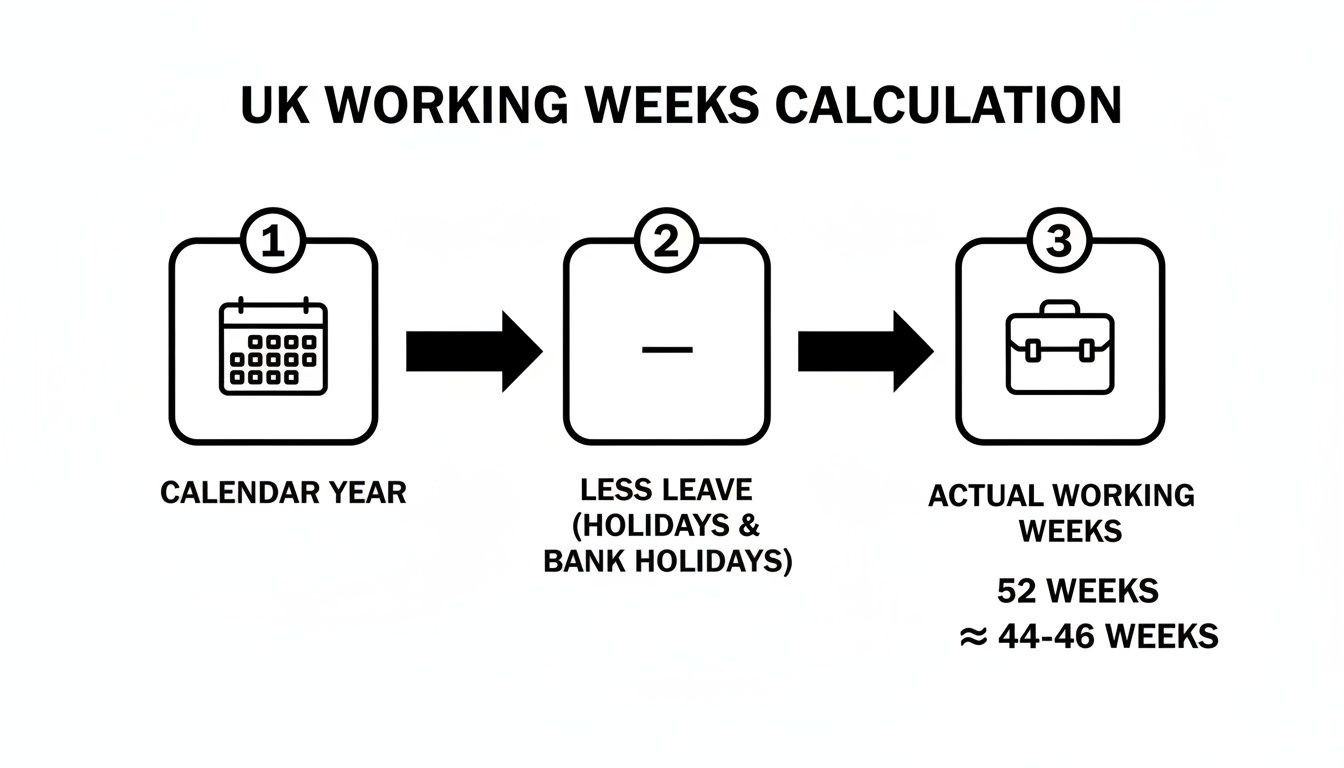
This little bit of maths shows that once you deduct leave, the actual time available for work is quite a bit less than the 52 weeks you start with. It's a crucial distinction for any manager.
Accounting for Leap Years
Don't forget about leap years! Every four years, we get an extra day, bringing the total to 366 days. This small bump adjusts our starting point to approximately 52.28 weeks.
It might not seem like a huge difference, but for businesses that depend on hourly billing or have razor-thin project schedules, that extra day absolutely matters. Factoring it in ensures your forecasts and plans stay sharp and accurate, year after year.
This level of detail is what separates good planning from great planning. And just as it's vital to understand working weeks, it’s equally important to be able to calculate how many hours are in a work year. The two metrics together give you a complete picture of your team's capacity, giving you a powerful tool for planning, even without fancy software.
Adjusting for Part-Time and Flexible Contracts
The standard calculation for a full-time employee is a great starting point, but let’s be honest, today's workforce is rarely that straightforward. Most businesses are a vibrant mix of full-time staff, part-time experts, and flexible contractors. Trying to calculate working weeks without accounting for these differences is like trying to manage your budget using only rough estimates—it’s just not going to give you an accurate picture.
To get a real handle on your team's capacity, you need to fine-tune your calculations for each person's working arrangement. This isn't just about being fair with leave entitlement; it’s about getting a true measure of the resources you have available at any given time.
Calculating for Part-Time Employees
The most common adjustment you'll make is for part-time staff. The key principle here is pro-rata, which is just a fancy way of saying "in proportion." A part-time employee's leave is directly proportional to the hours they work compared to a full-time colleague.
Let's walk through an example. Imagine you have an employee who works three days a week instead of the standard five.
- Work out the Pro-Rata Percentage: This employee works 60% of a full-time week (3 days ÷ 5 days). Simple.
- Calculate Pro-Rata Leave: Because they work 60% of the hours, they get 60% of the leave. If your full-time allowance is 28 days, their entitlement is 16.8 days (28 days x 0.6).
- Find Their Effective Working Weeks: Their 16.8 days of leave translates to 5.6 weeks off, based on their three-day work week (16.8 ÷ 3). Subtracting this from the 52.14 calendar weeks leaves you with 46.54 working weeks.
While the final number of working weeks might look similar, their total paid days off are fewer, which correctly reflects their reduced schedule. This can get tricky, so for a deeper dive, check out our guide on holiday calculation for part-time workers.
Dealing with Zero-Hour and Flexible Contracts
Zero-hour contracts and other flexible arrangements throw a different kind of spanner in the works. For these roles, leave isn't a fixed amount at the start of the year—it builds up based on the hours they actually work.
The standard way to handle this is to calculate holiday entitlement at 12.07% of the hours worked. This figure comes from the statutory 5.6 weeks of holiday, divided by the remaining 46.4 working weeks of the year.
This method ensures that even employees with the most unpredictable schedules receive their fair, legally required paid time off.
Handling Extended Absences
Long-term absences like maternity, paternity, or extended sick leave also have a huge impact on an individual's working weeks in a given year. It's crucial to remember that employees on these types of leave continue to accrue their statutory holiday entitlement, even though they aren't actively working.
You absolutely have to track these absences separately. For accurate resource planning, you need to subtract these entire weeks of leave from your capacity forecast. Forgetting to do this can lead to overestimating your team’s availability and committing to deadlines you simply can't meet. When dealing with a mix of employment types, it's also helpful to understand what contractor management entails, as these agreements often have their own unique schedules.
To see how these different scenarios play out side-by-side, have a look at this comparison table.
Comparing Working Weeks for Different Employee Scenarios
This table breaks down how working weeks are calculated across different employment types, showing the impact of various working patterns on the final number.
| Employee Type | Annual Leave Entitlement (Weeks) | Bank Holidays (Prorated Weeks) | Effective Working Weeks |
|---|---|---|---|
| Full-Time (5 days/week) | 4.0 | 1.6 | 46.54 |
| Part-Time (3 days/week) | 2.4 (pro-rata) | 0.96 (pro-rata) | 46.54 |
| Zero-Hour Contract | Accrued based on hours worked | Included in accrual | Varies based on hours worked |
| Employee on Maternity Leave | Continues to accrue | Continues to accrue | Subtracted from annual total |
As you can see, while the effective number of working weeks can appear similar for standard full-time and part-time roles, the actual paid leave and resource availability are quite different. For roles with variable hours or long-term leave, the calculation becomes a dynamic process that needs careful tracking.
Why This Calculation Is So Important for Your Business
Figuring out the exact number of working weeks in a year might sound like a minor HR task, but it's actually one of the most foundational pieces of your entire business strategy. This single number ripples through everything from your financial forecasts to your team's morale. Get it wrong, and you could be setting budgets that are destined to fail or project timelines that were unrealistic from day one.
Think of it as the bedrock for all your operational planning. When you have a firm grip on your team's true capacity, you can build everything else with confidence.
It's the Backbone of Your Financial Planning
For anyone keeping an eye on the company's finances, this calculation is non-negotiable. Your payroll, how you allocate resources, and your annual budgets all hinge on knowing the real number of productive weeks you have. If your financial models assume 52 weeks of output from every employee, but you're only getting 46.5 after holidays and leave, your revenue projections are built on shaky ground.
This isn't just about high-level strategy; it seeps into daily decisions. Knowing the actual number of working weeks helps you price projects accurately, calculate your overheads correctly, and make smart hiring decisions that are in sync with your real operational capacity.
It Drives Efficiency and Keeps Deadlines Realistic
Project managers live and breathe deadlines. An accurate working week calculation is what separates realistic goals from wishful thinking, turning project planning into a data-driven process that your team can actually achieve without burning out.
When you can confidently map out the available work weeks, you stop that painful chain reaction of missed deadlines, disappointed clients, and a stressed-out team. This clarity is what builds a reputation for reliability and keeps your operations running smoothly.
The concept of working weeks in the UK is also closely tied to the average hours people work. Recent ONS data shows that the average weekly hours stood at 31.80 in August 2025, a figure that's held steady since the pandemic. Understanding these metrics helps you prevent overwork and stay compliant. To see how these trends are evolving, you can explore the full dataset on UK average weekly hours at Trading Economics.
It Ensures Compliance and Boosts Team Morale
Finally, getting this right is crucial for HR and legal compliance. It’s what ensures you’re following the UK's Working Time Regulations by providing the correct statutory leave. A clear, transparent approach to calculating leave and working time doesn't just keep you compliant; it builds trust.
When your staff understands how their time off is calculated and sees that the process is fair for everyone, it’s a huge boost for morale. It gets rid of any ambiguity and makes people feel they are being treated equitably—a cornerstone of any healthy, productive workplace.
How Automation Eliminates Calculation Headaches
After wrestling with the complexities of statutory leave, part-time pro-rata adjustments, and bank holidays, one thing becomes crystal clear. Trying to keep track of all these variables on a spreadsheet isn’t just time-consuming; it's a fast track to errors, compliance risks, and wasted hours you could be spending on growing your business.
Manual entry is fragile, to say the least. A simple typo, a forgotten bank holiday, or a miscalculated pro-rata entitlement can easily spiral into incorrect payroll, unfair leave distribution, and serious compliance headaches. This is exactly where a smarter, more reliable approach becomes essential.

Shifting from Manual Spreadsheets to Smart Systems
Imagine a system that already knows all the UK bank holidays, automatically works out pro-rata leave for your part-time staff, and gives you a real-time view of who is available and when. This isn't some far-off dream; it's what modern leave management tools are built to do. They transform a chaotic administrative burden into a streamlined, dependable process.
Automation acts as your safety net. It handles all the complex rules we've talked about without you ever needing to pull out a calculator or double-check a formula. This frees you and your team up to focus on strategic work, not mind-numbing number-crunching.
For small businesses, this is a powerful step forward. To get a better sense of how this can reshape your operations, you can learn more about the benefits of automating your key HR processes and reclaiming that valuable time.
Gaining Instant Clarity on Team Availability
One of the biggest wins from automation is instant visibility. Instead of trying to cross-reference spreadsheets and calendars, you get a clear, immediate answer to the most critical question: "Who is actually available to work?"
With an automated system like LeaveWizard, you can instantly see team capacity for any given week or month. This allows for smarter project planning, fairer workload distribution, and ensures you're never caught understaffed during a critical period.
This level of insight is a game-changer. It allows you to:
- Plan Projects with Confidence: Allocate resources based on real-time availability, not guesswork.
- Prevent Staff Burnout: Easily spot potential scheduling conflicts or times when too many key people are away.
- Make Data-Driven Decisions: Use accurate attendance data to forecast future staffing needs and manage your team effectively.
Ultimately, automation removes the constant headache of figuring out how many working weeks in a year each employee truly has. It replaces manual effort with accuracy, uncertainty with clarity, and administrative drag with operational efficiency, giving you the solid foundation you need for smart business planning.
How We Got the Modern British Working Week
To really get your head around the way we structure our work schedules today, it helps to glance back at just how much the idea of a ‘working week’ has changed here in the UK. We now base our year on roughly 46 to 47 working weeks, a number that’s carefully carved out by statutory leave and regulated hours. But this is a very new concept in the grand scheme of British working life.
For centuries, the thought of paid time off was pure fantasy. Work wasn't dictated by HR policies or employment law; it was driven by the seasons and the simple need to survive. This reality only intensified with the Industrial Revolution, which ushered in gruelling schedules that are almost impossible to imagine by today’s standards.
From Relentless Toil to Regulated Time
The difference between then and now is staggering. A quick dive into the history books shows just how radically working life has been reshaped over the centuries.
Take this for a spin: historical data shows that back in the 13th century, a peasant might have put in around 1,620 hours a year. Fast-forward to 1840, and the average industrial worker was clocking between 3,105 and 3,588 hours annually. That’s the equivalent of working over 70 weeks at a punishing 50-hour-a-week pace. Even as recently as 1988, a manufacturing worker was still averaging 1,856 hours per year. You can dig deeper into these historical working hour shifts over on Clockify.me.
This historical perspective hammers home a crucial point: structured time off, like annual leave and bank holidays, is a modern invention. It’s the product of hard-won labour rights and a growing appreciation for employee well-being.
This journey from non-stop work to regulated working weeks is exactly why today’s management systems are so vital. They aren't just a handy way to book holidays; they are the modern tools we need to manage legally protected rights that simply didn't exist for our ancestors. This shift reframes modern HR software not as a business luxury, but as the necessary next step in the evolution of fair and effective management.
Frequently Asked Questions
It's natural to have questions when you're wading through the details of working weeks and leave management in the UK. Let's tackle some of the most common ones that pop up for business owners and HR managers.
Do I Have to Give Part-Time Employees Paid Bank Holidays?
Absolutely. In the UK, part-time workers are legally entitled to paid bank holidays, but it's done on a pro-rata basis. This just means their entitlement is proportional to the hours they actually work.
So, if someone works three days a week, they get 3/5ths of the bank holiday allowance that a full-time employee receives. To keep things simple and fair, many businesses find it easier to calculate the total annual leave pot in hours, rolling the bank holiday entitlement into that figure. A good leave management system can do this pro-rata maths for you, taking the headache out of staying compliant.
How Does a Leap Year Affect Working Week Calculations?
A leap year throws an extra day into the mix, giving us a 366-day year. This nudges the total weeks up slightly to about 52.28 (that's 366 ÷ 7).
It's a small shift, but it's one that can make a difference, especially for payroll if you have staff paid by the hour or day. You might need to make tiny adjustments in your financial planning. For most salaried employees, it's barely a blip on the radar, but it's one of those details that's good to be aware of for keeping your yearly calculations precise.
What if an Employee Starts or Leaves Mid-Year?
When someone joins your team or heads off to a new role part-way through the year, you'll need to calculate their holiday entitlement and working weeks on a pro-rata basis for the time they were with you.
The standard approach is to figure out their full annual entitlement, divide it by 12 to get a monthly accrual rate, and then multiply that by the number of months they worked. Getting this final calculation spot on is crucial for ensuring their final payslip, including any leftover holiday pay, is accurate and fully compliant with UK law.


