
For a full-time employee in the UK working a typical 8-hour day, the answer to how many working hours are in a month usually lands somewhere between 160 and 184 hours. This isn't a fixed number, of course. It shifts and changes depending on how many working days are in that particular month.
Your Quick Answer to Monthly Working Hours

Getting a handle on your monthly work hours is the first real step towards managing your schedule, checking your pay is correct, and planning your time properly. While the exact figure will always fluctuate, a simple reference table can give you a solid estimate straight away.
Think of this section as the quick answer you came for, before we get into the nitty-gritty of precise calculations. It's also worth remembering the difference between working hours and working days—they're related, but not the same thing. You can learn more about that in our guide on how many working days are in a month.
Estimated Monthly Working Hours at a Glance
For a quick summary, the table below breaks down the typical working hours per month. It's based on the number of working days in a given month and assumes a standard 8-hour or 7.5-hour workday.
| Working Days in Month | Total Working Hours (8-hour day) | Total Working Hours (7.5-hour day) |
|---|---|---|
| 20 Days | 160 Hours | 150 Hours |
| 21 Days | 168 Hours | 157.5 Hours |
| 22 Days | 176 Hours | 165 Hours |
| 23 Days | 184 Hours | 172.5 Hours |
This table is a fantastic tool for a quick estimate. Just keep in mind that things like bank holidays, annual leave, and any overtime you work will ultimately tweak your final total for the month.
While your contract gives you a baseline, the real-world data paints a slightly different picture. In the United Kingdom, the average number of weekly working hours for full-time employees is about 36.5 hours. This works out to an average month containing roughly 158 to 160 working hours—a useful figure for seeing how your own schedule compares to the national average.
Two Simple Ways to Calculate Your Monthly Hours

Figuring out your working hours doesn't need to be a headache. The total naturally shifts from one month to the next, but there are a couple of straightforward ways to get a reliable answer.
We'll walk through two simple methods. The first gives you a precise, to-the-minute figure for a specific month, while the second is brilliant for getting a solid average for longer-term planning.
The Working Days Method
If you need the most accurate number possible for a particular month, the Working Days Method is your best friend. It’s exactly what it sounds like: you count the actual working days in that month and multiply them by your daily hours. Simple.
Here’s the formula to remember:
(Number of Working Days in the Month) x (Your Daily Contracted Hours) = Total Monthly Working Hours
Let's put it into practice. Imagine you work a standard 8-hour day, Monday to Friday. You want to figure out your total hours for a month that has 22 working days.
- Step 1: Count the working days. In this case, it’s 22.
- Step 2: Multiply that by your daily hours, which is 8.
- Calculation: 22 days x 8 hours/day = 176 hours.
This approach is perfect for double-checking a payslip or mapping out your workload because it reflects the reality of that specific month. It correctly accounts for the difference between a short month like February and a longer one like March.
The Average Weeks Method
Need a quick, dependable average instead of a month-specific total? The Average Weeks Method is incredibly handy. It smooths out those monthly bumps by using an average number of weeks.
Now, you might be tempted to just multiply your weekly hours by four, but that’s a common mistake. Most months are longer than exactly four weeks (28 days), so that calculation will always come up short.
The magic number here is 4.33. This represents the true average number of weeks in a month across the year (52 weeks ÷ 12 months = 4.333…).
Here’s how it works for someone on a standard 40-hour work week:
- Step 1: Start with your weekly contracted hours, which is 40.
- Step 2: Multiply this by the average number of weeks per month, 4.33.
- Calculation: 40 hours/week x 4.33 weeks/month = 173.2 hours.
This gives you a solid average that’s ideal for things like annual salary breakdowns or business forecasting. Once you’ve got these two simple formulas down, you’ll be able to look at your work schedule from every angle with complete confidence.
Factors That Change Your Monthly Work Hours
That simple calculation we just did—multiplying working days by your daily hours—gives you a great starting point. It’s your baseline. But in the real world, that number almost never stays put. Think of it like a monthly budget; you have your expected income, but then life happens.
Several factors will nudge your total working hours up or down each month. Getting a handle on these is the key to understanding why your timesheet or payslip might look different from one month to the next. It’s not just about how many days are in the month, but what actually happens on those days.
Leave and Public Holidays
The most common reason your working hours will change is, of course, time off. This isn't just one thing, though; it comes in a few different flavours, and each one affects your total hours in a slightly different way.
- Public Holidays: Months like April, May, and December are often shorter in the UK thanks to bank holidays. These are typically paid days off, so they reduce the hours you’re expected to work.
- Annual Leave: When you take a well-deserved holiday, you’re still paid, but those hours are subtracted from your working total for that month.
- Sick Days: Much like annual leave, any paid sick days you take will lower your active working hours while making sure your pay packet is unaffected.
- Unpaid Time Off: If you take any leave without pay, this will directly reduce both your working hours and what you earn that month.
The real trick is to track the time you actually worked versus the time you were contracted to work. A month with two bank holidays and a week of annual leave is going to look completely different from a quiet month with none.
Your Work Arrangements
Beyond holidays and sick days, the very nature of your job and contract plays a huge part. A one-size-fits-all calculation just doesn't cut it anymore, especially with how much work patterns have evolved. It's also worth keeping an eye on wider trends that shape our work lives, like the dynamic of office versus work-from-home arrangements.
Flexible schedules, like working a compressed week (40 hours over four days) or having a part-time contract, demand their own unique maths. Then you have systems like annualised hours, where your work time is averaged out over a full year. These setups are fantastic for flexibility but completely change how you tally up your monthly hours. If that sounds like your setup, you can learn more by reading our guide explaining what annualised hours are.
How Working Hours Vary Across UK Industries
That classic 40-hour week might feel like a universal standard, but it’s really just a starting point. The reality is, what constitutes a "normal" work month is hugely dependent on your profession. The hours clocked by a farm manager will look worlds away from those of someone running a busy city-centre café.
This isn't just random chance; it's baked into the nature of the work. Industries driven by seasons, tight deadlines, or round-the-clock customer demand simply don't fit into a neat 9-to-5 box. Getting your head around these differences is key, whether you're planning your career, benchmarking your own workload, or just trying to understand the rhythm of the UK's diverse economy.
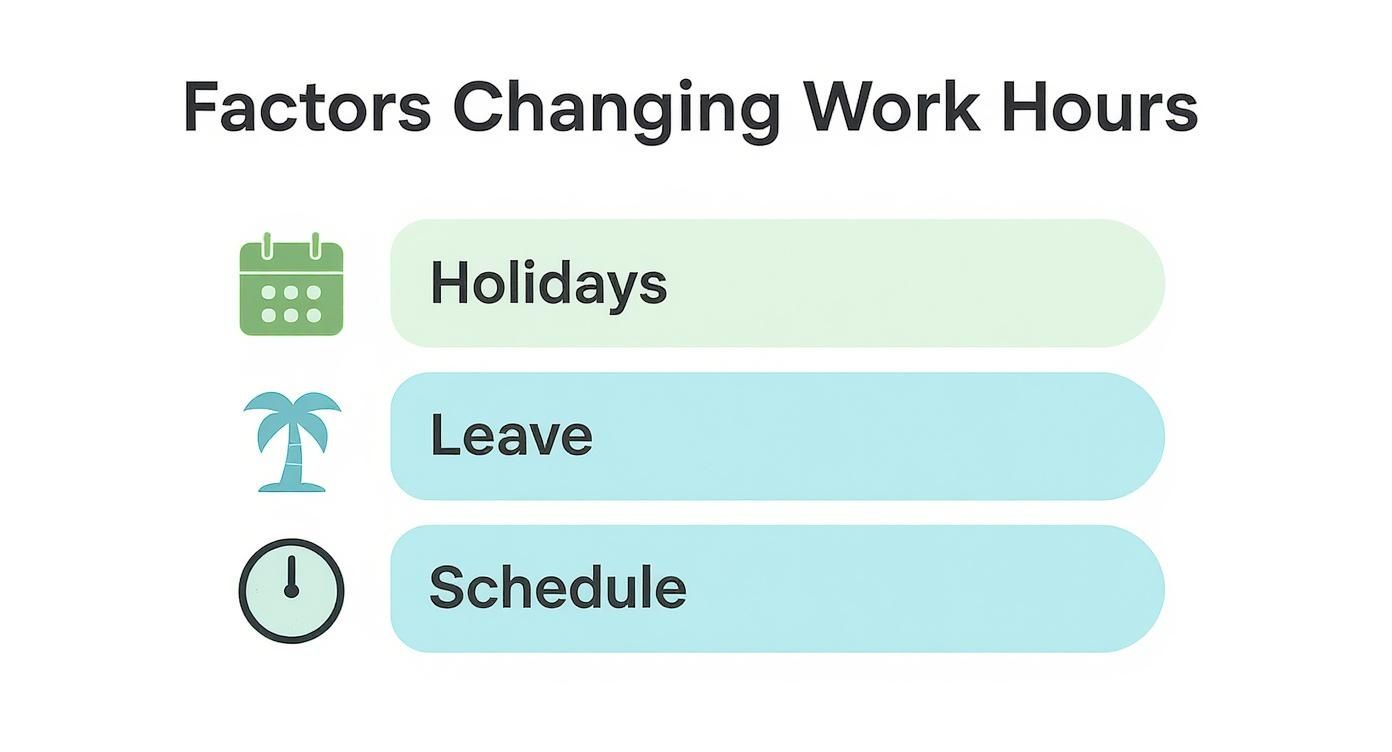
As this infographic shows, your contracted schedule is just one piece of the puzzle. Things like bank holidays and annual leave play a huge role in shaping your final monthly total.
A Look at Different Sectors
To really grasp how much schedules can vary, you need to look at the numbers. Some industries are notorious for long hours, while others are known for part-time work and greater flexibility.
Take agriculture, forestry, and fishing, for example. Workers in this sector log the longest average week at roughly 42.2 hours, which adds up to about 183 hours per month. On the other side of the spectrum, the accommodation and food services sector comes in with the lowest average of around 26.3 weekly hours, or about 114 hours a month. You can explore more data on working hours to see how other industries stack up.
That’s a massive gap—almost 70 hours a month between the two. It perfectly illustrates why a one-size-fits-all answer to "how many working hours in a month?" is so often misleading.
To paint a clearer picture, let's compare the typical hours across several key UK sectors. This provides some much-needed context, whether you're managing teams across different fields or just figuring out where your own career path fits in.
Average Monthly Working Hours by UK Industry
The table below breaks down the average working hours across different UK sectors, highlighting the significant variations that exist. It uses the standard 4.33 weeks-per-month average to provide a consistent monthly estimate based on the latest weekly data.
| Industry Sector | Average Weekly Hours | Estimated Monthly Hours |
|---|---|---|
| Agriculture & Fishing | 42.2 Hours | 183 Hours |
| Construction | 40.9 Hours | 177 Hours |
| Transport & Storage | 40.5 Hours | 175 Hours |
| Manufacturing | 38.1 Hours | 165 Hours |
| Retail | 31.3 Hours | 135 Hours |
| Hospitality | 26.3 Hours | 114 Hours |
As the data shows, the industry you work in is one of the single biggest factors defining your monthly schedule. It's not just about your job title; it's about the entire ecosystem you operate in.
Understanding Your Legal Rights and Overtime Rules

Knowing the exact number of working hours in a month isn't just about double-checking your payslip. It's about understanding the legal guardrails that protect you. The UK’s Working Time Regulations are there for a reason: to ensure everyone is treated fairly and to prevent burnout by setting clear boundaries on what an employer can ask of you.
These rules might look a bit complex on the surface, but their core principles are refreshingly simple. They’re designed to look after your well-being, capping excessive hours and making sure you get the proper rest you need to be at your best—both on the job and in your personal life.
The 48-Hour Average Week
One of the cornerstone rules is the limit on weekly working hours. In the UK, you shouldn't have to work more than an average of 48 hours per week.
Now, the crucial word there is "average." This isn't a hard-and-fast weekly cap. Instead, your hours are typically averaged out over a 17-week 'reference period'. This means you can absolutely work more than 48 hours in some weeks, provided your average over that whole 17-week stretch stays at or below the limit.
This setup offers some flexibility, allowing businesses to handle busy seasons and tight deadlines without breaking the law, as long as those intense periods are balanced out by quieter weeks.
It’s a common misconception that working a 50-hour week is illegal. The reality is more nuanced; it’s the sustained average over several months that matters, not a single demanding week.
Opt-Out Agreements and Rest Periods
You may have heard of an 'opt-out' agreement. This is a voluntary, written agreement where you can choose to work more than the 48-hour weekly average. The key thing to remember is that you can never be forced to sign one, and you have the right to cancel it at any time with the proper notice.
Beyond the weekly limits, the regulations also lock in essential rest periods. As a general rule, you are entitled to:
- A daily rest period of at least 11 consecutive hours in every 24-hour period.
- A weekly rest period of at least 24 uninterrupted hours each week (or a solid 48 hours per fortnight).
- An in-work rest break of 20 minutes if your workday lasts more than six hours.
These rules are the bedrock of fair working practices in the UK. Of course, overtime is another massive piece of the puzzle, and we break that down in our essential UK guide on how to calculate overtime. Getting to grips with these rights empowers you to make sure your work schedule isn't just productive, but also fair and compliant.
Right, let's unpack the story behind the standard UK work week. The whole 9-to-5, Monday-to-Friday rhythm feels like it’s been around forever, doesn’t it? But it's actually a pretty modern invention.
To really get to grips with today's working hours, you have to rewind to a time when the idea of a weekend—let alone a 40-hour week—would have sounded like a fairy tale to most people in the UK. This isn’t just a history lesson; it's the story of the huge social and legal shifts that built the labour standards we often take for granted.
Imagine the industrial era for a moment. The day wasn't shaped by an 8-hour contract but by the relentless churn of factories and mills. A typical work week was a punishing ordeal, easily stretching to 55 hours or more. It wasn't just a job; it was a way of life that left precious little time for rest, family, or anything else. This grind was the backdrop for some of the biggest social reform movements in British history.
From Long Days to Standard Weeks
The push for change wasn't an overnight revolution. It was a slow, hard-fought battle. Over many decades, trade unions, social reformers, and a few forward-thinking employers started making the case for shorter hours. They argued that a less exhausted workforce wasn't just a more humane one—it was a more productive one too.
This gradual shift in thinking paved the way for the standardised work week we know today. Society began to move away from a culture of constant labour towards one that actually valued a healthier work-life balance.
You can see this evolution starkly in the data. During periods of immense national effort, like World War I around 1914, the average working week could hit a staggering 55 hours. Some workers were even pushing an incredible 72 hours to keep up with production demands. Wind the clock forward to January 2023, and that figure has settled to an average of about 40.4 hours per week. You can discover more insights about working hour trends on everhour.com.
That's a dramatic drop of nearly 15 hours from the wartime average, and it highlights one of the most significant social achievements of the last century. It wasn't handed to us; it was the result of persistent campaigning for workers' rights and well-being.
Why This History Matters Today
Understanding this journey from punishing schedules to protected hours gives real context to our current rules and regulations. The legal limits on weekly hours, the right to guaranteed rest breaks, and paid annual leave didn't just appear from thin air. They are the direct descendants of a long struggle for a fair and sustainable way of working.
This historical perspective is a good reminder that the number of working hours in a month is more than just a figure on a timesheet. It represents a hard-won social contract—one designed to protect employees, boost productivity, and make sure we all have a life outside of work.
Frequently Asked Questions
Even when you've got the formulas and legal rules down, real-life situations can still throw up some tricky questions. Let's tackle some of the most common queries about working hours, giving you clear, straightforward answers to help you figure things out.
Think of this as your quick-reference guide for those practical problems that pop up.
How Do I Calculate Hours for a Part-Time Job?
When you’re working part-time, the most reliable way to calculate your hours is by using the 'Working Days Method'—it's far better than just guessing with a weekly average. First, you need to be crystal clear on your contracted hours for each day you actually work (say, 5 hours per day).
Next, simply count the exact number of days you’re scheduled to work in a specific month. Multiply your daily hours by the number of days, and you've got your total. So, if you work 5 hours a day for 12 days in a month, your total is 60 working hours. This method is a lifesaver for accuracy, especially if your working days change from one week to the next.
Are Paid Lunch Breaks Included in My Working Hours?
This one comes down to what's written in your employment contract. In the UK, there's no legal requirement for employers to pay you for rest breaks, so you absolutely have to check your agreement.
If your contract says you have a 40-hour week "inclusive of a one-hour paid lunch," then yes, those breaks are part of your total hours. More often than not, though, you'll find contracts are "exclusive of lunch breaks."
For example, being at your workplace from 9 AM to 5 PM with an hour for lunch doesn't mean you've worked an 8-hour day. If that lunch break is unpaid, you've actually worked a 7-hour day. Getting this right is crucial for accurate calculations.
What Is the Legal Maximum of Hours I Can Work in a Month?
UK law doesn't actually set a strict monthly cap; it's all based on a weekly average. The legal limit is an average of 48 hours per week, calculated over a standard 17-week reference period.
This works out to roughly 208 hours per month (that's 48 hours x 4.33 weeks). The key word here is average. You can work more hours in some weeks as long as it's balanced out by working fewer hours in others. It's also possible to voluntarily sign an 'opt-out' agreement to work more than this. Just remember that some jobs, like professional drivers, have their own specific and often stricter rules.


