
An annualised hours contract is a different way of thinking about the working week. Instead of a fixed number of hours every single week, your employee agrees to work a set number of hours spread across the entire year.
Think of it like a yearly allowance for work hours. It gives you a total pot to draw from, letting you schedule more staff time when your business needs it most. This approach provides incredible flexibility, especially if you deal with seasonal peaks and troughs.
Unpacking the Annualised Hours Model
So, what does an annualised hours system look like in practice?
Instead of a rigid 40-hour week, an employee might have a contract for 1,900 hours per year. This total figure is worked out by taking their contracted hours and subtracting their statutory holiday entitlement.
You can then schedule them to work more hours during your busy periods (like a retailer in the run-up to Christmas) and fewer hours when things are quiet. The real beauty of it? They still receive a consistent, predictable salary every single month. No more fluctuating pay packets.
This model is definitely gaining traction here in the UK, where flexible working is becoming more and more valued by employees. In fact, around 2.1 million workers are now on annualised hours contracts, which really shows it's becoming a practical alternative to the old-school nine-to-five. For those who like the numbers, you can dig into the data behind these trends on Statista.
At its heart, this system moves the focus away from rigid weekly schedules to your actual yearly demand. It’s a much more strategic way to manage your workforce.

The core idea is simple: match your staffing levels precisely to your business's fluctuating needs without the administrative headache and cost of constant overtime or temporary staff. This proactive approach to scheduling can transform operational efficiency.
To get started, it’s crucial to understand the total number of working days in a year. This forms the foundation for building a fair and effective annualised hours system from the ground up.
Annualised Hours vs Traditional Contracts at a Glance
To see the differences clearly, it helps to put the two models side-by-side. One is built for predictability and routine, while the other is designed for adaptability.
| Feature | Traditional Contract | Annualised Hours Contract |
|---|---|---|
| Scheduling | Fixed hours per week (e.g., 40 hours) | Total hours per year (e.g., 1,900 hours) |
| Flexibility | Low; changes require overtime or shift swaps | High; hours scheduled to match business demand |
| Pay Structure | Consistent weekly/monthly salary for standard hours | Consistent monthly salary, regardless of hours worked that month |
| Overtime | Paid for hours worked beyond the weekly contract | Not typically used; extra hours are part of the annual total |
| Best For | Businesses with stable, predictable workloads | Businesses with seasonal or fluctuating demand |
Ultimately, the choice depends entirely on your business's rhythm. For companies facing predictable peaks and quiet spells, the annualised model offers a powerful way to manage resources without the chaos of last-minute scheduling.
How to Calculate Annualised Hours Correctly
Getting the numbers right is the bedrock of any successful annualised hours system. It’s not just about ticking boxes; it’s about ensuring fairness for your employees and bringing operational clarity to your business. The calculation itself is surprisingly straightforward once you break it down into a few simple steps.
Let's walk through it with a typical full-time employee contracted for 40 hours per week. The first thing we need to do is figure out their total potential working hours for the year.
- Calculate Gross Annual Hours: Just multiply the weekly hours by the number of weeks in a year.
- 40 hours/week × 52 weeks = 2,080 gross hours per year.
This number, 2,080, is your starting block. Think of it as the total pool of time available before you factor in any paid time off.
The infographic below shows how this initial sum fits into the bigger picture of flexible scheduling.
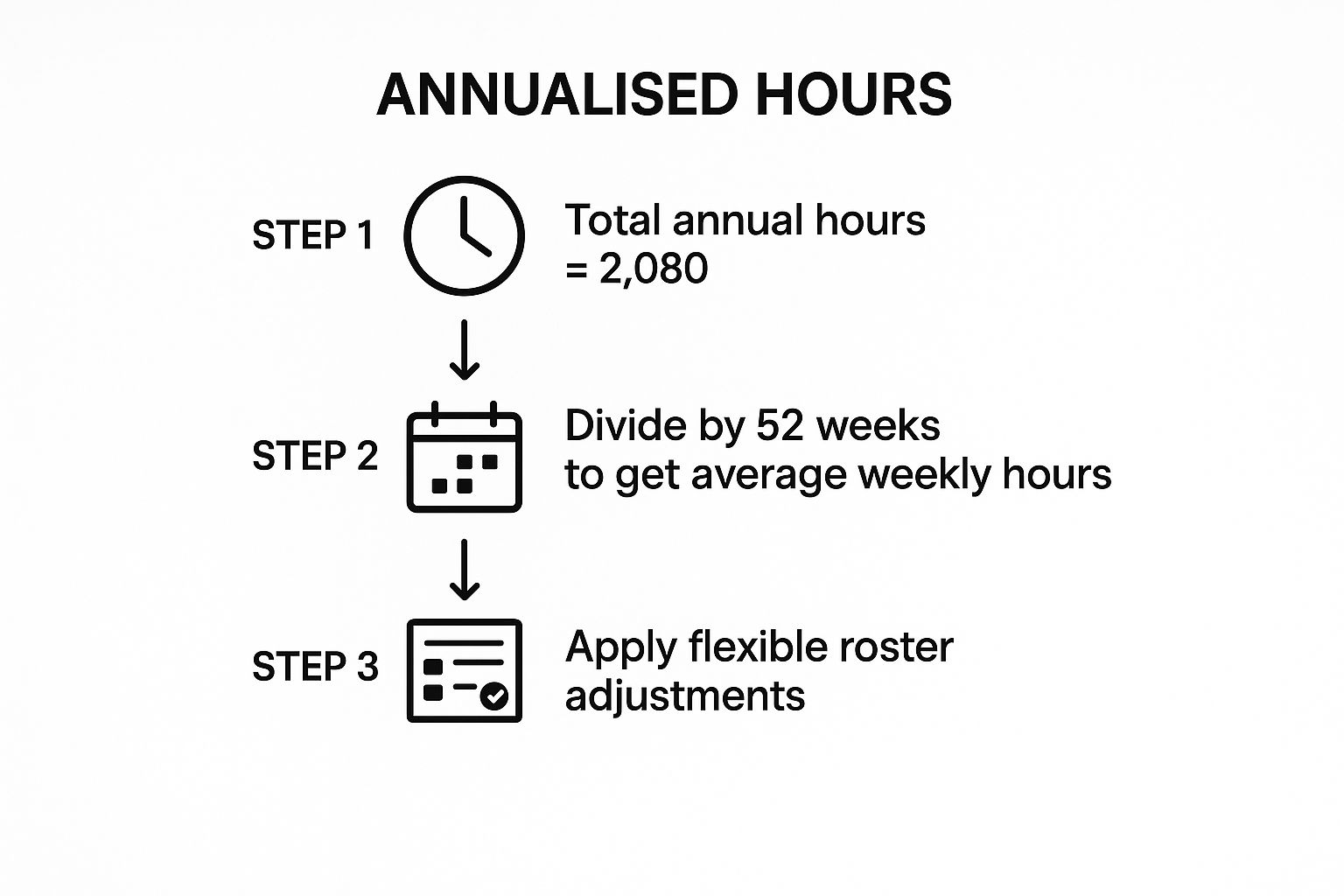
As you can see, it's a logical flow from calculating the total hours to then applying them flexibly across the peaks and troughs of the year.
Adjusting for Annual Leave
Now for the crucial next step: subtracting the employee's holiday entitlement. In the UK, most full-time workers are entitled to a minimum of 28 days (or 5.6 weeks) of paid annual leave. You can't just ignore these – they have to be removed from the total.
To do this, we need to convert those leave days into hours. This is a vital step to find out how many hours they are actually contracted to work.
Let’s stick with our example of an employee on a 40-hour, five-day week. That works out to a standard eight-hour day.
- Holiday Hours: 28 days × 8 hours/day = 224 hours of annual leave.
If you want to get into the nitty-gritty of leave calculations, our detailed UK annual leave calculation formula guide is a great resource.
Finding the Final Figure
We're almost there. The final piece of the puzzle is to subtract the holiday hours from the gross annual total. This gives us the net working hours – the magic number for the contract.
- Net Annual Hours: 2,080 gross hours – 224 holiday hours = 1,856 net working hours.
And there you have it. This final figure of 1,856 hours is the "pot" of hours you can schedule flexibly throughout the year. It's the number that goes into the employment contract, giving you and your employee a clear, shared understanding of their commitment.
The Real Benefits for Your Business and Your Team

Switching to an annualised hours system is much more than a simple tweak to the rota. Think of it as a strategic shift that delivers real, tangible benefits for both your company and your employees. When you stop thinking in rigid weekly blocks, you unlock a more agile and responsive way of working—one that naturally follows the rhythm of your business year.
The advantages for the business are immediate and powerful. Picture a seaside café that’s quiet through the winter but absolutely buzzing in the summer. With annualised hours, you can schedule more staff during that peak tourist season without getting stung by expensive overtime pay. You’re directly aligning your staffing levels with customer demand, which is a massive win for efficiency.
When your team’s presence perfectly matches your customer traffic, you cut out the waste. You’re no longer paying people to stand around during quiet spells, and you’re never caught short-staffed when you need all hands on deck. This is a powerful form of business process optimization that has a direct, positive impact on your bottom line.
Advantages From Both Sides
But the perks go well beyond pure operational gains. This model genuinely creates a win-win situation, fostering a team that feels more stable and satisfied in their roles.
For your business, the key gains are:
- Reduced Overtime Costs: You can handle your busiest periods using the pre-agreed annual hours, which dramatically cuts down on extra wage costs.
- Improved Efficiency: Staff are always scheduled where they’re needed most, boosting productivity and keeping customers happy.
- Enhanced Budgeting: Even with fluctuating work patterns, your monthly wage bill becomes predictable. This makes financial planning a whole lot simpler.
For your team, the appeal is just as strong:
- Stable Monthly Pay: Employees get the same salary each month, giving them financial security no matter how many hours they actually worked that month.
- Better Work-Life Balance: Planned downtime during the off-peak seasons means your team can enjoy longer breaks or focus on personal projects.
- Increased Job Security: A stable, annual contract offers far more security than relying on unpredictable zero-hour arrangements.
This whole approach is a cornerstone of managing flexible work arrangements in a way that truly works. By building a system on predictability and flexibility, you cultivate a workforce that is not only more resilient but also far more motivated.
Navigating UK Legal Requirements and Contracts
Switching to an annualised hours system isn’t just an operational shift; it’s a legal one. Nailing the contract details from day one is absolutely crucial to protect your business and, just as importantly, to treat your team fairly. Think of a well-drafted annualised hours contract as the bedrock of the whole system.
The contract needs to be crystal clear on several key points. It must explicitly state the total number of net working hours for the year, break down how you calculated that number, and detail the process for creating and communicating rosters. Any vague language is a recipe for confusion, so precision is your best friend when it comes to avoiding future disagreements.
Core Contractual Clauses
To make sure your contract is solid, you need to clearly define the rules of the game. This means spelling out what happens with overtime once the annual total is hit, how you'll handle sickness absence, and the procedure if an employee leaves part-way through the year.
Your contract also has to account for statutory and contractual leave entitlements within the total annual hours. For instance, a full-time employee working 7 hours and 24 minutes a day over a year with 261 working days would have a total of around 1,931 hours. You can find more examples of how to build leave into these sums to stay compliant. These annualised hours guides on Totalmobile.com offer some great insights.
A critical legal backstop is the Working Time Regulations 1998. Your rosters must ensure every employee gets their statutory rest breaks. Crucially, their average weekly hours can't top 48 hours over the reference period unless they've formally opted out in writing.
Finally, even while you’re focused on employment models, don’t forget your wider legal duties. This includes understanding mandatory Employers Liability Insurance, which is a non-negotiable for most UK businesses. Getting the legal framework right protects everyone involved.
Your Step-by-Step Implementation Plan

Successfully rolling out an annualised hours system is all about careful planning and crystal-clear communication. It’s not just a case of updating contracts; it's about bringing your team along for the ride. Taking a structured approach is the best way to ensure a smooth transition and get everyone on board.
The whole process has to start with an open conversation. Before you even think about drafting new policies, you need to consult with your employees. Explain why you’re considering the change, and be clear about the benefits for them — like stable pay and properly planned downtime. This is your moment to listen to their concerns and answer questions.
By tackling any worries head-on, you build trust and show you're being transparent. A successful launch hinges on your team understanding exactly how the system will work in practice, from rostering to booking holidays. This initial chat is absolutely critical.
Key Implementation Steps
Once you’ve built that foundation of understanding, you can get into the practical side of things. Each stage builds on the last, helping you create a solid and legally sound framework for your new way of working. A methodical approach is the only way to avoid confusion and make sure the launch goes off without a hitch.
- Draft Compliant Contracts: Get a legal expert involved to help create contracts that clearly state the total annual hours, pay structure, and the rules around rostering and overtime. It also needs to cover what happens if an employee leaves part-way through the year.
- Establish a Tracking System: You absolutely need a reliable way to monitor hours worked against the annual total. This could be dedicated software or even a well-built spreadsheet system, but it must be transparent for both managers and employees.
- Develop a Fair Rostering Process: Create a clear policy explaining how and when rosters will be shared. The key is to give schedules well in advance so your team can actually plan their personal lives around work.
- Manage the Transition: Set a firm start date and make sure you provide training for your managers. They need to know how to manage the system effectively and understand all the new legal and operational responsibilities that come with it.
Common Questions About Annualised Hours
Even with the best plan in place, moving to an annualised hours system can bring up some practical, "what if" questions. It's completely normal. Let's walk through some of the most common queries that pop up for businesses considering the switch. Getting these cleared up can give you the confidence to move forward.
How Is Pay Handled With Annualised Hours?
This is usually the first question on everyone's mind, and for good reason. The most common—and fairest—way to handle it is to divide an employee's total annual salary into 12 equal monthly payments.
This approach gives your team a predictable, consistent income all year round, even if they work a huge number of hours one month and far fewer the next. That kind of stability is a massive plus for employees, taking the stress out of fluctuating pay packets.
Of course, the employment contract needs to be watertight on how you'll handle overtime. You have to spell out whether any hours worked beyond the agreed annual total will be paid at a higher rate or if they'll be given back as time off in lieu (TOIL).
Predictable pay is a cornerstone of a successful annualised hours contract. It offers employees financial security, which in turn fosters trust and improves morale, even when work schedules vary significantly from one month to the next.
What Happens If an Employee Leaves Part-Way Through the Year?
This is a critical scenario, and your employment contract must have a specific clause to cover it. When an employee leaves, you'll need to do a final calculation to square things up.
It's a simple reconciliation: you balance the hours they've actually worked against the salary they've been paid up to their leaving date.
If they've worked more hours than they've been paid for on a pro-rata basis, you'll owe them a final payment. On the flip side, if they've been paid for more hours than they've actually put in, you may be entitled to deduct the overpayment from their final salary. This is where having accurate, transparent records is non-negotiable—it keeps the whole process fair and avoids disputes.
Are Annualised Hours Suitable for Every Business?
Honestly, no. They shine brightest in businesses that have predictable peaks and troughs in demand throughout the year. If your workload has a clear seasonal or cyclical rhythm, this system could be a game-changer.
Industries that often get the biggest benefit include:
- Retail: Perfect for managing the Christmas rush or big summer sales events.
- Hospitality: Helps handle the peak tourist seasons and bank holiday weekends smoothly.
- Agriculture: A natural fit for aligning staff hours with planting and harvesting cycles.
- Manufacturing: Great for coping with fluctuating production orders without constantly hiring and firing.
But if your business has a steady, consistent workload year-round, the administrative effort of managing an annualised hours system might not be worth it. The advantages just won't outweigh the simplicity of a traditional contract. It's really important to analyse your own operational patterns before making the leap.


