
If you're involved in planning schedules, managing payroll, or forecasting projects, there's one number you absolutely need to know: the total working days in a year. Here in the UK, the baseline figure for a standard, non-leap year is 253 working days. For a leap year, that bumps up to 254.
This simple number is the foundation for almost all of your leave and resource planning.
Your Quick Guide to UK Working Days
Figuring out how many working days per year there are might seem like a basic task, but getting it right is the bedrock of solid financial and operational management. Whether you're a small business owner sorting out payroll, an HR manager tracking annual leave, or a contractor forecasting your income, this number is critical. It directly influences budgets, project timelines, and your team's availability.
The calculation itself is pretty straightforward. You start with the total number of days in the year (365 or 366) and simply subtract all the days people aren't expected to work. This means taking out every Saturday and Sunday, plus all the official bank holidays for your specific part of the UK.
The Standard Calculation Breakdown
In the UK, the average number of working days—once you remove weekends and bank holidays—hovers around 253 for a standard year and 254 during a leap year. This is based on a typical Monday-to-Friday workweek with 104 weekend days and the standard eight bank holidays for England and Wales. You can discover more insights about working day calculations and see how this figure shifts from year to year.
To make it even clearer, let's walk through the maths for a standard, non-leap year.
Here’s a simple table that shows how we get to that magic number:
| Standard UK Working Days Calculation | |
|---|---|
| Item | Number of Days |
| Total days in a standard year | 365 |
| Minus weekend days (Saturdays & Sundays) | -104 |
| Minus standard bank holidays (England & Wales) | -8 |
| Total Working Days | 253 |
This table gives you a clean overview of the baseline. But, as we'll get into, this number isn't set in stone. Things like regional bank holiday differences in Scotland and Northern Ireland, or even a bank holiday falling on a weekend, can change the final count. This is exactly why a clear understanding is so vital for accurate planning.
Calculating Your Working Year From Scratch
So you've got the standard number, but how do we actually get there? Understanding the maths behind it is a game-changer, letting you tweak the calculation for any year or situation. It's a surprisingly powerful tool for workforce planning.
Before diving in, it's worth knowing the official definition of working time. This makes sure any calculations you make are on the right side of the law.
The whole process is just a simple, three-step subtraction. Let's break it down and demystify the official count, giving you a practical way to see exactly how we arrive at that final number.
Step 1: Start with the Total Days
This first step is the easiest one. You always start with the total number of days in the calendar year you're looking at.
- For a standard year: Begin with 365 days.
- For a leap year (like 2024): Begin with 366 days.
Think of this as your blank canvas. It's the entire calendar, and from here, we'll start carving out all the non-working days to get a true picture of your working year.
Step 2: Remove All Weekend Days
Next up, we need to subtract all the days that fall outside the typical Monday-to-Friday workweek. For most years, this number is pretty consistent.
A standard year is made up of 52 full weeks and one extra day. That gives you 52 Saturdays and 52 Sundays, for a grand total of 104 weekend days.
So, the calculation looks like this:
365 (Total Days) – 104 (Weekend Days) = 261 Potential Work Days
This new total of 261 is your maximum number of weekdays in a normal year. It’s a key milestone in figuring out how many working days per year are available before we account for holidays, which is our final step.
Step 3: Subtract the Bank Holidays
The last piece of the puzzle is to take out the public bank holidays. In England and Wales, there are typically eight standard bank holidays each year.
By subtracting these days, you get to the final, practical number used for most business planning. The formula is: Total Weekdays – Bank Holidays = Total Working Days.
Let’s finish the calculation for a standard year in England and Wales:
261 (Potential Work Days) – 8 (Bank Holidays) = 253 Total Working Days
And there you have it. This simple three-step process gives you that baseline figure of 253 working days. Of course, you can apply the same logic on a smaller scale, too. If you want to zoom in on monthly figures, check out our guide on calculating the number of business days per month.
Why the Working Day Count Changes
That baseline figure of 253 working days is a great starting point, but it's rarely the final number. Think of it more as an estimate. Several key variables can shift this total from one year to the next, meaning the real answer to "how many working days are in a year?" is nearly always "it depends". Getting to grips with these factors is crucial for accurate scheduling and payroll across your business.
One of the most predictable changes comes from leap years. Every four years, we add an extra day—February 29th—to the calendar. When this day falls on a weekday, as it did in 2024, it bumps the total working day count from 253 up to 254.
This simple infographic neatly summarises how the calculation works.
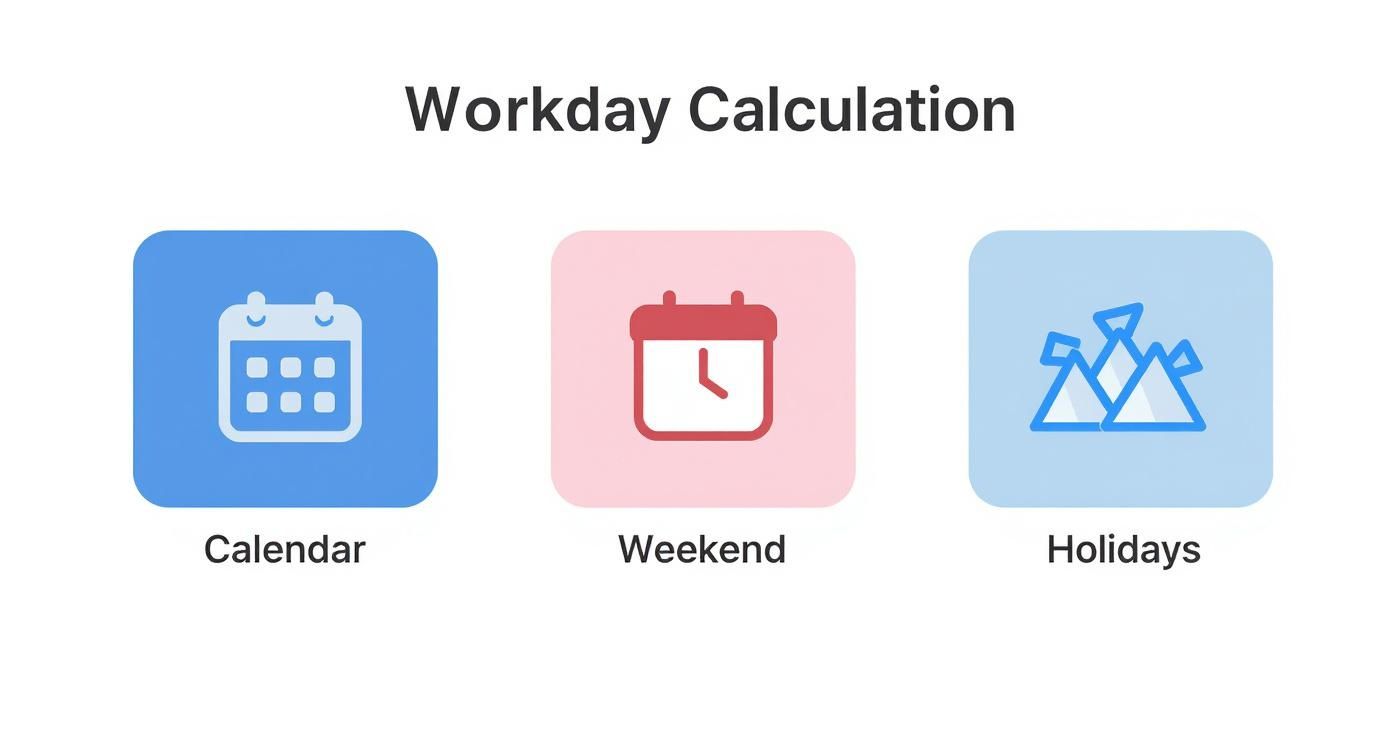
As you can see, the process is just straightforward subtraction: start with the full calendar year, take out the weekends, and then deduct the public holidays.
The Impact of Bank Holidays
Bank holidays are another major wild card. While there's a standard set for England and Wales, the actual number of working days they remove can fluctuate depending on when they fall. For instance, if a bank holiday like Christmas Day lands on a Saturday or Sunday, a substitute day is given on the following weekday instead.
This system makes sure employees don't lose out on their public holiday entitlement, but it directly impacts the annual working day count for that specific year. The placement of these substitute days can easily alter your monthly and yearly totals.
This substitute day system is a crucial detail. It means you can't just subtract a fixed number of holidays each year without first checking the calendar to see where they land.
For any business, this just highlights the need to consult an up-to-date calendar each year rather than relying on a static number. The world of public holidays has more quirks than you might think, and you can explore some interesting facts about UK bank holidays to see just how much they can vary.
Regional Differences Across the UK
Perhaps the most significant reason the working day count changes is simply geography. The United Kingdom isn't uniform when it comes to public holidays, which creates different working year lengths for each nation.
For any company with a UK-wide presence, these regional distinctions are vital. You can't assume everyone is working to the same calendar.
Comparing UK Bank Holidays By Nation
This table breaks down the standard differences you'll find across the UK.
| Nation | Standard Number of Bank Holidays | Impact on Total Working Days |
|---|---|---|
| England & Wales | 8 | This is the baseline for many UK calculations. |
| Scotland | 9 | An extra day off reduces the annual working day count. |
| Northern Ireland | 10 | Has the most public holidays, resulting in the fewest working days. |
What does this mean in practice? An employee in Belfast will have a different number of annual working days compared to a colleague in Bristol. Forgetting this can lead to serious errors in payroll, leave entitlement calculations, and resource planning. To get it right, you absolutely have to take a location-specific approach.
The True Story of the Modern Work Year
The structured working year, with its neat 253-day count, feels like it’s been around forever. It’s the backbone of everything from payroll and project timelines to when we book our holidays. But this system is surprisingly modern, born from massive social and economic shifts rather than some timeless tradition.
Believe it or not, before the Industrial Revolution, the idea of a standardised work year just didn't exist. Work was dictated by the rhythm of the seasons, the hours of daylight, and a whole host of religious and local holidays. The calendar was a patchwork of labour and rest that today’s nine-to-five employee would find completely unrecognisable.
From Seasonal Labour to Factory Clocks
In the pre-industrial world, the line between work and life was much blurrier. Agricultural cycles, not spreadsheets, determined when you worked flat-out and when you had downtime. This era was also famous for what historians call ‘St Monday’—an informal, but widely practised, tradition of taking the first day of the week off to recover from Sunday’s fun.
As industrialisation picked up speed, this organic approach to work collided head-on with the relentless demands of factory production. Before factories took over, estimates suggest that by 1700, the average person worked around 270 days a year. By 1750, that figure had jumped to roughly 300 days as factory owners pushed for longer hours and more predictable schedules to squeeze every last drop of value out of their machinery. You can explore more details on pre-industrial work patterns to get a real sense of how these economic shifts reshaped daily life.
The move from a task-oriented agricultural calendar to a time-oriented industrial one was a seismic change. It created the need for a predictable, measurable unit of work: the working day.
The Birth of the Modern Work Week
The transition was anything but smooth. The gruelling schedules of early factories—often 10-12 hours a day, six or even seven days a week—sparked widespread social unrest. People pushed back, and that pressure eventually led to the landmark labour reforms that shaped the system we know today.
A couple of key developments really set the stage:
- The Weekend: The idea of a two-day weekend was popularised in the early 20th century. Pioneers like Henry Ford championed it, not just out of kindness, but because he saw it as a smart way to boost worker productivity and morale.
- Statutory Holidays: The Bank Holidays Act of 1871 was the first major step towards formalising public holidays in the UK, giving workers legally recognised days off.
These milestones didn't just give people a break; they fundamentally redefined the calendar. They created the very framework that allows us to ask, "how many working days are in a year?", transforming a chaotic schedule into a predictable, quantifiable system. Our modern work year is the direct legacy of this historic struggle for a better balance between work and life.
Moving Beyond the Official Count
That standard figure of 253 working days is a nice, tidy baseline, but anyone managing a team knows it often feels worlds away from reality. While the calendar gives us a theoretical maximum, the actual number of days your team is present and productive is always, always lower. This is the crucial gap between the official count and your operational reality.
Bridging this gap means looking past the simple maths of weekends and bank holidays. The real story of how many working days per year are available to your business is written in your absence records. Every single day taken for annual leave, sickness, or parental leave chips away at that initial 253-day total.
Trying to plan resources without anticipating these inevitable absences is like planning a budget without accounting for any expenses—it’s a recipe for failure.
The Real-World Reductions
The biggest factor shrinking the working year is, of course, annual leave. In the UK, a full-time employee is entitled to 5.6 weeks of paid holiday, which works out to a minimum of 28 days. As soon as you subtract this statutory leave, your available working days per employee immediately drop from 253 to 225.
And that's before we even get to unplanned absences, which play a huge role. Sickness is a major contributor to lost time. In 2023/24, an estimated 33.7 million working days were lost in Great Britain just from work-related ill health and injuries. This data shows just how big the issue is, with each affected person taking around 15.5 days off on average. You can read the full findings from the Health and Safety Executive to really grasp the impact on businesses.
For managers, this means the 253-day count is just the start of the calculation. True productivity and scheduling depend entirely on anticipating and planning for these unavoidable dips in your team's availability.
Adapting to Modern Work Schedules
The classic Monday-to-Friday model isn't the only game in town anymore, which throws another spanner in the works for simple annual counts. Flexible arrangements are becoming more common, and they require a totally different way of calculating available work time.
Compressed workweeks, for example, fundamentally change the equation. Arrangements like a 9/80 work schedule completely alter the number of working days in a year for an employee. In this model, they work their 80 hours over nine days instead of ten, giving them an extra day off every two weeks.
And there are other factors that reduce the total, too:
- Parental Leave: Maternity, paternity, and shared parental leave can take an employee off the schedule for months at a time.
- Compassionate Leave: You have to factor in unexpected time off for things like bereavement or family emergencies.
- Training and Development Days: While these are productive for the business, they're often off-project days that affect a team's immediate capacity.
Ultimately, the official calendar gives you a starting block, but your true number of working days is a dynamic, shifting figure that’s unique to your team and how your business actually runs.
Automating Your Annual Leave Management
Let's be honest: manually calculating working days, juggling regional bank holidays, and figuring out pro-rata entitlements is a minefield. It’s a tedious administrative chore that’s ripe for error, often leading to payroll mistakes, scheduling headaches, and frustration for everyone involved.
This is where you can let technology do the heavy lifting. Instead of wrestling with spreadsheets that never seem to be quite right, a dedicated leave management system automates all of these complex calculations in an instant. It handles all the fiddly bits we've discussed, from Scotland's extra bank holiday to getting the leave right for that new part-timer who just joined the team.
A clear, automated dashboard gives you an at-a-glance view of team availability, turning abstract numbers into a practical tool for daily operations.

Suddenly, you know exactly who is in and who is off, without having to cross-check calendars or send a flurry of emails.
Turning Theory into Practice
The real magic of automation is how it turns all those theoretical numbers into a streamlined, error-free process. Your focus shifts from dreary admin to actual strategic oversight. You get a crystal-clear view of your team's availability at all times, which kills the guesswork and helps managers make smart decisions about projects and deadlines.
By taking the manual work out of the equation, you get some major wins:
- Eliminate Payroll Errors: Automated calculations mean entitlements are always spot-on, preventing costly and awkward mistakes down the line.
- Save Administrative Hours: What used to take hours of checking calendars and policies now takes a few seconds.
- Gain Real-Time Visibility: Instantly see who's on leave, who's working, and who has holidays coming up, all in one central place.
Automating leave management isn't just about being more efficient; it's about being accurate and clear. It ensures every employee is treated fairly and gives managers the solid data they need to plan with confidence.
Moving to an automated system is simply the most practical way to handle the complexities of the modern work year. If you want to see how these calculations work for yourself, why not try a free tool like this UK holiday calculator to quickly work out entitlements? It’s a great way to see just how much simpler things can be with the right tools for the job.
Frequently Asked Questions
When you get down to the nitty-gritty of working days and leave, a few common questions always seem to pop up, especially when you're juggling different types of contracts. To clear things up, here are some straightforward answers to the queries we see most often from UK businesses.
How Do I Calculate Working Days for Part-Time Employees?
For part-time staff, the secret is to think in terms of ‘pro-rata’. It’s all about fairness and proportion. The first step is to figure out their full-time equivalent (FTE) as a simple percentage. For instance, if someone works three days a week instead of the usual five, their FTE is 0.6 (that’s just 3 divided by 5).
Once you have that magic number, you apply it to whatever your standard full-time holiday entitlement is. So, if your full-timers get 28 days off, the part-time employee is entitled to 16.8 days (28 days x 0.6). Most companies will round this up to the nearest half or even full day to keep things simple.
Are Bank Holidays Included in Statutory Annual Leave?
This one trips a lot of people up. In the UK, every full-time employee has a legal right to 5.6 weeks of paid holiday. What’s flexible, however, is how an employer handles bank holidays. They can either include them within that 5.6-week allowance or grant them on top of it.
It’s a common misconception, but there is no automatic legal right to have a paid day off on a bank holiday. The decision rests entirely with the employer, and it must be clearly laid out in the employment contract.
That contract is the definitive guide, so if you're ever in doubt, that's the first place you should look.
Does the Number of Working Days Affect Contractor Pay?
Absolutely. For contractors on a day rate, getting a handle on how many working days per year there are is fundamental to their financial planning. Their entire potential income is a direct result of the number of days they can actually work and bill for in any given month or year.
Months with a cluster of bank holidays, like April or December, will naturally have fewer working days, which means a dip in potential earnings. This makes accurate forecasting a must-do for contractors managing their budgets and for businesses setting aside funds to pay for their expertise.


