
Knowing how many working days you have in a calendar year is one of those fundamentals that underpins almost all business planning in the UK. It affects everything from payroll and holiday allowances to project timelines. The magic number most businesses start with is 253 working days in a non-leap year and 254 in a leap year.
Think of it as a baseline – a solid starting point before you factor in the unique details of your own business.
Your Starting Point for UK Working Days
Figuring out the number of working days in a year is a bit like solving a simple puzzle. You begin with the full 365 days and then just start removing the pieces that don't count as 'work' days. This foundational number is the bedrock of strategic planning, from managing staff holidays to forecasting project deadlines.
The calculation itself is refreshingly simple. First, you take out the weekends. A year has 52 full weeks, which means you need to subtract 104 days for all the Saturdays and Sundays. Straight away, that brings your total down from 365 to 261 days.
The next piece to remove is the public holidays, and this is where it gets a little more specific.
The Standard Calculation Breakdown
For most businesses operating in England and Wales, the standard is to subtract 8 bank holidays. A quick bit of arithmetic gives you the final, most commonly used figure for planning.
Calculation: 365 Total Days – 104 Weekend Days – 8 Bank Holidays = 253 Working Days
This core formula provides a reliable starting point for pretty much any UK business. It's a straightforward but critical answer: UK employees work approximately 253 days in a standard year, and this bumps up to 254 during leap years.
To make it even clearer, here’s a quick summary of how it all adds up for a business in England & Wales.
Standard UK Working Year At a Glance (England & Wales)
| Metric | Standard Year | Leap Year |
|---|---|---|
| Total Days in Year | 365 | 366 |
| Weekend Days (Saturdays & Sundays) | – 104 | – 104 |
| Bank Holidays (England & Wales) | – 8 | – 8 |
| Total Working Days | 253 | 254 |
This table shows the basic maths, giving you a solid baseline for annual business planning, project timelines, and especially staff holiday allowances.
But of course, this is just the beginning. This number can change depending on where you are in the UK, the specific year (sometimes there are extra bank holidays!), and your employees' working patterns. Nailing this core number is the first step, but mastering the variables is what leads to truly accurate HR management.
You can explore a detailed guide on the UK annual leave calculation formula to see how these numbers apply in practice. Getting this baseline right is essential before we dive into the nuances of regional public holidays and pro-rata calculations for part-time staff.
Adjusting for Public Holidays and Leap Years
That basic calculation gives us a solid starting point, but the UK's working calendar isn't quite that simple. To get a truly accurate picture, we need to account for a couple of key variables that regularly change the total number of working days: public holidays and leap years.
Getting these adjustments right is crucial for fair and accurate planning, especially for any business with staff spread across the country.
First up, the easy one: leap years. Roughly every four years, we get an extra day in February. If 29th February happens to fall on a weekday, it adds one more working day to that year's total. For a year with 8 bank holidays, this would bump the count up from 253 to 254. It’s a simple tweak, but one that affects everything from project timelines to annual payroll.
The UK's Diverse Public Holiday Landscape
Beyond the occasional leap year, the biggest variable by far is the UK's regional approach to public holidays. It's easy to fall into the trap of using the standard 8 bank holidays for England and Wales as a baseline, but that figure doesn't apply to everyone.
For instance, an employee in Scotland typically gets 9 bank holidays, while someone working in Northern Ireland has 10. These might seem like small differences, but they directly change the number of working days you have for each employee.
A business with offices in London, Glasgow, and Belfast must juggle three separate holiday calendars to stay compliant and ensure fairness. A one-size-fits-all approach is a recipe for inaccurate leave calculations and planning headaches.
This diagram breaks down how we get to the final working day count by stripping out all the non-working days from the calendar.
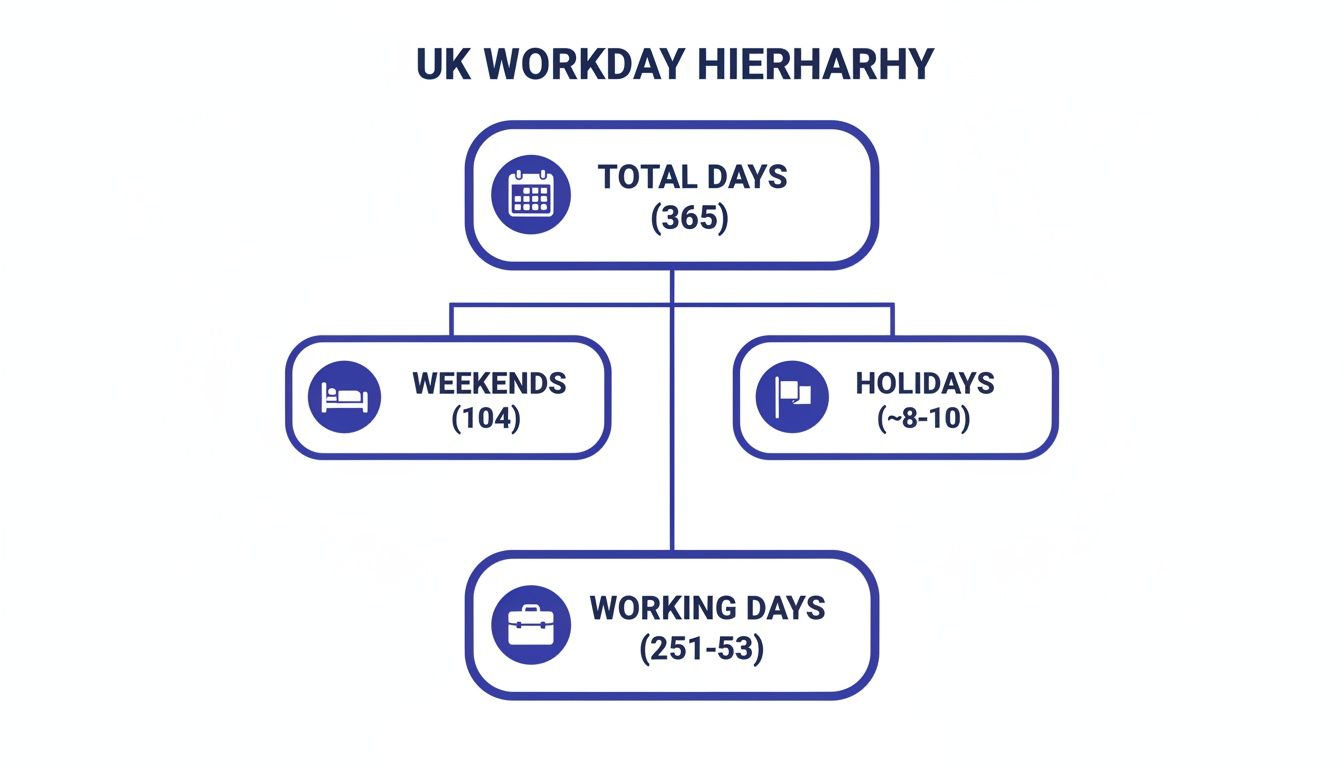
As you can see, it's a process of elimination. You start with the total days in a year, then remove all the weekends and public holidays to find what’s left.
Keeping on top of these regional differences isn't just good practice; it's a legal necessity. For any company with staff across the UK, manually tracking these schedules can get complicated fast. To make sure you’ve got it all covered, our guide to UK public holidays for 2025 breaks down all the specific dates for each country. This way, every employee's leave is calculated correctly, reflecting their exact location and entitlement.
Choosing Your Calculation Method: Manual vs. Automated
Once you’ve got a handle on all the moving parts that affect your working days, the next big question is: how do you actually calculate the final number? Really, you have two paths to choose from. You can go the manual route with spreadsheets, or you can use an automated system built for the job. Both will give you an answer, but they are worlds apart when it comes to time, accuracy, and sanity.
The manual route is usually the first port of call for small businesses. Firing up a spreadsheet in Microsoft Excel or Google Sheets seems like a practical first step for basic planning.
The Manual Spreadsheet Approach
If you’re going down this road, your best friend is the NETWORKDAYS function. It’s a handy little formula designed to count the full workdays between a start and end date, and it automatically skips weekends.
To make it work properly, though, you have to feed it a list of public holidays to exclude as well. For example, if you wanted to calculate the working days for 2025 in England, you'd have to:
- Set Your Dates: Pop the start date (01/01/2025) and end date (31/12/2025) into two separate cells.
- Create a Holiday List: Somewhere else in your sheet, you'll need to list out all 8 bank holiday dates for the year.
- Use the Formula: Your formula will look something like this:
=NETWORKDAYS(start_date, end_date, holiday_list).
While this works in a pinch, it’s loaded with potential problems. You have to set it up from scratch every single year. If you have team members in Scotland or Northern Ireland, you need to build and maintain separate, accurate holiday lists for them. The risk of a simple human error—a typo in a date, a forgotten bank holiday—is surprisingly high, and that one mistake could throw off your payroll or leave allowance calculations.
The Superiority of Automation
This is where dedicated HR platforms really shine. Instead of you wrestling with formulas and lists, these systems handle all the complexity behind the scenes. An automated solution is purpose-built to manage these calculations with precision, saving you hours of admin headaches.
Automated systems eliminate the guesswork and manual data entry that often lead to costly errors. They come pre-configured with the correct regional holiday calendars and automatically account for variables like leap years, ensuring every calculation is accurate from the start.
A dedicated leave management tool, for example, gives you a clear, real-time picture of who's in and who's out.

This dashboard from LeaveWizard shows how an automated system pulls all your employee leave information into one place, making planning completely straightforward. By automating how many working days are in a calendar year, you get peace of mind and the strategic insight you need to manage your team effectively.
Calculating Working Days for Part-Time Employees
A flexible workforce is a huge asset for any modern business, but things can get a bit tricky when it comes to calculating working days for part-time staff. You can't just apply the standard 253-day baseline across the board. Instead, you need to adjust it proportionally to reflect each person's specific contract.
Getting this right is crucial. It ensures fairness, keeps your holiday entitlement calculations accurate, and makes sure you're fully compliant with UK employment law.
The key here is to think in terms of Full-Time Equivalent (FTE). This is just a simple way to scale the full-time working year down to match a part-time employee's schedule. It’s a bit like scaling a recipe: the core ingredients (the total full-time working days) stay the same, but you adjust the portions based on how many days a week someone actually works.
The Pro-Rata Calculation Method
To get an accurate count, you'll take the total working days for a full-timer in that year and simply multiply it by the employee's FTE. An employee's FTE is their working week divided by what you consider a standard full-time week (which is usually five days).
Let's walk through a clear example for a standard year in England with 253 working days.
- Employee A (Full-Time): Works 5 days a week. Their FTE is 5 ÷ 5 = 1.0.
- The calculation is straightforward: 253 days x 1.0 = 253 working days.
- Employee B (Part-Time): Works 3 days a week. Their FTE is 3 ÷ 5 = 0.6.
- The calculation is: 253 days x 0.6 = 151.8 working days.
This pro-rata approach guarantees that every employee, no matter their schedule, has their working days and holiday entitlements worked out on the same fair basis.
Important Note: This calculation is the foundation for determining statutory holiday allowance. A part-time worker is legally entitled to the same holiday as a full-time worker, just on a pro-rata basis. This isn't just good practice; it's a legal requirement here in the UK.

Using this method means you can manage entitlements confidently and maintain a real sense of equity across your whole team. If you want to dive deeper into the specifics, our guide on calculating holiday for part-time workers will walk you through every detail. Nailing these calculations is a vital part of managing a modern, flexible workforce effectively.
Why an Accurate Working Day Count Is a Business Superpower
Knowing how many working days are in a year might feel like a simple bit of admin, but don't be fooled. It’s actually a strategic business advantage hiding in plain sight. This one number is the bedrock of your operational and financial planning, and it ripples out to affect far more than just your team's holiday schedule.
Getting it right translates directly into tangible business success. It’s the key to running precise payroll, accurately budgeting for holiday pay, and setting project timelines that your team can actually meet without burning out. An accurate count is a pillar of smart resource management. For businesses looking to sharpen their financial strategy, working with fractional CFO services can really shine a light on just how critical this calculation is.
The Foundation of Operational Excellence
When you know your exact working days, you can make sure you have the right people in the right place at the right time. This simple foresight prevents those dreaded operational gaps during your busiest periods and protects your team from the stress that comes with being constantly overstretched.
An accurate working day count isn't just about crunching numbers; it's about fostering a culture of fairness and transparency. It’s a cornerstone of legal compliance and, just as importantly, employee trust.
Getting this figure wrong can quickly spiral into payroll disputes, incorrect holiday pay, and seriously damaged team morale. On the flip side, getting it right shows competence and reinforces a positive, organised work environment where people feel valued and treated fairly.
Ultimately, this calculation is much more than just an HR chore. It’s a fundamental part of smart management that underpins several key areas of your business:
- Financial Health: Ensures precise budgeting for salaries, leave, and project costs.
- Operational Stability: Helps you maintain optimal staffing levels to meet demand without a hitch.
- Legal Compliance: Guarantees you're meeting your statutory requirements for pay and leave.
- Employee Morale: Builds trust and prevents frustrating disputes over entitlements.
How the UK Working Year Has Evolved
To really get a feel for why the modern standard is around 253 working days a year, it helps to take a quick look back. The whole idea of a "working week" in the UK has gone through a massive shift, moving away from pure endurance towards a healthier focus on productivity and wellbeing. That history gives today's calculations some much-needed context.
Rewind a few centuries, and the working year was a gruelling ordeal, dictated entirely by the seasons and the relentless demands of industry. There was no real line between work and life as we see it now; for most people, the rhythm of labour was constant and unforgiving.
From Relentless Labour to Regulated Work
The Industrial Revolution threw fuel on the fire, dramatically cranking up the intensity of work. Factory owners were chasing maximum output, which meant incredibly long hours and work years that often topped 300 days. For the average worker, the concept of a weekend or paid time off simply didn't exist.
That era was the peak of sheer hours worked, but it also planted the seeds of change. Over the following decades, labour movements and social reformers started to push back against this culture of overwork. They argued that relentless toil wasn't just inhumane—it was actually counterproductive.
The historical numbers tell a fascinating story. Back in 1700, the average person in England worked about 270 days a year. By 1750, as industrialisation really took hold, that figure had climbed to roughly 300 days. It’s a stark reminder of how far we've come, and you can see how working hours have been cut in half since 1830 even as productivity has skyrocketed.
The Modern Focus on Smarter Work
This long journey brings us to today, where the goalposts have fundamentally moved. The question is no longer "How many hours can we squeeze out of someone?" but rather, "How can we get the best results in a reasonable amount of time?"
The modern working year is all about a smarter approach. We now recognise that real productivity isn’t tied to the number of days spent at a desk, but to the quality of work we produce when we’re focused, rested, and engaged.
This evolution is directly linked to how modern businesses operate. Technology and more intelligent management have enabled us to achieve more in less time. This shift underlines the value of tools that help businesses keep working smarter, not just harder. Figuring out how many working days are in a year is the first step in optimising them for better business outcomes and—just as importantly—better human outcomes.
Your Working Day Calculation Questions Answered
Even when you've got the formulas down, certain situations can still throw a spanner in the works. Let's walk through some of the most common questions we hear from business owners and HR managers trying to pin down the exact number of working days in a year.
Think of this as the practical, real-world guide to getting your numbers right every time.
What Happens When a Bank Holiday Falls on a Weekend?
Good question. In the UK, the total number of days off doesn't actually change. When a bank holiday lands on a Saturday or Sunday, we get a ‘substitute’ day off instead, which is almost always the following Monday.
This handy system makes sure everyone still gets their full entitlement. So, while the specific date might shift, the total number of working days in the year is still reduced by the correct amount (e.g., 8 in England and Wales). The best part is that automated systems handle these substitute days without you having to lift a finger.
How Do I Calculate for Someone Who Starts Mid-Year?
For anyone joining the team part-way through the year, you'll need to work out their working days on a pro-rata basis. It sounds more complicated than it is.
Simply count the number of days they are scheduled to work from their start date until the end of the year. Then, just subtract any public holidays that fall within that specific period. This is the exact same logic you'd use to calculate their pro-rata holiday allowance. Of course, doing this manually is a pain and ripe for errors. This is where HR software really shines, instantly giving you the right figures based on a start date.
As the world of work changes, so do our ideas about what a "standard" year looks like. Conversations are heating up around how things like AI might reshape the traditional five-day week, challenging our old assumptions. You can find some interesting thoughts on this by exploring the myth of the shorter workweek.
What's the Best Way to Manage Lots of Different Working Patterns?
Honestly? A dedicated leave management system. Trying to manage a mix of full-time, part-time, and compressed hours in a spreadsheet is a recipe for disaster, especially once you throw different regional holiday calendars into the mix.
A proper HR platform lets you set up custom working patterns for each employee and automatically applies the correct bank holidays. It does all the heavy lifting, giving you a clear, accurate, and real-time view of who's available and what everyone's entitled to.


