
Knowing how many working days you have in a year is more than just a bit of trivia; it’s the cornerstone of effective business planning. For any small business owner or HR manager, this number dictates everything from project timelines and resource planning to payroll and holiday allowances.
Getting it right from the start saves a world of headaches down the line and keeps things fair for the whole team.
Your Quick Answer to UK Working Days
So, what's the magic number? In a standard UK year, you're looking at around 253 working days. This is the figure you get once you strip out all the weekends and bank holidays.

The Basic Calculation
The formula to get here is actually quite simple. You start with the total number of days in the year and just subtract the days people don't typically work.
For a standard non-leap year in England and Wales, you begin with 365 days. From this, you remove 104 weekend days (that’s 52 Saturdays and 52 Sundays) and the usual 8 bank holidays. It's a straightforward bit of maths that gives you your baseline of 253 working days.
Of course, in a leap year, you've got an extra day, bringing the total to 366. The number of weekends and bank holidays stays the same, so that bumps up your working day count to 254.
At its core, determining working days is an exercise in subtraction. You start with the total days available and remove all the non-working ones to find your true capacity for the year ahead.
Here’s a simple table to show how that calculation works for a standard year.
Standard Working Day Calculation for a UK Non-Leap Year
| Calculation Component | Number of Days |
|---|---|
| Total Days in a Year | 365 |
| Minus Weekend Days (104) | -104 |
| Minus Bank Holidays (8) | -8 |
| Total Working Days | 253 |
This gives you a solid foundation for your annual planning.
While having the yearly figure is great for a big-picture view, you'll often need a more granular breakdown for day-to-day management. For help with your monthly scheduling, check out our guide on the number of business days per month.
So, How Do You Actually Calculate Working Days?
To get a real grip on your business's capacity for the year, you need to look past a simple, fixed number and understand what goes into it. Think of it like budgeting your company's time. You start with the total number of days in the year (your assets) and then subtract the days you can't work (your fixed costs, like weekends and bank holidays). What's left is your real, productive time.
The basic formula is straightforward, but it’s the foundation for all your resource planning, from hitting project deadlines to managing everyone's annual leave.
Total Days in the Year – Total Weekend Days – Total Bank Holidays = Total Working Days
This simple equation is your starting point for figuring out how many working days in a year UK businesses really have to work with. Let's pull apart each piece to see how it all fits together.
The Building Blocks of the Calculation
Each part of the formula has a job to do. Some parts are pretty much set in stone, while others can shift around a bit from one year to the next.
-
Total Days in the Year: This is your big number to start with. Most of the time, it’s 365. But every four years, we get a leap year, which adds an extra day and brings the total to 366. That one extra day, 29th February, nearly always lands on a weekday, giving you a bonus working day for the year.
-
Total Weekend Days: This bit is the most predictable. A year has 52 full weeks, which means you can always count on 104 weekend days (that’s 52 Saturdays and 52 Sundays). This is a reliable constant you can subtract from your total every single time.
-
Total Bank Holidays: Here’s where things get a little more flexible. For England and Wales, the standard is 8 bank holidays per year. However, this isn't set in concrete. Special occasions, like the extra bank holidays we saw for royal events in recent years, can change this number.
So, if we apply this to a standard, non-leap year in England and Wales, we get a clear result: 365 days – 104 weekend days – 8 bank holidays = 253 working days.
Dealing With Those Tricky Variables
But what happens when a bank holiday, like Christmas Day, falls on a weekend? The system has a neat little solution for that.
When a fixed bank holiday lands on a Saturday or Sunday, we get a 'substitute' day off instead, which is usually the following Monday. This clever trick ensures the total number of non-working days stays the same, so your calculation doesn't get thrown off.
By getting comfortable with these core mechanics, you can move from just knowing a number to having a strategic tool. It allows you to build a solid framework for managing leave and forecasting your team's capacity with real confidence.
How Regional Bank Holidays Affect Your Total
The simple calculation for working days works perfectly well if your entire team is based in England and Wales. But what happens when your business grows? If you've got staff dotted across the UK, assuming everyone gets the same public holidays off is a surefire way to cause payroll headaches and compliance issues.
The UK isn't a single entity when it comes to bank holidays. The number of days off varies depending on whether your people are in Scotland or Northern Ireland, which means the answer to "how many working days in a year?" isn't one-size-fits-all. Each country has its own unique holidays, often rooted in local history and culture, and they directly chip away at the total working day count for employees based there.
Getting these regional nuances right isn't just a nice-to-have; it's essential for any business operating across the UK.
Before we dive into the differences, this visual breaks down the basic maths that underpins it all.
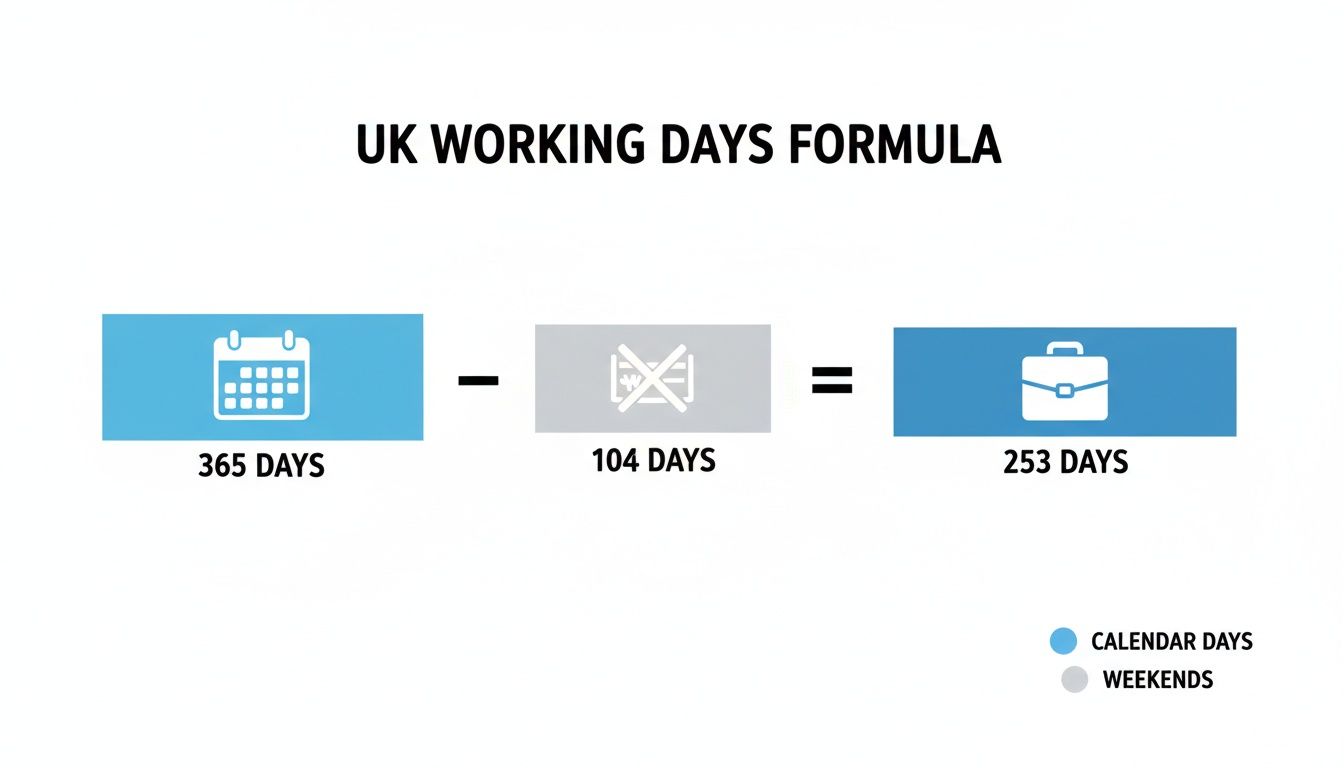
This formula gives us the starting point for England and Wales, but it's the holiday part of the equation that changes as soon as we cross the borders.
The Key Differences Across UK Nations
So, what are the specific variations you need to keep an eye on? While major holidays like Christmas and New Year's Day are shared across the board, a few key dates are unique to each nation, altering the final working day tally.
Here’s a quick rundown of the main distinctions:
- England and Wales: These two share the standard 8 bank holidays, which forms the baseline we've been using.
- Scotland: Things are a bit different here, with 9 bank holidays typically observed. This includes St Andrew's Day (30th November) and an early May bank holiday, but it's worth noting that Easter Monday isn't an official bank holiday.
- Northern Ireland: With 10 public holidays each year, Northern Ireland has the most. These include national holidays like St Patrick's Day (17th March) and the Anniversary of the Battle of the Boyne (12th July).
These might seem like small differences, but they have a big impact. For an employer with staff in London, Glasgow, and Belfast, it means juggling three separate holiday calendars to stay compliant and treat everyone fairly. If you're curious about the history behind these days, you can check out these 10 interesting facts about UK bank holidays.
For businesses with remote or multi-location teams, mastering these regional nuances is essential. It prevents payroll errors, maintains legal compliance, and ensures every employee receives their correct entitlement, fostering a fair and organised company culture.
This table clearly shows how those different holiday entitlements affect the total working days in a typical year.
UK Bank Holidays by Country and Impact on Working Days
| Country | Standard Bank Holidays | Average Working Days (Non-Leap Year) |
|---|---|---|
| England & Wales | 8 | 253 |
| Scotland | 9 | 252 |
| Northern Ireland | 10 | 251 |
As you can see, the final count isn't quite the same across the board. Accurate annual planning demands that you look beyond a single national figure and account for the specific location of your employees.
How to Calculate Working Days for Flexible Work Patterns
The classic Monday-to-Friday, nine-to-five schedule isn't the reality for many UK businesses anymore. As flexible working becomes the norm, you need a different way of thinking to calculate working days and holiday entitlements. The old full-time model just doesn't cut it.

For anyone on a non-standard schedule, a simple annual count of working days is basically useless. What matters are their specific contracted days. This is crucial for getting fairness and compliance right, especially when it comes to pro-rata bank holiday entitlements. Get this wrong, and you're heading for payroll headaches and unhappy staff.
Part-Time Employees
Part-time work is probably the most common flexible arrangement you'll deal with. The key here is to ignore the national average and focus entirely on the employee's specific working days.
Let's take an example: you have an employee who works every Tuesday, Wednesday, and Thursday.
- Calculation: 3 days per week × 52 weeks = 156 working days per year.
That number—156—is the new baseline for all their annual planning and leave calculations. A common tripwire for employers is getting bank holidays wrong. A part-time employee is entitled to a pro-rata share of bank holidays, and it doesn't matter if the holiday falls on a day they'd normally work or not.
For instance, someone working three days a week in England (that's a 60% contract) gets 60% of the 8 bank holidays, which comes out to 4.8 days. If a bank holiday falls on a Monday, they don't automatically get that day off if Monday isn't one of their workdays. Instead, it's all managed through their pro-rata allowance.
Compressed Hours and Four-Day Weeks
Compressed schedules, like a four-day week where someone works their full hours in fewer days, bring a different kind of challenge. They might be in the office less often, but they're still full-time employees.
Picture an employee who works Monday to Thursday.
- Total Working Days: They work four days a week, so their annual total is 4 days × 52 weeks = 208 working days.
The crucial bit is their holiday entitlement. Statutory leave is 5.6 weeks, not a rigid number of days. For a five-day worker, that’s 28 days. But for this four-day worker, their 5.6 weeks of leave works out to 22.4 days (5.6 weeks x 4 days).
You also have to manage bank holidays carefully. What if a bank holiday, like Good Friday, lands on their non-working day? They are still entitled to that day off. The fairest way to handle this is to give them their full pro-rata bank holiday allowance. You then deduct any bank holidays that fall on their normal workdays, and the rest becomes additional leave they can book.
This approach makes sure that someone on a compressed week isn't losing out compared to a colleague on a standard five-day pattern. A clear, consistent policy is absolutely vital for keeping things fair across all the flexible working arrangements in your business.
The True Impact of Unplanned Employee Absences
Knowing the theoretical number of working days in a year is a solid starting point for any business. But let's be honest—that number represents a perfect world. A world where every employee is present and productive, every single day. The reality on the ground for most small businesses is often quite different.
Unplanned employee absences, especially due to sickness, can take a serious bite out of your actual workforce capacity. This isn't just about losing a day's work here and there; it's about the ripple effect it has on project deadlines, team morale, and, ultimately, your bottom line. Moving from a theoretical count to a realistic one means facing the true cost of lost time.
The Financial and Operational Drain
For anyone managing finance or operations, getting a grip on these absences is critical. It’s not simply a matter of tracking sick days in a spreadsheet. It’s about recognising that each lost day represents a tangible cost in lost productivity, potential overtime for other staff, and missed business opportunities.
This gap between planned capacity and actual availability is where strategic planning can completely fall apart. If your forecasts are built on 253 working days per employee, but you consistently lose 5% of that time to sickness, your resource planning is flawed from the get-go.
The true number of working days isn't just a calculation; it's a reflection of your team's wellbeing. High absence rates often signal deeper issues that, if addressed, can protect your business's most valuable asset—its people.
The Scale of Work-Related Sickness in the UK
The impact of employee health on the UK workforce is huge. The data shows that millions of days are lost each year, not just to minor bugs, but to more serious, long-term conditions that demand a strategic response from employers.
Recent statistics from the Health and Safety Executive (HSE) paint a very clear picture. In Great Britain, stress, depression, or anxiety accounted for a staggering 22.1 million lost working days. Musculoskeletal disorders were responsible for another 7.1 million. On average, each worker affected by these issues took off 16.4 days, which really highlights the profound effect on business continuity. You can dig deeper into these findings in the HSE's official report.
This data underscores a crucial point for business owners: knowing how many working days in a year UK employees are actually available isn't just about subtracting weekends and bank holidays. It's about proactively managing employee health and wellbeing to minimise the disruption caused by unplanned absences. By understanding these trends, you can move from just reacting to problems to building a more resilient and supportive workplace.
Streamline Your Leave Management with Smart Tools
Let’s be honest, manually tracking employee leave on spreadsheets is a risky game. It’s an administrative headache just waiting to happen, prone to human error that can quickly snowball into compliance issues and payroll mistakes as your business grows. The moment you start juggling different work patterns and regional holidays, the complexity spirals.
This is the point where you trade manual chaos for automated clarity. Modern tools are built to handle all the tricky variables we’ve talked about. They automatically account for regional bank holidays in Scotland or Northern Ireland, adjust for leap years without a second thought, and perform flawless pro-rata calculations for your part-time staff. All the guesswork is removed, ensuring fairness for every single employee.
An organised dashboard like this gives you an immediate, clear overview of who is off and when.
Free Up Your Time and Reduce Risk
The real win with automation is getting your valuable time back. Instead of drowning in spreadsheets, business owners and managers can focus on what actually moves the needle: growing the business. These systems are packed with features designed to simplify everything:
- Self-Service Portals: Employees can request leave and check their balances right from their phones, which means fewer interruptions and questions for you.
- Automated Reporting: Get a real-time overview of staff availability and spot absence trends with just a glance.
- Compliance Assurance: Good software stays updated with UK regulations, helping you sidestep those costly legal mistakes.
By bringing in a dedicated system, you’re not just buying software; you’re investing in a more efficient, scalable, and compliant way to manage your team.
Adopting a smart tool is about swapping administrative burden for strategic oversight. It allows you to manage your team’s time effectively while ensuring accuracy and fairness across the board.
For more comprehensive tools that cover the full spectrum of human resources, you can also explore specialized HR software solutions like Hubdrive HR. Ultimately, the goal is to find a system that makes managing your team simpler. You can learn more about how dedicated employee leave management software can provide the clarity your business needs.
Frequently Asked Questions About UK Working Days
Even with the formulas down, you’ll always run into specific situations that can throw a spanner in the works. Let's clear up some of the most common questions that pop up.
How Do I Calculate Working Days for a Mid-Year Starter?
When an employee joins part-way through the year, you’ll need to work out their working days and holiday entitlement on a pro-rata basis. It’s pretty straightforward.
First, just count the number of working days left in the year from their start date. Don’t forget to factor in any bank holidays that are still to come. Their annual leave is then calculated based on the portion of the year they'll actually be working. For example, someone starting on 1 July is there for roughly half the year, so they’d get half of the standard leave allowance. Simple as that.
Do Weekend Bank Holidays Change the Total?
Good question, but no, they don’t. When a UK bank holiday like Christmas Day lands on a weekend, we get a ‘substitute’ day off instead, usually the following Monday.
This clever little system makes sure the total number of non-working days in the year stays the same. So, the final count of how many working days in a year UK businesses have doesn't change.
How Do Bank Holidays Work for Part-Time Staff?
Part-time employees get a pro-rata entitlement to bank holidays, which keeps things fair for everyone.
Think of it this way: if a full-time employee gets 8 bank holidays, someone working 60% of the hours (say, three days a week) is entitled to 4.8 days (which is 60% of 8).
If a bank holiday happens to fall on one of their usual working days, they just take it off and it comes out of that 4.8-day allowance. If it falls on a non-working day, their pro-rata entitlement means they don’t miss out – they can take that time off at a later date.


