
Figuring out your holiday entitlement should be straightforward, and for most full-time UK workers, it is. The law is clear: you're entitled to 5.6 weeks of paid annual leave. If you work a typical five-day week, that translates neatly into 28 days of paid time off each year.
Simple, right? But as with many things in employment law, the devil is in the detail.
Understanding Your Basic UK Holiday Entitlement

Before we get into the trickier calculations for part-timers or new starters, let's get the foundation right. This core entitlement is the bedrock for all holiday calculations, no matter your work pattern. It's there to make sure every worker has a legal right to paid time away from their job.
The key figure to remember is 5.6 weeks. This is the universal starting point set by the government. It’s designed to be proportional, applying fairly to everyone. For someone on a standard five-day week, the maths is simple:
- 5 days worked per week x 5.6 weeks = 28 days of paid holiday.
This is the absolute minimum an employer can legally give you. Of course, many companies offer more generous leave policies as a perk, but they can never go below this statutory amount.
To make this easier to visualise, here’s a quick breakdown of the minimum entitlement based on the days you work.
UK Statutory Holiday Entitlement At a Glance
This table provides a quick summary of the minimum statutory holiday entitlement based on the number of days worked per week.
| Days Worked Per Week | Weeks Entitlement | Equivalent Days Entitlement |
|---|---|---|
| 5 days | 5.6 weeks | 28 days |
| 4 days | 5.6 weeks | 22.4 days |
| 3 days | 5.6 weeks | 16.8 days |
| 2 days | 5.6 weeks | 11.2 days |
| 1 day | 5.6 weeks | 5.6 days |
As you can see, the entitlement is capped at 28 days. Even if someone works 6 or 7 days a week, their statutory entitlement doesn't go beyond this.
What's the Deal with Bank Holidays?
This is where it often gets confusing. Do the eight UK bank holidays come out of your 28 days, or are they on top? The answer is… it depends on your employer. They have two main options, and you can get additional insights on annual leave in the UK to see the official guidelines.
So, what does this actually mean for you?
- Inclusive Approach: Your contract might say you get 28 days of leave, including bank holidays. This means you have 20 days to book whenever you like, while the other 8 are fixed on days like Christmas and Easter Monday.
- Exclusive Approach: A more generous contract might offer 28 days of leave plus bank holidays. In this scenario, you’d get a total of 36 paid days off (28 flexible days + 8 fixed bank holidays).
It’s absolutely vital to check your employment contract to see which approach your company takes. This one detail makes a huge difference to your flexible time off.
Contractual vs. Statutory Leave
It's also important to understand the difference between what the law demands and what your employer chooses to give you.
- Statutory Entitlement: This is the legal minimum of 5.6 weeks we've been talking about. It’s your right, protected by law.
- Contractual Entitlement: This is any extra leave your employer offers on top of the statutory minimum. It’s a part of your employment agreement and a pretty common workplace perk.
For example, a company might offer 30 days of annual leave plus bank holidays. Here, your total entitlement is 38 days. This is made up of the 28 statutory days and 10 extra contractual days. Your employer can also set different rules for this additional leave, like whether you can carry it over into the next year.
Key Takeaway: Always check your employment contract first. It is the single source of truth for your total annual leave, how bank holidays are handled, and any other company-specific rules that go beyond the legal minimum.
Once you’ve got this baseline sorted, you’re in a great position to tackle more complex situations, like calculating leave for part-time hours or working out what you’re owed when you start or leave a job.
Calculating Leave for Full-Time and Part-Time Staff

Right, let's get down to the practical side of things. For a full-time employee on a standard five-day week, the calculation is simple—they get their full 5.6 weeks. But things get a bit more interesting when an employee works fewer days or hours. This is where we need to talk about pro-rata.
The term sounds more complicated than it is. It simply means "in proportion." It’s the method we use to make sure part-time workers get a fair slice of the holiday pie, proportional to the time they actually work. It’s all about preventing a scenario where someone working two days a week gets the same 28 days of leave as a full-time colleague.
Let's break down exactly how you work this out in a few common situations.
Working Out Leave for Part-Time Staff on Set Days
This is probably the most common setup you'll encounter: an employee works the same set days each week. The calculation here is thankfully straightforward and builds directly on that statutory 5.6-week foundation.
Here’s the simple formula:
Number of days worked per week × 5.6 = Total annual holiday days.
Let's say you have an employee, Sarah, who works a regular three-day week.
- 3 days × 5.6 weeks = 16.8 days
So, Sarah is entitled to 16.8 days of paid leave per year. In practice, most employers will round this up to the nearest half or full day to keep things tidy, making it 17 days. Just remember, you can round up but you can’t legally round down.
Here’s another quick example for someone working four days a week:
- 4 days × 5.6 weeks = 22.4 days
Again, this would likely be rounded up to 22.5 days to make booking easier. While the maths is simple, getting it consistently right can be a faff. For a quick and guaranteed accurate answer, using a dedicated holiday entitlement calculator can be a real time-saver.
Calculating for Staff on Set Weekly Hours
Some part-time roles aren't defined by days, but by the number of hours someone works each week. Think about a retail employee contracted for 20 hours a week, but whose shift patterns vary. In these cases, you need to calculate their holiday entitlement in hours.
First, you need a baseline. Let's assume your full-time week is 37.5 hours. The total holiday hours for a full-timer would be:
- 37.5 hours/week × 5.6 weeks = 210 hours of annual leave.
Now you can figure out the pro-rata amount for your part-time employee. Let’s take Alex, who works a 20-hour week.
The calculation is:
- 20 hours/week × 5.6 weeks = 112 hours of annual leave.
This means Alex can book 112 hours of paid leave during the year. If they take a day off when they were scheduled for a four-hour shift, they simply use four hours from their total pot. This method is incredibly fair because it doesn't matter how their shifts are structured day-to-day.
A Quick Tip for Fairness: Calculating leave in hours is often the most equitable approach for anyone whose workday length varies. It ensures they receive pay for the exact hours they would have worked, whether they take a four-hour shift or an eight-hour shift off.
The Bank Holiday Complication for Part-Time Workers
Ah, bank holidays. They can create a real headache when it comes to part-time staff. In England and Wales, we have eight permanent bank holidays. If a part-timer’s regular working day falls on a bank holiday Monday, great—they get the day off. But what about the person who never works on a Monday?
This is where things can quickly become unfair, with some part-time staff effectively getting more paid leave than their colleagues.
Imagine a company gives 28 days of leave, inclusive of those bank holidays.
- Employee A works Monday to Wednesday. Lots of bank holidays fall on a Monday, so they get those days off as paid leave, seemingly automatically.
- Employee B works Wednesday to Friday. They miss out on every single Monday bank holiday.
So, how do you fix this? The best and fairest approach is to give all part-time staff their full pro-rata entitlement in days or hours. They then have to book any bank holidays that fall on their normal working days from that total allowance.
For Employee A (3 days/week, 16.8 days leave):
- If a bank holiday falls on a Monday, they must use one of their 16.8 days to cover it, just like any other day off.
For Employee B (3 days/week, 16.8 days leave):
- If a bank holiday falls on a Monday, it doesn't affect them. It’s not their working day, so they don’t need to book it off. They still have their full 16.8 days to use as they wish.
This approach ensures everyone receives their correct proportional entitlement. No one is penalised or benefits unfairly just because of the days of the week they happen to work. It's a vital step in keeping your holiday policy fair and transparent.
Managing Holiday Pay for Starters and Leavers

It’s a rare day when an employee’s start or end date lines up perfectly with the company’s holiday year. People come and go throughout the year, which means you need a solid handle on calculating their holiday entitlement on a pro-rata basis. This is all about fairness, ensuring someone who joins in October gets their fair share, just as someone leaving in March does.
The core principle is simple: holiday entitlement builds up, or accrues, as the year goes on. An employee earns a slice of their total annual leave for each month they work. This system is what stops a new hire from booking their full 28 days of leave in their first month and then handing in their notice.
The standard calculation is straightforward. You just divide the full annual entitlement by 12 to find the monthly accrual rate. For a full-timer on the statutory minimum, that looks like this:
- 28 days / 12 months = 2.33 days per month
For every full month of service, an employee adds 2.33 days to their holiday pot.
Calculating Entitlement for a New Starter
Let's put this into practice. Imagine a new employee, David, starts on 1st March. If your company’s holiday year runs from January to December, David will have worked for 10 full months by the time the year is out.
His pro-rata entitlement for that first year is worked out using the monthly rate we just calculated:
- 10 months worked × 2.33 days/month = 23.3 days
So, David is entitled to 23.3 days of paid leave. Most employers I know would round this up to 23.5 days to keep things simple and avoid dealing with awkward fractions of a day.
Handling Final Holiday Pay for Leavers
Working out the final holiday pay for someone leaving is one of the most critical parts of the offboarding process. You have to figure out if you owe them for any untaken leave, or, in some cases, if they owe you for taking more leave than they'd earned. Get this wrong, and you're looking at payroll headaches and a potentially disgruntled former employee.
The calculation itself is a simple three-part process:
- First, work out the total holiday they accrued up to their last day.
- Then, subtract the number of holiday days they’ve already taken.
- The result tells you what’s owed – either a payment to them or a deduction from their final pay.
A Crucial Point: Paying an employee for any untaken statutory holiday is a legal requirement. You can't just write it off. If they've earned it but not taken it, you must pay them for it in their final salary.
Worked Example for a Leaver
Let's walk through a common scenario. Meet Chloe, a full-time employee who gets the standard 28 days of leave. Your holiday year is January to December, and she hands in her notice to leave on 15th August.
When Chloe leaves, she will have worked for 7.5 months of the year.
First, we need to calculate her total accrued leave for that period:
- 7.5 months × 2.33 days/month = 17.475 days
We'll round that up to 17.5 days for practicality. This is the total holiday Chloe was entitled to. A quick check of your records shows she has already taken 12 days off this year.
Now for the final calculation:
- 17.5 days accrued – 12 days taken = 5.5 days owed
This means you must pay Chloe for 5.5 days of untaken leave in her final payslip. Our guide on how to https://www.leavewizard.com/calculate-holiday-pay/ has even more detail on this.
But what if Chloe had been a bit more liberal with her holidays and had already taken 20 days?
- 17.5 days accrued – 20 days taken = -2.5 days
In this situation, Chloe has taken 2.5 more days of leave than she had actually earned. As long as your employment contract has a clause allowing it, you can deduct the value of this excess leave from her final salary. Without that clause, clawing it back becomes much trickier.
To give you a clearer picture of how leave accumulates, here’s a quick breakdown for a leaver after 7.5 months:
Example Accrual Calculation for a Leaver
This table shows the month-by-month holiday accrual for a full-time employee, illustrating how the total entitlement builds over their time with the company.
| Months Worked | Calculation (28 days / 12 months) | Accrued Holiday (Days) |
|---|---|---|
| 1 | 1 x 2.33 | 2.33 |
| 2 | 2 x 2.33 | 4.66 |
| 3 | 3 x 2.33 | 6.99 |
| 4 | 4 x 2.33 | 9.32 |
| 5 | 5 x 2.33 | 11.65 |
| 6 | 6 x 2.33 | 13.98 |
| 7 | 7 x 2.33 | 16.31 |
| 7.5 | 7.5 x 2.33 | 17.48 |
As you can see, the final figure of 17.48 (rounded to 17.5) matches our calculation for Chloe.
Getting these calculations right is fundamental, but sometimes businesses run into wider challenges. For anyone wanting to explore related financial topics, resources discussing issues related to unpaid entitlements can offer valuable context. It all underscores just how vital clear policies and meticulous record-keeping truly are.
Navigating the Rules for Irregular Hours and Part-Year Workers
Work patterns that don’t fit the standard Monday-to-Friday mould, like zero-hours contracts, casual staff, and seasonal work, often create the biggest headaches when it comes to holiday pay. For years, these situations have been a bit of a grey area, but recent changes have brought some much-needed clarity.
Knowing how to work out holiday entitlement in these scenarios is essential. The key is to move away from a "days" based system and start thinking in terms of the actual hours worked. This ensures that holiday accrues in direct proportion to the work someone does, which is the fairest method for everyone involved.
The Shift to a Percentage-Based Calculation
For workers with irregular hours or those who only work part of the year (like term-time or seasonal employees), the most accurate way forward is to use a percentage of the hours they’ve worked. This approach keeps pay fair and reflects their fluctuating work patterns.
A major legal reform came into effect in January 2024, which changes how holiday entitlement is calculated in the UK. This new method calculates entitlement as 12.07% of the actual hours worked during a pay period, directly reflecting the statutory minimum of 5.6 weeks paid leave. This calculation smooths out the inconsistencies of previous approaches.
The reforms also re-introduced 'rolled-up' holiday pay, which can simplify payroll administration and make entitlements clearer for employees.
Why 12.07%? This figure isn't just pulled out of thin air. It’s derived from the statutory 5.6 weeks of holiday divided by the total working weeks in a year (52 weeks – 5.6 weeks = 46.4 weeks). So, 5.6 ÷ 46.4 gives you 12.07%.
This simple percentage is now the standard for calculating accrued leave for these types of workers, making it a vital number for any payroll or HR manager to have in their back pocket.
Applying the 12.07% Rule in Practice
Let's see how this works with a real-world example. Imagine you have a casual worker, Alex, on a zero-hours contract. Last month, his timesheets show he worked a total of 80 hours.
To figure out the holiday time he’s earned, you just apply the percentage:
- 80 hours worked × 0.1207 = 9.656 hours
So, in that month, Alex earned just over 9.6 hours of paid holiday. This pot of accrued holiday hours builds up over time. When he wants to take a paid day off, the hours he was scheduled to work that day are simply deducted from his pot.
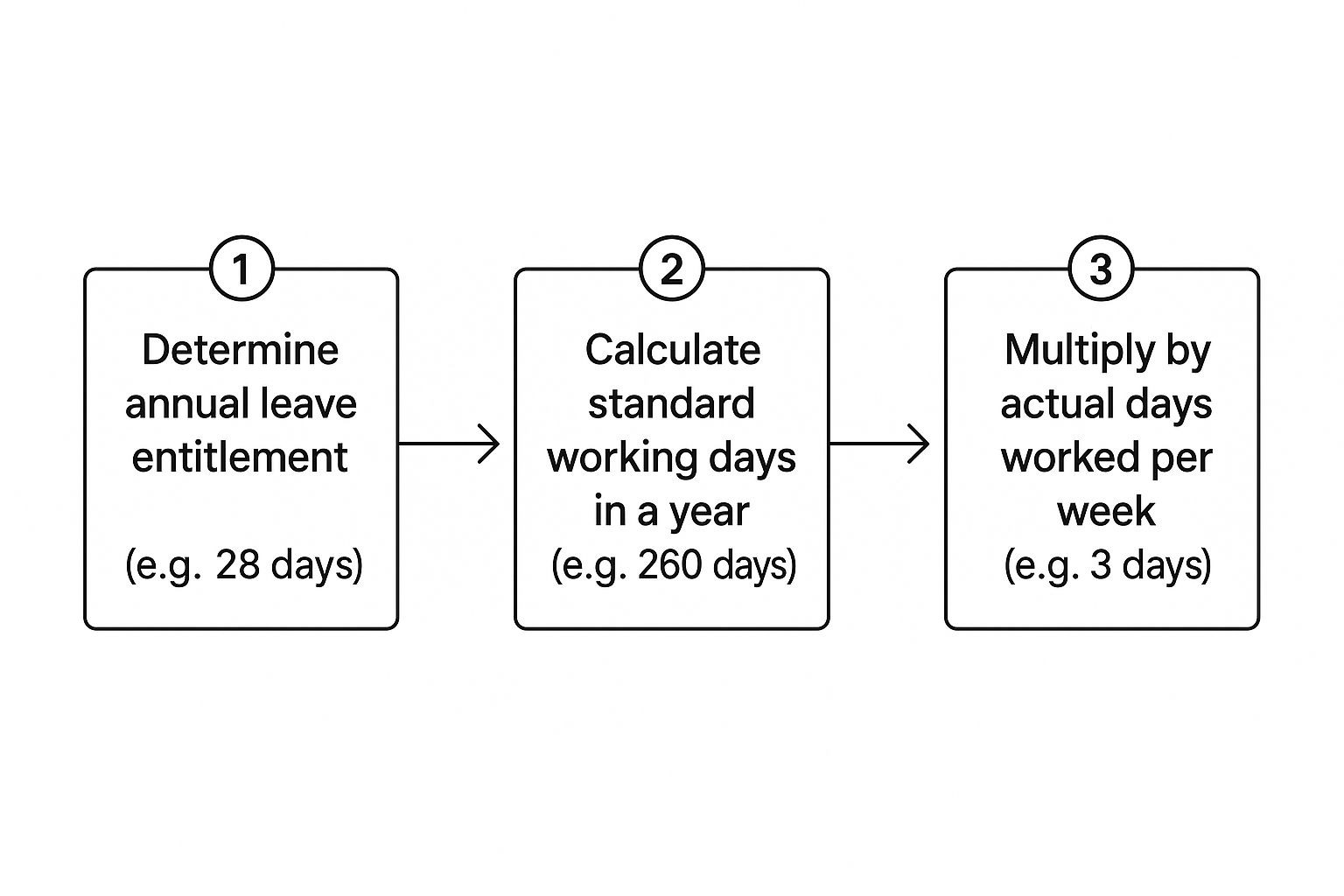
While the visual above illustrates the logic for fixed part-time roles, the 12.07% method applies this same principle of proportionality to hours, making it perfect for variable work patterns. For a deeper dive into the specifics, you might find our detailed guide on holiday entitlement on a zero-hours contract useful.
Demystifying Rolled-Up Holiday Pay
Another significant development is the return of 'rolled-up' holiday pay for irregular-hours and part-year workers. This practice had previously been deemed unlawful, but the recent reforms have made it a compliant option once again.
So, what exactly is it?
- Rolled-up holiday pay is when an employer pays an additional amount on top of a worker’s normal hourly rate. This extra sum represents their holiday pay for the hours they've just worked.
- The extra payment must be at least 12.07% of their pay.
- Crucially, this amount must be clearly itemised on the worker’s payslip so they can see exactly what they've received as holiday pay.
Let's go back to Alex, our casual worker. If his hourly rate is £11.50, his rolled-up holiday pay calculation would look like this:
- £11.50 (hourly rate) × 0.1207 = £1.39
This means for every hour Alex works, he receives an extra £1.39 in holiday pay, making his effective hourly rate £12.89. If he works 80 hours in a month, his payslip would show his regular earnings (£920) plus an additional £111.20 listed clearly as holiday pay.
The biggest benefit here is simplicity. It removes the headache of tracking accrued holiday hours and calculating pay when leave is taken. For the worker, it means immediate payment for the holiday they’re earning. The flip side, of course, is that when they do take time off, that time will be unpaid, as they've already received their holiday pay in advance. This approach really hinges on clear communication so that employees understand how it works and can budget accordingly.
Common Holiday Entitlement Mistakes to Avoid
Knowing how to calculate holiday entitlement is one thing, but avoiding the common slip-ups that can lead to disputes is another skill entirely. Once you've got the basic numbers down, you need to be aware of the tricky details that often trip up managers and employees alike.
Think of this as your guide to navigating the grey areas. We'll look at the specific rules around rounding partial days, carrying leave into the next year, and what happens when someone is on long-term absence. Getting these nuances right is the difference between a fair, compliant holiday policy and a future headache.
The Problem of Partial Days
So, your calculation spits out a fraction of a day, like 16.8 days for a part-timer. What now? This is a really common point of confusion, but thankfully, the law is crystal clear on one point.
You are legally allowed to round holiday entitlement up, but you can never round it down.
- An entitlement of 16.8 days can be rounded up to 17 days or even to 16.5 days to make booking easier.
- It is absolutely illegal to round this figure down to 16 days.
Why? Because rounding down means the employee receives less than their statutory minimum, putting the business at serious legal risk. In my experience, most employers simply round up to the nearest half or full day. It keeps the booking process clean and ensures everyone stays compliant.
Handling Unused Holiday and Carry-Over Rules
What about when an employee hasn't used all their holiday by the time the year ends? The rules around carrying over leave are quite specific. Under the Working Time Regulations, your team must take at least four weeks of their statutory leave within the year it's due.
However, employers can allow staff to carry over the remaining 1.6 weeks (that's eight days for a full-timer) into the next leave year. This is only permitted if you have a written agreement in place. Many companies offer this as a gesture of goodwill, but it’s crucial to remember it isn't an automatic right.
A Quick Heads-Up: The rules were relaxed temporarily during the pandemic, allowing more leave to be carried over, but those standard regulations are now back in full swing. Always double-check your company policy to see what's allowed.
The Impact of Long-Term Absence
Here's a critical point that many managers miss: an employee's right to paid holiday continues to build up even when they are off work on long-term sick leave or family leave, such as maternity or paternity.
If someone is on sick leave for six months, they are still accruing their holiday entitlement during that entire period. If their illness prevents them from taking this leave, you must allow them to carry it over into the next leave year. This protects their fundamental right to paid rest, regardless of their health status.
Encouraging Staff to Actually Take Their Leave
It might sound strange, but a growing problem is employees simply not taking their full holiday allowance. This is a fast track to burnout and a dip in productivity. In fact, recent data shows a worrying trend where the average annual leave taken dropped to 33.9 days in 2023, a big fall from 38 days in 2020. This decline is especially steep in sectors like construction (-10.98%) and financial services (-9.11%). You can dig deeper into these UK annual leave trends by industry if you're curious.
As a manager, your role isn't just to approve requests; it's to actively encourage your team to take restorative breaks.
- Lead by example. When you take your own holidays and properly switch off, it sends a powerful message that it’s okay for everyone else to do the same.
- Have regular check-ins. Casually bringing up holiday plans in one-to-one meetings helps normalise taking time off.
- Keep an eye on balances. Notice someone has a lot of leave left? A gentle prompt to get some time booked in can make all the difference.
A well-rested team is a more effective team. Making sure leave doesn't pile up avoids that last-minute rush at the end of the year and genuinely supports your staff's well-being. It’s a win for everyone.
Still Have Questions About Holiday Pay?
Let's dig into some of the common questions I hear all the time when people try to get their heads around holiday entitlement. These are the real-world situations that often trip people up, so let's get them cleared up.
Can My Boss Tell Me When I Have to Take My Holidays?
The short answer is yes, they can. An employer can actually dictate when you take your annual leave, but there's a key condition: they have to give you proper notice.
The rule of thumb is they must provide notice that's at least double the length of the leave they want you to take. So, if they need you to take a week off, they have to let you know at least two weeks beforehand. This is quite common for businesses that have a planned shutdown, like over the Christmas break.
Do I Still Build Up Holiday Time if I'm on Sick Leave?
You certainly do. Your statutory holiday entitlement keeps building up just as it normally would while you're off on sick leave, and it doesn't matter how long you're away. Since you're still legally employed, your right to paid leave remains protected.
What’s more, if you can't actually use your holiday because of your illness, your employer has to let you carry it over into the next leave year. They can't stop you from taking the leave you've accrued once you're back at work.
One thing to be crystal clear on: your employer cannot force you to take annual leave while you are certified sick. That decision is entirely yours.
What Happens if I Change from Full-Time to Part-Time?
If your contract changes part-way through the year, your holiday entitlement needs a bit of a recalculation to make sure it's fair. It’s essentially a two-step process.
First, you figure out how much leave you earned while you were working full-time. Then, you calculate your new pro-rata entitlement for the rest of the year based on your new part-time hours. Just add those two figures together, and you've got your total for the year.
Here’s a practical example:
- Let's say you worked full-time (5 days a week) for the first 6 months and then switched to part-time (3 days a week) for the final 6 months.
- Full-time portion: (28 days statutory leave / 2) = 14 days
- Part-time portion: (16.8 days pro-rata leave / 2) = 8.4 days
- Your total entitlement for the year: 14 + 8.4 = 22.4 days
This method ensures your holiday allowance is a true reflection of the hours you've actually worked across the whole year.


