
Let's get straight to it. When you're trying to figure out holiday entitlement, everything starts with one simple rule: full-time workers in the UK are legally entitled to 5.6 weeks of paid annual leave.
For the vast majority of people working a typical five-day week, this translates directly to 28 days off per year. Simple as that.
Your Basic UK Holiday Entitlement Explained
So, what does that statutory minimum actually mean in practice? Think of it as the legal foundation for all UK holiday rights. It’s the baseline that guarantees every full-time worker gets a protected amount of paid time off, no ifs or buts.
This mandatory 28 days (or 5.6 weeks) of paid leave usually includes the 8 UK public or bank holidays. Some employers are more generous, but this is the absolute minimum required by law.
The Role of Bank Holidays
Bank holidays are a classic point of confusion, and I see it all the time. Your employer has two ways of handling them:
- Inclusive: The 8 bank holidays are simply counted as part of your total 28-day allowance.
- Additional: You get 28 days of annual leave on top of the 8 bank holidays, giving you a much healthier 36 days in total.
Which one applies to you? Your employment contract is the only place to get a definitive answer. It absolutely must spell out how bank holidays are treated. If it’s vague or doesn't mention them at all, the default assumption is that they are included within the standard 28 days.
It's a common misconception, but there's no automatic legal right to take bank holidays off. An employer can require you to work on these days, provided they make sure you still get your full 5.6 weeks of leave at another time.
Understanding this statutory minimum is the first step, because it’s the starting point for every other calculation. Whether you’re working part-time, on a zero-hours contract, or joining a company halfway through the year, it all comes back to this number. For a deeper look, check out our guide on understanding annual leave entitlement.
Getting holiday entitlement right isn’t just good practice; it's a crucial part of your legal duties as an employer. To make sure you're on top of other obligations, this business compliance checklist is a really useful resource.
Calculating Holiday For Part-Time Workers
Working less than a five-day week doesn’t mean you miss out on holiday. It simply calls for a pro-rata approach, where your annual leave mirrors the fraction of full-time hours you put in.
Imagine full-time staff get 28 days statutory leave. If you’re on a three-day week, you’d calculate your entitlement like this:
- Days Worked Per Week: 3
- Full-Time Days Per Week: 5
- Full-Time Holiday Allowance: 28
Then apply the formula:
(3 / 5) × 28 = 16.8 days
This visual guide walks you through every stage, from spotting the statutory minimum to tweaking the figures for part-time patterns.
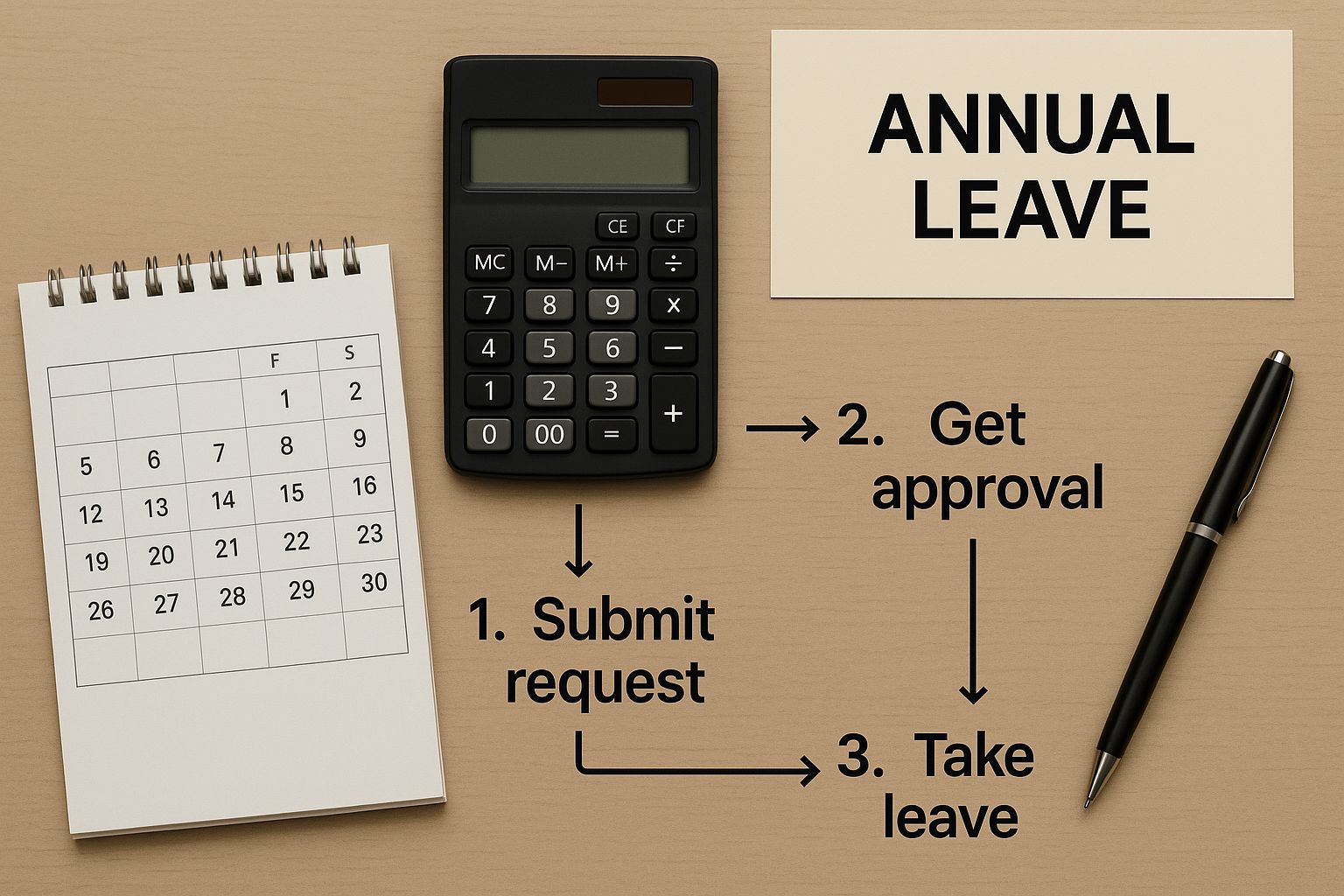
It all starts with working out the full-time equivalent before you scale down to part-time hours.
Working Out Holiday In Hours
Days work well when shifts are consistent. But if someone alternates between an 8-hour day and two 4-hour days, hours give a fairer picture.
Our three-day-week employee racks up 16 hours per week (8 + 4 + 4). A standard full-timer puts in 40 hours (8 × 5). First, find total annual hours:
- 28 days × 8 hours = 224 hours
Then pro-rata:
(16 / 40) × 224 = 89.6 hours of leave
By measuring leave in hours, taking an 8-hour day off counts exactly twice a 4-hour day. No guesswork, just fairness—essential for healthy workplace relations.
Manually juggling these sums can lead to slip-ups. For extra examples, tips and ready-made templates, dive into our guide on holiday calculation for part-time workers. It’s the quickest way to keep your records spot-on and your team smiling.
Navigating Leave for Irregular and Zero-Hour Contracts
Working out holiday entitlement for casual, zero-hour, or other irregular contracts can often feel like pure guesswork. The trick is to stop thinking in terms of days and start focusing on the hours you've actually worked, using a simple percentage to calculate your leave.
This method keeps things fair by directly linking your holiday allowance to the time you've put in. The magic number here is 12.07%. This figure isn't just plucked out of thin air; it represents the statutory 5.6 weeks of holiday as a percentage of the total working weeks in a year (which is 52 weeks minus your 5.6-week entitlement).

The Percentage Method in Action
So, how do you figure out how much leave you've earned? You just multiply the hours you’ve worked during a pay period by 12.07%.
Let's imagine you worked 60 hours last month. The calculation is straightforward:
60 hours × 0.1207 = 7.24 hours of holiday accrued
This amount builds up with every payslip, giving you a clear, running total of the paid leave you're entitled to take. It’s a transparent way to handle holiday for roles where your hours can change from one week to the next. For a deeper dive, check out our full article on holiday entitlement on a zero hours contract.
Keeping Up with Recent Rule Changes
The rules for irregular hours and part-year workers have seen some important updates recently. New UK legislation has clarified holiday rights, officially endorsing the 12.07% method for calculating leave based on the hours someone has worked.
One of the biggest updates is the return of 'rolled-up' holiday pay as a compliant option for these types of workers. This allows employers to include an additional amount for your holiday pay directly in your regular wages, rather than paying it when you take the time off.
This change is designed to make payroll simpler for businesses that rely on a flexible workforce. If your employer uses this system, your payslip should clearly break down the holiday pay portion. Being aware of these rules is key to making sure you're getting the holiday pay you've rightfully earned.
Handling Holiday When Someone Joins or Leaves
Figuring out holiday entitlement gets a little more interesting when an employee's start or end date doesn't line up neatly with the company's leave year. This is a super common scenario, and the answer is to calculate their holiday allowance on a pro-rata basis.
Essentially, this just means they earn a fraction of the full annual entitlement for each month they're on the payroll.
Holiday leave starts to accrue from their very first day on the job. The simplest way to keep track of this is to remember that an employee earns one-twelfth of their total annual leave for each full month they work. For a standard 28-day allowance, that works out to about 2.33 days of holiday per month.
This gradual build-up is the fairest way to make sure their entitlement accurately reflects the portion of the year they've actually been with the company.
Example for a New Starter
Let's walk through a real-world situation. Imagine Sarah joins your company on 1st July, and your holiday year runs from January to December. Her full-time contract gives her the statutory 28 days of leave.
So, how much holiday does she have for the rest of the year? Here's the simple calculation:
- Months worked: Sarah will be with the company for 6 months of the leave year (July through to December).
- Monthly accrual: 28 days / 12 months = 2.33 days per month.
- Total entitlement: 2.33 days × 6 months = 13.98 days.
You'd almost always round this up, giving Sarah 14 days of paid leave she can take before the end of December.
What Happens When an Employee Leaves?
The exact same logic applies when someone is leaving your team. Their final holiday entitlement is calculated right up to their last day of employment. It's a legal requirement that you pay them for any statutory leave they've accrued but haven't managed to use.
Let's take another example. David resigns, and his last day is 30th September. He's worked for a total of 9 months of the year.
- Accrued leave: (28 days / 12 months) × 9 months = 21 days.
- Leave taken: Looking at the records, David has already used 15 days of holiday this year.
- Untaken leave: 21 days accrued – 15 days taken = 6 days.
In this case, David's employer must include a payment for these 6 untaken days in his final paycheque. This is often called 'pay in lieu of holiday', and it's not optional—it's a legal obligation.
Common Scenarios and Holiday Pay Questions
Beyond the standard calculations, real life often throws curveballs that can make holiday entitlement a bit tricky. Questions about sick leave, parental leave, or company policies on carrying over unused days are common hurdles for both employees and managers. Getting your head around these nuances is key to making sure everything is fair and compliant.
So, what happens if you're on long-term sick leave? It's a common question. Your holiday entitlement continues to build up just as it normally would. You can even carry over up to four weeks of this statutory leave into the next holiday year if you weren't able to take it due to your illness.

Carrying Over and Using Your Leave
The rules around carrying over unused holidays can vary quite a bit. While you have a right to carry over leave accrued during sick or parental leave, it’s your employer's specific policy that matters for any other unused days. Always check your contract—many companies have a "use it or lose it" approach for any leave you get on top of the statutory minimum.
Interestingly, many of us in the UK don't actually use our full holiday allowance. Data shows the average holiday taken dropped from 38 days in 2020 to around 34 days in 2023, with about five days left unused per employee each year. To dig deeper into these annual leave trends, you can explore the full UK report.
Your employer has to give you a fair chance to take your statutory holiday. They can't just refuse requests without a solid business reason. This is where clear booking policies and open communication become essential to avoid any disagreements.
To get on top of the more complex questions about paid time off, mastering calculating PTO effectively is a massive help for everyone involved.
Another frequent question is about "selling" holiday days back to your employer. This is only allowed for leave that is above the statutory 5.6 weeks. You can't be paid in lieu for your minimum statutory entitlement unless you're leaving your job. This rule exists for a good reason—to make sure everyone takes the time they need to rest and recharge.
Even once you've got the hang of the basics, a few specific questions always seem to pop up. Let's tackle some of those common queries so you can feel completely confident about how holiday entitlement works in practice.
What Happens if My Pay Changes?
It's a great question, and the answer is yes – if you get a pay rise, your holiday pay should reflect that. Holiday pay is worked out based on your average weekly earnings over the previous 52 paid weeks.
Any pay increase you receive gets factored into this average. This ensures the time you take off is paid at a rate that reflects what you're currently earning, not what you were earning months ago.
Can an Employer Actually Deny My Holiday Request?
In short, yes, they can. An employer is allowed to refuse a holiday request, but they can't just do it on a whim. They need a solid business reason for it and must give you proper notice.
The rule of thumb for notice is that it has to be at least as long as the holiday you requested. So, if you've booked a two-week holiday, your employer needs to give you at least two weeks' notice if they have to deny it.
It's worth remembering that an employer can't just issue a blanket ban on all holiday requests. Having a clear, fair policy and open communication is absolutely essential for keeping things running smoothly for everyone involved.


