You're staring at a spreadsheet while an employee waits for an answer. They work different shifts each week, have taken several bank holidays, and have earned commission that may affect their holiday pay. The formula looks simple until you need to apply it to a real person with a changing schedule.
That's the operational problem with holiday entitlement. The legal baseline is manageable, but translating it into payroll, rotas, approvals and payslips requires consistent records. This guide breaks the process into practical decisions, so you can replace guesswork with a calculation you can explain and audit.
Table of Contents
- Why Manual Holiday Calculations Fail Small Businesses
- The Core Statutory Holiday Calculation Formula Explained
- Adapting the Formula for Part-Time and Irregular Hours
- Calculating Holiday Pay for Variable and Commission Earners
- Navigating Bank Holidays and Pro-Rata Entitlements
- Common Spreadsheet Mistakes in Leave Tracking
- Building a Compliant and Transparent Leave Policy
Why Manual Holiday Calculations Fail Small Businesses
An HR manager receives a leave request from a part-time employee whose working days change from week to week. The manager opens a spreadsheet, checks the employee's contract, counts bank holidays, searches old payslips and tries to work out whether commission belongs in the holiday pay calculation. By the time the answer is ready, the spreadsheet contains several manual adjustments that another colleague may struggle to follow.
That situation is common because statutory leave rules interact with working patterns. A fixed-hours employee can often be managed with a straightforward annual allowance. A casual, seasonal or zero-hours worker needs a record of hours worked, leave accrued and pay history. Bank holidays add another policy decision, while rounding can create small discrepancies that become difficult to explain over time.
Practical rule: A holiday calculation is only reliable when another person can follow the inputs, formula and result without asking the original spreadsheet owner for help.
Manual tracking usually breaks at the handover points. Payroll may hold the pay data, HR may manage entitlement, and line managers may approve leave in a separate calendar. If those records don't connect, someone can approve leave against an outdated balance or calculate pay without the relevant variable earnings.
A sound process starts with the basic holiday calculation formula and then adds the right layer for each worker. You need to identify the worker's pattern, choose days or hours as the tracking unit, decide how bank holidays are treated and preserve the information used for holiday pay. A practical guide to running payroll can also help you connect leave records with wider payroll controls, especially if one person currently handles every stage manually.
The aim isn't to turn a small business into a legal department. It's to create a repeatable process that produces the same answer when the same facts are entered, even when the employee's schedule changes.
The Core Statutory Holiday Calculation Formula Explained
The UK starting point is 5.6 weeks of paid leave for a full leave year. For a worker on a full leave year, entitlement is capped at the lower of 28 days or 5.6 times the number of days worked per week. The rule acts like a common measuring tape: first identify the employee's normal working week, then multiply that pattern by 5.6.
The resulting entitlements are 28 days for a 5-day worker, 22.4 days for a 4-day worker, 16.8 days for a 3-day worker, 11.2 days for a 2-day worker and 5.6 days for a 1-day worker, as set out in GOV.UK guidance on calculating holiday entitlement for different contract types.
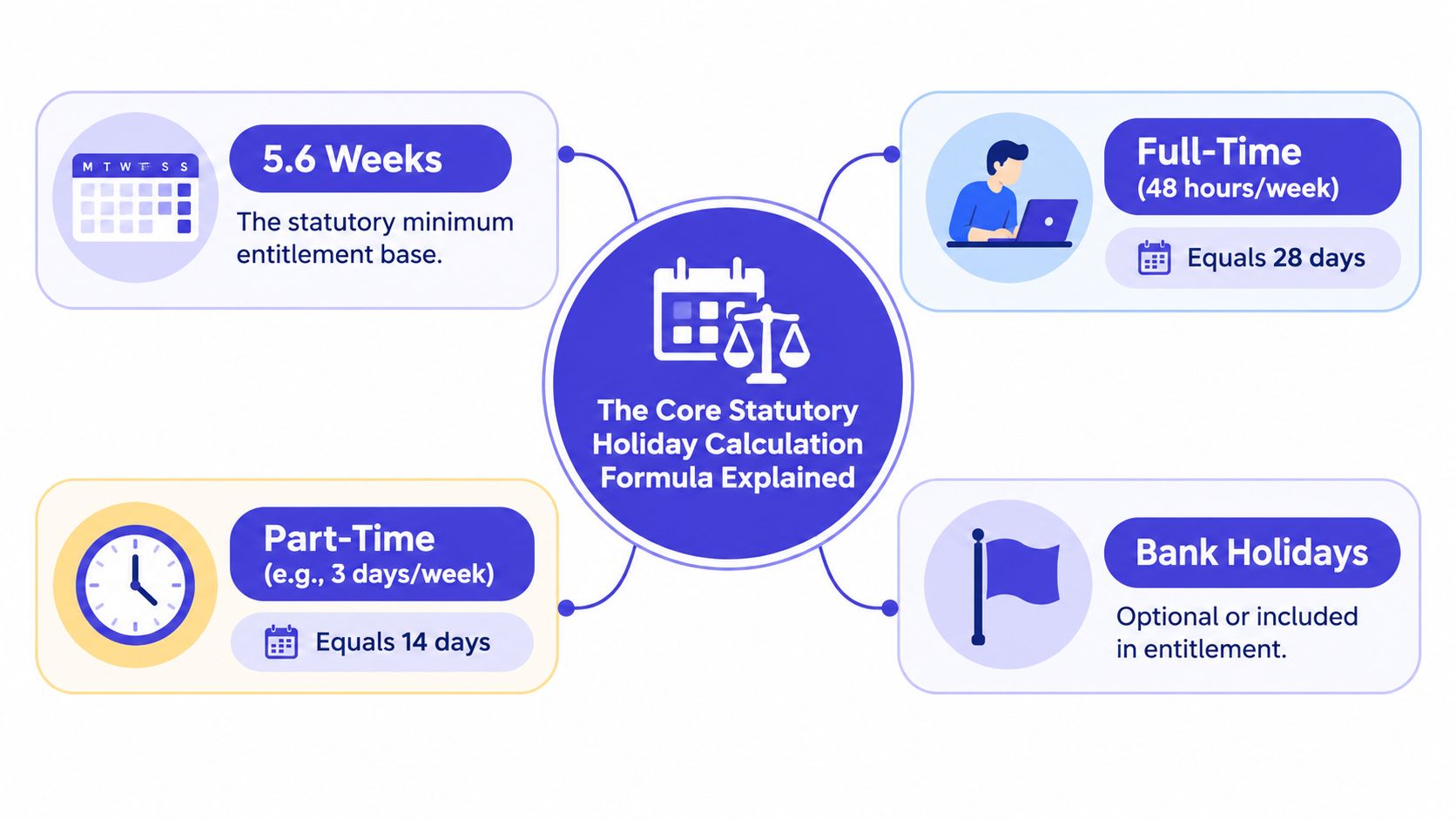
Turning weeks into working days
Suppose an employee normally works three days each week. The entitlement isn't calculated by giving them the same number of calendar days as a five-day employee. The working pattern is the unit of measurement, so the 5.6-week baseline produces 16.8 days for that worker.
That distinction matters when staff work compressed hours. An employee might work fewer days but longer shifts. If the organisation records leave in days, a day should represent the employee's relevant working day. If it records leave in hours, the business needs a consistent hourly policy and accurate contracted or worked-hour records.
The 28-day cap also prevents a five-day worker from receiving more statutory entitlement merely because a formula has been applied without checking the limit. Additional contractual leave can exist, but it should be clearly separated from the statutory baseline in the policy and payroll records.
Where bank holidays fit
Bank holidays don't automatically sit outside the statutory allowance. UK guidance says employers can include bank or public holidays within statutory annual leave, so the policy and contract need to state how the allowance is presented to employees. A leave system should therefore distinguish the total entitlement from the dates on which the business closes or expects staff to take leave.
A simple formula is useful only when the inputs are defined. Record the number of working days, the leave year, whether the employee is part-year, and whether the business expresses entitlement in days or hours. That foundation prevents later calculations from mixing incompatible units.
The following video offers another visual explanation of the underlying calculation:
Adapting the Formula for Part-Time and Irregular Hours
Fixed part-time patterns are usually handled by pro-rating the statutory baseline. The harder task begins when an employee's hours change from one pay period to the next, or when they work only during part of the year. In that situation, a day-based allowance can give a misleading impression of the leave the person has earned.
For irregular-hours and part-year workers, the modern accrual method uses 12.07%. The rate comes from the statutory relationship between working time and leave: 52 working weeks minus 5.6 weeks of leave equals 46.4 working weeks, and 5.6 divided by 46.4 equals 12.07%, as explained in the GOV.UK summary of the holiday pay and entitlement reforms from 1 January 2024.
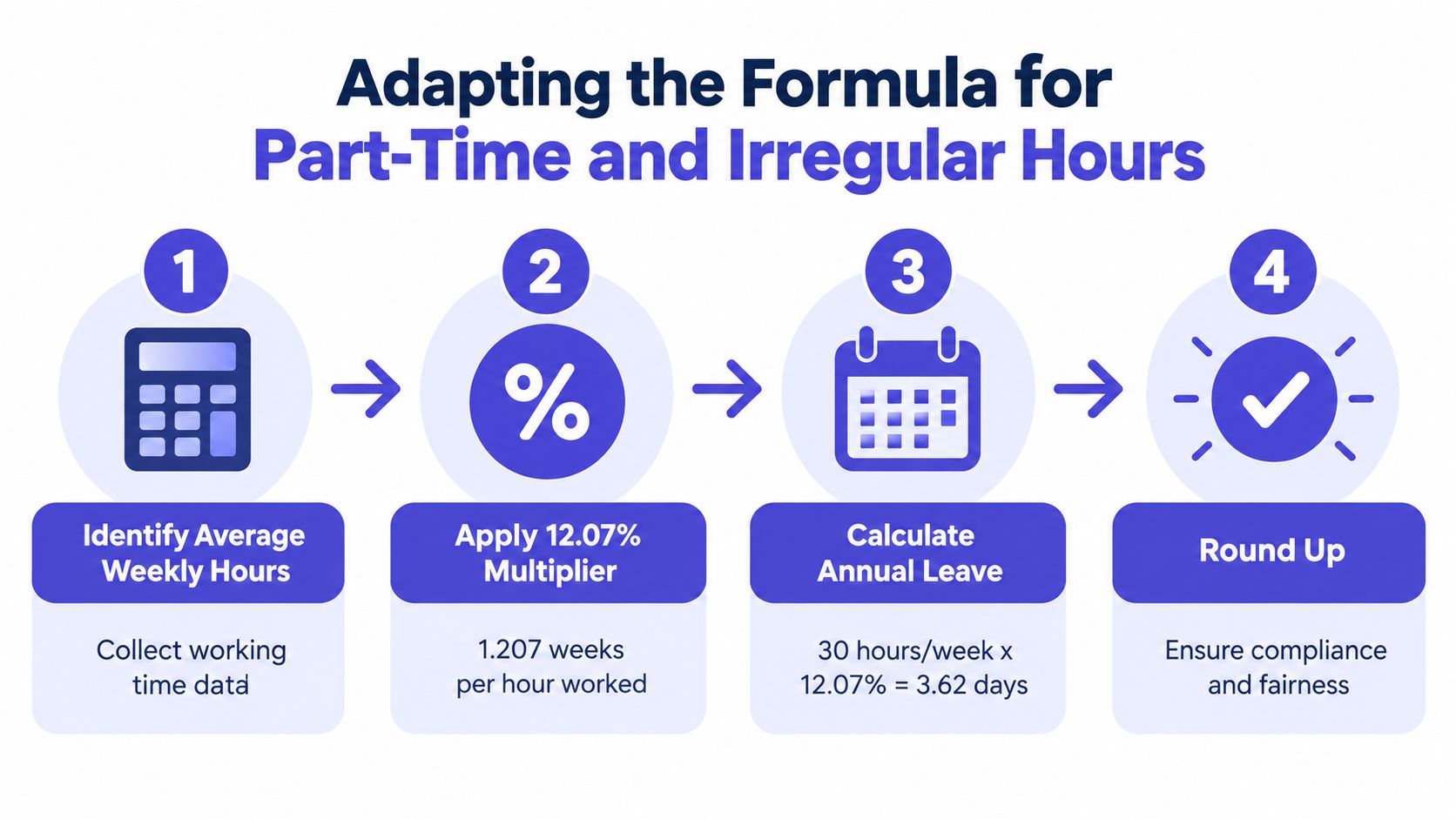
A repeatable hours-based process
Use this sequence whenever the worker's entitlement is based on hours worked:
- Collect the hours worked. Take the hours recorded for the relevant pay period and make sure payroll and rota records agree.
- Apply the accrual rate. Multiply the total hours worked by 12.07% to calculate the statutory holiday hours generated by those hours.
- Add the result to the leave balance. Keep the accrual attached to the correct worker and leave year rather than entering a manually rounded figure with no audit trail.
- Apply the organisation's rounding rule. The rule should be documented and applied consistently. Don't round some employees up while truncating others just to make a spreadsheet look tidy.
A worked calculation is easiest to understand symbolically. If a casual worker records H hours in a pay period, the accrued holiday is H × 12.07%. For example, if the payroll record contains a particular total of worked hours, enter that total once, multiply it by 12.07%, retain the unrounded result in the calculation record, and display the approved rounded balance according to the policy.
The important point is that the formula uses hours worked, not an assumed weekly pattern. LeaveWizard's guidance on holiday calculation for part-time workers provides a useful reference for businesses deciding whether their current day-based process still reflects their staff's working arrangements.
Why the input record matters
The calculation itself is short. The evidence behind it is not. A payroll administrator should be able to identify the pay period, the hours included, the rate applied and the rounding decision. If a worker disputes the balance, the business can show how the figure was produced rather than asking someone to reconstruct the calculation from a series of overwritten spreadsheet cells.
The UK government also explains that entitlement for irregular-hours and part-year workers can be calculated by taking total hours worked in the previous 52 weeks and multiplying by 12.07% to produce entitlement in hours, as described in its guidance on calculating holiday entitlement for part-year and irregular-hours workers. That makes the quality and continuity of time records a payroll requirement, not merely an HR preference.
Calculating Holiday Pay for Variable and Commission Earners
A leave balance tells you how much time an employee can take. It doesn't always tell you what the employee should be paid during that time. For workers with variable hours, commission or other relevant variable payments, the payroll team needs a defensible average rather than a rate copied from the latest payslip.
The reference period is generally the previous 52 paid weeks. Weeks containing no pay are excluded from the average, and if the worker has fewer than 52 paid weeks, the reference period is shortened to the paid weeks they worked. The ACAS guidance on calculating holiday pay also explains that relevant variable payments, including commission, task-linked payments and status-related allowances, must be included where the rules require them.
Separate entitlement from the pay rate
The 5.6 weeks of statutory leave aren't treated as one identical pay block. At least 4 weeks must be paid at the worker's normal rate of pay, while the remaining 1.6 weeks can be paid at a basic rate, according to GOV.UK holiday pay rights.
| Leave portion | Pay rate required | Included elements |
|---|---|---|
| First 4 weeks | Normal rate of pay | Relevant variable payments such as commission, task-linked payments and status-related allowances |
| Remaining 1.6 weeks | Basic rate of pay | Basic pay under the applicable payroll policy and statutory rules |
This split creates a practical data challenge. A payroll system needs to know which leave has been taken, which portion remains, and which earnings belong in the relevant average. If the business pays every statutory day at one rate, it still needs to confirm that the approach meets its obligations. If it uses different rates, the records must make the distinction visible.
Build the average from reliable records
Start by defining what counts as a paid week for the worker. Exclude weeks with no pay from the average, preserve the underlying pay components, and avoid replacing historical values with a single manually edited average. A commission payment that disappears from the calculation can understate holiday pay even when the employee's leave balance is correct.
The process should also account for workers with fewer than the full reference period of paid weeks. In that situation, use the weeks worked rather than filling the missing history with zeros. Payroll and HR should agree how earnings are classified before the next holiday request arrives.
For a practical explanation of the operational steps, use this guide to calculating holiday pay in the UK alongside your payroll procedure. The key control is simple: preserve the evidence that supports the average and show employees how the rate was reached.
Navigating Bank Holidays and Pro-Rata Entitlements
Many small businesses describe bank holidays as if they were a separate legal entitlement. They aren't automatically one. There is no standalone legal right to paid bank holidays unless the contract says so, and an employer can include bank holidays within the statutory holiday allowance, as outlined in ACAS guidance on checking holiday entitlement.
That choice needs to appear clearly in the contract, handbook and leave system. If bank holidays are included, the business must deduct them from the employee's total allowance when the employee would normally work on those dates. If they are offered in addition, the system should keep the contractual allowance separate from the statutory baseline.
Why part-time staff expose weak policies
A five-day worker may usually take bank holidays as part of the overall annual leave arrangement. A part-time employee may not work on those dates, or may work a different pattern from week to week. Giving every employee the same bank-holiday allocation can therefore create an unfair result, either reducing a part-time worker's usable leave or giving them more time off relative to their working pattern.
The correct approach is to start with the person's entitlement and then apply the contractual bank-holiday rule to their working pattern. Don't treat a bank holiday as a universal deduction only because the business is closed. Check whether the employee was scheduled or contractually expected to work that day, and express the result in the same unit used for the rest of the entitlement.
Days or hours?
Hours often provide a clearer basis for staff whose shifts vary in length. They also create more opportunities for spreadsheet errors. A sheet may deduct a whole standard day from an employee who was scheduled for a shorter shift, or compare an hourly balance with a day-based request.
Choose one primary unit, define how a day converts into hours where necessary, and make the rule visible to managers. Employees should be able to see whether bank holidays are included, how non-working bank holidays are treated and why their balance differs from a colleague's.
Common Spreadsheet Mistakes in Leave Tracking
A spreadsheet can store a holiday balance, but it doesn't automatically understand the relationship between a rota, a leave request and a payroll average. The more working patterns a business supports, the more likely it is that someone will copy a formula, overwrite a source value or apply an old policy to a new employee.
The recurring errors are operational rather than mathematical:
- Rounding too early: A decimal accrual is rounded before later periods are added, so small adjustments disappear or accumulate inconsistently.
- Overwriting the audit trail: A revised balance replaces the original calculation, leaving no record of the hours, dates or rule that produced it.
- Using a fixed allowance for changing hours: A casual worker receives a static annual figure even though their entitlement depends on recorded work.
- Forgetting the pay history: Payroll calculates leave pay from basic salary while leaving relevant variable payments outside the average.
- Mixing bank-holiday rules: One employee's bank holidays are deducted automatically, while another employee's are treated as additional leave.
- Ignoring carryover settings: Unused leave moves into a new leave year without a clear record of why it was carried forward or which policy applies.
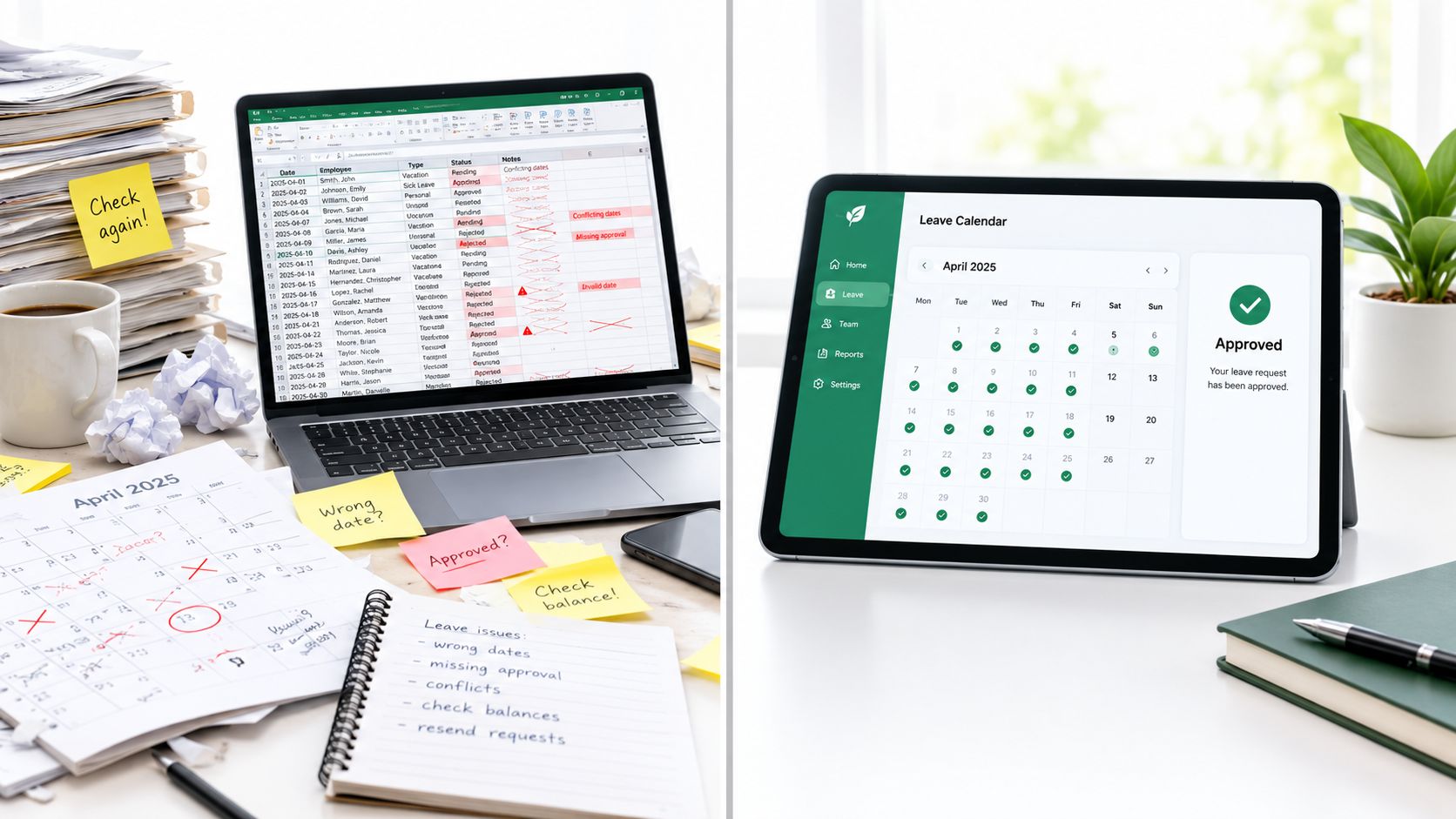
Compare the working methods
| Spreadsheet-led process | Purpose-built leave process |
|---|---|
| Staff enter balances and adjustments manually | Accrual rules are applied consistently to recorded data |
| Managers rely on emailed or printed balances | Employees and managers can view current availability |
| Payroll reconciles separate records | Leave, worker details and pay inputs can be checked together |
| Policy changes require formula edits in several places | Rules are held in a controlled policy configuration |
| Errors may appear only during a review | Exceptions can be identified closer to the time they occur |
A business doesn't need to automate every HR task at once. Start with the points where manual work creates the greatest risk, such as irregular-hours accrual, approval visibility and holiday-pay records. A resource on how to replace a holiday spreadsheet can help you assess the change in terms of controls, ownership and day-to-day usability rather than treating software as a simple file replacement.
Building a Compliant and Transparent Leave Policy
A formula becomes useful when employees and managers know what it means. Your policy should describe the entitlement unit, the treatment of bank holidays, the handling of variable schedules and the records used to calculate pay. Avoid a promise such as “holiday is pro-rated” without stating whether the business uses days, hours or accrued leave linked to hours worked.
Use the policy as an operating document, not just a contract attachment. It should tell a manager what to check before approving leave and tell an employee why their balance may change after a pay period.
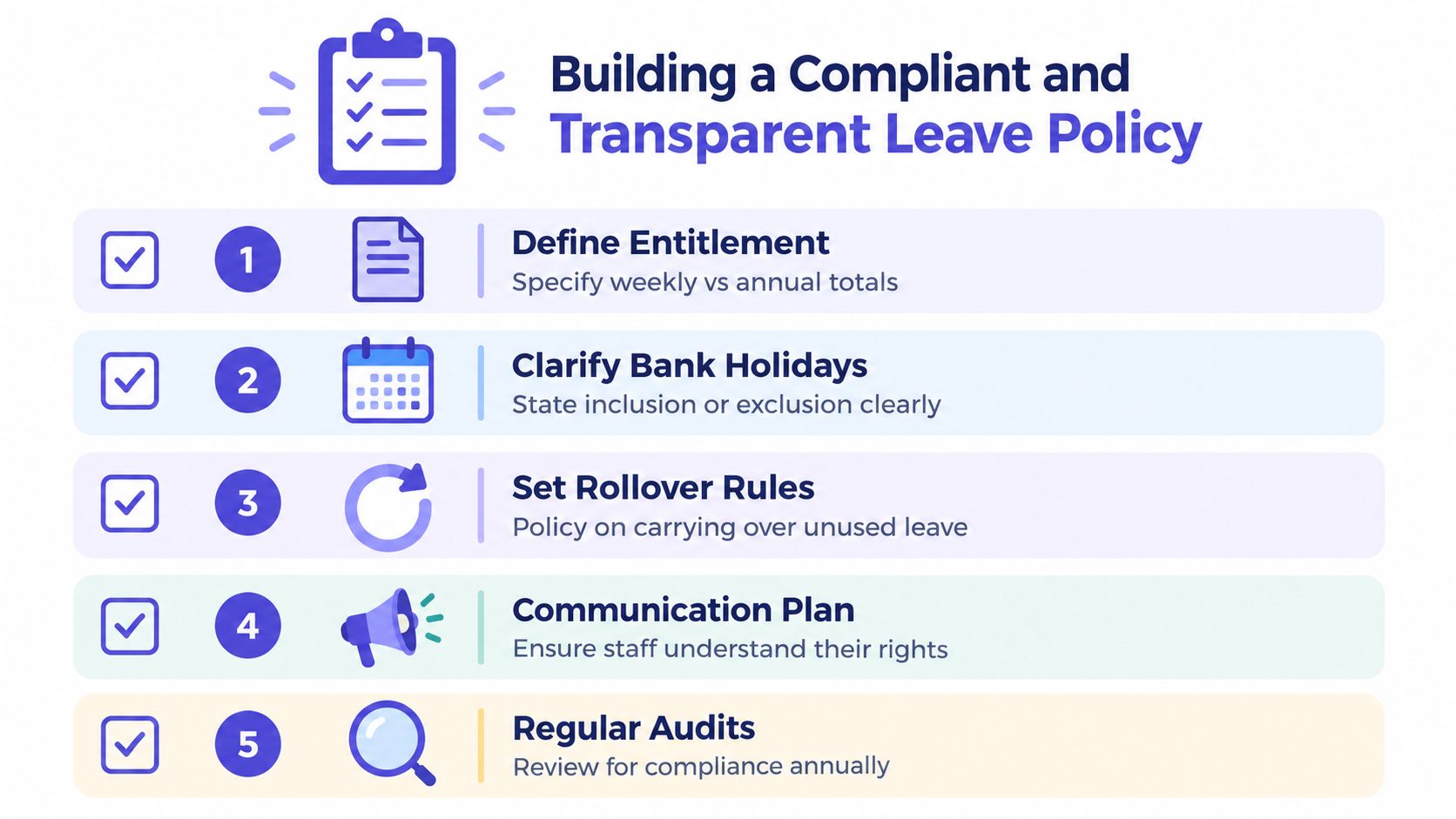
Five controls worth putting in writing
- Define entitlement. State the statutory baseline, the contractual additions and whether the business records leave in days or hours.
- Clarify bank holidays. Explain whether they sit inside the overall allowance, are provided separately or depend on the employee's normal working pattern.
- Set rollover rules. Record when unused leave can move into a new leave year and who approves an exception.
- Create a communication plan. Give employees access to their balance and explain the information used to calculate it.
- Schedule regular audits. Review worker categories, accrual formulas, pay components and approval records so an old spreadsheet rule doesn't remain in use after circumstances change.
For managers: Don't approve a request until the balance, working pattern and bank-holiday treatment are clear.
The policy should also assign responsibility. HR can own the rules, payroll can validate pay data, and line managers can confirm operational coverage. Employees need a straightforward route to query a calculation, with the underlying inputs available for review.
A compliant process is transparent without being complicated. When the formula, records and policy all agree, small businesses can answer leave questions promptly, pay workers accurately and schedule cover with greater confidence.