
Calculating leave entitlements in the UK always starts with one key figure: 5.6 weeks of paid holiday per year. It's the statutory minimum. For a full-time employee knocking out five days a week, this translates directly to a straightforward 28 days of paid annual leave.
Understanding Core UK Leave Entitlements

Before you can even think about running calculations, you need a solid grasp of the foundational rules. The law in the UK provides a clear baseline for all workers, and this is the absolute starting point for any leave policy you create. Think of it less as a guideline and more as a legal requirement designed to make sure everyone gets adequate rest.
Here's a quick look at how the statutory minimum breaks down for different working patterns.
UK Statutory Annual Leave at a Glance
This table summarises the minimum paid holiday entitlements based on the standard 5.6 weeks.
| Employment Type | Statutory Minimum Leave (Weeks) | Statutory Minimum Leave (Days) |
|---|---|---|
| Full-Time (5 days/week) | 5.6 weeks | 28 days |
| Part-Time (3 days/week) | 5.6 weeks | 16.8 days |
| Part-Time (2 days/week) | 5.6 weeks | 11.2 days |
As you can see, the 5.6 weeks applies to everyone, but the number of days changes depending on their work schedule. This is where pro-rata calculations, which we'll cover later, become so important.
Statutory Versus Contractual Leave
It's absolutely vital to distinguish between what's legally required and what your company chooses to offer on top. This is the classic difference between statutory and contractual leave.
- Statutory Leave: This is the non-negotiable minimum of 5.6 weeks mandated by the government. You simply cannot offer less than this.
- Contractual Leave: This is any paid leave offered above the statutory minimum. For instance, a company might offer 30 days of annual leave plus bank holidays to stay competitive.
Many businesses provide more generous leave allowances to attract and retain top talent. If your company offers contractual leave, that becomes the new baseline for your calculations, not the government minimum. Your employment contracts must clearly state the total leave entitlement and be explicit about how bank holidays are handled.
For businesses operating in the UK without a local legal entity, figuring out what an Employer of Record (EOR) is can be a game-changer for managing legal and payroll duties, including leave entitlements.
A common point of confusion I see all the time is how to handle bank holidays. An employer can choose to include the 8 bank holidays within the 28-day statutory minimum or offer them in addition to it. There's no single right way, but whatever you decide, it must be crystal clear in the employment contract to avoid any disputes.
The Mechanics of Holiday Accrual
When a new employee joins your team, they don't get their full year's holiday allowance handed to them on day one. That wouldn't be practical. Instead, they earn it over time through a process called holiday accrual. It's the standard, fair way to manage leave in their first year, making sure the time off they get is proportional to the time they've actually worked.
The most common approach is the simple 1/12th rule. For every full month they work, an employee accrues one-twelfth of their total annual holiday entitlement. This method is a lifesaver, really—it prevents a new starter from taking their full 28 days of leave in their first month and then promptly resigning.
Applying the Monthly Accrual Formula
Calculating leave this way is straightforward. You just take the employee's total annual leave allowance and divide it by 12.
Let’s run through a quick example. Imagine a new hire, David, starts on the 1st of March. His contract gives him the statutory minimum of 28 days of annual leave.
- Annual Entitlement: 28 days
- Monthly Accrual Rate: 28 / 12 = 2.33 days per month
After his first month is up, David has earned 2.33 days of holiday. By the end of May, after three months on the job, he would have accrued 7 days (2.33 x 3 = 6.99, which we'd round up).
This infographic breaks down the simple process for figuring out an employee's leave entitlement.
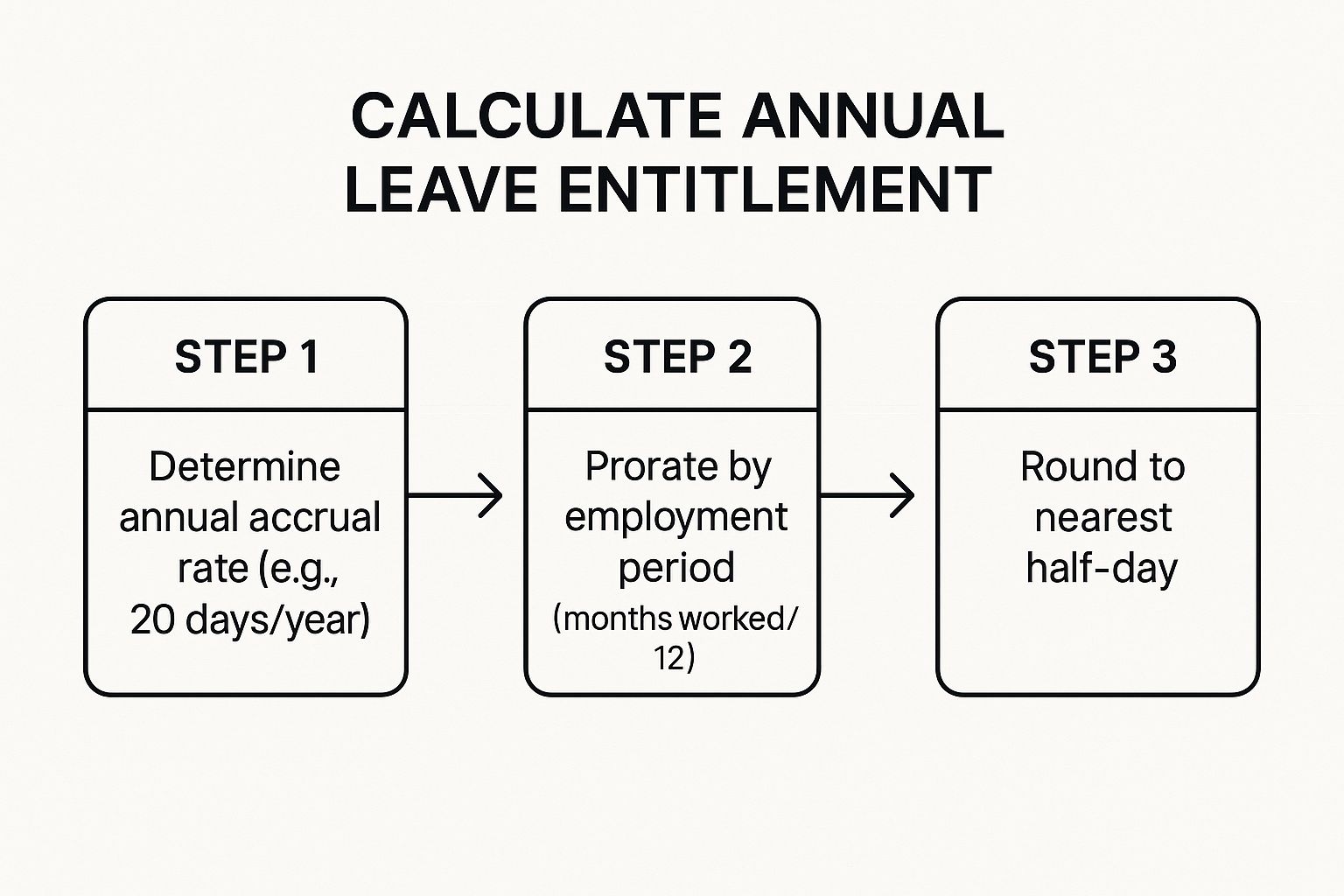
As you can see, locking in the annual rate is the crucial first step. From there, it's just a case of prorating it for the period they've worked.
Handling Mid-Month Starters and Rounding
But what happens when someone doesn't start neatly on the first of the month? If a new team member joins halfway through, you could just start their accrual from the beginning of the next full month. For complete accuracy, though, you can calculate it based on the proportion of the month they worked.
One of the stickiest points is always rounding. Since dividing by 12 often creates fractions of days, you need a consistent policy. Best practice is to always round up to the nearest half or full day. Whatever you do, never round down—that could mean an employee receives less than their statutory entitlement, which is a big no-no.
If you want to get into the weeds on this, you can explore more about the accrual of leave and see how different systems handle the finer details.
Ultimately, a clear and consistent approach to accrual is fundamental. It’s not just about staying compliant with the law; it’s about being transparent with your new starters. Helping them understand exactly how their holiday pay is calculated from day one is a cornerstone of fair and effective leave management.
Calculating Pro-Rata Leave for Part-Time Staff

This is where many well-intentioned managers and HR teams stumble. Calculating holiday for part-time employees isn't rocket science, but it absolutely demands precision.
The core principle is fairness. Your part-time staff are legally entitled to the same 5.6 weeks of statutory leave as their full-time colleagues. The only difference is that their entitlement is adjusted proportionally—or pro-rata—to match their working hours.
Getting this right is non-negotiable for legal compliance and keeping team morale high. A slip-up here can easily lead to disputes and leave employees feeling undervalued. The goal is simple: ensure someone working three days a week receives the same proportional holiday time as someone working five.
The Standard Pro-Rata Formula
The most reliable way to figure out leave for part-time staff is to compare their working week to a standard full-time week, which is typically five days in the UK.
The formula looks like this:
(Number of days worked per week ÷ 5) x Full-time leave entitlement (in days) = Pro-rata leave entitlement
Let's walk through a real-world example. Imagine your full-time employees receive the statutory minimum of 28 days annual leave. You have a part-time team member, Sarah, who works a consistent three days every week.
Plugging her details into the formula, you get:
(3 ÷ 5) x 28 = 16.8 days
So, Sarah is entitled to 16.8 days of paid holiday for the year. Standard practice is to round this up to the nearest half or full day, which would give her 17 days. To save yourself the manual maths and potential for error, a dedicated holiday calculator for part-time workers can be a lifesaver.
Handling Variable Work Schedules
But what about staff whose hours are all over the place? For employees on zero-hours contracts or with irregular shift patterns, the "days per week" formula just won't work.
In these situations, the only fair approach is to calculate their leave entitlement based on the actual hours they've worked. The established method for this uses a specific percentage: 12.07%. This figure comes from the 5.6 weeks of statutory leave, divided by the remaining 46.4 working weeks of the year (5.6 ÷ 46.4 = 12.07%).
Let's say another employee, Tom, is on a zero-hours contract. Last month, he worked a total of 80 hours.
To work out the holiday he earned in that period, you'd do this calculation:
80 hours x 12.07% = 9.656 hours of leave
This method ensures Tom accrues holiday time that is directly proportional to his contribution. It’s the fairest, most compliant way to manage leave for workers without a fixed schedule.
The key takeaway here is consistency. Whichever method you use, apply it consistently across all similar roles in your organisation. Make sure you document the process clearly in your company handbook so every team member understands exactly how their holiday pay is worked out.
Navigating Complex Leave Scenarios

Calculating leave for a standard full-time employee is usually straightforward. But let's be honest, how often is it really that simple? The modern workforce is a mix of variable hours, mid-year starts, long-term absences, and unexpected departures.
This is where things can get tricky. These are the situations where mistakes happen, leading to payroll headaches and, worse, unhappy employees. Getting these complex scenarios right is what separates good leave management from a potential HR disaster. It’s all about knowing the rules and applying them consistently, ensuring everyone is treated fairly and legally.
Casual and Zero-Hours Contracts
For anyone on a casual or zero-hours contract, a fixed annual leave entitlement just doesn't work. Their holiday has to be earned in direct proportion to the hours they actually put in.
This is where the magic 12.07% figure comes into play. This number isn't random; it represents the statutory 5.6 weeks of holiday as a percentage of the remaining 46.4 working weeks of the year.
To work it out, you simply multiply the total hours an employee worked in a pay period by 12.07%. So, if someone worked 60 hours in a month:
- 60 hours x 12.07% = 7.24 hours of leave accrued
This method keeps everything fair and compliant because holiday pay directly mirrors their work. Of course, this means you need to be meticulously tracking their hours. For a deeper dive, our guide to holiday entitlement on zero hours contracts has all the details.
Handling Starters and Leavers
It makes sense that someone joining or leaving part-way through the year won't get the full annual holiday allowance. Their leave needs to be calculated on a pro-rata basis, reflecting only the time they were actually employed.
When an employee leaves, you'll need to calculate the total leave they've accrued up to their last day and then subtract any holiday they've already taken. If there's a positive balance, you owe them that amount in their final paycheck.
Here's a common trap: what happens if an employee has taken more holiday than they've earned when they leave? Your employment contract is your best friend here. It must explicitly state you have the right to deduct the value of that excess leave from their final pay. Without that clause, you’ll have a tough time getting it back.
Adjusting for Sickness and Family Leave
This is a big one that often catches managers out. Statutory holiday entitlement continues to accrue even when an employee is on other types of statutory leave. This includes:
- Maternity, paternity, adoption, or shared parental leave
- Ordinary sick leave
Someone on long-term sick leave is still building up their holiday time as if they were working. Likewise, an employee who takes a full year of maternity leave will return with their entire holiday allowance for that year ready to use. Planning for these situations is vital for managing team capacity and avoiding budget surprises.
For businesses with an international footprint, this gets even more complex as you juggle different legal frameworks. Having solid comprehensive global payroll strategies is non-negotiable to keep things running smoothly.
Finally, remember to be crystal clear about your carry-over rules. While the first four weeks of statutory leave generally can't be carried over into the next year, you can allow employees to carry over any extra contractual leave, often with a set expiry date.
Calculating Leave for Different Worker Types
The calculation method you use depends entirely on the type of contract your employee is on. Here’s a quick breakdown to help you keep track.
| Worker Type | Primary Calculation Method | Key Consideration |
|---|---|---|
| Full-Time | Fixed annual entitlement (e.g., 28 days) | Straightforward, but needs pro-rata adjustment for starters/leavers. |
| Part-Time | Pro-rata based on full-time equivalent (FTE) | Ensure calculations are based on days or hours worked vs. the standard week. |
| Zero-Hours/Casual | Percentage of hours worked (12.07%) | Accurate and consistent tracking of all hours worked is absolutely essential. |
| Term-Time | Calculated based on weeks worked in the year | Often complex; holiday pay may be "rolled up" or paid during school holidays. |
As you can see, a one-size-fits-all approach just won't cut it. Each worker type requires a specific calculation to ensure you're meeting legal requirements and treating your team fairly.
Common Pitfalls in Leave Calculation
Even with the best intentions, getting leave calculations wrong is surprisingly common. And when the numbers are off, it’s not just a payroll headache—it can damage morale and even put your business at legal risk. Knowing what to watch out for is the best way to build a fair, compliant system from the ground up.
The Part-Time Pro-Rata Puzzle
One of the most frequent slip-ups is miscalculating pro-rata entitlements, especially for part-time staff. It’s easy to get tangled up when determining how bank holidays apply to them.
A part-time employee is entitled to a pro-rated equivalent of bank holidays, even if the holiday falls on a day they don't typically work. Forgetting this simple rule means they get short-changed on their total leave allowance, which isn't fair and can lead to disputes.
"Use It or Lose It" Traps
Another major issue I see is the rigid application of ‘use it or lose it’ policies. While it’s perfectly legal for employers to manage how much leave can be carried over, UK law is very clear about protecting the core 5.6 weeks of statutory leave.
A blanket policy that forces an employee to forfeit this statutory minimum can be challenged. This is especially true if they were unable to take their leave due to circumstances outside their control, like long-term sickness.
The Challenge of Unused Leave
The problem of employees not taking their full holiday allowance just won't go away. It’s more than an admin issue; it's a direct threat to employee wellbeing and a fast track to burnout. Encouraging your team to take their well-deserved breaks is just as important as getting the maths right.
The data backs this up. A recent analysis of over 250,000 UK users revealed a telling trend. While the average annual leave allowance is around 22 to 23 days (plus bank holidays), employees left an average of 5 days unused. That’s a whole working week of rest and recovery down the drain. You can dig into the numbers in the latest annual leave statistics report.
This isn't just about an employee losing a few days off. Unused leave becomes a financial liability on your balance sheet, representing accrued holiday pay that you’ll have to pay out if an employee leaves. Proactively managing this is just smart financial planning.
So, how can you steer clear of these pitfalls?
- Audit Regularly: Make a habit of periodically spot-checking the calculations for a few part-time and variable-hour employees. It’s the quickest way to catch systemic errors before they become big problems.
- Clarify Policies: Make sure your employee handbook is crystal clear on how you handle bank holidays, carry-over rules, and the impact of sickness on leave accrual. No grey areas.
- Automate Processes: Using dedicated software like LeaveWizard takes human error out of the equation. It guarantees every calculation is precise, consistent, and compliant with the latest regulations.
By understanding these common traps, you can refine your processes and build a system people trust. Accurate and transparent leave management isn't just about compliance—it's about showing your team they're valued, which is the cornerstone of any great workplace culture.
Got Questions About Leave Calculations? We’ve Got Answers.
Even with the best formulas and processes, real-life scenarios always throw a few curveballs when it's time to work out leave entitlements. These are the tricky situations that can catch you off guard, but getting them right is crucial for keeping your team happy and staying compliant with UK employment law.
A lot of these questions come down to pay, especially for team members who don't work a standard 9-to-5. The core principle here is simple: an employee’s holiday pay should match what they would have normally earned if they were working. This ensures no one is financially worse off for taking a much-needed break.
How Do I Calculate Pay for Staff on Variable Hours?
This is easily one of the most common head-scratchers. How do you handle holiday pay for employees on zero-hours contracts or those who earn commission or regular overtime? The rules are actually very clear: you need to calculate their average pay over the previous 52 paid weeks.
When you're crunching these numbers, remember to:
- Only count the weeks where the employee actually received pay.
- Completely ignore any weeks where they earned nothing.
- If you need to, you can look back as far as 104 weeks to find 52 weeks of pay data to build your average from.
Following this method ensures that things like consistent overtime and commission are fairly baked into their holiday pay, giving a true reflection of their normal earnings.
What Happens to Holiday Pay When Someone Resigns?
Another classic query. When an employee hands in their notice, your job is to figure out the total leave they’ve earned up to their very last day and then subtract any holiday they’ve already taken.
If they have leave left over, you’re legally required to pay them for this untaken statutory holiday. This payment is made in their final payslip and is often called a payment in lieu of holiday.
But what if they’ve taken more holiday than they’ve actually accrued? This is a critical point. You can only deduct the value of this extra holiday from their final pay if there is a specific, written clause in their employment contract allowing you to do so. Without that clause, you have no legal ground to reclaim that money.
Can We Tell Our Staff When to Take Their Holidays?
Business owners often ask if they can dictate when employees take their annual leave. The short answer is yes, but there are important strings attached.
You can absolutely require an employee to take leave on certain dates, like during a planned Christmas shutdown or on bank holidays. However, the key is giving them proper notice. The rule is that you must provide notice that is at least twice as long as the holiday you're asking them to take.
For example, if you need them to take one week of leave, you must give them a minimum of two weeks' notice.


