
So, what exactly is an annual leave accrual calculator? Think of it as a smart tool that does the heavy lifting for you, automatically working out how much paid holiday an employee has earned over a certain period.
It’s an absolute lifesaver for managing pro-rata leave, especially when you're dealing with part-time staff, new starters, or people leaving the company. Most importantly, it keeps you compliant with UK regulations.
Understanding UK Annual Leave Accrual
Trying to navigate UK holiday law can feel like a bit of a minefield at times. But it all really boils down to one simple principle: fairness.
Every single one of your workers is entitled to paid time off. As their employer, it's your job to calculate this entitlement with pinpoint accuracy. Getting it wrong isn't just a payroll headache; it can land you in legal hot water and seriously damage team morale.
The whole system is built on the foundation of statutory minimum leave. In the UK, a full-time worker is entitled to a minimum of 5.6 weeks of paid holiday each year. This works out to 28 days, which can include bank holidays.
Many businesses rely on an annual leave calculator to make sure everyone, particularly those on part-time or irregular hours, gets their fair share. For instance, a part-timer working three days a week is entitled to 16.8 days of paid annual leave (5.6 weeks × 3 days).
Things get a bit trickier when you throw different working patterns into the mix, which is where many companies start to stumble.
Pro-Rata Entitlements for Different Working Patterns
The real challenge pops up with anyone not on a standard, full-time contract. How do you handle someone who joins halfway through the year? Or leaves before their anniversary? What about staff who work variable hours?
This is where the idea of pro-rata—or proportional—leave becomes essential. You have to make sure their holiday pay is directly proportionate to that of a full-time colleague.
Let's say someone starts on 1st July. They’ve only worked for half of your leave year, so they wouldn't get the full 28 days. Instead, they'd accrue half of it: 14 days. People on zero-hours contracts are another classic example; they earn holiday based on the hours they actually work, which is often calculated using the 12.07% method.
These are exactly the kinds of scenarios where trying to track everything manually can easily lead to mistakes.
To give you a clearer picture, here’s how the statutory minimum breaks down for different weekly work schedules.
UK Statutory Annual Leave Entitlement At-a-Glance
| Working Pattern | Days Worked Per Week | Minimum Statutory Leave (Days) |
|---|---|---|
| Full-time | 5 days | 28 days |
| Part-time | 4 days | 22.4 days |
| Part-time | 3 days | 16.8 days |
| Part-time | 2 days | 11.2 days |
| Part-time | 1 day | 5.6 days |
As you can see, the entitlement is scaled perfectly to match the time worked. This pro-rata principle ensures fairness across the board, no matter how many days a week someone works.
An annual leave accrual calculator completely removes the guesswork from these complex situations. It automates all the pro-rata calculations, ensuring every employee gets exactly what they are legally owed, regardless of their contract type or start date.
The Importance of Accrual Periods
The accrual period is simply the timeframe over which an employee earns their holiday. Do they get a little chunk each month, or does it build up hour by hour as they work?
By far the most common method in the UK is monthly accrual. With this system, an employee earns one-twelfth of their total annual entitlement each month they work. For a full-timer with 28 days entitlement, that comes out to 2.33 days per month (28 ÷ 12).
This approach gives both you and your employees a clear, predictable way to track earned leave as the year progresses. For a deeper dive into this, you might find our essential guide to annual leave accrual for HR really helpful.
How to Manually Calculate Holiday Pay
While an annual leave accrual calculator is a massive time-saver, knowing how to do the maths yourself is incredibly useful. It gives you the power to spot-check results, confidently answer employee questions, and really grasp the nuts and bolts of holiday pay. Understanding the formulas behind the scenes demystifies the whole process and puts you in complete control of your payroll.
Let’s walk through three common scenarios that HR managers and small business owners face every day. We'll cover your full-time staff on standard contracts, part-timers with fixed hours, and those on more flexible arrangements.
The infographic below gives a great overview of the typical process for figuring out leave entitlement here in the UK, from the statutory minimums right down to the specific calculations.
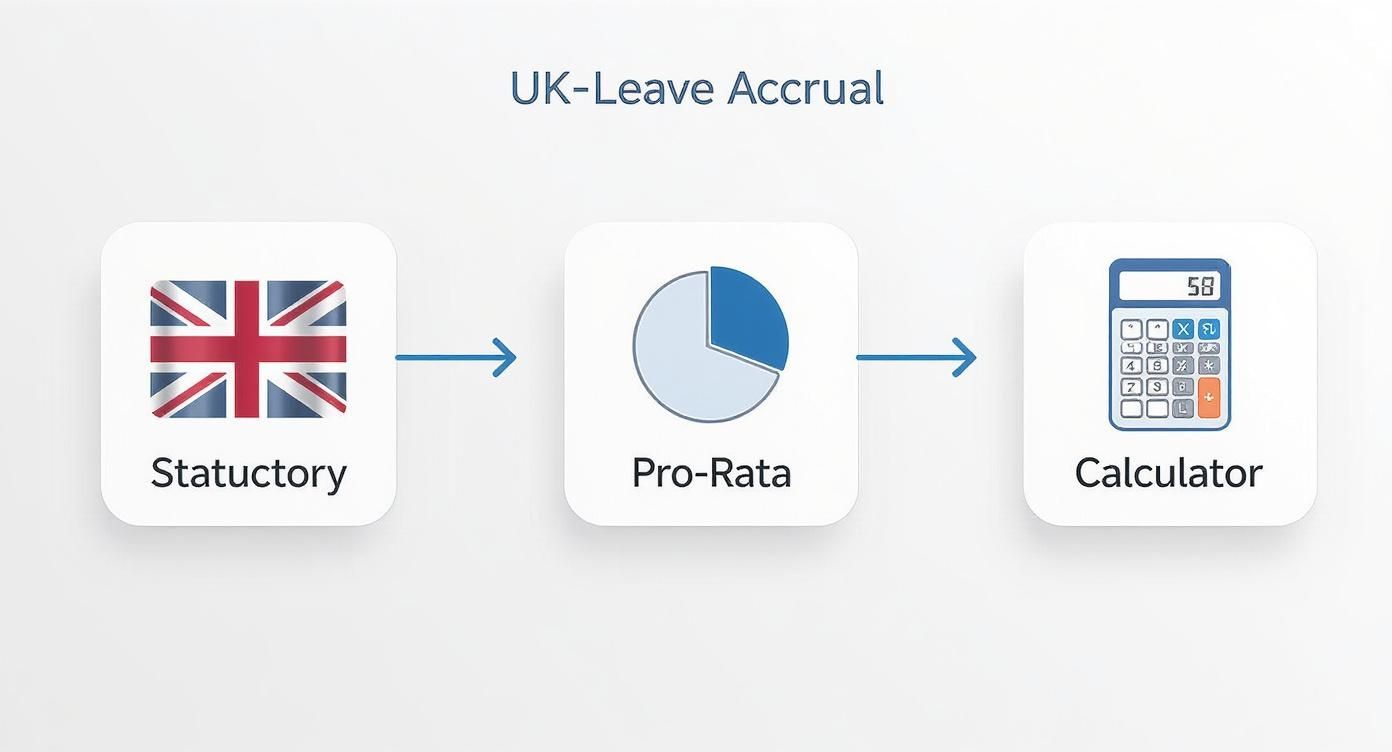
This visual journey shows how every calculation—whether you do it by hand or with a tool—starts with the legal framework and then adapts to each person's unique working situation.
Full-Time Employee on Monthly Accrual
This is the most straightforward calculation of the lot. Your full-time employees on a standard contract earn their holiday entitlement evenly throughout the year, which keeps things simple.
Most UK businesses use a monthly accrual system. For every full month an employee works, they simply earn one-twelfth of their total annual holiday allowance.
Let's look at a real-world example:
- Employee: Sarah, a full-time marketing manager.
- Annual Entitlement: 28 days (which is the statutory minimum).
- Calculation: 28 days ÷ 12 months = 2.33 days accrued per month.
After three months of work, Sarah will have built up 7 days of holiday (2.33 x 3 = 6.99, which is usually rounded up). It's a simple, predictable method that provides clarity for everyone. If you need a more detailed breakdown, you can learn more about how to calculate holiday pay for different employee types.
Part-Time Employee with Consistent Hours
Now, what about part-time staff? The key principle here is pro-rata—their holiday entitlement must be proportional to that of a full-time colleague. Anything less is unfair and illegal.
Imagine you have a team member, David, who works three days a week.
- Calculate Total Days: First, you need to work out his total annual leave. The formula is 5.6 weeks × (days worked per week). For David, this works out as 5.6 × 3 = 16.8 days per year.
- Calculate Monthly Accrual: Just like with a full-timer, you divide this annual figure by 12. So, 16.8 ÷ 12 = 1.4 days accrued each month.
This ensures David receives his fair, legal entitlement based on his specific working pattern.
Remember, treating part-time employees differently from full-time staff when it comes to holiday entitlement is discriminatory. The pro-rata calculation is your essential tool for ensuring fairness and legal compliance.
Casual Workers and the 12.07% Method
What about staff on zero-hours contracts or those with highly irregular working patterns? This is where the trusty 12.07% method comes into play.
So where does that number come from? It's derived directly from the statutory 5.6 weeks of holiday. The standard working year is 46.4 weeks (52 weeks – 5.6 weeks of leave). When you calculate 5.6 as a percentage of 46.4, you get 12.07%.
The formula is beautifully simple: Hours Worked × 12.07% = Holiday Hours Accrued.
For example, if a casual worker named Chloe works 50 hours in a month, she accrues 6.035 holiday hours (50 × 0.1207). This method directly ties holiday entitlement to the actual time worked, making it the fairest and most accurate approach for variable schedules.
Choosing Your Annual leave accrual calculator

Ready to finally ditch the manual spreadsheets and sidestep those costly calculation errors? Picking the right annual leave accrual calculator is a huge step towards making your HR processes simpler and more reliable.
But with so many options on the market, it's easy to get lost. Many tools look similar on the surface, but the devil is in the detail. The key is to look beyond the basic calculation function and find a system that actually solves your day-to-day business challenges. A great tool should feel less like a calculator and more like an integrated part of your workflow.
Core Features That Truly Matter
When you start comparing options, there are a few features that are pretty much non-negotiable for UK businesses. Getting these right will save you a world of time and prevent any compliance headaches down the line.
- Seamless Payroll Integration: Your leave calculator shouldn't live on an island. Look for tools that plug directly into your payroll software. This ensures holiday pay calculations are always accurate and up-to-date, completely wiping out the need for manual data entry.
- Automatic Bank Holiday Management: The UK has different bank holidays for England, Wales, Scotland, and Northern Ireland. A smart calculator will automatically apply the correct public holidays based on an employee's location—a lifesaver for remote or multi-site teams.
- Flexible Carry-Over Policies: Can you easily set rules for how much leave can be rolled over into the next year? Your tool needs to let you configure these policies to match your company handbook, whether you run a strict "use-it-or-lose-it" system or something more flexible.
The screenshot above from the GOV.UK website shows a basic but handy government tool for checking statutory entitlement. While it's great for a quick check, it really just highlights the need for a more powerful system that can handle ongoing accruals, manage company policies, and integrate with your other software automatically.
Setting Up Your System for Success
Once you've picked a calculator, getting the implementation right is crucial. A messy setup can quickly create distrust and confusion among your team, which defeats the whole purpose.
The most critical phase is the initial data input. You'll need to accurately enter each employee's start date, their contractual hours, and any leave balance they've already accrued. Being precise here is the best way to prevent future disputes and make sure the system starts off on a reliable footing. If you need to double-check any existing figures, you can use a reliable leave entitlements calculator to cross-reference them before migrating the data.
A well-implemented leave calculator fosters transparency. When employees can see their own leave balance in real-time through a self-service portal, it empowers them and dramatically reduces the number of queries landing on HR's desk.
Ultimately, think of your annual leave accrual calculator as more than just a tool for compliance. It's a system for promoting fairness, cutting down on admin, and giving both managers and employees much-needed clarity. Choose a platform that can grow with your business, adapting to new policies and an expanding team without needing a complete overhaul. It's a strategic choice that supports a more organised and productive workplace for everyone.
Of course, the real world of HR is rarely as straightforward as a simple calculation. While an annual leave accrual calculator is fantastic for the day-to-day maths, things get messy when you're dealing with complex situations like long-term sickness or family leave. These are the moments that truly test your policies and expertise.
It’s a legal requirement that an employee’s statutory right to accrue annual leave continues, even when they’re off work for a long time. This covers periods of sick leave, maternity leave, and paternity leave. Their holiday entitlement keeps building up just as it would if they were in the office every day. This is a critical detail that manual tracking systems often get wrong, and it can land you in some serious legal trouble.
There's a common myth that leave accrual just stops during these absences, but that couldn't be further from the truth. It's on you to make sure the employee's record stays up-to-date, so when they come back, their accrued holiday balance is accurate and ready for them.
Managing Long-Term Absences
Let's take long-term sick leave. Not only does the employee continue to accrue their statutory holiday, but they might also be able to carry it over. If someone is genuinely too ill to take their holiday within the current leave year, they are legally entitled to carry over up to four weeks—that's 20 days for a full-timer—into the next leave year.
The same principle holds for maternity leave. An employee accrues their full contractual holiday entitlement throughout their entire maternity leave. Since they obviously can't take this holiday while they're away, it has to be available for them to use when they return. Alternatively, you must have a clear policy allowing them to carry it into the next leave year.
Getting the documentation right for these different leave types is absolutely crucial. To make sure you're on top of it, especially when navigating these tricky scenarios, it's worth checking out a practical guide to employee time off request forms.
Holiday Carry-Over and Forfeiture
Dealing with unused holiday at the end of the year is another classic HR headache. While your company policy can set the rules for any leave you offer above the statutory minimum, the legal baseline is crystal clear: an employee must be given a reasonable chance to take their statutory leave. You can't just let it disappear.
Interestingly, recent data shows that UK employees leave an average of five days of holiday unused each year. This is where a good accrual calculator really shines. It helps you spot these patterns and can support policies, like mandatory leave periods, to nudge staff to actually take their well-deserved breaks. The tool also makes managing carry-over rules much simpler; for example, UK law allows carrying over up to four days of statutory leave if the employer agrees, and that policy needs to be managed consistently for everyone.
My advice? Be proactive. Don't wait until the last three months of the year to start panicking about unused leave. Use your calculator's reporting features to send out reminders and work with managers to get time off scheduled. This prevents that last-minute scramble and ensures your team doesn't lose out on their entitlement.
Building a Fair and Transparent Leave Policy

A great leave policy is built on trust and clear communication, not just ticking boxes and running calculations. While an annual leave accrual calculator ensures your numbers are spot on, the real magic happens when you create a system that your team actually understands and appreciates. It’s all about shifting the focus from mere compliance to genuinely fostering a culture of well-being.
Transparency needs to start from day one. Clearly outlining your leave accrual process during onboarding and in the employee handbook saves a world of confusion down the line. Ditch the jargon and use simple, relatable examples to show new starters exactly how their holiday entitlement builds up over the year.
Empower Employees with Direct Access
One of the best ways I've seen to build trust is simply giving employees easy, direct access to their own leave balances. When people can check their accrued time off on their phones or laptops whenever they want, it gives them a real sense of autonomy and ownership over their time.
This one change can dramatically cut down the administrative headache for your HR team. Instead of fielding constant emails asking, "How much holiday do I have left?", your team can focus on bigger-picture initiatives. It empowers employees to plan their time off proactively, which is a win for them and for the business.
Connecting Leave to Employee Wellbeing
A solid leave management system does more than just track days off; it can be a powerful tool for heading off burnout before it starts. Recent figures show a worrying trend, with the average leave taken by UK employees dropping from 38 days in 2020 to 33.9 days in 2023. An annual leave accrual calculator is essential for keeping an eye on these patterns and making sure staff take the breaks they're entitled to.
When you notice a team member hasn't taken a break in six months, that's a red flag. Your tracking tool can highlight these patterns, prompting managers to step in and encourage staff to schedule some well-deserved rest.
A well-defined policy is the backbone of this whole system. To make sure yours is fair and transparent, it's worth exploring the steps to create a leave request workflow that simplifies everything for everyone involved, from the initial request to the final approval.
This proactive approach to managing leave shows your employees that you genuinely care about their health and work-life balance. It transforms a simple policy into a meaningful part of your company culture.
Got Questions About Leave Accrual? We've Got Answers
Even with a handy annual leave accrual calculator, you're bound to run into some tricky situations. Getting to grips with the finer points of UK leave law is what gives you the confidence to manage your team fairly and effectively.
We see the same questions pop up time and again from business owners and HR managers. Let's walk through some of the most common ones. While every case has its own quirks, understanding the principles here will set you up to handle almost anything that comes your way.
What Happens to Leave When an Employee Leaves?
When someone's contract ends, your final piece of admin is to calculate any holiday they've accrued but haven't used up to their last day. This amount has to be paid out with their final payslip, a process often called payment in lieu of holiday (PILOH).
Think of it this way: if an employee leaves exactly halfway through your company's leave year, they're entitled to half of their annual holiday allowance. If they’ve taken less than that, you owe them payment for the difference.
But what if they've used more than their entitlement? You can usually deduct the excess from their final pay, but only if this is clearly spelled out in their employment contract.
Key Takeaway: Always make sure your employment contracts have a clear clause that allows you to deduct pay for any excess holiday taken when an employee leaves. Without it, you might find you can't legally get that money back.
How Do Bank Holidays Work for Part-Time Staff?
This is a big one. Part-time employees are entitled to a pro-rata share of bank holidays, just like the rest of their annual leave. It's a common mistake to think they only get the day off if a bank holiday happens to fall on one of their normal working days. That's not right, and it can lead to unfairness.
Here’s how to calculate it properly:
- A full-time employee gets the statutory minimum of 28 days of leave, which can include the 8 UK bank holidays.
- So, a part-timer working three days a week gets 16.8 days (28 ÷ 5 days × 3 days).
- This 16.8-day figure is their total leave pot for the year. If a bank holiday falls on a day they'd normally work, they simply use one day from this allowance. If it falls on their day off, their pot of 16.8 days stays untouched for them to book another time.
This method ensures everyone gets their fair, proportional entitlement, no matter their working pattern.
Can You Pay Employees Instead of Them Taking Holiday?
The short answer is no. You cannot pay an employee in lieu of their statutory minimum holiday (5.6 weeks) while they are still working for you. The law is crystal clear on this: that time is meant for rest and recovery.
The only time you can pay out for holiday is when an employee is leaving, as we covered above.
Now, if your company offers contractual leave that's more than the statutory minimum, your own policy can decide whether that extra bit can be paid out. But the core 5.6 weeks must always be taken as actual time off.


