
Accrued leave, in simple terms, is the holiday time you build up as you work. It’s a bit like having a 'time off bank account' where you make small 'deposits' of paid leave with every pay period, watching your balance grow throughout the year.
What Accrued Leave Actually Means for You

But let's go a bit deeper than a simple definition. Getting your head around what accrued leave means is a game-changer for both employees and employers here in the UK. This isn't just a nice-to-have company perk; it's a fundamental system that ensures you get the paid rest you're legally entitled to, helping prevent burnout and keeping everyone happy and healthy.
The idea is really quite straightforward. Instead of getting all your annual holiday days dumped on you in one go at the start of the year, you earn them bit by bit. This method makes sure the leave you have available genuinely reflects the time you’ve put in.
The 'Time Off Bank Account' Analogy
Let’s stick with that bank account idea. Imagine you start a new job on 1st January. Your 'time off bank account' is empty. With each week or month that goes by, your employer 'deposits' a fraction of your total annual holiday entitlement into that account.
Fast forward to the end of June. You've now 'saved up' half of your yearly holiday allowance, which is sitting there ready for you to 'withdraw' for a well-earned break. It’s a fair and transparent way to manage holiday time.
This approach is also brilliant for handling things fairly when people join or leave. If an employee leaves part-way through the year, they get paid for any holiday they've accrued but haven't used. On the flip side, if they've somehow used more holiday than they've earned, the value of that extra time might be deducted from their final pay cheque.
Your Legal Entitlement in the UK
The whole system of accruing leave is firmly rooted in UK law. Put simply, accrued leave is the amount of paid annual leave you accumulate over time just by being employed. Legally, almost every worker in the UK is entitled to a minimum of 5.6 weeks of paid annual leave each year.
For someone working a standard five-day week, that works out to 28 days. Your employment contract might specify that this includes bank holidays. For part-time workers, the entitlement is calculated on a pro-rata basis, which keeps things fair no matter how many hours you work. You can find more details about UK annual leave rules on websites like Vacation Tracker.
To help make these core ideas crystal clear, here’s a quick breakdown of the key concepts you’ll encounter when dealing with accrued leave in the UK.
Key Accrued Leave Concepts at a Glance
| Concept | UK Definition & Standard |
|---|---|
| Accrued Leave | Holiday time earned progressively based on time worked, not given in a lump sum. |
| Statutory Minimum | 5.6 weeks of paid annual leave per year for nearly all UK workers. |
| Full-Time Equivalent | For a 5-day work week, the statutory minimum is 28 days per year. |
| Pro-Rata Entitlement | Part-time workers receive a proportional amount of leave based on their hours. |
| Bank Holidays | Can be included in the statutory 5.6 weeks if stated in the employment contract. |
| Final Pay | On leaving, unused accrued leave is paid out; overused leave may be deducted. |
Understanding these points isn't just about ticking boxes; it's about making the system work for everyone.
Getting this right is so important. It gives employees the power to track their earned time off with confidence and helps employers manage their teams effectively. This way, the business keeps running smoothly while everyone’s legal rights and well-being are respected.
How to Calculate Your Accrued Leave Correctly
Figuring out your holiday entitlement can feel like a headache, but it really doesn't have to be. Once you break the maths down into simple, manageable steps, you can confidently check your leave balance and make sure you're getting the right amount of paid time off.
The most common way businesses handle this for full-time employees is through a monthly accrual rate. If you're entitled to the statutory minimum of 28 days per year, you earn this leave bit by bit as you work. This is a fair system that stops new starters from using up their entire year's allowance straight away.
The Standard Monthly Calculation
For a full-time employee on a typical five-day week, the calculation is refreshingly simple. All you need to do is divide your total annual leave days by the number of months in the year.
- Total Annual Leave: 28 days
- Months in a Year: 12
- Calculation: 28 ÷ 12 = 2.33 days of leave accrued each month
What this means in practice is that after working for three months, you'd have earned just over seven days of holiday. It’s a straightforward approach that many companies use to keep holiday management transparent and fair.
The infographic below paints a clear picture of this process, showing how you earn, save up, and sometimes carry over your leave.
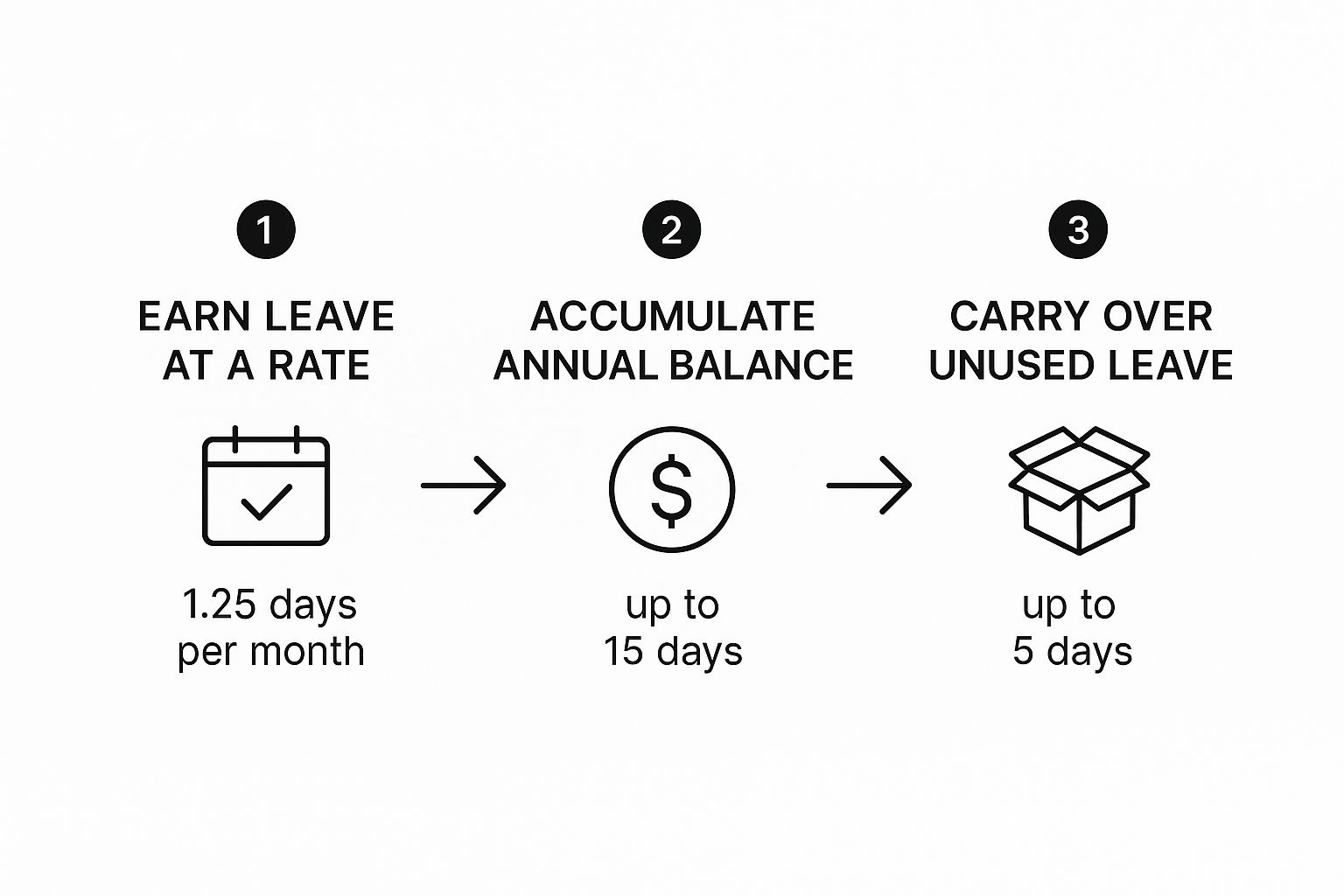
As the visual shows, your balance grows steadily with each month you work. Most companies also have rules about carrying unused days into the next holiday year.
Calculating Leave for Part-Time Staff
For part-time team members, the principle is exactly the same, but the entitlement is worked out on a pro-rata basis. This just means they get a fair, proportional amount of leave based on the days they actually work.
First, you figure out the full-time equivalent (which is usually 28 days). Then, you multiply this by the number of days the part-timer works each week and divide it by five (for a standard working week).
Example for someone working a 3-day week:
(28 days ÷ 5 days) × 3 days = 16.8 days of annual leave.
It's a simple bit of maths that ensures someone working 60% of a full-time week receives 60% of the full-time holiday entitlement. Fair is fair.
Key Takeaway: Whether you're full-time or part-time, your accrued leave is an entitlement, not just a perk. These calculations are designed to be transparent and directly reflect the time you've put into the business.
Handling Variable and Zero-Hour Contracts
Things can seem a bit more complicated for staff with irregular hours, but there's a set formula for that too. For casual or zero-hour contract workers, leave is accrued based on the actual hours they've clocked in. The government standard uses a rate of 12.07% of hours worked.
Where does that number come from? It's derived from the statutory 5.6 weeks of leave, divided by the remaining 46.4 weeks of the year (52 weeks – 5.6 weeks). If you want to get into the nitty-gritty of the rules, you can learn more about how to calculate annual leave for various employment situations.
Here’s how you work it out:
- Add up the total hours worked in a pay period (like a month).
- Multiply that total by 12.07% (or 0.1207).
- The result gives you the holiday time, in hours, that you've earned for that period.
This method guarantees that even workers without a fixed schedule receive their statutory paid holiday entitlement fairly and accurately.
Your Legal Rights and Employer Obligations

It’s one thing to get your head around the accrued leave meaning, but knowing your legal rights is what really counts. In the UK, your holiday entitlements are primarily protected by the Working Time Regulations 1998. This isn't just a dusty piece of legislation; it sets out the ground rules for both you and your employer.
These regulations are legal obligations, not friendly suggestions. They ensure fairness and protect your wellbeing by dictating everything from how you can book leave to what happens if your employment ends.
Payment in Lieu When You Leave a Job
One of the most common questions we hear is, "What happens to my unused holiday when I leave?" Whether you've resigned or been made redundant, the law is refreshingly clear: you're entitled to be paid for any statutory leave you've earned but haven't taken.
This is often called payment in lieu of notice (PILON). So, if you leave a job halfway through the holiday year but have only used a quarter of your statutory days, your employer must pay you for the time you've accrued up to your final day. This payout is calculated based on your normal rate of pay.
Rules for Carrying Over Annual Leave
As a general rule, you have to take your 5.6 weeks of statutory leave within the leave year it's earned. But that’s just the legal minimum. Many companies have more generous policies, often allowing you to carry over a set number of days into the next year. Your employment contract is the first place you should look for the specifics.
There are also a few legal exceptions to the "use it or lose it" rule. For instance, if you couldn't take your holiday because you were on long-term sick leave, you may have the right to carry it over. The government also brought in temporary rules during the pandemic, and you can see how those changes to annual leave carry over rules impacted workers in our dedicated article.
Your employer cannot pay you instead of you taking your statutory holiday, with the single exception being when you leave your job. The law is designed to make sure you actually take time off to rest and recharge, not just to line your pockets.
Can Your Employer Dictate Your Holiday?
Believe it or not, yes—within reason. Your employer can tell you when to take your holidays. This is quite common in sectors like manufacturing or education, where the entire business might shut down for a specific period. But they can't just spring it on you.
They have to give you proper notice, which must be at least twice as long as the holiday they want you to take. So, if they need you to take a week off, they must let you know at least two weeks beforehand. For companies with a global footprint, it's also vital to be aware of the bigger picture, and an international employment law guide is a good starting point for ensuring compliance across different countries.
Why Is So Much Accrued Leave Going Unused?
Even though most UK workers understand what accrued leave is, it's startling how many end the year with a hefty bank of unused holidays. This isn't just a case of forgetting to book time off; it's a widespread issue, often tangled up in deep-seated workplace pressures and personal anxieties.
For a lot of people, the main culprit is a relentless workload. When deadlines are always looming and projects keep piling up, taking even a few days off can feel like an impossible luxury. This kicks off a vicious cycle: employees desperately need a break, but the stress of what will be waiting for them on their return is so high that they just forfeit their well-earned time off.
The Rise of 'Leave Guilt'
A huge psychological hurdle is what many now call ‘leave guilt’. It’s that nagging feeling that taking a holiday means you're letting the team down, dumping your responsibilities on them while you switch off. This is especially common in close-knit teams where everyone feels immense pressure to pull their own weight.
Think about someone like Alex, a dedicated marketing pro. With a massive product launch on the horizon, Alex sees the whole team working flat out. Even with a healthy balance of accrued leave, the idea of taking a week off feels completely selfish. They start worrying about falling behind and creating a mountain of extra work for everyone else, so that holiday request form stays firmly in the drafts folder.
This isn't just a personal feeling, it's a cultural problem that can quickly lead to widespread burnout and sink productivity. When your team doesn't feel psychologically safe enough to take the rest they've earned, it's not just their well-being that suffers – the company’s performance does, too.
There's a worrying trend in the UK showing a big drop in how much annual leave people are actually taking. Recent data revealed that the average number of holiday days taken by UK workers fell to 33.9 in 2023. That’s down from 38 just three years earlier—a drop of nearly 12%. It really highlights the growing problem of employees racking up unused leave. You can explore the full UK annual leave report for a deeper dive.
Economic and Practical Hurdles
It's not all about workplace culture, though. Practical and financial realities play a massive part. With the rising cost of living, the expense of a proper holiday is simply out of reach for many. If taking a break just means sitting at home with nothing to do, the appeal fades fast. A lot of people would rather save their leave for a time when they can actually afford to get away.
Other common reasons for unused accrued leave often boil down to:
- Lack of Cover: In smaller teams, there might genuinely be nobody available to cover an employee's duties, making it almost impossible to get away.
- Fear of Being Seen as Dispensable: Some people quietly worry that if the team gets on perfectly fine without them, their job security might suddenly look a bit shaky.
- Saving for a Big Event: It's also common for employees to hoard their leave for a future life event, like a wedding, a big house move, or that once-in-a-lifetime trip.
When you add all these pressures together, you get an environment where accrued leave—a benefit designed for rest and recovery—ends up going to waste. This doesn't just impact personal health; it chips away at the overall effectiveness of the business.
Smart Strategies for Using Your Accrued Leave

Knowing what accrued leave is and how to use it wisely are two completely different things. The real secret is making your time off work smarter for you. Instead of burning through your entire leave allowance on one big holiday, a savvy little trick called ‘leave stacking’ can unlock longer, more restorative breaks throughout the year.
This is a simple but incredibly effective strategy where you plan your annual leave around public holidays. By booking off just a handful of days at the right time, you can create a surprisingly long, continuous holiday. It takes a bit of forward-thinking, but the payoff is huge: you maximise your time away from work without draining your leave balance dry.
How Leave Stacking Works
The idea is really straightforward. You just need to look at a calendar and spot when a bank holiday creates a long weekend. For example, if a bank holiday falls on a Monday, you can book off the following four days (Tuesday to Friday). Just like that, you’ve turned four days of annual leave into a glorious nine-day break (your four leave days + one bank holiday + two full weekends).
This approach can dramatically stretch your holiday time. The UK has a decent number of bank holidays to play with – eight in England and Wales, nine in Scotland, and ten in Northern Ireland. In 2025, for example, it’s possible to get as many as 67 days off using only 29 days of leave by carefully stacking them around public holidays.
This method is all about being proactive with your wellbeing. Planning your breaks well in advance ensures you get meaningful rest scattered throughout the year. You'll return to work feeling properly refreshed and recharged, not just like you had a long weekend.
Maximising Your Time Off
To really get the most out of your accrued leave, you have to plan ahead. Big holiday periods like Easter and Christmas are prime opportunities for some serious leave stacking.
Here are a few tips to get you started:
- Plan Early: The best holiday dates get snapped up fast, both for booking time off at work and for finding good travel deals. Get your calendar out at the start of the year and map out your plan.
- Talk to Your Team: Have an open chat with your colleagues about everyone’s holiday plans. This helps avoid clashes and makes sure there’s always enough cover.
- Use a Planner: A calendar, whether it’s on your wall or on your phone, is your best friend here. Mark all the bank holidays and weekends so you can instantly see the best stacking opportunities.
By applying these strategies, you can make a real, noticeable difference to your work-life balance. For more ideas on managing your time off effectively, check out our accrued annual leave tips for compliance and wellbeing.
Best Practices for Managing Holiday Time
Getting holiday management right is a two-way street. It’s not just a box-ticking exercise; it’s about creating a system that benefits everyone, from the company director right through to the newest hire. Once you grasp what accrued leave is, the real magic happens when you build smart, clear processes around it.
This isn’t just about avoiding that mad rush for leave at the end of the year. A proactive approach sidesteps disputes, keeps the business ticking over smoothly, and most importantly, ensures your team is healthy and well-rested.
For Employers: A Proactive Approach
For any business owner or manager, the best thing you can do is build a robust system on a foundation of total clarity. If you don't, you’re just inviting confusion and frustration to take hold down the line.
Your single most important tool here is a clear and transparent leave policy. This document needs to be a go-to resource for everyone, written in plain English, not a load of legal jargon. It should spell out exactly how holiday time accrues, the process for requesting time off, any rules on carrying days over, and specific blackout periods.
Next, you absolutely need a reliable way to track everything. A spreadsheet might seem fine when you’re a tiny team, but it quickly becomes a tangled mess of admin headaches and human error as you grow. Modern leave management software is a game-changer, automating all the tricky calculations for full-time, part-time, and even zero-hour contract staff. It gives everyone a real-time, accurate picture of where they stand.
But it’s not all about policies and software. Fostering a culture that genuinely encourages people to take their time off is just as crucial. When leadership takes proper holidays and managers actively support their teams in doing the same, it sends a powerful message: we value rest, and we know it’s essential for top performance.
For Employees: Taking Ownership
As an employee, it’s up to you to stay on top of your own holiday time. Get into the habit of checking your accrued leave balance regularly so you’re never in the dark about how much time you have. This simple step can save you from a nasty surprise when you try to book that much-needed break.
Here are a few tips to help you manage your time off like a pro:
- Plan Ahead: Don’t be that person who requests leave at the eleventh hour. Planning your time off well in advance gives your manager a fair chance to arrange cover. It also massively increases the odds of your request getting approved, especially if you’re eyeing up popular holiday periods.
- Communicate Clearly: Booking leave isn't just a transaction. When you put in a request, have a quick chat with your manager and your team. A simple conversation about deadlines and handover notes makes for a much smoother transition before you jet off and a far calmer return.
- Don't Hoard Your Days: It’s tempting to save all your leave for one epic trip, but that can be a fast track to burnout. Taking shorter, more regular breaks throughout the year is often a much better way to stay refreshed and on top of your game. Remember, your holiday time is a vital part of your compensation package—it’s there for your wellbeing, so use it
Of course. Here is the rewritten section, crafted to sound like it was written by an experienced human expert, following your specific style and formatting requirements.


