It's not yet seven and your phone is already warm. Someone's called in sick, someone else has swapped without telling you, and Friday's rota now has a hole exactly where your most experienced person should be. If that feels familiar, workforce scheduling optimization isn't an enterprise concept you can ignore. It's how you stop rebuilding the same week, twice.
Table of Contents
- When a Spreadsheet Is No Longer Enough
- What Workforce Scheduling Optimisation Actually Means
- Five Levers That Drive a Better Schedule
- UK Compliance Rules Your Schedule Must Respect
- Metrics That Tell You Whether the Schedule Is Working
- How LeaveWizard Fits Into an Optimised Workflow
- A Small Business Walkthrough
- Your 30-60-90 Day Rollout Plan
When a Spreadsheet Is No Longer Enough
The ping lands at 6am. A team member can't do Friday, the shared spreadsheet still shows them on shift, and the only obvious replacement finished late last night. You're now doing three jobs at once, checking availability from memory, guessing who's owed a break, and trying not to upset the person who always says yes.
That scramble is the cost of manual scheduling. A spreadsheet can hold names and times. It can't easily tell you whether a swap creates a rest problem, clashes with approved leave, or leaves a skill uncovered. Every change forces you to recheck cells that looked settled yesterday.
Who Feels This First
This hits HR leads, operations managers, team leads and founders running roughly five to 150 people. You're big enough that informal knowledge breaks down, but not big enough to employ a dedicated planner. The rota lives with whoever is most organised, which usually means it also interrupts their actual job.
I see the same pattern in service businesses, care teams, retail and leisure. Even niche operators who research tools like scheduling software for gyms from Fitness GM are really asking the same question, how do I know who's available, qualified and rested before I publish this?
A rota isn't finished when every box contains a name. It's finished when the cover is legal, skilled, fair and still workable after someone books leave.
What follows is practical rather than theoretical. You'll get a plain English definition, the levers worth pulling, the UK rules that set the floor, the metrics that expose weak schedules, and a rollout you can start without pausing operations. The payoff isn't a prettier spreadsheet. It's fewer early morning surprises, because problems surface while you've still got options.
What Workforce Scheduling Optimisation Actually Means
At its simplest, workforce scheduling optimisation answers who works when, where and doing what. The optimisation part means you don't answer those questions one at a time. You weigh demand, skills, contracted hours, labour cost, rest rules, approved leave, availability and employee preferences together, then choose the workable pattern with the fewest harmful trade-offs.
Traditional rota planning works the other way round. A manager copies last week's fixed hours, fills obvious gaps, publishes, then patches problems as leave requests, sickness and customer demand arrive. It looks orderly until reality touches it.
Trade-Offs You Can Score
Think of an objective function as a scoring sheet for a proposed schedule. You penalise understaffing, excessive overtime, preference clashes, split shifts people didn't choose, and sequences that leave too little recovery time. You reward adequate skilled coverage, stable hours and fair distribution of unpopular shifts. No schedule scores perfectly. A good one makes its compromises visible before staff bear them.
- Demand: When is work arriving, and what service level must you protect?
- Supply: Who's contracted, available, trained and not on leave?
- Constraints: Which legal rules, location needs and minimum staffing levels can't flex?
- Preferences: Which availability patterns and swap choices should you honour where possible?
It's similar to a chef running service with limited ingredients, different cooking times and dietary requirements. Putting any dish on a plate isn't success. The right dishes need to leave together, safely, without exhausting one station.
If you want a sector specific contrast, it's useful to compare scheduling methods for restaurants from MAJC, because hospitality exposes the same tension between manual familiarity and automated recalculation. Most small businesses already hold the starting data in contracts, leave records, training lists and demand patterns. Optimisation begins when you stop storing those facts separately and start using them as inputs to one decision.
Five Levers That Drive a Better Schedule
Five levers do most of the work. Pull one without watching the others and the rota improves on paper while deteriorating in practice.
Demand forecasting comes first. You estimate work by day, hour, location or service type using bookings, footfall, case volumes or repeat weekly patterns. Without a forecast, coverage is just habit. You'll overstaff quiet periods and still miss peaks.
Shift design shapes the building blocks. Start and finish times, shift length, rotation direction, split patterns and on-site or remote eligibility determine whether forecast demand can be covered without awkward fragments. Good design also reserves time for handovers, training and breaks rather than treating those activities as interruptions.
Coverage Needs Skills, Not Just Heads
Coverage balancing matches people to those blocks by skill, contracted hours, availability and fairness. This matters more now that flexibility is uneven across teams. The UK Government's 2024 to 2025 employee survey found 79% of employees had at least one flexible-working option available, with flexible hours available to 54%, hybrid work to 40% and part-time work to 39%, while SME Skills Horizon 2025 separately reported 90% of SMEs identified skills gaps and 26% anticipated staffing challenges.
That's why a simple headcount can mislead. Three available people don't help if none can open the building, administer medication, drive the route or supervise a trainee. A clear coverage planning view lets you see scarce competencies before you approve competing leave or publish the week.
Compliance is the essential lever. Rest, breaks, night work and leave accrual aren't preferences to trade away for a cheaper week. Build them into the template and approval checks, not a last minute audit.
Cost optimisation comes last for a reason. Once demand, skills and legal limits are satisfied, you can reduce unnecessary overtime, avoid premium cover caused by late discovery, and move movable activities into quieter periods. Chase cost first and you may buy a cheap rota that creates breaches, absence and rework.
Used together, forecasting informs shift design, design enables balanced coverage, compliance sets boundaries, and cost helps you choose between feasible options. That's optimisation. Anything less is gap filling.
UK Compliance Rules Your Schedule Must Respect
Compliance isn't a policy folder you check after publishing. It's the floor under every scheduling decision. If a pattern only works by trimming rest or miscalculating leave, it doesn't work.
Start with annual leave. UK government guidance states almost all workers receive 5.6 weeks of statutory paid annual leave, capped at 28 days for a full leave year, and irregular-hours and part-year workers accrue leave at 12.07% of hours worked in each pay period under the amended rules. Your scheduler therefore needs to distinguish contracted staff from irregular-hours workers instead of applying one allowance formula to everyone.
Rest Rules to Check Before You Publish
Legal minimums aren't the same as fatigue-aware design. HSE fatigue guidance recommends allowing at least 12 hours between shifts where possible and allowing two days off after a run of night shifts. Swaps need the same scrutiny as manager created shifts, because an employee initiated exchange can still produce a quick return.
- Between-shift gap: Check every finish followed by a start, including swaps and overtime.
- Daily break: Flag working days over six hours without a proper uninterrupted break.
- Weekly rest: Confirm recovery time across the full reference cycle, not just within one calendar week.
- Night-worker average: Review normal hours across the applicable period before adding extra nights.
- Leave position: Reconcile approved leave and accrual before assigning cover.
Keep your approach to complying with employment laws alongside the rota process, not separate from it. Managers don't need to become employment lawyers. They do need repeatable checks that catch obvious problems while there's still time to choose different cover.
Metrics That Tell You Whether the Schedule Is Working
Good attendance sounds reassuring and tells you almost nothing. A team can attend reliably while the rota depends on excessive overtime, constant changes and the same few people absorbing every emergency. Measure schedule quality directly.
Coverage rate against forecast demand shows whether required skills were present when work arrived. Pair it with time-to-fill, the time from a call-out or newly discovered gap to confirmed cover. The first reveals planning quality. The second reveals how much managerial firefighting the system needs.
Signals That Point to a Fix
- Overtime share: Persistent overtime by person or skill suggests demand, recruitment or shift design problems, not admirable flexibility.
- Rest-rule breaches: Count issues found in each published rota and separately track breaches created later by swaps.
- Schedule stability: Record how often shifts change after publication, who requested the change, and how much notice employees received.
- Absence by reason and pattern: Look for repeat pressure points without making medical assumptions about individuals.
- Preference and fairness: Review who receives desirable shifts, emergency cover and short-notice changes over time.
Context matters. CIPD's 2025 survey found average employee absence reached 9.4 days per employee, up from 7.8 days in 2023 and 5.8 days in 2022, with mental ill health cited among the top three causes of long-term absence by 41% of employers. That doesn't mean your rota caused every absence. It does mean a plan with no slack, recovery protection or alternative cover is fragile.
Use a compact set of HR efficiency metrics and review them together. For a 25-person team, sensible aims are no unresolved rest breaches at publication, fewer post-publication changes month by month, and emergency cover spread visibly across qualified staff. Don't optimise one number in isolation. Cutting labour cost while time-to-fill and absence rise isn't efficiency. It's cost moving somewhere harder to see.
How LeaveWizard Fits Into an Optimised Workflow
The screenshot below shows the planning view that matters most, leave and availability sitting where managers make cover decisions.
In an optimised workflow, LeaveWizard handles the supply side inputs that rotas often receive too late. Approved leave appears against team availability in real time, so a manager can spot overlap and likely understaffing before approving another request. Self-service through the smartphone app and web portal moves requests out of inboxes and paper forms, while employees can see their own balances and team calendar context.
That changes the manager's day in specific ways. You're not retyping holiday dates into a rota, chasing who asked first, or recalculating entitlement for different working patterns by hand. Automated leave calculations and configurable policies handle routine accrual logic, and reports give you an audit trail when finance, HR or a compliance review asks how a balance was reached.
Turning Absence Records Into Planning Inputs
The short walkthrough below shows how that visibility works in practice.
The value isn't in storing absence neatly. It's using approved leave, recurring absence patterns and remaining entitlements to forecast pinch points. If three people with the same scarce skill want the same school holiday period, you can discuss alternatives early. If one department carries repeated short notice absence, you can plan backup cover rather than pretending the template will hold.
Practical rule: Make leave approval a coverage decision, not an inbox task. Check skills, minimum staffing and already approved absence at the moment of approval.
A platform doesn't replace managerial judgement. You still decide service priorities, who needs development exposure, when a phased return requires adjusted duties, and how to handle sensitive circumstances fairly. What it removes is the manual reconstruction of facts you need for those decisions. Flexible policies can then grow with the business without creating a new spreadsheet for every pattern.
A Small Business Walkthrough
Take a 25-person home-care provider working across two counties. Coordinators managed visits, travel time and staff availability in a shared spreadsheet. Holiday requests arrived by message, swaps were agreed informally, and the office discovered some clashes only when clients needed cover.
The visible problem was last minute change. The underlying problem was fragmented information. One coordinator knew who could drive, another knew who disliked consecutive early starts, and nobody had a reliable view of approved leave beside required skills. Reliable carers received repeated emergency calls because their names were easiest to remember.
What Changed in the Week
The provider centralised leave requests through self-service, added required skills and minimum cover to its weekly planning view, and forecast demand from recurring client visits before assigning staff. Swap requests stayed possible, but a coordinator checked rest gaps and qualifications before approval. A short pre-publication audit covered weekly rest, night patterns, leave overlap and uncovered specialist visits.
That approach fits wider frontline practice. The CIPD 2023 survey reported 60% of employees had flexible working arrangements in their current role, up from 51% in a 2022 survey, while 65% of organisations offered some form of flexibility to frontline workers, 31% allowed employees to swap shifts with colleagues and approximately one-third offered flexibility in shift or rota scheduling. The provider didn't remove flexibility. It made flexibility visible and conditional on safe cover.
After the change, coordinators spent planning time reviewing exceptions rather than rebuilding the whole week. Time-to-fill fell because qualified backups were identified in advance. Rest concerns surfaced before publication, and emergency requests were distributed more fairly. Staff feedback improved where people could see why a request was approved, moved or declined.
There was no magic algorithm. The gain came from connecting demand, leave, skills and rest checks early enough for coordinators to choose. That is achievable without enterprise software or a planning department.
Your 30-60-90 Day Rollout Plan
Start smaller than your frustration suggests. A clean pilot with one team teaches you more than a business-wide launch built on messy availability data.
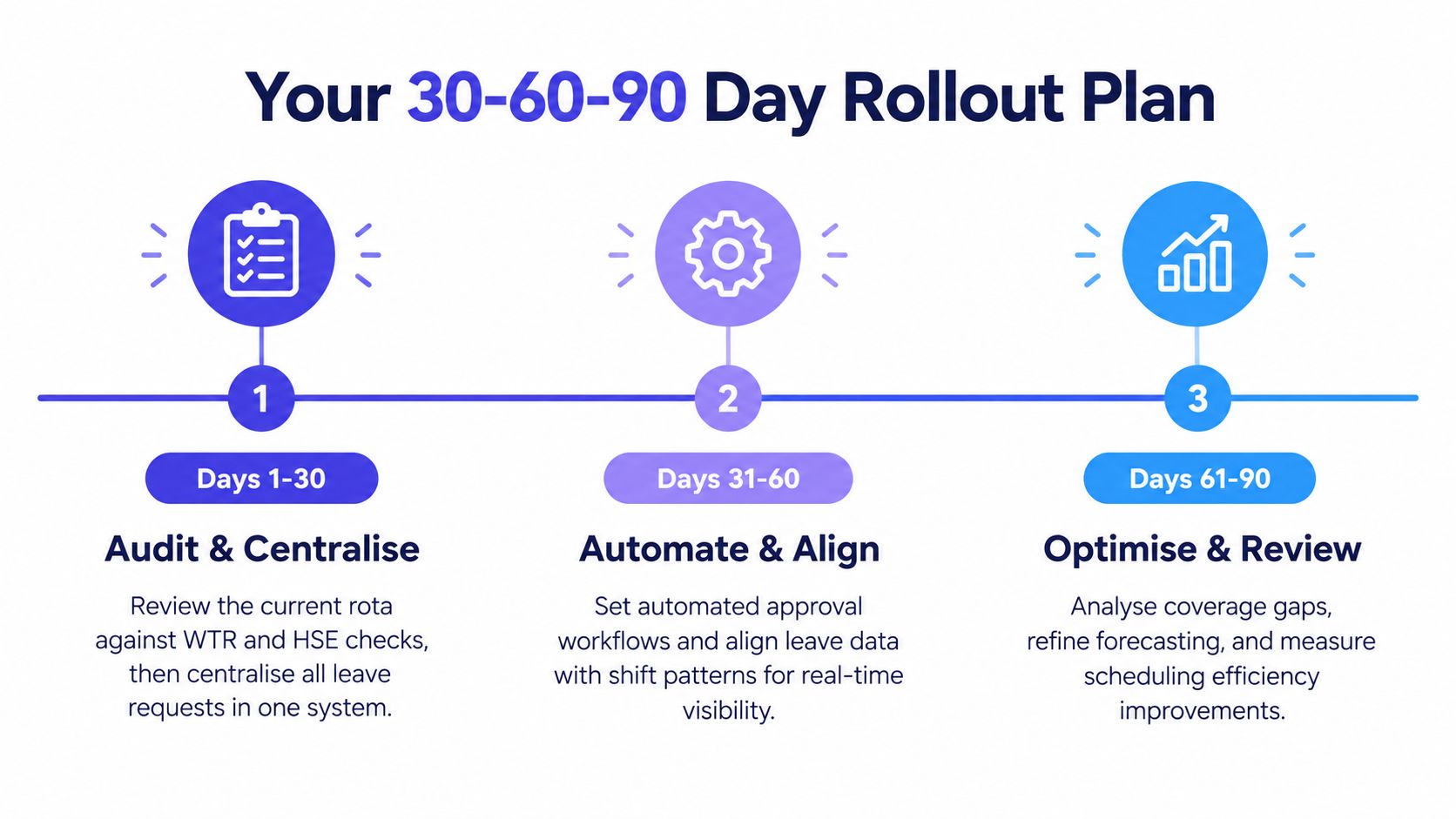
Days 1 to 30 Audit and Centralise
Audit recent published rotas against rest gaps, breaks, weekly rest and night-worker checks. List where leave, availability, skills and contracted hours currently live, then choose one source for each. Agree scoring rules with managers, including minimum skilled cover, who can approve swaps, and how you'll distribute unpopular shifts fairly.
Days 31 to 60 Automate and Align
Pilot self-service leave and a forward schedule with one team. Put approved absence beside the rota before publication, set approval workflows, and track coverage, time-to-fill, overtime, rest breaches and post-publication changes from the first week. Ask employees where the process feels unclear or unfair, then adjust the rules while the group is small enough to hear everyone.
Days 61 to 90 Optimise and Review
Extend the pilot to a second team only after the first can publish without reconstructing data manually. Compare absence against coverage problems, refine demand assumptions using what happened in practice, and formalise backup arrangements for scarce skills. Update policies after the workflow works, not before anyone has tested it.
- Managers first: Train approvers on checks, fairness rules and escalation routes.
- Employees second: Show people how to request leave, view balances and propose swaps.
- Policy third: Write down the proven process, including notice expectations and exceptions.
- Feedback loop: Hold a short monthly review of metrics, complaints and near misses, then change one rule at a time.
Don't announce optimisation as a cost-cutting project. Explain it as earlier visibility, safer cover and fairer decisions, then prove that with the first pilot.
By day 90, you won't have a perfect rota. You'll have something more useful, a repeatable planning cycle that exposes risk early and gets less fragile each month.