A leaver's final payslip is ready for approval. The employee has resigned, their notice period is nearly complete, and someone needs to decide whether the business owes holiday pay or can make a lawful deduction. The annual allowance looks simple, but the answer depends on the leaving date, the leave year, the contract, holiday already taken, and sometimes the employee's working pattern.
A reliable holiday calculator when leaving a job should do more than divide annual leave by months. It should reconstruct entitlement at the final date, separate statutory and contractual leave, account for valid carry-over, and show how the result was reached. That's the difference between a figure that looks plausible and a final settlement that a manager can explain with confidence.
Table of Contents
- Why the Final Holiday Calculation Matters
- Understanding Your Statutory Holiday Entitlement
- Applying the Pro-Rata Formula Correctly
- Navigating Irregular Hours and Variable Pay
- Handling Edge Cases and Complex Scenarios
- Ensuring Accuracy with Automated Tools
Why the Final Holiday Calculation Matters
Every manager wants the same outcome at the end of employment: a final payslip that is accurate, timely, and easy to defend. A small mistake can create an awkward conversation with the departing employee, delay payroll approval, or force HR to revisit records that should already have been settled.
The pressure usually appears in a familiar situation. An employee leaves part-way through the leave year, has taken several days already, and asks whether unused holiday will be paid. The manager checks a spreadsheet, sees a remaining balance, and assumes the answer is straightforward. Then someone notices that the company offers additional contractual leave, or that the employee carried days over after sickness, and the original calculation no longer tells the whole story.
Practical rule: Treat the leaving date as a compliance checkpoint, not just another payroll input.
The legal baseline is clear. Most UK workers are entitled to paid statutory holiday, and untaken statutory leave must generally be paid when employment ends. GOV.UK also explains that employers may pay statutory holiday in lieu only when the worker leaves, including where the employee is dismissed for gross misconduct. A final settlement must therefore establish what has accrued, what has been used, and what remains payable before payroll calculates the amount.
The calculation also sits alongside other exit payments. Notice pay, payment in lieu of notice, and holiday pay can interact in the final payroll process, but they aren't interchangeable. Managers who need to distinguish those arrangements can review this explanation of payment in lieu of notice before approving the payslip.
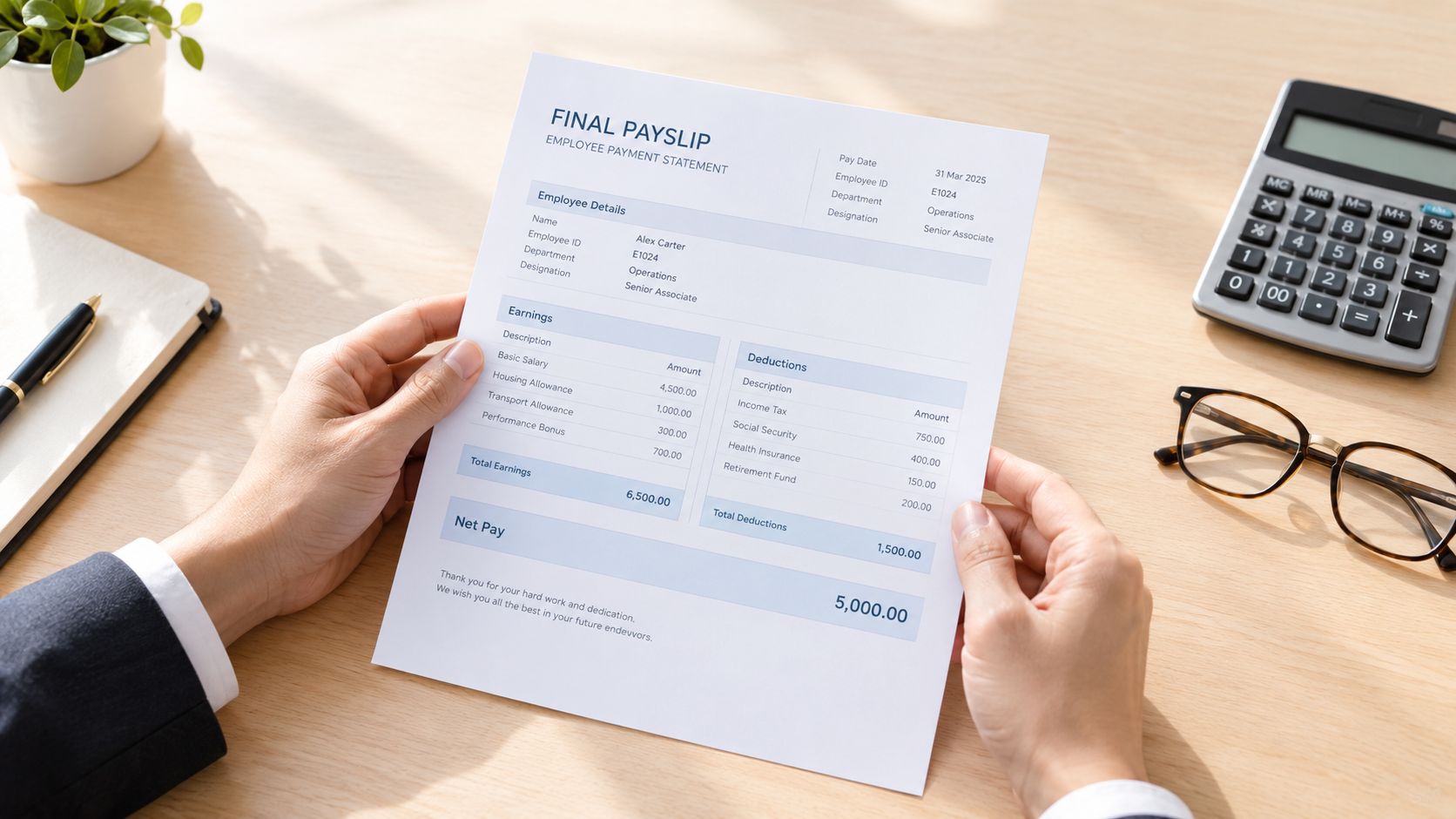
The relief comes when the result is supported by a short audit trail: the leave year dates, annual entitlement, leaving date, leave taken, carry-over, pay basis, and any contractual rule applied. That record gives HR and finance a shared answer instead of a number that depends on who last edited the spreadsheet.
Understanding Your Statutory Holiday Entitlement
Start with the statutory baseline before considering company enhancements. In the UK, most workers are legally entitled to 5.6 weeks of paid holiday per leave year, which equals 28 days for someone working five days a week, according to GOV.UK guidance on holiday entitlement calculations. The entitlement may include bank holidays, depending on the employment contract and the employer's holiday policy.
The important point is that 5.6 weeks is a time-based entitlement, not a universal number of days for every worker. A part-time employee receives the same weeks of leave on a pro-rata basis, usually expressed against their working pattern. Someone working fewer days each week won't normally receive 28 individual days, because each day represents a different amount of working time.
Build the calculation from three inputs
Use this framework for a standard employee:
- Identify the full-year entitlement. Check the contract and holiday policy. Record the statutory allowance and any additional contractual days separately.
- Confirm the leave year. A calendar year is common, but the contract may use a different start and end date. The leaving date must be measured against the correct leave year.
- Apply the leaving-date proportion. GOV.UK describes the calculation as full-year entitlement multiplied by the months started, divided by 12. Then subtract holiday already taken and account for any valid carry-over.
For example, an employee with a 28-day entitlement who leaves after six months would generally have accrued 14 days before holiday already taken is considered, based on the GOV.UK formula linked above. That result is not automatically the final payment. If the employee has taken fewer days than accrued, the employer normally pays the untaken statutory balance in the final pay.
Keep statutory and contractual leave distinct
A business might offer more holiday than the statutory minimum. Those extra days are contractual and may be governed by different wording about accrual, carry-over, or payment on termination. Don't put the entire allowance into one cell and assume the same rule applies to every day.
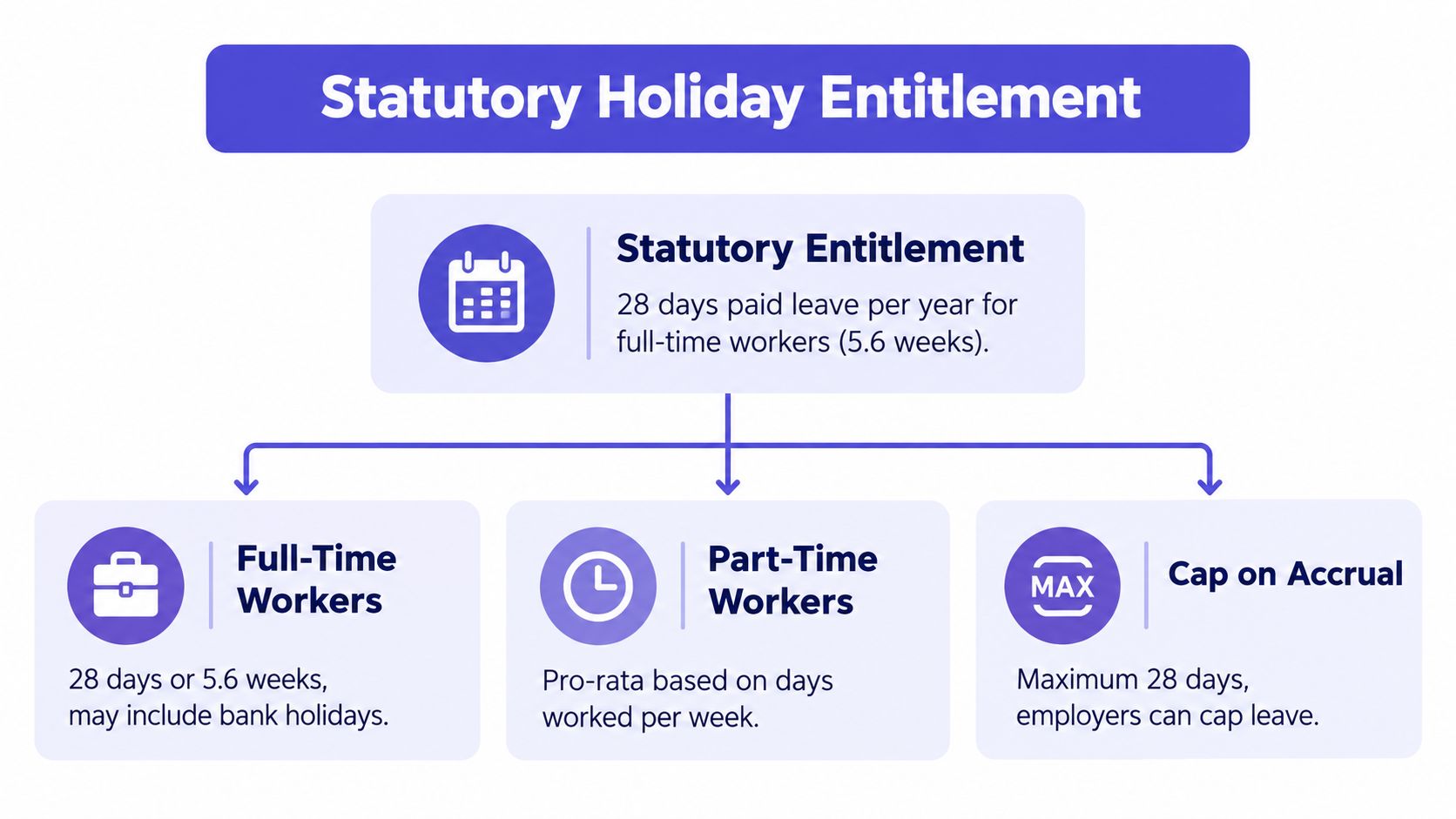
Managers who want a concise reference for the baseline can use this guide to statutory holiday entitlement in the UK, then return to the contract for any enhanced terms.
Applying the Pro-Rata Formula Correctly
The standard formula works well for a regular employee whose entitlement is stated in days and whose leave year is known. The mistake is treating it as a universal method. It applies to a defined set of circumstances, and the result still has to be reconciled against leave taken and contractual terms.
Consider a team member with a 25-day contractual allowance who resigns three months into a standard calendar leave year. For this worked example, assume the employment contract uses the same monthly pro-rata approach and the employee has taken two days before leaving.
Work through the figures
The calculation is:
25 days × 3 months ÷ 12 months = 6.25 days accrued
After subtracting the two days already taken:
6.25 days accrued minus 2 days taken = 4.25 days remaining
The employer then needs to apply its contractual rounding policy and payroll treatment. The example shows the method, but it doesn't remove the need to check whether the contract uses calendar months, months started, days, or hours. GOV.UK describes the statutory leaving-date approach as full-year entitlement multiplied by months started divided by 12, so the chosen method should match the applicable rule and documented policy.
| Step | Action | Example Calculation |
|---|---|---|
| 1 | Confirm the full-year allowance | 25 contractual days |
| 2 | Measure service in the leave year | 3 months started |
| 3 | Calculate accrued entitlement | 25 × 3 ÷ 12 = 6.25 days |
| 4 | Subtract leave already taken | 6.25 minus 2 = 4.25 days |
| 5 | Check contract and rounding rules | Apply the documented treatment before payroll |
Do not skip the reconciliation: Annual allowance minus leave taken isn't enough unless the allowance has first been accrued up to the leaving date.
Handle an overused balance carefully
If the employee has taken more holiday than accrued, don't automatically deduct the apparent excess from final pay. A deduction is generally permitted only where the employment contract or a prior written agreement allows it. Without that authority, the manager should refer the matter to HR or payroll rather than converting a spreadsheet balance into an immediate deduction.
A good pro-rata holiday calculation guide can help managers understand the arithmetic, but the calculator still needs accurate inputs. Record the leave year, allowance, leaving date, leave taken, carry-over, and contractual basis before accepting the result.
Navigating Irregular Hours and Variable Pay
The monthly formula becomes unreliable when a worker's hours change from pay period to pay period. An employee working variable shifts doesn't accrue leave in the same way as someone with fixed weekly hours, so a fixed annual allowance divided by calendar months can overstate or understate the balance.
For irregular-hours and part-year workers whose leave years begin on or after 1 April 2024, UK employers use a specific statutory accrual method. Statutory holiday accrues at 12.07% of hours worked in each pay period, subject to the annual maximum of 5.6 weeks. GOV.UK sets out this approach in its guidance on holiday pay and entitlement reforms.

A worker completing 100 paid hours in a pay period would accrue 12.07 hours of statutory leave under that method. Across 1,000 hours, the calculation produces 120.7 hours before the applicable statutory maximum and rounding rules. GOV.UK states that an entitlement result must be rounded up to the nearest hour when the result is 0.5 of an hour or more, so the system must preserve the unrounded calculation until the correct point.
Combine working pattern and exit decisions
The hours method doesn't operate in isolation. Before approving a final balance, check:
- Leave-year start date: The 12.07% method doesn't automatically apply to every employee or historical leave year.
- Qualifying hours: Use paid hours worked in the relevant pay periods, not an assumed monthly schedule.
- Sickness records: Confirm whether leave was prevented by long-term sickness and whether carry-over applies.
- Notice-period leave: Establish whether holiday was taken, authorised, or remained unused before the final date.
- Pay reference period: Holiday pay may be based on average pay over the previous 52 weeks in which the worker worked and earned pay, rather than a fixed weekly salary.
The practical insight is that entitlement and holiday pay are separate calculations. A correct hours balance paired with the wrong pay basis can still produce an incorrect final payment.
This short video can help teams visualise the kind of records a variable-hours calculation depends on:
A reliable workflow therefore connects the rota, timesheet, leave record, sickness history, and contract. If one of those records is missing, the output should flag the gap rather than present a false sense of precision.
Handling Edge Cases and Complex Scenarios
The difficult settlements are rarely difficult because the arithmetic is advanced. They become difficult because several valid rules apply at once. A worker may have taken leave during notice, carried leave over after sickness, received contractual top-up days, or been dismissed without notice. A single balance column cannot explain those distinctions.
Check the rules that change the result
Long-term sickness can preserve statutory leave that the employee couldn't take. Workers can carry over four weeks of leave in those circumstances and generally must use it within 18 months, according to GOV.UK guidance on taking holiday before leaving a job. The final calculation should identify the carried-over period, confirm that it remains valid, and keep it separate from the current leave year's accrual.
Notice-period decisions also need a record. The employer may arrange for leave to be taken before the final date, but the final balance must show whether each day was actually used. If sickness prevented the employee from taking approved leave, don't treat the absence as completed holiday merely because the dates appeared on a rota.
Gross misconduct doesn't remove the entitlement to payment for accrued, untaken statutory leave. The employer must still pay outstanding statutory holiday when employment ends. Conversely, an employer can't normally deduct money for holiday taken above accrued entitlement unless the contract or a prior written agreement authorises that deduction.
A termination reason may affect the employment process, but it doesn't erase an accrued statutory holiday balance.
Why spreadsheets become a liability
A spreadsheet can calculate a fraction, but it often fails to preserve the reasoning behind the fraction. It may merge statutory and contractual days, overwrite a previous balance, or leave no clear record of how sickness carry-over was assessed.
An audit-friendly process should show:
- The source records: Contract, leave year, timesheets, approved leave, sickness information, and leaving date.
- The treatment of each category: Statutory leave, contractual top-up, carried-over leave, and leave already taken.
- The decision points: Whether an overuse deduction is authorised and whether notice-period leave counts as taken.
- The calculation history: The inputs and output that were available when the final settlement was approved.
From 6 April 2026, employers must retain detailed records of leave, carry-over, holiday pay, and payments in lieu for at least six years, as described in the GOV.UK guidance linked above. That makes an unexplained spreadsheet result a weak control. A system that preserves assumptions and changes gives managers a more defensible record.
Ensuring Accuracy with Automated Tools
A final settlement often begins with a simple question, such as “How many days are left?” The answer may require several data sources and different calculation methods. Manual work becomes fragile when an HR administrator copies a balance from a leave calendar, checks hours in payroll, searches an email for sickness carry-over, and then adjusts a final payslip by hand.
Dedicated leave software changes the workflow. Instead of asking a spreadsheet to remember every exception, the business can store the employee's working pattern, leave year, allowance, absences, and approvals in one controlled process. The tool should still allow HR to inspect the inputs, because automation is useful only when the underlying records are correct.
What a defensible tool should show
A suitable system for leaver calculations should provide:
- Date-aware accrual: It calculates entitlement up to the actual leaving date rather than using the full annual allowance.
- Pattern-aware treatment: It distinguishes regular employees from irregular-hours and part-year workers.
- Balance reconciliation: It subtracts leave taken and identifies remaining entitlement instead of displaying gross annual allowance.
- Separate categories: It keeps statutory entitlement, contractual top-ups, and carry-over visible.
- Calculation history: It records assumptions, adjustments, and the approved final result.
- Payroll-ready reporting: It gives finance a clear figure and supporting detail for the final payslip.

A small business replacing spreadsheets should also consider how the tool fits with payroll and absence records. Resources such as streamline payroll with Wistec are useful when the wider payroll workflow needs better coordination, but the leave system still needs to preserve the entitlement logic behind each final payment.
The strongest outcome is practical rather than flashy. A manager can open the leaver record, see the leaving date and leave year, verify the leave taken, review any carried-over balance, and send payroll a result that another colleague can reproduce. The employee receives an accurate final payment, while the business retains a clear compliance trail.