A customer asks for a week off, your part-time worker submits a request in hours, and a casual team member's balance still sits in a spreadsheet copied from last year. You open the payroll file, check a few formulas, and wonder whether bank holidays count, whether the worker has accrued enough leave, and whether the 2024 changes affect your calculation.
That uncertainty is common in small businesses. Minimum holiday entitlements are straightforward in principle, but the calculation changes with each person's working pattern. The safest approach is to identify the worker's category, apply the correct formula, and keep a record that someone else can audit later.
Table of Contents
- Why Minimum Holiday Entitlements Trip Up Small Employers
- How the 5.6 Week Statutory Minimum Actually Works
- Worked Calculations for Full-Time, Part-Time, and Shift Workers
- Holiday Pay for Irregular Hours and Part-Year Workers After 2024
- Common Holiday Entitlement Mistakes Small Businesses Make
- A Practical Holiday Compliance Checklist for SMEs
- Putting Holiday Entitlements on a Sustainable Footing
Why Minimum Holiday Entitlements Trip Up Small Employers
A café owner receives a holiday request from a barista who works three shifts a week, but not always on the same days. The owner knows the worker is entitled to paid holiday, yet the familiar full-time figure doesn't fit neatly. Should the request be measured in days, hours, or shifts? What happens when the rota changes next week?
The legal anchor is 5.6 weeks of paid statutory holiday each year for almost all workers, including part-time and irregular-hours workers, under the UK government's holiday entitlement guidance. For someone working five days a week, that equals 28 days. For someone working three days a week, it equals 16.8 days, calculated as three days multiplied by 5.6.
The rule is designed to follow the worker's pattern rather than force every employee into a five-day template. That sounds simple, but small employers often have to manage the process without a dedicated HR team.
Why spreadsheets create uncertainty
In a growing business, the same person may write contracts, approve leave, run payroll, and cover absences. A spreadsheet that worked for fixed-hour staff can become unreliable when the team includes zero-hours workers, term-time staff, starters in the middle of a leave year, or people whose shifts vary from pay period to pay period.
A manual record can also hide the difference between:
- Entitlement, the amount of statutory leave the worker should receive.
- Accrual, the amount built up as the worker works.
- Leave taken, the time already used.
- Holiday pay, the amount paid while the worker is away or accrued under the permitted method.
Practical rule: Never decide a holiday request from a balance alone. Check the worker's pattern, the leave year, the accrual method, and the pay treatment behind that balance.
An incorrect calculation can lead to disputes about unpaid holiday, unlawful deductions, tribunal exposure, and loss of trust. The answer isn't to make every manager a solicitor. It's to replace informal assumptions with a clear calculation and an evidence trail.
How the 5.6 Week Statutory Minimum Actually Works
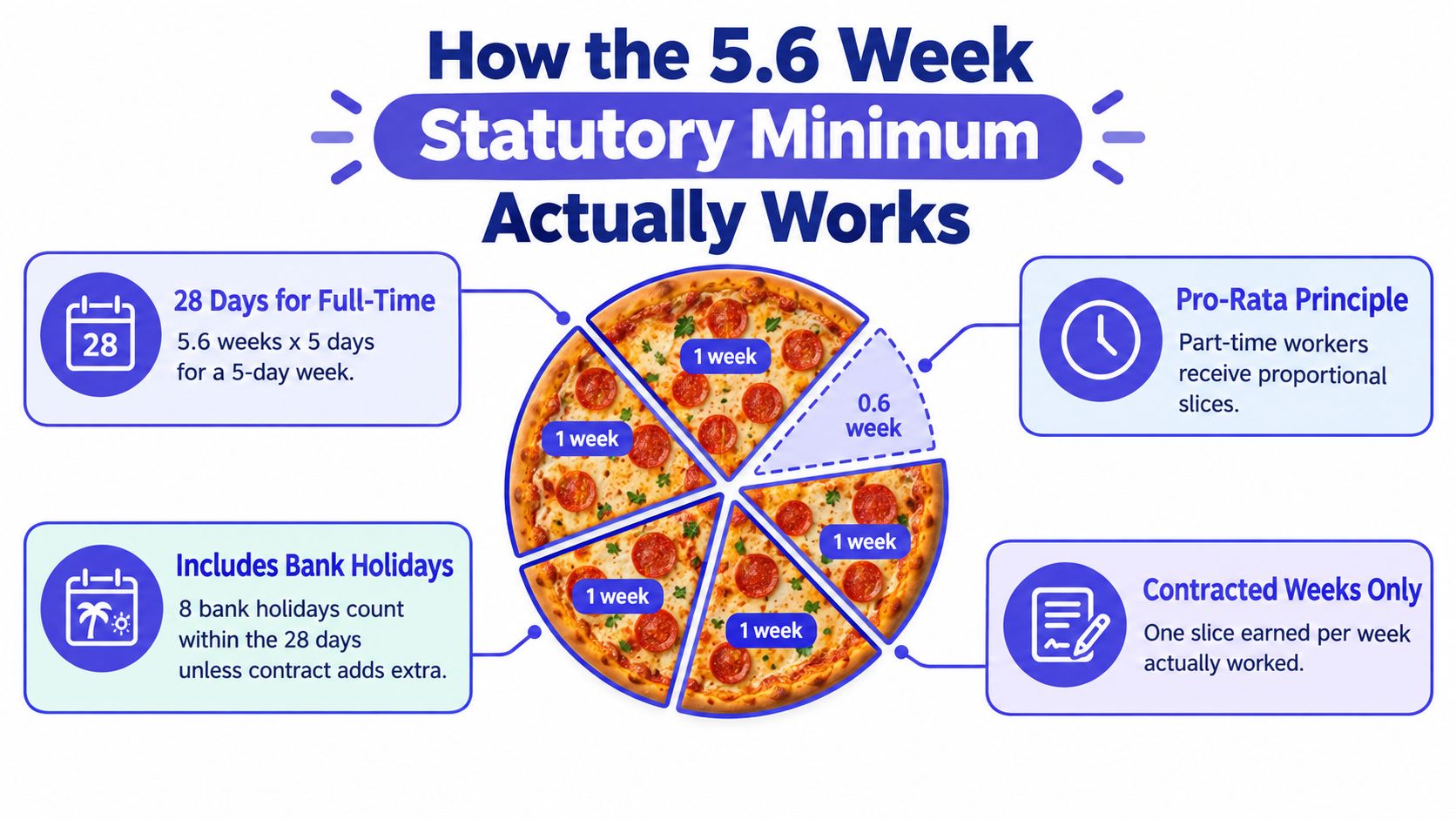
Think of the working year as a pizza divided into 5.6 slices. Each slice represents one week of statutory leave. A worker's normal working pattern determines how large each slice appears in days or hours.
For a five-day worker, multiply 5.6 weeks by five working days. The result is 28 days, the familiar full-time minimum. A worker on fewer days receives the same number of weeks, converted into the number of days that matches their pattern. The ACAS explanation of holiday entitlement confirms that the statutory minimum is 5.6 weeks, with a legal cap of 28 days for someone working more than five days a week.
The legal building blocks
The Working Time Regulations 1998 divide the statutory minimum into two parts. The first four weeks sit under regulation 13. The additional 1.6 weeks sit under regulation 13A, as explained in the government's holiday-pay and entitlement reforms guidance.
That distinction matters because the two portions have different rules around pay and carry-over. Employers shouldn't treat the entire entitlement as a single flexible pot without checking the relevant legal conditions. Payment instead of taking statutory leave generally arises when employment ends, rather than as a routine substitute during employment.
Bank holidays don't automatically sit on top of the statutory minimum. An employer can include them within the 5.6 weeks, provided the worker still receives the full entitlement. A contract may offer more generous leave, but the statutory baseline remains the starting point.
Which workers are covered
The entitlement applies broadly to employees and workers, including people on fixed-term contracts, zero-hours arrangements, and part-time schedules. The practical calculation depends on whether the person has:
- Fixed hours, where the normal working week provides the basis for the calculation.
- Part-time hours, where the five-day equivalent is reduced proportionately.
- Irregular or part-year hours, where entitlement is built from the hours worked under the applicable rules.
The key question is not whether the contract looks traditional. It's whether the person is legally a worker and what working pattern the contract and actual work show.
Worked Calculations for Full-Time, Part-Time, and Shift Workers
The easiest way to test your process is to work through examples using the same sequence every time: identify the pattern, apply 5.6 weeks, and express the outcome in the unit your payroll and rota systems use.
Example one, full-time office administrator
An administrator works five days a week and 40 hours a week.
- Days: 5.6 weeks × five days = 28 days.
- Hours: 5.6 weeks × 40 hours = 224 hours.
The days figure is useful for a standard Monday-to-Friday policy. The hours figure is more practical if the organisation records leave against daily hours or if each day has a different length.
Example two, part-time school receptionist
A receptionist works three days a week and has 22.5 contracted hours.
- Days: 5.6 weeks × three days = 16.8 days.
- Hours: 5.6 weeks × 22.5 hours = 126 hours.
The worker receives the same 5.6 weeks as a full-time colleague, but each week contains three working days rather than five. That's why the entitlement is lower when expressed in days.
Example three, irregular shift worker
A shift worker has no fixed weekly pattern. Their entitlement needs a reference period based on the worker's average working pattern. Under the government's guidance, the averaging method looks back over the last 52 weeks. Weeks with no contracted hours are left out and replaced with earlier weeks until the reference period contains 52 relevant weeks.
The calculation should retain the underlying weeks used, the hours recorded, and any excluded zero-hour weeks. That record gives the worker and employer a way to understand how the result was reached.
| Worker Type | Working Pattern | Formula | Annual Entitlement | In Hours |
|---|---|---|---|---|
| Full-time administrator | Five days, 40 hours a week | 5.6 × five days, or 5.6 × 40 hours | 28 days | 224 hours |
| Part-time receptionist | Three days, 22.5 hours a week | 5.6 × three days, or 5.6 × 22.5 hours | 16.8 days | 126 hours |
| Irregular shift worker | Variable pattern | Average relevant weeks using the last 52 weeks | Based on average pattern | Based on average hours |
For a second check, compare your result with the LeaveWizard holiday entitlement calculator. The important control is consistency. Two people should reach the same result from the same inputs, even if one checks the maths manually and the other uses software.
Holiday Pay for Irregular Hours and Part-Year Workers After 2024
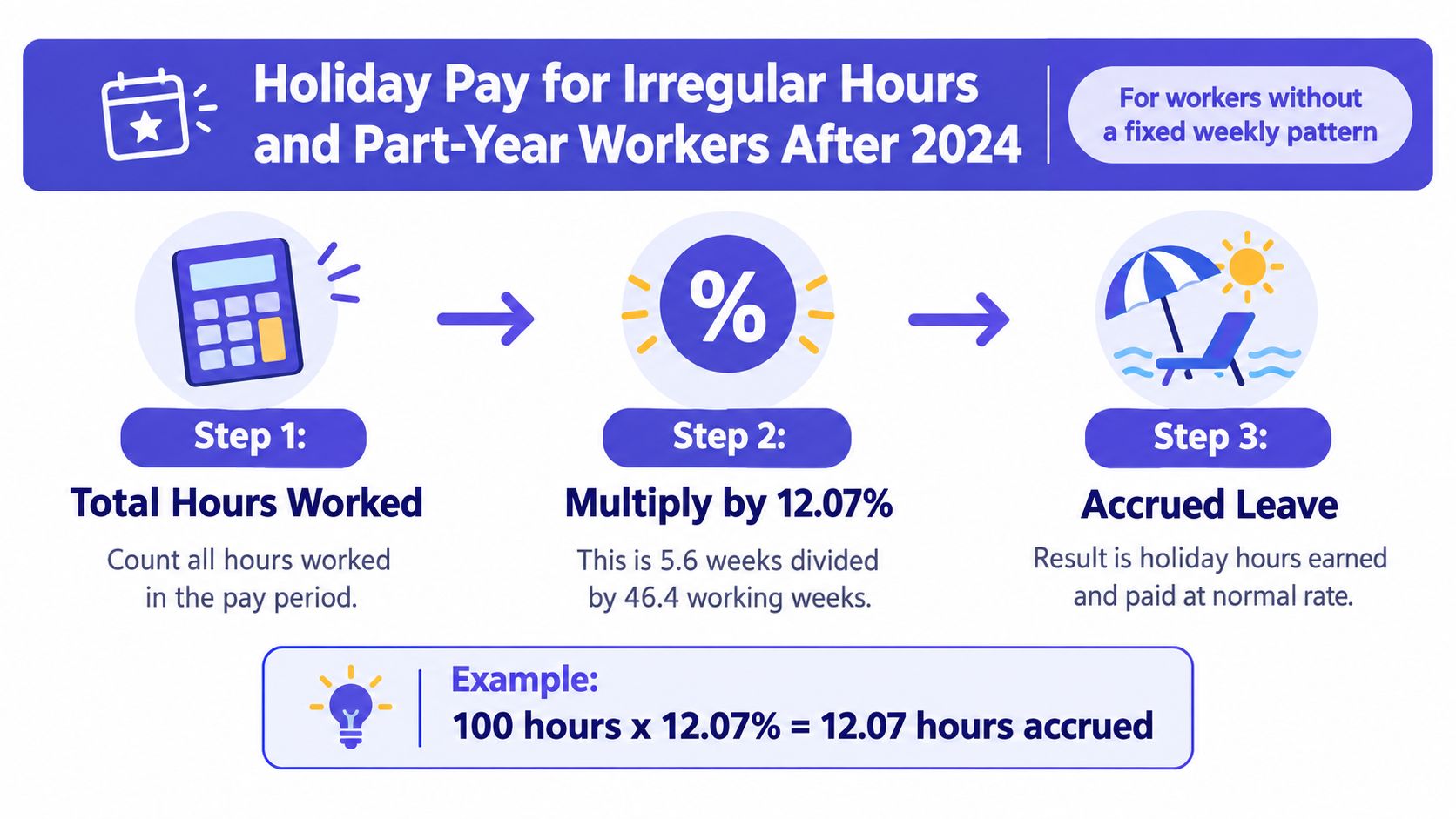
Irregular-hours and part-year workers need a different operational treatment because their working time isn't spread evenly across the year. For eligible workers, the government's holiday entitlement calculation guidance uses an accrual approach equal to 12.07% of hours worked in a pay period.
The practical sequence is:
- Add the worker's hours worked in the pay period.
- Multiply those hours by 12.07%.
- Record the resulting holiday hours.
- Pay holiday at the worker's normal hourly rate when leave is taken, unless a lawful rolled-up method applies.
Holiday already taken shouldn't be counted again as hours worked for the accrual calculation. Your payroll record should therefore distinguish worked hours from holiday hours.
A worked term-time example
A term-time worker works 32 weeks of 20 hours and earns £12 an hour.
- Total hours worked: 32 × 20 = 640 hours.
- Holiday accrued: 640 × 12.07% = 77.2 holiday hours.
- Equivalent holiday pay: 77.2 × £12 = £926.40.
The worker's holiday hours are a separate balance from the hours worked. If the worker takes the leave, the employer pays for the holiday at the applicable normal rate. The figures should be visible on the payroll record so the worker can see how the balance arose.
For a practical way to check an irregular pattern, use the LeaveWizard irregular-hours holiday calculator, then retain the inputs and calculation output with your payroll records.
Where rolled-up holiday pay fits
Rolled-up holiday pay is permitted only for irregular-hours workers or part-year workers, and only for leave years beginning on or after 1 April 2024, according to the government guidance on rolled-up holiday pay. Under that method, the employer adds 12.07% to pay instead of paying holiday when the worker takes leave.
The payslip must show the holiday pay separately. Using rolled-up holiday pay for permanent staff or workers outside the eligible categories is unlawful. Don't apply the method because it's convenient for payroll.
Common Holiday Entitlement Mistakes Small Businesses Make
Holiday errors usually come from a plausible shortcut. The problem is that a shortcut can remove a legal condition that matters.
| Common Mistake | Correct Rule | Corrective Action |
|---|---|---|
| Treating 28 days as the universal entitlement | 28 days is the full-time figure for a five-day worker and the cap for someone working more than five days a week. Part-time entitlement follows the normal pattern. | Calculate in weeks first, then convert to days or hours. |
| Assuming bank holidays must always be extra | Bank holidays can count within the statutory minimum if the worker still receives the full total. | State the treatment clearly in the contract and handbook. |
| Paying only basic pay for every holiday | Holiday pay may need to reflect normal pay, including relevant regular variable elements. | Review overtime, commission, and shift premia before setting the pay rule. |
| Refusing payment for accrued leave when employment ends | Accrued but untaken statutory leave must be paid on termination. | Add a leaver calculation to the final payroll checklist. |
| Calculating part-time leave from hours alone | A part-time worker's entitlement is proportionate to the normal working pattern, expressed across 5.6 weeks. | Check both the working days and contracted hours. |
The 28-day misunderstanding
The phrase “28-day cap” causes particular confusion. For a five-day worker, 28 days is the statutory result. For someone working more than five days a week, the legal entitlement is still capped at 28 days. For a worker on fewer days, the correct result is proportionate, not automatically 28 days.
The pay problem
A worker who regularly receives overtime, commission, or shift premia may not receive the right holiday pay if payroll uses basic pay alone. The calculation should reflect normal pay where the regulations require it. Keep the decision documented, especially if different parts of statutory leave use different pay treatment.
The termination check
Unused accrued leave doesn't disappear because the employment relationship ends. Ask payroll to calculate what the worker has accrued, what they've taken, and what remains payable before the final payslip is approved.
A Practical Holiday Compliance Checklist for SMEs
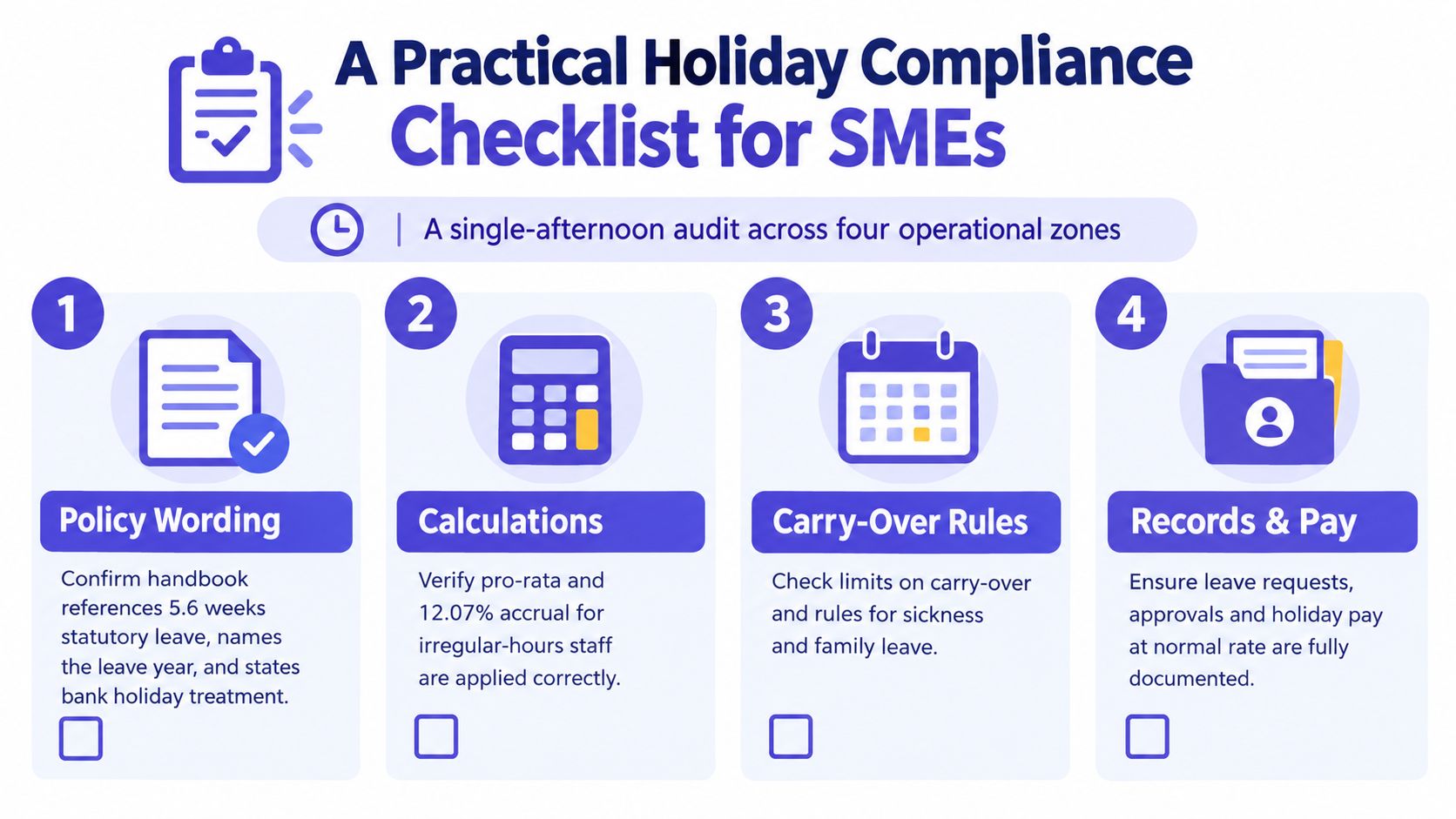
A small business can complete a useful holiday audit in one afternoon if it checks the records in a fixed order. Start with the policy, then test the calculations, then inspect the events that cause the most errors, particularly starters, leavers, and changing hours.
Policy wording
Confirm that the handbook and contracts:
- State the baseline: Reference 5.6 weeks of statutory leave.
- Name the leave year: Make the start and end dates easy to find.
- Explain bank holidays: Say whether they're included within the statutory total.
- Record end-of-employment treatment: Explain that accrued untaken leave is paid on termination.
- Describe carry-over: Set out the applicable contractual and statutory conditions rather than promising unlimited transfer.
Records and calculations
For each worker, check that the system records entitlement, leave taken, remaining balance, approval history, and the date of each adjustment. Irregular-hours workers also need hours-worked records that support the relevant accrual calculation.
Test one fixed full-time worker, one part-time worker, and one irregular-hours or part-year worker. Compare the result with the applicable formula and check that holiday pay uses the correct normal-pay approach.
Starters and leavers
For a mid-year starter, calculate the fraction of the leave year worked, using:
Days employed ÷ working days in the leave year × annual entitlement.
Use the worker's actual pattern and keep the working-day assumptions with the calculation. For a leaver, confirm the final payroll includes pay for accrued statutory leave that hasn't been taken.
Repeat the audit at the start of each leave year and whenever the workforce changes from fixed-hour employment to flexible or part-year work. The SME HR compliance checklist can help you organise the wider review around documented policies, records, calculations, and approvals.
Putting Holiday Entitlements on a Sustainable Footing
The 5.6-week statutory minimum is the foundational starting point. Compliance becomes manageable when every worker follows the same decision path: identify the working pattern, choose the correct accrual method, apply the right pay rules, and save the evidence.
Three habits make that process durable:
- Write for the person approving leave: Use plain English and show how bank holidays, part-time patterns, carry-over, and termination payments work.
- Audit routinely: Review balances and calculations during the leave year, not only when a dispute appears.
- Automate the repetitive work: Use a leave system to track requests, balances, approvals, and irregular-hours inputs, while keeping human judgement for unusual cases.
Automation doesn't replace HR judgement. It reduces the risk that a copied formula, missed shift, or forgotten leaver adjustment will decide someone's legal entitlement. That gives owners and managers a clearer record, faster answers, and more time for the work that grows the business.