
In the UK, the choice between 'working days' and 'business days' really boils down to context. You'll find that most UK companies lean towards 'working days' for internal HR matters—things like holiday entitlement and payroll—because it neatly reflects an employee's specific contract.
On the flip side, 'business days' tend to be the go-to for anything external or client-facing. Think project deadlines, service agreements, and delivery timelines. It’s a common language that usually means Monday to Friday, knocking off any bank holidays.
Unpacking the Standard UK Approach
While you might hear ‘working day’ and ‘business day’ used interchangeably in casual chats, they carry distinct and significant weight in a professional UK setting. For any savvy UK company, the choice isn't just about semantics; it's a strategic decision that ripples through everything from employee contracts to client relationships. Getting this distinction right is fundamental for keeping operations clear and staying on the right side of the law.

It’s true that for a standard full-time employee, their working days often line up perfectly with business days. But that’s where the similarity ends. Today’s workforce is filled with diverse schedules—part-timers, shift workers, compressed hours—that a simple Monday-to-Friday model just can't cover. This is where knowing when and how to apply each term becomes so critical.
Key Differentiators at a Glance
To make it crystal clear, let's look at the primary focus of each term within a typical UK business. The table below breaks down the core differences in how and where UK companies put these terms to use, offering a quick reference for HR managers and business owners.
| Feature | Working Days | Business Days |
|---|---|---|
| Primary Context | Internal (HR, Payroll, Leave) | External (Clients, Suppliers, Contracts) |
| Definition Basis | An individual's employment contract | Standard operational hours (Mon-Fri) |
| Exclusions | Non-contractual days, weekends, holidays | Weekends and official UK bank holidays |
| Flexibility | High (accommodates part-time, shifts) | Low (generally fixed and universal) |
Think of it this way: a company's internal rhythm is measured in 'working days,' tailored to each employee's unique schedule. Its external promises to the market, however, are almost always measured in 'business days,' giving everyone a predictable, universal standard to work from.
Understanding the typical monthly breakdown can also be incredibly useful. For a deeper dive, check out our guide on how many business days per month for detailed insights. The core principle never changes: precision in your terminology isn't just good practice—it's essential for preventing costly mix-ups and ensuring everyone is on the same page.
So, What Are We Actually Talking About in the UK?
In the UK, the difference between a ‘business day’ and a ‘working day’ is much more than just a bit of jargon – it’s a crucial legal and contractual distinction that can save you from some seriously costly headaches. If you want to avoid payroll errors, missed deadlines, or legal challenges, getting the language right in your company policies is your first and best line of defence.
At its core, a ‘business day’ is almost universally understood in UK commercial law as any day from Monday to Friday. The critical part of this definition is that it automatically excludes official bank holidays in England, Wales, Scotland, or Northern Ireland, depending on where your contract is based. It’s the standard, predictable yardstick for most commercial operations.
On the other hand, a ‘working day’ is all about the individual. It's defined entirely by an employee’s contract of employment and is designed to be flexible enough to handle the reality of modern work patterns.
How Contracts Draw the Line
Think about it this way: a retail employee’s working week might run from Tuesday to Saturday. At the same time, their colleague in the head office could be on a compressed schedule, working Monday to Thursday. Both are perfectly valid examples of ‘working days’ for those individuals, but neither lines up with the standard ‘business day’ model.
This is exactly where things can get messy for businesses. If a contract is vague, it’s a recipe for confusion.
The golden rule here is that the employment contract is king when it comes to defining an employee's schedule. A fuzzy policy that just defaults to "business days" for a shift worker is practically guaranteed to cause incorrect holiday pay calculations and arguments over notice periods.
This distinction also has a huge knock-on effect on resource planning and financial forecasting. For instance, the UK's standard working year is often pegged at 253 working days, which is what you get when you subtract weekends and bank holidays from the calendar. But this figure isn't set in stone; 2023 had only 250 working days, showing how the placement of public holidays can really shift your annual capacity. You can get a deeper dive into calculating the UK's working days in a year to sharpen up your HR planning.
Why This Legal Clarity Is a Non-Negotiable
Failing to define these terms clearly in both your employment contracts and client agreements is just asking for trouble. For employees, it can lead to real confusion over their leave entitlement. For the business, it could mean breaching service-level agreements (SLAs) or missing statutory deadlines.
At the end of the day, UK law always falls back on what’s written in the contract. Your staff handbook and employment agreements must spell out exactly how your company interprets each term, especially for staff on non-traditional schedules. This simple act of clarification protects everyone, ensuring you and your employees are all on the same page, with a shared, legally sound understanding of your commitments. It’s the bedrock of compliant and efficient operations.
Comparing Applications Across Business Functions
The real-world difference between ‘working days’ and ‘business days’ snaps into focus when you see how UK companies use them in different departments. This isn't just about picking a term you like; getting it right is crucial for operational precision, legal compliance, and clear communication with both your team and your clients. The term you choose directly impacts everything from holiday calculations to project delivery dates.
For internal areas like HR and payroll, the spotlight is firmly on an individual employee’s contract. In sharp contrast, for any external, client-facing work, you need a universal standard that everyone can rely on to manage expectations and define service levels.
This decision tree shows the general rule most UK companies follow, depending on who the contract is for.
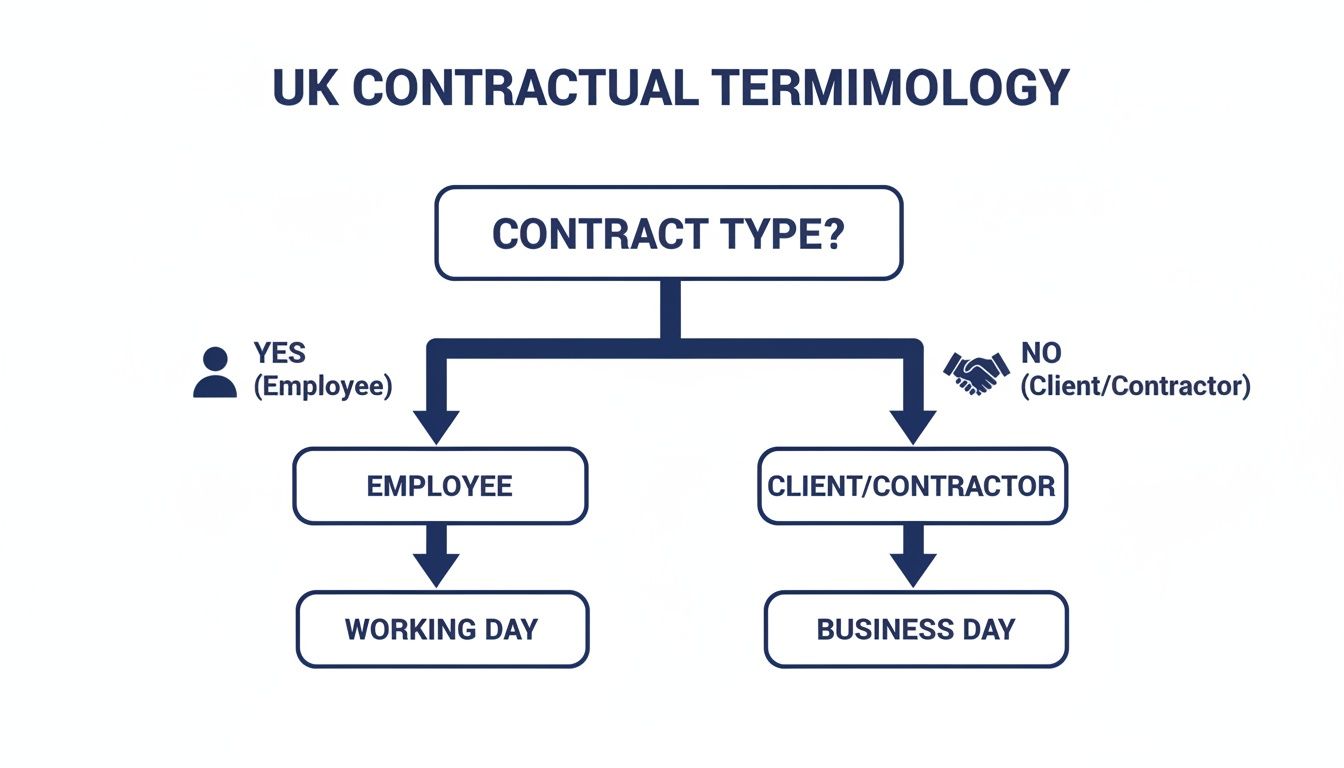
The image breaks it down simply: internal, employee-related matters use 'working days', while external contracts with clients or partners depend on 'business days'.
Human Resources And Employee Management
When you're managing staff, ‘working days’ is the only term that really gives you the accuracy you need. It’s entirely employee-centric, reflecting the specific days an individual is actually contracted to work.
- Annual Leave Calculation: This is the most common place you'll see it. For a part-time employee who works Tuesday to Thursday, their leave is calculated and taken from their three-day working week. Using 'business days' (Monday to Friday) here would be completely inaccurate and unfair.
- Notice Periods: While employment contracts often specify notice in weeks or months, if you define it in days, it must be 'working days'. This aligns with the employee's actual schedule and prevents any arguments over their final day of employment.
- Payroll Processing: For anyone paid an hourly or daily rate, payroll is entirely dependent on the number of 'working days' they've completed in a pay period. This easily accommodates all kinds of varied shift patterns.
The golden rule for HR is fairness and precision. Using 'working days' ensures every employee, no matter their schedule, is treated equitably and their entitlements are calculated correctly based on what their contract says. This is a cornerstone of UK employment practice.
Operations And Client Services
For any external commitments, UK companies almost universally switch to ‘business days’. This term offers a stable, operations-focused framework that clients and partners can easily understand and plan around.
It neatly sidesteps the confusion of individual employee schedules, creating a reliable standard for delivery and project management.
- Service Level Agreements (SLAs): A promise to sort a support ticket within "two business days" means Monday to Friday, excluding bank holidays. It gives clients a clear, predictable timeline that isn't thrown off by which of your team members happens to be on shift.
- Project Deadlines: Setting a client project deadline of "10 business days" provides a concrete date both parties can work towards. It doesn't matter if your internal team includes part-time staff; the deadline is fixed.
- Delivery and Logistics: Courier services and suppliers across the UK operate on a 'business day' schedule. A "next business day delivery" for an order placed on a Friday will arrive on Monday (as long as it's not a bank holiday). This standard is absolutely vital for smooth supply chain management.
To help you decide which term fits where, this table breaks down the common applications in a typical UK business.
Working Days vs Business Days: A UK Business Application Guide
| Business Function | Working Days (Employee-Centric) | Business Days (Operations-Centric) | Recommended Usage |
|---|---|---|---|
| Annual Leave | Calculates leave based on an individual’s contracted days. Fair for part-time staff. | A generic Mon-Fri schedule. Unsuitable and unfair for varied work patterns. | Working Days is essential for internal HR policies. |
| Notice Periods | Defines the notice period based on the days an employee actually works. | Could create ambiguity and disputes over the final employment date. | Working Days should be specified if notice is defined in days. |
| Client SLAs | Irrelevant to the client. Their timeline shouldn't depend on one employee's schedule. | Provides a clear, universal Mon-Fri (minus bank holidays) timeline for delivery. | Business Days is the professional standard for all external agreements. |
| Project Deadlines | Creates confusion. A deadline shouldn't change if a team member works part-time. | Sets a fixed, predictable date that both the company and client can rely on. | Business Days ensures clarity and manages client expectations effectively. |
| Supplier Agreements | Not used. Suppliers operate on a standard industry schedule. | Aligns with logistics and delivery networks that follow a Mon-Fri schedule. | Business Days is the only term to use for supply chain and logistics. |
Ultimately, the choice is simple. If you're dealing with an internal employee matter governed by their specific employment contract, stick with 'working days'. For everything external—from client contracts to supplier deadlines—'business days' provides the universal clarity you need to operate professionally.
Navigating the Legal and Contractual Implications
Vague terms in any contract are a recipe for trouble, but in employment and commercial agreements, they can be a serious liability. When you leave terms like ‘working days’ and ‘business days’ undefined, you’re creating a grey area that can easily lead to costly disputes, damaged relationships, and even legal action. Frankly, the risks are just too high to ignore.
This isn't just about good practice; it's because UK law places huge importance on the explicit wording of a contract. If your terms are woolly, interpretations can vary wildly, paving the way for conflict over crucial deadlines and entitlements.
The Real-World Cost of Vague Language
Think about a supplier agreement that promises delivery within "10 business days." If that deadline straddles the Easter bank holidays, the client is probably expecting delivery two calendar days earlier than the supplier who has factored them out. That simple misunderstanding can snowball into project delays, financial penalties, and a serious breakdown in a commercial relationship.
It's just as tricky in an employment context, where ambiguity can cause chaos:
- Termination Notice Periods: An employee’s contract specifies a notice period of "20 working days," but they work a Tuesday-to-Saturday rota. If HR calculates this based on a standard Monday-to-Friday week, they'll get the final day wrong, potentially leading to a messy dispute.
- Holiday Pay Calculations: Failing to properly define a ‘working day’ for part-time staff is a fast track to miscalculating their pro-rata holiday entitlement—a clear breach of employment regulations.
- Project and Task Deadlines: Setting internal deadlines using "business days" can cause genuine confusion for team members on non-standard hours, resulting in missed targets and frustration.
Getting this distinction right has become more critical than ever for UK companies focused on compliance. Business days almost always mean Monday to Friday, excluding public holidays. In contrast, working days should reflect the actual days an employee is contracted to work.
For a typical full-time employee in England and Wales, you can subtract the 8 standard bank holidays from the 260 weekdays in a year, leaving 252 working days. This number is a vital baseline for HR planning and resource management.
Under UK law, the responsibility for clarity lies squarely with the person who drafted the contract—usually the employer. In a dispute, a tribunal or court will often interpret ambiguous language in favour of the party who didn't write the agreement.
This legal principle makes it absolutely essential for UK companies to be precise. Your contracts and policies must state clearly whether calculations are based on the standard Monday-to-Friday model (business days) or an individual’s specific schedule (working days). Nail this down, and you’re building a much more robust and legally sound foundation for your operations. For more on this, check out our resources on complying with employment laws.
How to Calculate Timelines Accurately
Knowing the difference between working days and business days is one thing, but applying it correctly is what stops operational headaches before they start. Let's walk through a few real-world UK business scenarios. Turning theory into practice is the only way to make sure your HR processes and project timelines are always spot on.
First up, a classic: calculating a one-month notice period for an employee resigning just before a bank holiday.
Calculating a Notice Period with Bank Holidays
Getting this right is crucial for a smooth and professional employee exit. It’s a situation where a small miscalculation can cause a lot of unnecessary friction.
- Scenario: A full-time employee, working Monday to Friday, hands in their notice on Monday, 15th April. Their contract states a one-month notice period. Coming up is the Early May Bank Holiday on Monday, 6th May.
- The Wrong Way (Confusing it with 'Business Days'): A common mistake is to think in terms of a set number of business days. A manager might just look at the calendar, jump one month ahead to 15th May, and then try to subtract the bank holiday, landing on the wrong date.
- The Right Way (Following the Contractual Month): A "one-month" notice period is almost always interpreted as a calendar month. This means the employee’s last day of employment is simply 15th May. The bank holiday doesn’t push the end date out; it's just a paid non-working day that falls within that final month.
The key takeaway is that a "month's notice" is tied to the calendar date, not a specific count of working days. If the contract specified "20 working days' notice," then you'd be counting 20 of the employee's scheduled shifts, skipping weekends and the bank holiday. The wording is everything.
Setting a Project Deadline Over Christmas
Now, let's flip to an external project deadline where 'business days' are king. This is standard practice when quoting work for clients.
- Scenario: Your team has quoted a project to take "15 business days" to complete, with a kick-off on Monday, 16th December.
- The Calculation: Here, you need to be methodical, excluding all weekends and official bank holidays (Christmas Day and Boxing Day).
- Week 1 (16th-20th Dec): That’s 5 business days.
- Week 2 (23rd-27th Dec): Monday 23rd, Tuesday 24th, and Friday 27th count. Wednesday 25th and Thursday 26th are out. That's another 3 business days.
- Week 3 (30th Dec-3rd Jan): Monday 30th and Tuesday 31st are in. New Year’s Day (Wednesday 1st Jan) is out. This adds 2 more business days, bringing our running total to 10.
- Week 4 (6th-10th Jan): We need 5 more business days, which takes us to the end of this week.
- The Final Deadline: With the 15th day falling on Friday, 10th January, the project would be due for delivery on Monday, 13th January.
Using business days gives clients a clear, predictable timeline that accounts for holidays. This also highlights how much the available time can fluctuate from month to month. UK companies typically have between 20 and 22 business days to play with. May, with its two bank holidays, consistently shrinks available project time by nearly 10% compared to a month with none.
These examples really drive home why clarity is so important. Using the right term sets the right expectation for everyone involved. For a deeper dive, you can explore our full guide on calculating the total number of working days in a UK year.
Implementing Clear Policies in Your Business
Any ambiguity between a ‘working day’ and a ‘business day’ can create genuine legal and operational headaches down the line. To sidestep these risks, the single best thing you can do is establish crystal-clear, written policies.
Your employment contracts and staff handbook are the perfect places to define precisely what your company means by each term. Getting this right protects everyone—your business and your people—and ensures you’re all working from the same page.

This really brings home the importance of not just defining your terms, but actively embedding those definitions into the tools and processes you use every single day. Consistency is everything.
Recommended Wording for UK Contracts
When it comes to drafting your policies, specificity is your best friend. A generic clause just won’t cut it, especially when you’re dealing with a mix of work patterns like part-time schedules or compressed hours.
You might want to consider adopting wording similar to this for your employment contracts:
“For the purpose of this agreement, a ‘Working Day’ is defined as any day on which the employee is contractually scheduled to work. A ‘Business Day’ is defined as Monday to Friday, excluding any official bank holidays in England and Wales. All calculations relating to annual leave, notice periods, and absence will be based on the employee’s specific Working Days.”
This clause does a great job of separating the employee-centric term from the company’s operational one, leaving no room for confusion. It’s a simple change that offers some powerful legal protection and makes day-to-day operations much smoother.
Automating Your Policies for Consistency
Defining your terms is one thing; applying them consistently is another challenge entirely. Manually trying to track different working patterns is not only a huge time sink, but it’s also ripe for human error. Those little mistakes can easily snowball into compliance issues and payroll headaches.
This is where a dedicated system really proves its worth. Platforms like LeaveWizard are designed to let UK companies build their unique definitions right into their absence management process.
By setting up your specific rules for working days vs business days, you can automate every calculation. Whether it’s figuring out holiday entitlement for a four-day-a-week employee or adjusting for a bank holiday, the system handles it accurately and without any fuss, freeing up your admin time for more important things.
Frequently Asked Questions
Even when the definitions seem straightforward, real-world situations can throw up some tricky questions. Let's look at some of the common queries that land on the desks of UK business owners and HR managers.
Do Scottish Bank Holidays Affect Deadlines for an English Company?
Usually, no. If your commercial contract is governed by English law and doesn’t specify otherwise, only the bank holidays in England and Wales are factored into the ‘business days’ calculation.
But for employment contracts, it’s a different story. The ‘working day’ definition hinges on where your employee actually works. If you have team members across the UK, your HR policies absolutely must account for their respective local bank holidays. This is where a multi-region holiday calendar becomes a non-negotiable tool.
How Do We Calculate a One-Month Notice Period?
This is a classic example of why precise contract wording is so important. A 'one-month' notice period means exactly that—a calendar month. It's not tied to the number of working days. For example, if notice is handed in on the 15th of February, the last day is the 15th of March.
If your contract instead states the notice period in 'weeks' or 'working days', you have to calculate it precisely, excluding any non-working days. Using an automated system is the best way to get this right and avoid manual errors, especially when bank holidays fall within the notice period.
For an employee on a non-standard schedule, defining notice in 'working days' is the only way to ensure the calculation is accurate and fair. It removes all ambiguity by tying the notice period directly to their specific contracted shifts, rather than a generic calendar.
How Do We Define Leave for a Four-Day Work Week Employee?
For anyone not on a standard Monday-to-Friday schedule, the term ‘working day’ is absolutely critical. Using ‘business days’ would be completely wrong for calculating their leave allowance.
Your employment contracts must spell out that 'working days' are the four specific days the employee is scheduled to work. This makes sure all their entitlements are calculated against their actual schedule, not a traditional five-day model.


