
On average, a UK-based business can expect somewhere between 20 and 22 working days in a typical month. It sounds simple enough, but that little figure is the bedrock for everything from payroll runs to project deadlines. The catch? The actual number is always shifting depending on the month and its collection of public holidays.
Unpacking The Monthly Working Day Count

Figuring out the number of working days in any given month seems like it should be easy, but there's a bit more to it than meets the eye. Think of it less like a fixed number and more like a live calculation, constantly influenced by a few key factors. Getting this right is absolutely fundamental for smooth business operations, affecting everything from staff scheduling to financial forecasting.
The calculation always starts with the total number of days in the month. From there, you begin subtracting the non-working days. The first and most obvious deductions are the weekends—Saturdays and Sundays for most companies on a standard Monday-to-Friday schedule. But that’s just the first step.
Key Variables You Cannot Ignore
To get a truly accurate count, you have to factor in public holidays, which can really change the final number. While the number of working days in a UK month usually lands between 20 and 22, some years it can stretch from 20 to 23. This is because the UK’s four nations (England, Scotland, Wales, and Northern Ireland) each have their own specific set of bank holidays, which creates regional differences.
A common mistake is to just apply a generic average to every single month. For instance, April and May often have fewer working days thanks to Easter and the May bank holidays, whereas a month like October is usually packed with them.
Ultimately, getting to grips with the variables that influence the working days in a month is the first step toward sharper, more precise business planning. This monthly view is a critical piece of the bigger puzzle. To see how it all connects, you can check out our guide on calculating how many working days in a year.
To make this a bit easier, here’s a quick at-a-glance reference for what a typical month looks like before you start subtracting those pesky bank holidays.
Average Working Days Per Month in the UK (Monday to Friday)
This table shows the typical range of working days for each month, accounting for standard weekends but before deducting specific bank holidays or annual leave.
| Month | Total Days | Typical Working Days Range |
|---|---|---|
| January | 31 | 21 – 23 |
| February | 28/29 | 20 – 21 |
| March | 31 | 22 – 23 |
| April | 30 | 20 – 22 |
| May | 31 | 21 – 23 |
| June | 30 | 21 – 22 |
| July | 31 | 21 – 23 |
| August | 31 | 22 – 23 |
| September | 30 | 21 – 22 |
| October | 31 | 22 – 23 |
| November | 30 | 21 – 22 |
| December | 31 | 20 – 22 |
As you can see, even without bank holidays, the number fluctuates. This is why a one-size-fits-all approach just doesn't work for accurate planning.
Why Accurate Working Day Counts Are Crucial

Knowing the exact number of working days in a month might seem like a small detail, but it’s actually the operational heartbeat of your business. Think of it as the foundation for your payroll, project timelines, and financial forecasts. Getting this number wrong can set off a domino effect of costly and time-consuming problems.
But when you get it right? You empower yourself to run a smoother, more predictable, and more profitable operation. That fluctuating number becomes a strategic asset. When you know precisely how many productive days you have in the pipeline, you can plan with confidence and lead with clarity.
Ensuring Flawless Payroll and Compliance
Payroll is one of the first places you’ll feel the impact of an accurate working day count. For employees paid by the day or those whose salaries are pro-rated for any reason, a simple miscalculation leads directly to incorrect pay. This isn’t just frustrating for staff; it damages morale and can even create compliance issues.
An employee who is underpaid will feel undervalued, while overpayments can be a real headache to recover and throw your cash flow off balance. Precision here is non-negotiable for maintaining trust and stability within your team.
Getting this right isn't just about internal harmony. It ensures your payroll processing is spot on, which is a massive help when you’re working through a small business tax preparation checklist.
Sharpening Your Resource and Project Planning
How can you possibly set a realistic project deadline if you don’t know how many days your team is actually available to work? An accurate count of the working days in a month is the bedrock of effective resource allocation and project management.
It gives you solid answers to critical questions:
- Do we have enough staff capacity to get this project done on time?
- When can we realistically promise a client we’ll deliver?
- How do we need to adjust our timelines for the upcoming bank holidays?
Without this clarity, project plans are just guesswork. That guesswork often leads to missed deadlines, stressed-out teams, and unhappy clients. A precise count gives you a reliable foundation to build your schedules on.
A business that consistently delivers on time builds a reputation for reliability. This often starts with something as fundamental as knowing exactly how many workdays are available each month to fulfil promises.
Strengthening Financial Forecasting and Budgeting
Finally, your monthly working day count is a key driver for your financial forecasting. For many businesses, especially in service-based industries, revenue is directly tied to billable days. If you have a firm grip on your available workdays, you can make far more precise revenue projections.
This clarity flows right into your budgeting, too. Knowing your real operational capacity helps you manage costs, from wages to overheads, much more effectively. It allows you to align your spending with your productive output, leading to better cash flow management.
Ultimately, this single metric elevates your financial planning from hopeful estimates to a data-driven strategy, giving you a much clearer picture of your business's health and potential each month.
While software can do the heavy lifting, knowing how to calculate the working days in a month yourself is a surprisingly useful skill. It gives you a real feel for your team's capacity without needing any special tools. The good news is, it's pretty straightforward and boils down to just three simple steps.
First things first, you need a starting point. That’s simply the total number of days in the month you’re looking at—whether that’s 28, 29, 30, or 31. This is your maximum number before you start chipping away at non-working time.
Next, you get rid of the weekends. For most businesses in the UK running on a standard Monday to Friday week, this means taking out all the Saturdays and Sundays. This step alone makes a big dent in the total and gets you much closer to the actual number of days your team is available.
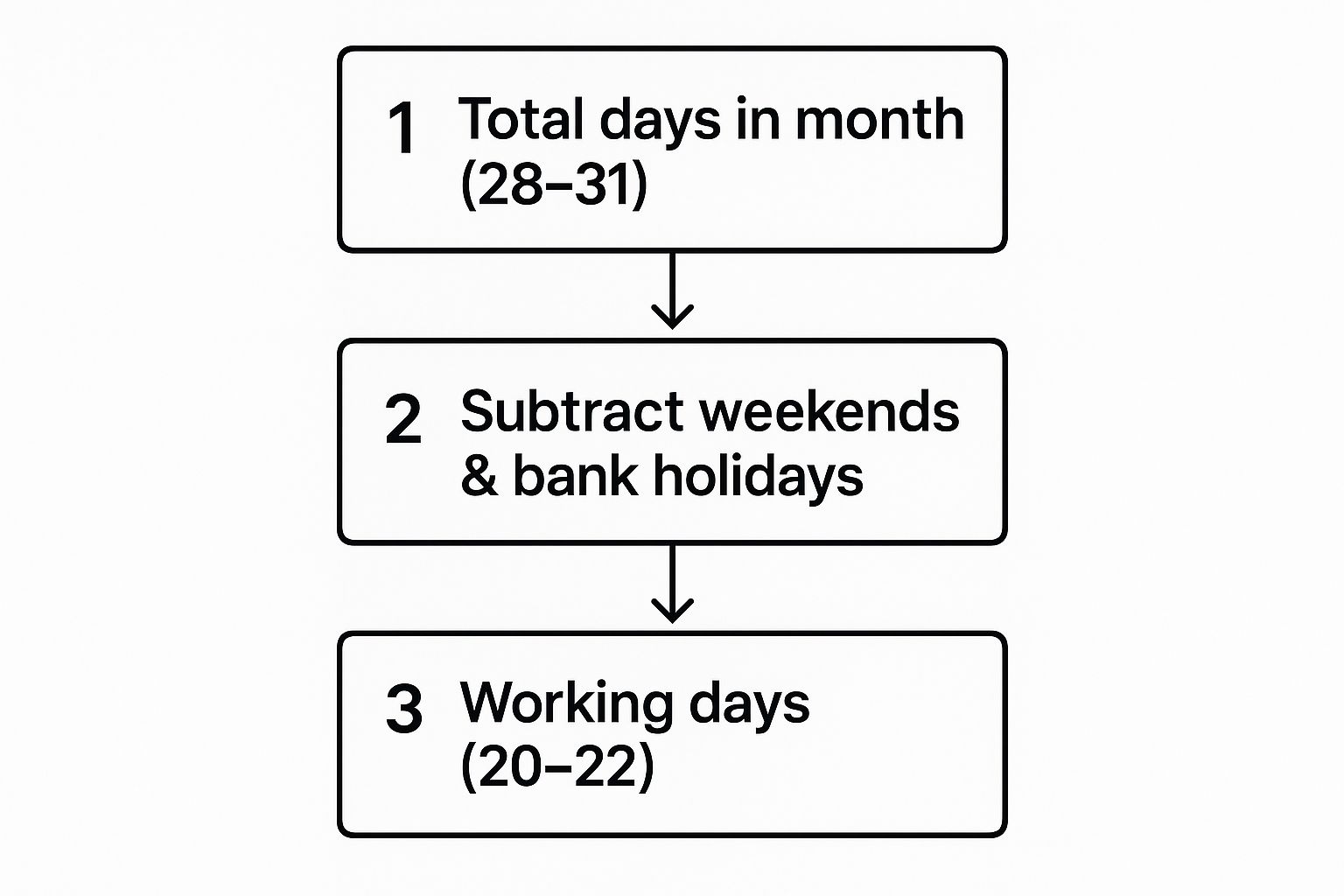
As you can see, it's just a process of elimination. You start wide and narrow it down until you're left with only the days that count.
The Three-Step Manual Calculation
Let’s get practical. The calculation is just a bit of subtraction that you can do with a calendar and the calculator on your phone.
- Start with the Total: Find the total number of calendar days in the month.
- Subtract All Weekends: Count up every Saturday and Sunday in that month and subtract them from your total.
- Deduct Bank Holidays: Finally, subtract any official bank holidays that fall within the month.
This last step is where you need to be careful. Bank holidays aren't the same across the UK; England, Wales, Scotland, and Northern Ireland all have slightly different schedules. If you use the wrong list, your final count will be off.
It's absolutely crucial to always check the official government list of bank holidays for your specific region. A holiday in Scotland might be a normal working day in England, and that can throw your planning for regional teams completely out of whack.
Make sure you're using the right list for your business's location. It's the only way to keep your payroll and project deadlines accurate.
A Worked Example for an English Business
Let's walk through an example and calculate the working days for May 2025 for a business based in England.
- Step 1: May has a total of 31 calendar days. Easy enough.
- Step 2: In May 2025, a quick look at the calendar shows four full weekends. That's 8 weekend days (4 Saturdays and 4 Sundays). So, we do 31 – 8 = 23 days.
- Step 3: For England, May 2025 has two bank holidays: the Early May bank holiday on the 5th and the Spring bank holiday on the 26th. That's another 2 days to subtract.
Our final calculation is 23 – 2, which gives us 21 working days for May 2025. That's the number you'd use for planning staff rotas, figuring out pay for daily-rate contractors, or setting realistic project deadlines.
For peace of mind, you can always find the correct, up-to-date bank holiday information right from the source at GOV.UK. Using the official resource takes all the guesswork out of it and ensures your calculations are always spot on.
The Hidden Variables That Reduce Available Work Time

So, you've worked out the number of working days in a month by subtracting weekends and bank holidays. That's a great starting point, but it paints a perfect-world picture—one where every single employee shows up every single day, ready to go. Anyone who's run a business knows reality is a lot messier than that.
To get a number you can actually rely on for planning, you need to account for all the real-world things that pull your team away from their desks. These variables are what separate a plan that looks good on paper from one that genuinely works in practice. If you ignore them, you're setting yourself up for missed deadlines, burnt-out staff, and forecasts that are miles off the mark.
The Impact of Statutory Annual Leave
The biggest and most predictable factor is, of course, annual leave. Here in the UK, every worker is entitled to a minimum of 5.6 weeks of paid holiday a year. This is a legal requirement you absolutely have to factor into your calculations.
For a full-time employee, that statutory minimum works out to at least 28 days off per year, which directly chips away at their available work time. This isn't just an annual number to track, either. It has a real monthly impact, as people take their holidays throughout the year. Your team's capacity in August is almost guaranteed to be lower than in a quieter month like November. Good planning means anticipating these absences before they happen.
The Unpredictable Nature of Sickness Absence
While you can plan for holidays, sickness is the curveball that can throw any schedule into chaos. Unplanned absences due to illness are just an unavoidable part of managing people, and they directly reduce the number of productive days you have at your disposal.
Even a single person calling in sick can disrupt a project timeline or impact customer service. When several team members are off at once, the effect multiplies, potentially putting your operations under serious strain. It really highlights why you need flexible plans and a bit of wiggle room.
Think of it this way: your calculated working days represent your maximum potential capacity. Your real-world capacity will always be lower due to both planned and unplanned leave. Understanding this gap is the key to realistic, effective planning.
And it doesn't stop with holidays and sick days. There's a whole host of other reasons an employee might be unavailable.
I've summarised the main culprits below. These are the factors that constantly shrink your theoretical pool of working days into a much more realistic, practical number.
Key Factors Reducing Available Working Days
| Factor | Description | Impact on Planning |
|---|---|---|
| Annual Leave | The statutory 5.6 weeks (or more) of paid holiday every UK employee is entitled to. | This is predictable but fluctuates seasonally. Must be tracked to manage capacity, especially during peak holiday times like summer. |
| Sickness Absence | Unplanned time off due to illness. This is completely unpredictable and can happen at any time. | Requires building contingency or 'buffer' time into project plans and rotas to absorb the impact of sudden absences. |
| Other Leave Types | Includes compassionate leave for family emergencies, jury service, or time off for training. | While often short-notice, these absences need to be accommodated. A clear policy helps manage expectations. |
| Extended Absences | Longer periods away from work, which could be related to situations requiring income protection and redundancy cover. | These have a significant, long-term impact on team capacity and require more substantial resource planning to cover the role. |
Each of these factors nibbles away at your available time. You also have to think about your own policies. For instance, do you need your staff to work on public holidays? If so, that changes their pay and leave entitlements, adding another layer to the calculation.
By acknowledging all these hidden variables, your estimate of the working days in a month transforms from a simple calendar count into a powerful strategic tool.
Making Life Easier with Modern Software
Getting to grips with the manual calculation gives you a solid foundation, but let's be honest—it’s a fiddly process and a recipe for human error. This is where a bit of smart technology can make a world of difference, turning a tedious admin chore into something that just… happens. Modern HR software completely changes the game.
Instead of juggling calendars and spreadsheets, these tools do all the heavy lifting for you. They’re built to manage all the moving parts of your team's availability in one central hub. This isn't just about saving a few minutes; it’s about getting it right every time and freeing up your people for more important work.
The Power of Automation in Action
Imagine a system that already knows every single bank holiday for England, Scotland, Wales, and Northern Ireland. Now, picture it instantly updating every time someone books a holiday or calls in sick. That’s the real magic of automation.
This kind of tool wipes out the risks that come with tracking everything by hand. You'll never forget a bank holiday or miscalculate someone’s remaining leave entitlement again. It's all logged, calculated, and updated in real-time, giving you a crystal-clear picture of your team’s capacity at any given moment.
The real value of automation is clarity. It replaces guesswork with certainty, allowing you to make faster, more informed decisions about project timelines, staff rotas, and resource allocation because you are always working with live, accurate data.
By taking the admin burden off your plate, you’re not just cutting down on mistakes; you’re giving valuable hours back to your team. They can then focus on tasks that actually grow the business, rather than getting bogged down in repetitive sums.
From Manual Hassle to Seamless Efficiency
Let's look at how the two approaches stack up with a simple scenario: planning around the August bank holiday.
- Manual Method: First, you’d need to check the calendar to confirm the date. Then, you'd have to manually adjust your project timelines and staff rotas in a spreadsheet. If an employee requests leave around that time, you're back to square one, recalculating everything and cross-referencing different documents to make sure there are no clashes.
- Automated Method: The software already has the bank holiday blocked out in everyone’s calendar. When an employee requests leave, the system instantly shows you who else is off, flags any potential conflicts, and updates the entire team’s availability as soon as you hit 'approve'. The process is totally seamless.
For a small business where every minute counts, that level of efficiency is a massive advantage. To see it for yourself, it’s worth exploring a dedicated employee leave management software solution to understand how you can eliminate these manual headaches for good.
Ultimately, using automation to calculate the working days in a month gives you a reliable, single source of truth for your most valuable asset: your people’s time.
Putting Working Day Calculations into Practice
Okay, so we’ve covered the theory. But let's be honest, that's only half the battle. The real magic happens when you see how these calculations solve actual, everyday business problems. These aren't just abstract numbers; they're practical tools for sharper planning.
By connecting the calculation of working days in a month to tangible business scenarios, you’ll see just how this simple metric can drive smarter decisions, no matter what industry you're in.
Scenario One: A Retail Business Rota Planning
Picture a small retail shop in Manchester gearing up for the Christmas period. This is their busiest, most chaotic time of year. Getting the staff rota right is absolutely crucial for managing the flood of customers and, just as importantly, preventing employee burnout.
They start by calculating the working days in December, making sure to subtract the bank holidays like Christmas Day and Boxing Day. This gives them a baseline number of operational days. But they also need to factor in the pre-approved annual leave from staff who (quite rightly) want time off with their families.
This detailed calculation helps the manager see exactly where the staffing gaps are. They can then:
- Offer overtime strategically on the days they know will be busiest.
- Hire temporary seasonal staff with clear start and end dates.
- Ensure a fair rota distribution so no one is overworked and morale stays high.
Without this precision, they’d just be guessing. That's a recipe for an understaffed shop during peak hours and a stressed, unhappy team.
Scenario Two: A Creative Agency Project Billing
Now, let's switch gears. Think about a creative agency in London billing a client for a project that spans from mid-April to the end of May. Their contract is based on billable days, so accuracy isn't just nice to have—it's non-negotiable for correct invoicing and keeping the client's trust.
The project manager can't just assume a standard number of workdays per month. April has the Easter bank holidays, and May brings two more of its own. They have to calculate the precise number of available working days across both months, excluding all public holidays and any planned leave for the designers on the project.
This precise calculation ensures the client is billed fairly for the exact number of days worked, heading off potential invoice disputes before they even start. It also allows the agency to provide a realistic project timeline from the very beginning, which builds confidence and manages expectations effectively.
For any service-based business, this level of detail is fundamental to its financial health and client relationships. Accurate working day data translates directly into accurate revenue.
Of course. Here is the rewritten section, designed to sound natural, human, and expert-driven, following the style of the provided examples.


