Absence management is the process of planning for, recording, and responding to employee time off, while connecting attendance data to costs and legal obligations such as Statutory Sick Pay. In the UK, employees lost an average of 4.4 working days each in 2025, contributing to 148.8 million working days lost overall, according to the Office for National Statistics sickness absence data.
You probably know the scene. Someone calls before the working day starts, a shift is suddenly uncovered, and the only record of previous absences is buried in a spreadsheet that nobody can find. The manager starts phoning colleagues, finance wonders whether overtime will be necessary, and the rest of the team tries to absorb the work.
That reaction is understandable, but it treats absence as an isolated inconvenience. A missing employee can affect service delivery, workload balance, payroll, employee wellbeing, insurance claims, and compliance. Good absence management turns an emergency response into a repeatable operating process.
Table of Contents
- What Unmanaged Staff Absence Actually Costs a Small Business
- Understanding Types of Absence and Legal Compliance
- The True Financial Cost of Absence in the UK
- Spreadsheets vs Dedicated Absence Software
- How LeaveWizard Simplifies Absence Tracking
- Best Practices for Building a Supportive Policy
What Unmanaged Staff Absence Actually Costs a Small Business
A manager checks the rota and finds three different versions of the truth. One sickness absence sits in a paper notebook, another appears in a messaging app, and a planned appointment is marked only on the office calendar. The spreadsheet on the shared drive is out of date, so nobody can confirm who is available or what cover has already been arranged.
The immediate disruption is only the first cost. A colleague works extra hours, customer responses slow down, and the manager loses time chasing information instead of running the business. A longer absence can require temporary support, occupational-health input, or a structured return-to-work process.

The hidden cost stack includes cover arrangements, overtime, management time, support services, delayed work, and health-insurance claims, alongside the absent employee's normal pay. The Institute for Employment Studies analysis found that absence-management costs represented 36.1% of total sickness-absence cost, compared with 50.9% direct costs and 12.9% indirect costs.
Practical rule: Record the operational consequence, not only the absence date. Capture what needed covering, who approved the arrangement, and whether the employee required support.
A reliable system turns scattered updates into information a manager can act on. Shared records show current availability, highlight repeated short absences, and make cover requirements visible before the rota becomes an emergency. That allows a small business to compare the cost of overtime or temporary help with the pressure placed on the remaining team.
The pattern matters too. If colleagues repeatedly absorb one role's work, workloads may become unsustainable. Reviewing how to redesign workloads sustainably can reduce that pressure and support more consistent attendance.
Read this guide to how employee absence impacts your business for a wider view of the operational effects. The practical shift is to treat absence as a managed business risk, with clear ownership, consistent records, and software that supports proactive planning rather than last-minute recovery.
Understanding Types of Absence and Legal Compliance
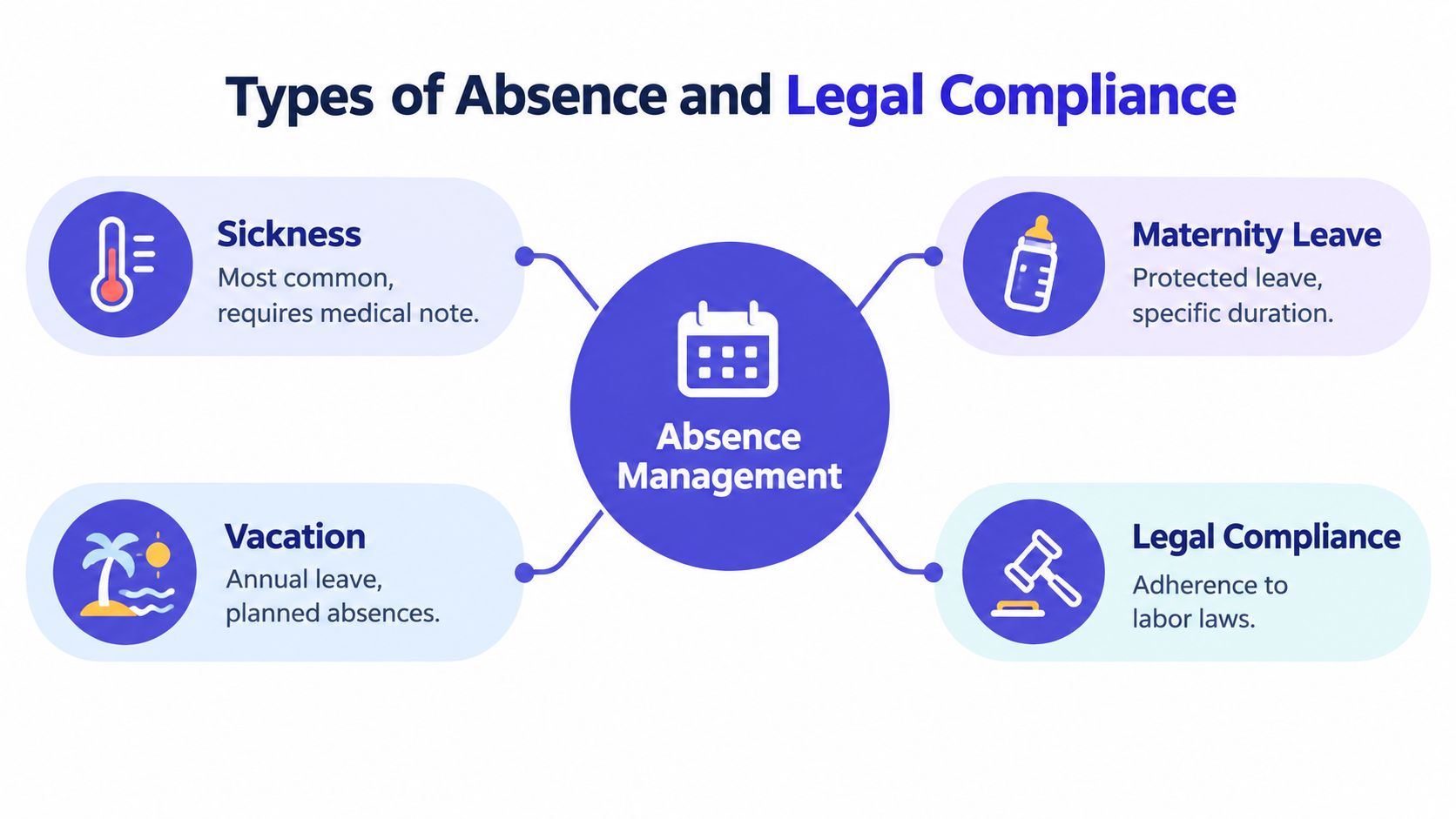
Start by separating planned absence from unplanned absence. Annual leave, appointments, maternity leave, bereavement leave, carer's leave, and unpaid personal time may be scheduled or requested in advance. Sickness absence often arrives with little warning and needs a clear reporting route, accurate records, and appropriate follow-up.
The category matters because the business response shouldn't be identical in every case. A holiday request is mainly a planning and entitlement question. A sickness absence may involve sick notes, Statutory Sick Pay, a return-to-work conversation, or adjustments that help someone resume work safely. Maternity and other protected forms of leave require particular care, so managers shouldn't improvise decisions based on informal precedent.
A useful policy should tell employees:
- Who to contact: Specify the manager or approved channel for reporting absence.
- When to report: Set a clear expectation for notifying the business before work begins, unless circumstances prevent it.
- What information is needed: Ask only for information that's relevant and appropriate to the absence.
- How records are handled: Explain who can access absence information and how confidentiality is maintained.
- What happens next: Set expectations for check-ins, evidence, and return-to-work arrangements.
The UK Government guidance on Statutory Sick Pay changes states that a major change applies from 6 April 2026. Eligible employees can receive SSP from the first full day of sickness absence, the three-day waiting period is removed, and the lower earnings limit is removed. The rate is the lower of £123.25 per week or 80% of average weekly earnings, and it can be paid for up to 28 weeks.
That change makes accurate first-day recording more important for eligible employees. Review your policy, payroll process, manager guidance, and software rules before the change takes effect. For a wider overview of categories, use this guide to types of employee leave, then confirm the details that apply to your organisation with qualified employment advice.
The True Financial Cost of Absence in the UK
A receptionist calls in sick before the morning shift. By midday, a manager has rearranged cover, a colleague is working overtime, and a customer deadline has moved. The salary for the missing employee is only one part of the cost. Absence also consumes management time, disrupts service, and creates follow-up work.
A private-sector study cited in the Institute for Employment Studies report estimated average absence costs at around £1,550 per employee per year, or about 9% of annual payroll. The figure will not apply equally to every small employer, but it shows why absence administration deserves attention. Recording a notification, arranging cover, checking progress, and documenting a return all require time.
The hidden cost stack usually includes three layers: cover, support, and claims. Cover may mean overtime, temporary staff, or shifting work to people with less capacity. Support may involve manager conversations, adjusted duties, occupational health input, or welfare follow-up. Claims can arise when poor records make it difficult to confirm what happened, apply policy consistently, or prepare accurate payroll information.
Where the money leaks
The cost develops through a chain of decisions:
- Reporting: Information arrives late, lacks key details, or sits in an email that others cannot find.
- Coverage: A manager makes a rushed replacement decision, sometimes paying overtime or delaying other work.
- Coordination: Tasks are redistributed, postponed, or handed to someone unfamiliar with the process.
- Support: Check-ins, adjustments, and return-to-work actions take longer without clear reminders.
- Claims and review: Incomplete records make payroll checks, policy decisions, and management analysis harder.
The same ONS dataset referenced earlier recorded a 2.0% sickness absence rate in 2025, with 2.9% in the public sector and 1.7% in the private sector. Those differences reinforce the need to examine absence by team, role, location, and duration instead of relying on one company-wide average.
Software changes the cost conversation by turning scattered updates into a planned workflow. A central record can show who is absent, what cover is required, when a review is due, and which actions remain open. That gives managers time to plan rather than react.
Ask, “What did this absence require the business to do, and how quickly did we do it?”
Track notification time, absence type, cover decision, expected review date, support actions, and return-to-work outcome. Those fields connect the absence itself to the work and cost created around it, giving a small business clearer evidence for better planning.
Spreadsheets vs Dedicated Absence Software
Spreadsheets work well for a simple list that changes infrequently. Absence data is different. It changes when someone reports sick, updates their expected return, uploads evidence, requests leave, or needs a manager to review an action. A file that was accurate yesterday can be incomplete today.
The problem isn't that Excel is incapable of storing dates. The problem is that a spreadsheet rarely controls the surrounding workflow. It may not tell an employee where to submit a request, prompt a manager to approve it, show real-time availability, or preserve a clear record of who changed a value.
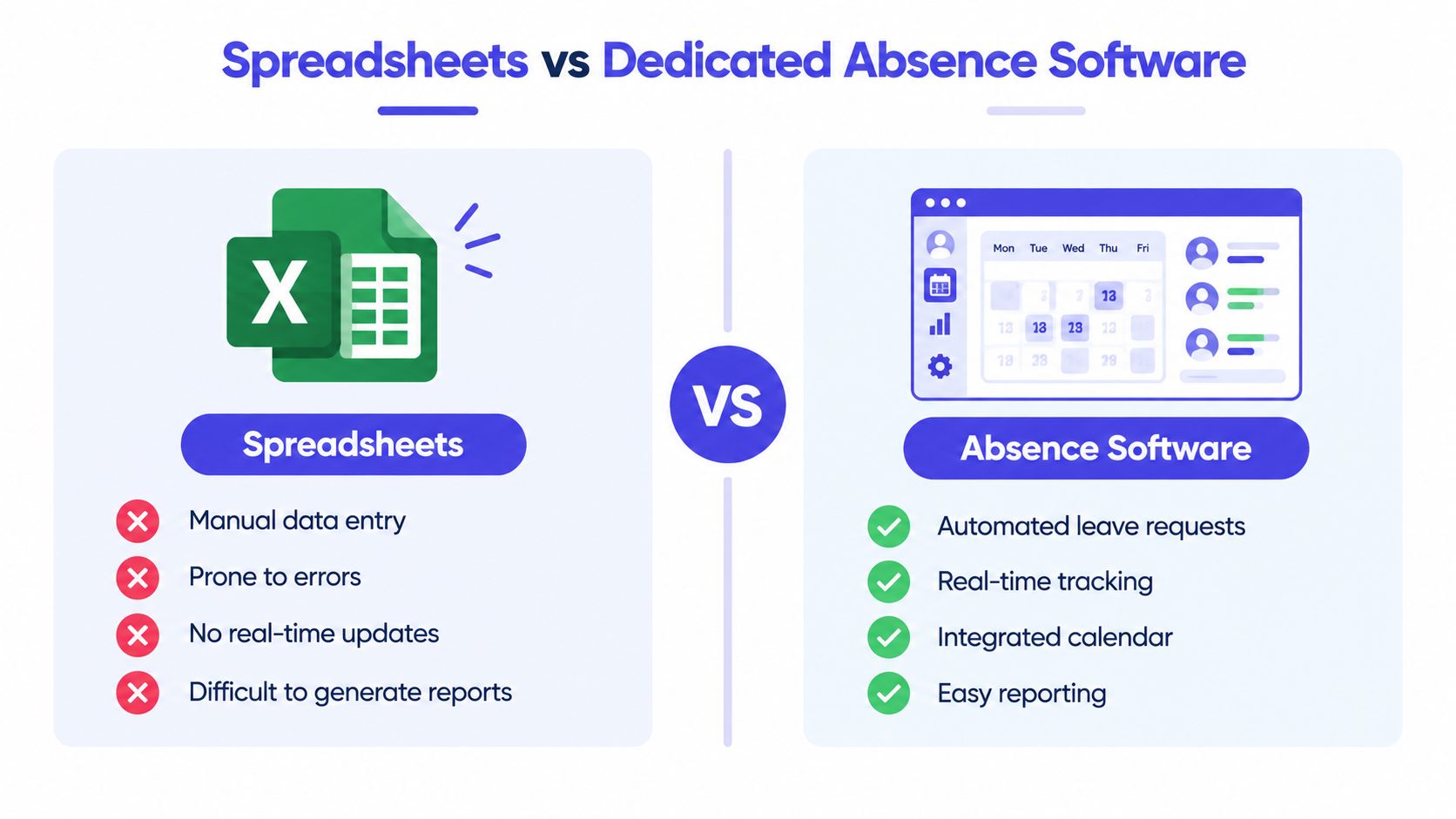
| Spreadsheet approach | Dedicated absence software |
|---|---|
| Manual entries and email-based updates | Employee requests and manager approvals in one workflow |
| Multiple versions can circulate | A central record provides current visibility |
| Managers must remember follow-ups | Notifications and task prompts support timely action |
| Reporting requires manual preparation | Calendars and reports make patterns easier to review |
| Rules may be applied inconsistently | Configured policies can support consistent checks |
The right choice depends on the business's complexity and tolerance for manual work. A tiny team with very limited leave activity may manage adequately with a disciplined shared system. Once several managers, locations, shifts, or leave rules are involved, the weakness is usually coordination rather than the spreadsheet itself.
In a 2024 survey of 128 UK organisations, 34% of employers reported higher employee absence in the prior year, with an average of 4.8 days lost per employee annually. The same WTW survey found 38% reported increased absence-management and occupational-health costs, while 37% reported higher health-insurance claims.
Before buying software, map the process you want it to improve. A useful comparison of LeaveWizard with traditional spreadsheets can help clarify the difference between recording absence and managing it. If your wider HR process needs modernising, a considered HR tech overhaul strategy can also help you avoid adding a disconnected tool.
How LeaveWizard Simplifies Absence Tracking
Software becomes useful when it removes decisions and reminders from the manager's memory. Set the policy once, give employees a clear route for requesting or reporting time off, and let the system keep the record visible to the people who need it.
A platform such as LeaveWizard provides tools for recording employee absence, handling requests, checking rules, tracking overtime and absence, and producing reports. Its sick leave workflow can also support absence records and sick-note uploads through browser and smartphone access. The exact setup still matters, because software can't compensate for an unclear policy or a manager who doesn't know when to intervene.
A practical implementation starts with the employee journey:
- Report or request: The employee submits planned leave or records sickness through the agreed channel.
- Check entitlement: The system applies configured rules and displays relevant information.
- Notify the manager: The responsible manager receives the request or absence update.
- Plan cover: The team calendar shows availability before work is reassigned.
- Track the case: Notes, dates, documents, and expected review points stay connected.
- Report patterns: Managers and administrators can review information for planning and follow-up.
That sequence gives a small business earlier visibility without requiring every manager to maintain a separate file. It also gives employees a self-service route, which reduces the need to ask HR or a manager to check basic entitlement information.
The calendar is especially useful for proactive planning. If a critical role has limited cover, you can identify the constraint before approving overlapping planned leave. If sickness absence continues, the recorded review date gives someone a clear responsibility for checking in rather than leaving the case in limbo.
Here's a closer look at how a digital leave workflow can support day-to-day coordination:
The best result comes from keeping the workflow proportionate. Don't create so many approval stages that a simple request becomes slow. Use automation for calculations, reminders, visibility, and reporting, while keeping sensitive decisions with trained managers.
Best Practices for Building a Supportive Policy
Technology records what happens. A supportive policy helps people understand what to do before, during, and after an absence. Employees should know how to report sickness, who will contact them, what information the business needs, and how the return-to-work conversation will work.
Start with a short policy that managers can follow. Long documents often fail when the practical instruction is buried under legal language. Make the reporting route obvious, define responsibilities, and explain that the business will handle health information carefully.
Make early communication easy
Ask employees to report sickness as soon as reasonably possible through one agreed channel. A manager who receives timely information has more options for cover, while an employee who knows the process doesn't need to decide whom to contact under pressure.
Your policy should distinguish between:
- Planned leave: Requests, approval, entitlement, and calendar visibility.
- Short-term sickness: Notification, expected updates, recording, and return.
- Longer absence: Review points, appropriate support, documentation, and next steps.
- Other leave: The relevant process for bereavement, caring responsibilities, maternity, or unpaid personal time.
Avoid treating every absence as a disciplinary problem. A pattern may indicate a health issue, an unsuitable workload, a difficult shift arrangement, or a team-management problem. Managers need a consistent process for noticing patterns without making assumptions about an employee's health or motives.
Use return-to-work conversations well
A return-to-work conversation should be brief, private, and constructive. Confirm that the employee is fit to return, check whether any support or temporary adjustment is needed, record the relevant outcome, and explain any follow-up. It shouldn't become an interrogation about medical details.
The Civil Service report for the year ending 31 March 2025 recorded an overall average of 8.2 working days lost per staff year, with 4.9 days from long-term sickness and 3.4 days from short-term sickness. It also found that 49% of civil servants took no sickness absence, while London recorded 6.5 days and Northern Ireland 10.4 days, as reported in the Civil Service sickness absence report.
These figures aren't a target for a small employer. They illustrate why duration, frequency, location, and workforce segment matter. Review your own data for operational patterns, but don't use averages as a shortcut for judging individuals.
Fairness matters: Apply the same reporting and review process consistently, then make reasonable decisions based on the person's circumstances and the needs of the role.
Train line managers to record facts, protect confidentiality, and escalate questions they can't answer. Review the policy when legislation or payroll rules change, including the SSP changes taking effect on 6 April 2026. A clear process helps employees feel supported and gives the business a defensible, organised way to maintain continuity.