
A day in lieu, or TOIL (time off in lieu) as it’s more commonly known, is a straightforward swap. Instead of getting paid overtime for extra hours you’ve put in, you get that time back as paid leave to use down the road. It’s a simple ‘time-for-time’ exchange that works well for both people and the businesses they work for.
What Exactly Is Time Off In Lieu?
Think of TOIL as having a time bank at work. When you work past your normal hours—maybe to get through a hectic period or cover a bank holiday—you don't get extra money on your payslip. Instead, those hours are "deposited" into your leave account, ready for you to "withdraw" as a paid day off whenever it suits you better.
This system is a popular arrangement here in the UK. At its heart, the principle is 'time for time': for every extra hour you work, you bank an hour of leave. It’s a flexible alternative to just paying out for overtime.
To give you a quick snapshot, here are the core ideas behind a day in lieu.
Day in Lieu at a Glance
| Concept | Brief Explanation |
|---|---|
| Definition | Time off from work granted instead of payment for overtime hours worked. |
| AKA | Time Off In Lieu (TOIL). |
| Core Principle | A 'time-for-time' swap. One hour of overtime equals one hour of leave. |
| Eligibility | Depends on company policy, employment contract, and local regulations. |
| Accrual | Time is typically accrued and tracked in a system, like a personal leave balance. |
| Usage | Employees request to use their accrued TOIL, usually with manager approval. |
Ultimately, it’s about giving back the time that employees have invested beyond their standard duties.
The Core Concept in Action
Let’s imagine Sarah works an extra eight hours on a Saturday to help her team hit a critical project deadline. Rather than adding those hours to her payslip, her manager approves it as TOIL.
The next month, Sarah can book a full day off using that banked time, and it won't touch her normal holiday allowance. This gives her a much-needed rest day, while the company gets to manage its staffing budget without an immediate cash payout. Digging into the different types of employee leave can help you see exactly where TOIL fits into the bigger picture.
This kind of arrangement offers a few key advantages:
- Flexibility for employees to take time off when they truly need it.
- Cost management for employers, who can avoid paying out overtime.
- Improved work-life balance, as it encourages people to properly switch off and recover after intense periods of work.
How a Day in Lieu Works in Practice
Knowing what a day in lieu is conceptually is one thing, but seeing it play out in the workplace really clarifies its value for everyone involved. The journey from putting in extra hours to enjoying that well-earned day off isn't complicated; it follows a clear, logical path that keeps things fair and transparent. Think of it as a simple cycle: you earn it, you track it, and then you redeem it.
It all kicks off when an employee works beyond their contracted hours. This often happens when covering a busy period or working on a bank holiday when the business needs all hands on deck.
This infographic breaks down the straightforward flow from earning to using a day in lieu.
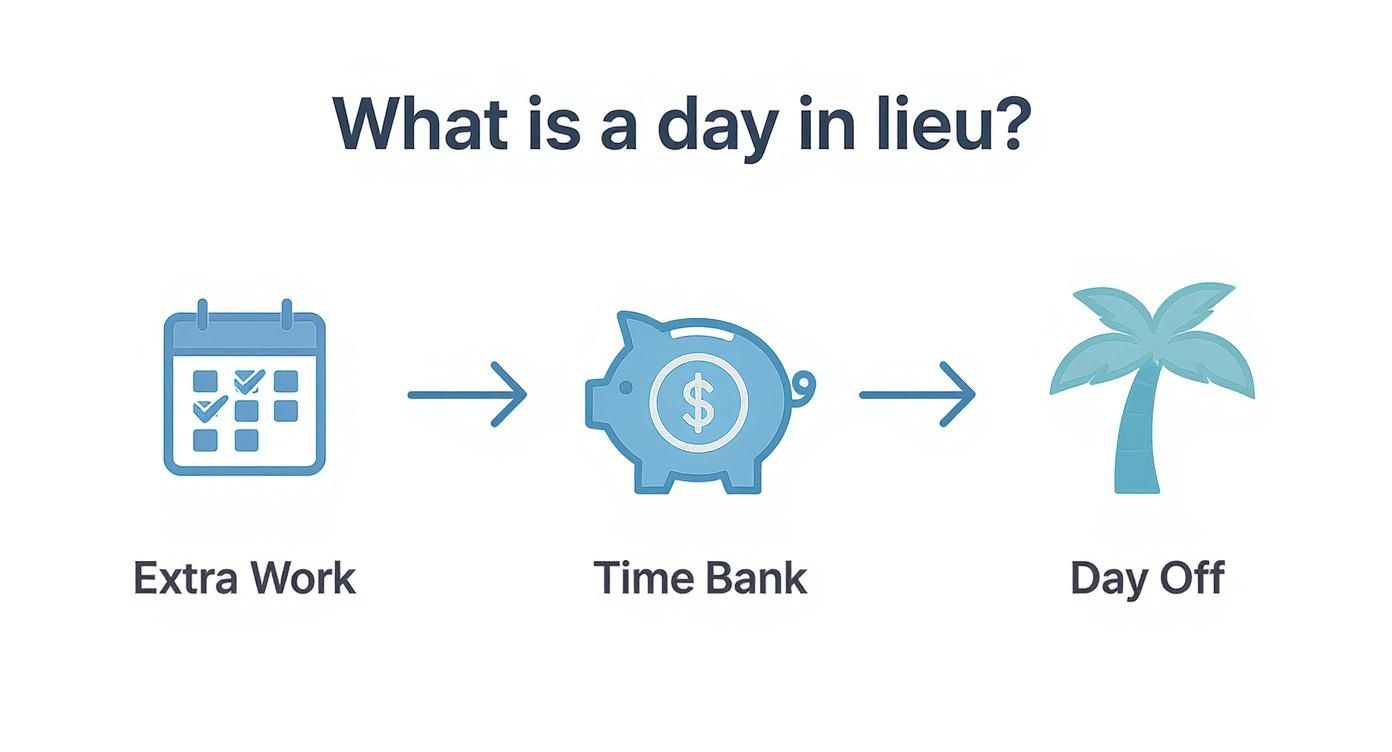
As you can see, the process moves seamlessly from the initial extra work, to banking that time, and finally, to taking the earned time off to recharge.
The Employee Journey Step by Step
For an employee, the whole thing is usually managed through existing company systems and hinges on clear communication. It's less about tricky calculations and more about sticking to a simple, established procedure.
- Gaining Approval: Before pulling a late one, an employee typically needs a nod from their manager. This quick check-in prevents any confusion down the line and confirms that the extra time will be officially recognised as TOIL.
- Tracking the Time: Next, the employee accurately logs their overtime hours. This might be done on a classic timesheet, but these days it’s more common to log it straight into a digital HR system. Getting this step right is crucial for accurate records.
- Accruing the Leave: Once the hours are submitted and approved, they’re converted into leave and added to the employee's time-off balance. They can then see their banked hours sitting right there alongside their standard annual leave.
- Requesting the Day Off: Finally, when they're ready for a break, the employee just puts in a leave request through the usual channels, making sure to specify they're using their TOIL balance.
A key detail in any TOIL policy is the accrual rate. While a standard 1:1 rate (one hour of leave for one hour worked) is common, some companies offer enhanced rates. For example, offering 1.5 hours of leave for every hour worked on a bank holiday can be a great extra incentive.
Building a Fair and Effective TOIL Policy
A well-defined Time Off In Lieu (TOIL) policy is the bedrock of any fair and transparent system. Let's face it, without clear guidelines, what should be a straightforward benefit can quickly descend into confusion, disputes, and administrative headaches.
For employers, a formal policy provides much-needed consistency. For employees, it offers clarity on exactly how they can earn and use their extra time off. This policy acts as a mutual agreement, making sure everyone understands the rules of the game from the very beginning. It removes any grey areas about who qualifies for a day in lieu and sets firm expectations for how the system works—which is essential for building trust.

Core Components of a TOIL Policy
To be truly effective, your policy must cover several key areas. Think of these as the essential pillars holding the whole structure up, ensuring it remains sturdy and fair for everyone in your organisation.
- Eligibility Rules: Be crystal clear about which employees are eligible for TOIL. Is it open to all staff, or is it reserved for specific roles or pay grades? It's common for salaried employees to be included, while hourly workers might receive standard overtime pay instead.
- Accrual Rates: Define exactly how time is earned. Is it a straight 1:1 swap—one hour of leave for one hour of overtime? Or do you sweeten the deal with enhanced rates, perhaps 1.5x for working on a bank holiday or even 2x for a Sunday shift?
- Accrual Caps: Set a sensible limit on how much TOIL an employee can bank. An unlimited cap might sound generous, but it can quickly become a significant liability. It could also accidentally foster a culture where employees feel pressured to work excessive hours. A cap keeps the system manageable.
Getting these foundational rules down prevents misunderstandings before they even have a chance to start. But a robust policy also needs to outline the practical steps for managing this leave.
A critical, and often overlooked, element is the expiry date. TOIL shouldn't be banked indefinitely. Setting a clear timeframe for its use—such as within three months of being accrued—encourages employees to take necessary rest and prevents large leave balances from piling up.
Approval and Offboarding Procedures
Finally, your policy needs to get into the nuts and bolts of how things work day-to-day. A clear workflow for requesting and taking TOIL is vital to avoid scheduling conflicts and keep the business running smoothly. In most cases, this should mirror your standard annual leave request process.
You also need a solid plan for what happens when an employee leaves the company. Specify whether outstanding TOIL will be paid out in their final salary or if it must be taken before their departure date. Getting these details down in writing is a crucial part of creating a comprehensive time off in lieu policy. This proactive approach doesn't just keep you legally compliant; it fosters a culture of fairness and respect within your team.
Choosing Between a Day in Lieu and Overtime Pay
Figuring out whether to offer a day in lieu (often called TOIL, or time off in lieu) or just pay for the extra hours is a classic puzzle for UK businesses. It’s a decision that really matters, affecting everything from your company's cash flow to your team's morale. Each path has its own set of trade-offs, and there's no single right answer.
For the business, it often boils down to a simple choice: cash versus admin. Paying overtime is a straightforward, immediate hit to the payroll budget. Offering TOIL, on the other hand, keeps cash in the bank for now but creates a future commitment—accrued leave. This leave needs to be tracked meticulously to avoid it piling up and causing scheduling headaches down the line.
Weighing the Employee Perspective
For your team members, the decision is much more personal. It's often a direct choice between a healthier bank balance and a healthier mind. Overtime pay gives an instant, tangible boost to their take-home salary, which is a powerful motivator for many.
But a day in lieu offers something money can't always buy: a chance to rest, recharge, and fend off burnout. For a lot of people, that extra day of freedom to handle life admin or just relax is far more valuable than the cash equivalent.
The best approach really depends on the individual and, of course, what’s written in their employment contract. Some people will always jump at the chance for extra pay, while others will consistently choose more time to themselves.
Ultimately, it’s not just about money versus time; it’s about what fits the company culture and personal needs. It's crucial to understand the financial nuts and bolts, and you can learn more about how to calculate overtime with our essential UK guide. Both TOIL and paid overtime can be great options, as long as the rules are crystal clear and applied fairly to everyone.
To help you see the differences at a glance, here’s a quick comparison.
Comparing TOIL and Overtime Pay
| Feature | Day in Lieu (TOIL) | Overtime Pay |
|---|---|---|
| Immediate Cost | No immediate cash outlay for the employer. | Direct, immediate cost added to the payroll. |
| Employee Benefit | Provides valuable rest and recovery time, improving work-life balance. | Offers a direct financial reward and increases take-home pay. |
| Administration | Requires a robust system to track accrued and taken leave accurately. | Simpler to administer through the existing payroll process. |
| Operational Impact | Can create scheduling challenges if too many employees take leave at once. | No future scheduling impact, as the work is already compensated. |
| Employee Choice | Appeals to employees who value time and flexibility over money. | Attracts employees who are motivated by financial incentives. |
In the end, a flexible approach that gives employees a choice—wherever possible—often yields the best results. It demonstrates trust and acknowledges that everyone's priorities are different and can change over time. This kind of adaptability is what builds a supportive and resilient workplace culture.
Why Company Culture Matters for TOIL
Let's be honest, a TOIL policy on paper is a great start, but it’s only as good as the culture that brings it to life. What’s the point of offering a day in lieu if your team feels too buried in work to actually take it? That’s a fast track to a burnout cycle, where time off becomes just another number on a spreadsheet instead of a real break.
The goal is to move TOIL from an administrative checkbox to a genuine chance for your people to rest and recover. When leadership actively encourages taking time off, it sends a clear message: employee wellbeing is a priority, not an afterthought.

Avoiding Leave Hoarding and Burnout
A supportive environment is the best defence against what’s known as ‘leave hoarding’. This is when employees stack up their earned days in lieu but never use them, often because they’re worried about falling behind or being seen as less committed than their colleagues.
It's a surprisingly widespread issue in the UK. While every worker is entitled to 5.6 weeks’ paid holiday each year, recent data for 2024 revealed that the average employee left five days of annual leave unused. That’s a full workweek of rest that never happened. This points to a culture where taking necessary time off often gets pushed to the bottom of the to-do list. You can dig into more UK leave statistics and see how a supportive culture makes a difference over at timetastic.co.uk.
A culture that champions rest understands a fundamental truth: well-rested employees are more productive, creative, and engaged in the long run. Time off isn't a cost; it's an investment in your team's sustainable performance.
Ultimately, a day in lieu system only works when it's part of a wider culture that genuinely values balance. Leaders can set the tone by taking their own holidays and talking openly about the importance of disconnecting. This is how you transform TOIL from a line in a policy document into a real tool that supports both your people and your business.
Frequently Asked Questions About TOIL
Let's be honest, the moment you introduce a Time Off In Lieu (TOIL) system, questions are bound to pop up from both sides of the table. Getting ahead of these common queries is the key to making sure the policy works fairly and effectively, without causing any headaches down the line.
So, let's dive into some of the most frequent questions we see.
A big one is whether a manager can force an employee to take a day in lieu instead of paying them for overtime. The short answer? It all comes down to the employment contract. If the contract clearly states that extra hours are compensated with TOIL, then that’s the agreement. But without that clause, the default is usually overtime pay, and swapping it for TOIL has to be something both parties agree on.
Can TOIL Be Refused?
This leads to another common scenario: can an employee refuse to take their TOIL, or can a manager deny a request to use it? While staff can't just stockpile their lieu days forever, they generally have a say in when they want to use them, as long as it doesn't clash with business needs.
By the same token, an employer can turn down a TOIL request if it’s going to leave the team in the lurch – just like they would with any other holiday request.
The core principle here is reasonableness from everyone. Your company needs a straightforward policy for booking TOIL, including how much notice is needed. This helps you manage staffing levels and avoids situations where a last-minute request causes chaos.
So what happens to all those accrued hours when someone hands in their notice? This is a crucial detail that absolutely must be covered in your TOIL policy.
Handling TOIL During Offboarding
When an employee leaves the company, any unused day in lieu has to be sorted out. There are really two ways to handle this:
- Payment in Lieu: This is often the simplest route. You just calculate the value of the outstanding TOIL hours and add it to the employee's final payslip.
- Taking Leave: The other option is to have the employee use up their accrued TOIL during their notice period. This means they finish up in the office a bit earlier before their official last day.
Whichever path you choose, it needs to be clearly written down in your policy. A clear, documented process ensures offboarding is smooth and fair for everyone involved and prevents any last-minute disagreements. Ultimately, a solid TOIL system is built on transparent rules that cover everything from how hours are earned to what happens when an employee moves on.


