
A time off in lieu policy is a fantastic, flexible alternative to simply paying for overtime. Instead of getting extra cash for working beyond their contracted hours, your team can bank these hours to use as paid time off later on. It’s a powerful way to handle those inevitable peaks in workload while giving your staff a better shot at a healthy work-life balance.
What Exactly Is Time Off In Lieu?

The easiest way to think of Time Off in Lieu (TOIL) is like a "work-hours savings account." When an employee has to put in extra time to hit a tight deadline or tackle an urgent project, those additional hours get deposited right into their account.
Later, they can "withdraw" from this account. This could be for a personal appointment, a family event, or just a much-needed day to switch off and recharge. It turns extra work from a simple financial transaction into a genuinely valuable and flexible benefit. It’s a great way to acknowledge an employee's dedication without an immediate hit to the payroll, which is why it’s so popular with businesses keeping a close eye on cash flow.
TOIL In The UK Legal Context
Here in the UK, TOIL is a pretty common alternative to overtime pay. It lets people who work extra hours take that time back as paid leave instead of getting it in their payslip. While having a time off in lieu policy isn't required by law, it absolutely must operate within the rules set out by the Working Time Regulations 1998. You can get more detail on the legal side of a TOIL policy on employmenthero.com.
What this means for you is simple: you have the freedom to offer TOIL, but you're still responsible for making sure your team isn't working more than the legal weekly hour limits on average. You also have to ensure they're getting their statutory rest periods. A clear, well-structured policy isn't just nice to have—it's essential for staying compliant.
A great TOIL system is a genuine win-win. The business gets the flexibility it needs to manage projects and control overtime costs. At the same time, employees get more say over their personal time, which is a massive boost for morale and a great defence against burnout.
How TOIL Differs From Other Leave Types
It's really important to draw a clear line between TOIL and other types of leave. Getting them mixed up can cause a lot of confusion for both managers and staff. Each one exists for a different reason and is governed by different rules.
To help clear things up, here’s a quick comparison of the main differences.
TOIL vs Overtime Pay vs Annual Leave
| Feature | Time Off in Lieu (TOIL) | Overtime Pay | Statutory Annual Leave |
|---|---|---|---|
| Compensation | Paid time off | Additional wages | Paid time off |
| Origin | Earned by working extra hours | Earned by working extra hours | A legal right for all employees |
| Purpose | To compensate for specific overtime | To provide a financial reward for extra hours | For rest and general time off |
| Legal Status | A discretionary company policy | Usually contractual (if in the contract) | Legally required |
| Accrual Method | Based on actual extra hours worked | Based on actual extra hours worked | Accrues over the course of the leave year |
As you can see, TOIL is a direct trade-off: extra hours worked now for time off later. It's earned, not just given. In contrast, annual leave is a legal entitlement for rest and recuperation, and overtime pay is a purely financial reward. Making sure everyone understands these distinctions is the first step to a successful policy.
Navigating the Legal Rules for TOIL in the UK
While offering time off in lieu is your call as a business—it’s not a legal requirement—it doesn’t exist in a law-free bubble. Any TOIL system you put in place has to play nicely with fundamental UK employment laws to be fair, compliant, and actually work in practice. The absolute cornerstone of these rules is the Working Time Regulations 1998.
Think of these regulations like the guardrails on a motorway. Your TOIL policy is your vehicle; it gives you flexibility. But you absolutely must stay within the legal lanes to keep everyone safe. Bending these rules can land you in serious legal and financial hot water.
The biggest rule you need to know about is the 48-hour average weekly work limit. This regulation says you can’t require an employee to work more than 48 hours a week on average, which is usually calculated over a 17-week period.
Understanding the 48-Hour Work Week
This 48-hour cap is a critical protection against overwork, and a TOIL policy can't be used as a backdoor to push employees past this limit consistently. If your business regularly needs people to work hours that would breach this average, you must have a formal opt-out agreement signed and dated.
This is simply a written agreement where an employee voluntarily agrees to work more than the 48-hour average. It’s crucial to remember that you can't penalise or dismiss someone for refusing to sign one. They also have the right to cancel their opt-out agreement whenever they want, just by giving the agreed-upon notice (typically between one week and three months).
Even with an opt-out, your duty of care doesn’t just disappear. You are still responsible for protecting the health and safety of your team, and that includes making sure they get enough rest.
A common mistake is thinking a TOIL policy replaces the need to manage working hours. In reality, it makes accurate tracking even more essential. Your policy has to work in harmony with the law, ensuring flexibility never comes at the cost of compliance or employee wellbeing.
Mandatory Rest Periods Are Non-Negotiable
The Working Time Regulations also set out specific, non-negotiable rest periods. Your TOIL policy can't touch these. No matter how many extra hours someone logs, they are still legally entitled to:
- 11 consecutive hours of rest in any 24-hour period.
- One whole 24-hour period of uninterrupted rest each week (or a 48-hour block every two weeks).
These rest breaks are there for a reason: to prevent burnout and give people proper time to recover between shifts. So, if an employee works late to hit a deadline, you can't ask them to be back in first thing the next morning if it cuts into their 11 hours of rest—even if you offer them TOIL. This is where good management and smart scheduling become vital. Our detailed guide can help you understand more about how to calculate overtime in the UK while staying on the right side of these rules.
This infographic breaks down the key legal pillars that every compliant TOIL policy needs to be built on.
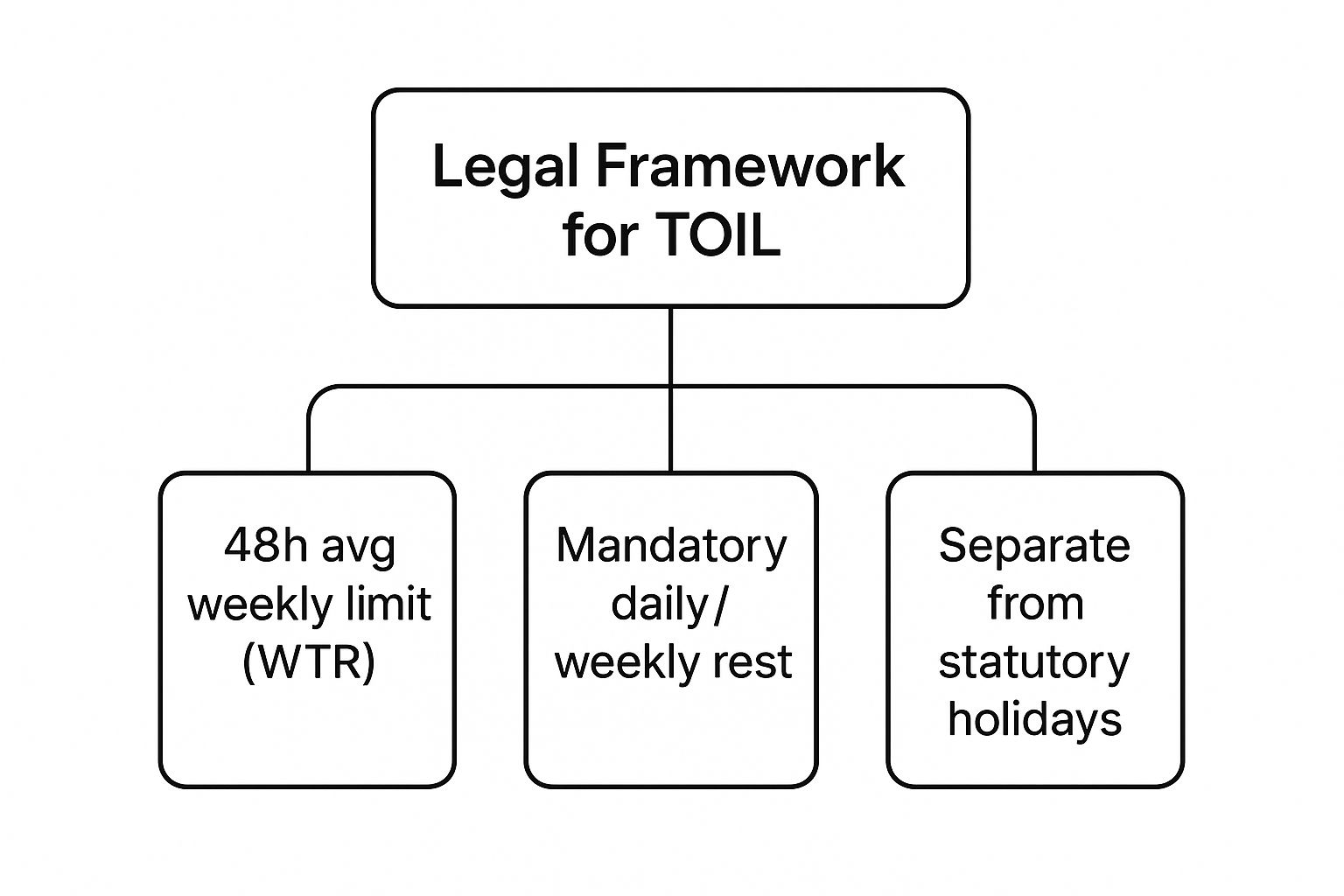
As you can see, while TOIL is a decision made at the company level, it always sits underneath these core legal requirements.
Keeping TOIL and Annual Leave Separate
Finally, it’s absolutely critical to draw a clear line between TOIL and statutory annual leave. They are two completely different beasts. You can’t use TOIL to substitute an employee’s legal holiday entitlement. Every full-time employee in the UK is entitled to 5.6 weeks of paid holiday each year.
This is a really important distinction, especially when you consider that many UK workers aren't even using their full holiday allowance. Research from 2023 showed that just under 61% of UK workers didn’t take their full statutory leave, a trend that’s been stubbornly consistent.
A good TOIL policy should add flexibility on top of annual leave, not replace this essential time to rest and recharge. Your policy must be crystal clear that TOIL is earned for working extra hours, whereas annual leave is a protected right for longer periods of recovery.
How to Build a Clear and Fair TOIL Policy

Moving from legal theory to practical action is where a great time off in lieu policy truly takes shape. Let’s be honest, a vague policy is just a recipe for confusion, disputes, and inconsistent decisions. To prevent that headache, your policy document needs to be a crystal-clear guide that leaves no room for guesswork.
Think of it as the instruction manual for your TOIL system. It needs to tell everyone involved—from employees to line managers and HR—exactly how things work, what the rules are, and who is responsible for what. Clarity and fairness have to be your guiding principles.
To build a really solid policy, there are several core components you need to get right. Each one answers a critical question that will inevitably pop up. Nail these elements from the start, and you’ll save yourself countless headaches down the line. It ensures the system is seen as a fair and valuable benefit, not a source of frustration.
Defining Eligibility and Scope
First things first: who can actually earn TOIL? It might not be practical or even necessary for every single role in your organisation to be included. For instance, senior managers on high salaries often have contracts that assume they'll work the hours required to get the job done, so they might be excluded.
You need to clearly spell out which employees, roles, or departments are part of the scheme.
- Role-Based Eligibility: Is this mainly for non-salaried staff, or specific operational teams who often face fluctuating hours?
- Departmental Scope: Does the policy apply company-wide, or is it limited to departments with unpredictable workloads, like project management or events teams?
- Contractual Status: Are there different rules for full-time, part-time, or temporary staff?
Being explicit about who is covered prevents any feelings of unfairness. If you do exclude certain roles, a brief explanation can help manage expectations and show the decision was carefully considered, not just arbitrary.
Setting Clear Accrual and Approval Rules
Once you know who’s eligible, the next step is defining how TOIL is actually earned and approved. This is the mechanical core of your policy, and it demands absolute clarity. A common—and fair—approach is a simple hour-for-hour exchange.
For every extra hour an employee works, they accrue one hour of TOIL. Some companies offer enhanced rates, like 1.5 hours of TOIL for every hour of overtime on a weekend, but a 1:1 ratio is the simplest and most common way to go.
Just as important is the approval process. Uncontrolled overtime can quickly become a significant hidden cost that spirals out of control.
Your policy must state that all overtime intended for TOIL requires pre-approval from a line manager. This simple step gives managers control over workloads and budgets, preventing employees from simply self-authorising extra hours.
This process ensures that overtime is only worked when it's genuinely necessary for the business, turning a reactive problem into a managed, predictable process.
Establishing Usage and Expiry Conditions
So, an employee has built up some TOIL. How and when can they use it? Without clear rules, you could be heading for operational chaos, with key team members all trying to take leave during a critical project phase. When you're putting your policy together, it's worth exploring tools for HR policy drafting that can help structure these complex rules efficiently.
Your usage rules should cover:
- Request Process: How do employees ask to use their TOIL? It should ideally follow the same process as requesting annual leave, using your standard system.
- Notice Periods: What’s the minimum notice required? This gives managers enough time to arrange cover and manage team schedules without last-minute scrambles.
- Blackout Periods: Are there specific busy times, like end-of-quarter reporting or seasonal peaks, when taking TOIL is restricted?
Finally, you must include an expiry clause. Allowing TOIL to build up indefinitely is a major risk. It can lead to employees hoarding huge balances that become impossible for them to take without causing massive disruption.
A typical expiry period is between three to six months from when the TOIL was earned. This encourages people to use their leave regularly, promoting proper rest and preventing a large liability from building up on your company's books.
Essential Components of a TOIL Policy
To help you pull this all together, here’s a quick checklist of the essential elements your TOIL policy should include. Thinking through each of these points will ensure your final document is comprehensive, fair, and easy for everyone to understand.
| Policy Component | Key Questions to Answer | Best Practice Example |
|---|---|---|
| Eligibility | Which employees, departments, or job levels are covered? Are there any exclusions? | "This policy applies to all full-time and part-time non-managerial employees in the Operations and Customer Support departments." |
| Accrual Rate | How is TOIL earned? Is it a 1:1 ratio, or are there enhanced rates for weekends/bank holidays? | "TOIL is accrued on a one-for-one basis. For every hour of pre-approved overtime worked, one hour of TOIL is earned." |
| Approval Process | Who needs to approve overtime before it's worked? What is the procedure for getting approval? | "All overtime must be approved in writing (via email or our HR system) by the employee's direct line manager at least 24 hours in advance." |
| Usage Rules | How do employees request to use their accrued TOIL? What are the notice periods? | "TOIL leave requests must be submitted through the company's leave management system with a minimum of one week's notice." |
| Restrictions | Are there any blackout periods when TOIL cannot be taken? Is there a cap on how much can be accrued? | "TOIL may not be taken during the last two weeks of a financial quarter. A maximum of 15 hours of TOIL can be held at any one time." |
| Expiry Clause | When does accrued TOIL expire? | "Accrued TOIL must be used within three months of the date it was earned. Any unused TOIL will expire after this period." |
| Payment in Lieu | Will the company pay out unused TOIL upon termination of employment? | "Accrued TOIL holds no cash value and will not be paid out upon termination of employment." |
By covering these bases, you create a fair system that works for everyone—protecting the business from operational risks while giving employees a valued and well-managed benefit.
Understanding the Pros and Cons of a TOIL System
Bringing a time off in lieu policy into your business might seem like an obvious win-win. It offers flexibility for the company and a perk your team will genuinely appreciate. But the reality is a little more nuanced. A truly balanced system only comes from understanding both the significant advantages and the potential pitfalls.
Weighing these carefully is the only way to figure out if TOIL really fits with your company’s culture and, just as importantly, your operational capacity. When managed well, it’s a powerful tool for keeping staff happy and your business agile, offering a practical way to handle busy spells without immediately hitting your payroll.
The Clear Advantages of Offering TOIL
One of the biggest benefits everyone talks about is the boost to employee work-life balance. Instead of just a financial top-up, TOIL gives employees back their most precious resource: time. This flexibility means they can deal with life's demands—like appointments or family commitments—or simply recharge after a tough project, which is a massive factor in preventing burnout.
For the business, this flexibility cuts both ways. When you're up against a critical project deadline or hit an unexpected busy period, you can manage the extra workload without having to fork out for expensive overtime. This helps you control operational costs and makes your financial forecasting that much more predictable. You can find out more about the advantages of offering Time Off in Lieu (TOIL) and how it can help your business.
This kind of approach almost always leads to a noticeable lift in team morale. When people feel their extra effort is recognised with a benefit that genuinely improves their lives, it builds a powerful sense of loyalty and appreciation. This positive atmosphere is a key driver for higher retention rates, as staff are far less likely to look for another job when they feel valued and respected.
The impact of flexible work and rest policies on staff retention is significant. When employees have more control over their time, they report higher job satisfaction and are less likely to suffer from burnout, directly benefiting the business through lower turnover and improved productivity.
Evidence from wider studies on flexible working backs this up. Take the UK's largest four-day workweek pilot, which involved 2,900 workers. During the trial, absenteeism fell by a staggering 65%. Even more impressively, resignations dropped by 57%. While this wasn't just down to TOIL, these numbers show how policies that promote proper rest and flexibility can dramatically improve retention and tackle burnout.
The Potential Downsides and Challenges
Despite all the good stuff, a TOIL system isn't without its challenges. Ignoring them can create some serious headaches down the line. The most common hurdle is the administrative burden of accurate tracking. Without a solid system, trying to manually log every extra hour for every employee on a spreadsheet can quickly turn into a complex and error-prone nightmare.
Another major risk is when employees start to hoard their accrued leave. If your policy doesn’t set a clear expiry date, you could find people sitting on huge balances of time off. This creates a double-whammy of problems. First, it completely defeats the purpose of giving regular rest, increasing the risk of burnout. Second, it creates a "leave liability," where a key team member taking weeks off at once could cause massive disruption.
Finally, without clear guidelines and firm management, you run a serious risk of inconsistent application. If one manager is relaxed about approvals while another is strict, it will quickly lead to feelings of unfairness and poison team morale. A successful policy has to be applied fairly and squarely to everyone who is eligible, every single time.
To give you a clearer picture, here’s a summary of the key pros and cons you'll need to consider.
| Advantages of a TOIL Policy | Challenges of a TOIL Policy |
|---|---|
| Improved Employee Morale | Administrative Complexity |
| Gives staff valuable time back, boosting satisfaction and well-being. | Tracking hours accurately can be difficult without the right tools. |
| Cost Management | Risk of Hoarding Leave |
| Reduces the need for costly overtime payouts, helping budget control. | Employees may save up large amounts of leave, causing coverage gaps. |
| Increased Flexibility | Potential for Inconsistency |
| Helps the business navigate busy periods without hiring temporary staff. | The policy may be applied unfairly if managers are not properly trained. |
| Higher Staff Retention | Burnout Risk If Unused |
| A valued perk that helps keep talented employees loyal to the company. | If staff don't take their TOIL, the system fails to prevent overwork. |
Ultimately, a time off in lieu policy is only as good as the framework you build around it. A successful system needs clear rules, consistent management, and the right tools to make tracking simple and transparent for everyone involved.
Effectively Managing and Tracking Your TOIL Policy

A well-written time off in lieu policy is a fantastic start, but it can quickly fall apart without a solid system to back it up. The practical, day-to-day administration is where your TOIL programme will either succeed or fail. Without an organised approach, you're opening the door to errors, employee disputes, and a mountain of administrative work.
The core challenge is keeping everything accurate. Every single hour of overtime needs to be recorded, approved, and tracked until it’s used. This creates a constant flow of data that has to be managed flawlessly. Even one small mistake can lead to payroll headaches or arguments over balances, chipping away at the trust your team has in the system.
Choosing Your Tracking Method
When it comes to tracking TOIL, businesses usually start with simple, manual methods before realising they need something more robust. Each approach has its own pros and cons, and figuring out the right fit for your company’s size and needs is key.
A common starting point is the humble spreadsheet. It’s accessible, familiar, and doesn't cost anything upfront, which makes it seem like an easy win for small teams.
But this manual approach is notoriously prone to human error. A single broken formula or a missed entry can throw everyone's balances off. Plus, it offers no automated way to handle approvals or send reminders when TOIL is about to expire. As the team grows, that simple spreadsheet quickly becomes a complex and unreliable burden.
The biggest hidden cost of a manual TOIL system isn't the software—it's the time lost to administrative tasks and correcting mistakes. A great tracking system should free up managers to focus on people, not paperwork.
Embracing Automated Leave Management
This is where dedicated HR software really makes a difference. Modern leave management tools are built to automate the entire workflow, getting rid of the risks and wasted time that come with manual tracking. They create a system that’s transparent, reliable, and easy for everyone to use.
Instead of messy email chains and frantic spreadsheet updates, the whole process becomes seamless:
- Request & Approval: An employee requests overtime through the system. Their manager gets a notification and can approve or deny it with a click, creating a clear digital paper trail.
- Automatic Accrual: Once the overtime is approved and completed, the hours are automatically added to the employee’s TOIL balance. No manual data entry needed.
- Real-Time Balances: Both employees and managers can see up-to-date TOIL balances whenever they want, which stops confusion and disputes before they even start.
- Expiry Reminders: The system automatically sends reminders to employees and managers when accrued TOIL is nearing its expiry date, encouraging people to actually use their time off.
This kind of automation doesn't just make life easier; it simplifies compliance and ensures the policy is applied fairly and consistently for everyone. The right technology can completely change how you track employee time off and boost productivity by giving everyone clear visibility and control.
How Technology Simplifies TOIL
Specialised platforms like LeaveWizard offer a clear dashboard where managing TOIL becomes straightforward. This visual approach gives you an at-a-glance overview of balances and requests, making the whole process intuitive.
Here’s an example of how a dedicated system presents TOIL balances clearly for managers.
This dashboard immediately shows the TOIL balance right alongside annual leave, providing a complete picture of an employee's entitlements all in one place.
By moving away from manual methods, you don't just cut down on administrative overhead; you build a more trustworthy and efficient TOIL system. This ensures your policy remains a valuable benefit rather than a source of frustration, helping you manage workloads effectively while looking after your team's wellbeing.
Successfully Launching Your New TOIL Policy
Creating a solid time off in lieu policy document is a great achievement, but it’s only half the battle. A policy is just a piece of paper (or a PDF!) until it’s brought to life with a clear and thoughtful launch. How you introduce your new TOIL system will directly impact how well it’s understood, adopted, and valued by your team.
A successful rollout isn't about just sending a single all-staff email and hoping for the best. Think of it as a planned communication campaign designed to build understanding and trust from day one. The goal is to be transparent, manage expectations, and give everyone the confidence to use the new system correctly, ensuring a smooth and positive transition.
Communicating the Change Effectively
The first step is a clear and concise announcement. This initial message should explain what the new TOIL policy is, why the company is introducing it, and how it benefits employees. You'll want to avoid corporate jargon and focus on the practical advantages, such as increased flexibility and a better work-life balance.
Follow up this announcement with dedicated Q&A sessions. These can be team meetings or informal drop-in sessions where people can ask questions directly. Being prepared to answer queries about eligibility, accrual rates, and expiry rules shows you're being upfront and helps clear up any confusion before it turns into misunderstanding.
A thoughtful launch is an investment in your company culture. It shows that you respect your employees enough to explain changes properly, listen to their concerns, and provide the support they need to adapt.
Finally, make sure the new TOIL policy is officially integrated into your company’s resources so it’s easy for everyone to find.
- Update the Company Handbook: Add the full policy document to your employee handbook. This makes it a permanent and easily accessible reference point.
- Inform New Hires: Make sure your onboarding process includes a clear explanation of the TOIL system for all new starters.
- Provide Digital Access: Post the policy on your company intranet or a shared drive for quick and easy access whenever someone needs it.
Training Your Managers for Success
Your line managers are the gatekeepers of your new policy. Their understanding and consistent application of the rules will make or break the entire system. Because of this, dedicated training for them isn't just recommended—it's essential.
This training should zero in on their specific responsibilities, including how to fairly approve overtime and how to manage scheduling when team members request to use their accrued TOIL. Give them practical scenarios and clear guidelines to follow. This ensures they apply the policy consistently across all teams, preventing any perception of favouritism or unfairness. A well-informed management team is your best asset for a successful rollout.
Got Questions About Your TOIL Policy?
Even with the clearest time off in lieu policy, a few practical and legal questions always seem to pop up. Tackling these head-on is the best way to build a system everyone understands and trusts. Here are the straightforward answers to the questions we hear most often.
Think of this as the essential FAQ cheat sheet for managers and employees alike. Getting these details sorted ensures everyone is on the same page, heading off misunderstandings before they start and proving your approach is fair.
Can an Employer Force TOIL Instead of Overtime Pay?
This is a big one, and the answer almost always boils down to a single document: the employment contract. If an employee’s contract clearly says that overtime will be compensated with TOIL, then yes, an employer can usually stick to that.
But here’s the flip side. If the contract promises paid overtime, or doesn’t mention TOIL at all, an employer can’t just decide to swap cash for time off. Any changes like that would need to be agreed upon by both sides. When it comes to TOIL, the contract is king, so the wording has to be spot on.
What Happens to Accrued TOIL When an Employee Leaves?
When someone hands in their notice or their employment ends, what becomes of their TOIL balance? This all comes down to what your policy says. There’s no law in the UK that forces employers to pay out unused TOIL.
This is exactly why having it written down in black and white is so critical. Your policy needs to spell out one of two paths:
- Forfeiture: The most common route. Any unused TOIL is forfeited when employment ends and has no cash value.
- Payout: Some companies choose to pay out the balance at the employee’s usual hourly rate in their final paycheque.
Whatever you decide, get it into the policy. It will save you from tricky disputes during an already sensitive offboarding process.
Key Takeaway: Your TOIL policy is the final word on how unused leave is handled when an employee leaves. Without a clear statement, you’re just creating grey areas that can lead to frustrating and totally avoidable disagreements.
Is There a Legal Limit on Accrued TOIL?
Legally, there isn't a specific UK law that puts a hard cap on how many TOIL hours someone can rack up. But that doesn’t mean it’s a free-for-all. The responsibility to manage this lands squarely back on the employer, guided by a couple of key principles.
First, the Working Time Regulations 1998 are still in play. You have to make sure that, even with TOIL, your team isn't working more than the 48-hour average weekly limit (unless they've opted out). Secondly, your own internal policy should set a sensible cap—say, 15 or 20 hours. This stops people from stockpiling huge amounts of leave, which is a recipe for burnout and scheduling nightmares down the line.


