
For any retail business, the best holiday management software is one built specifically for the chaos of the shop floor. It needs to handle complex shift patterns, peak season leave freezes, and the constant ebb and flow of staff numbers. Generic tools just can't keep up, but a platform like LeaveWizard gives you the visibility and control needed to ensure you're never left short-staffed.
Why Retail Demands Specialised Holiday Management Software
If you're managing a retail team, you already know that standard leave trackers and spreadsheets buckle under the pressure pretty quickly. The unique demands of retail—from unpredictable peak seasons and tangled shift patterns to the absolute necessity of having enough people on the floor—call for a solution that gets it.
Think of it this way: a generic leave tool is like a basic calculator. It's fine for simple sums, but you wouldn't use it for complex financial planning. A specialised retail system is more like an advanced financial tool designed from the ground up to manage a complicated budget with all its moving parts. It’s not just about ticking off days off; it’s about protecting your entire operation.
This infographic nails the core challenges retail managers are up against every single day and shows how a dedicated system can help.
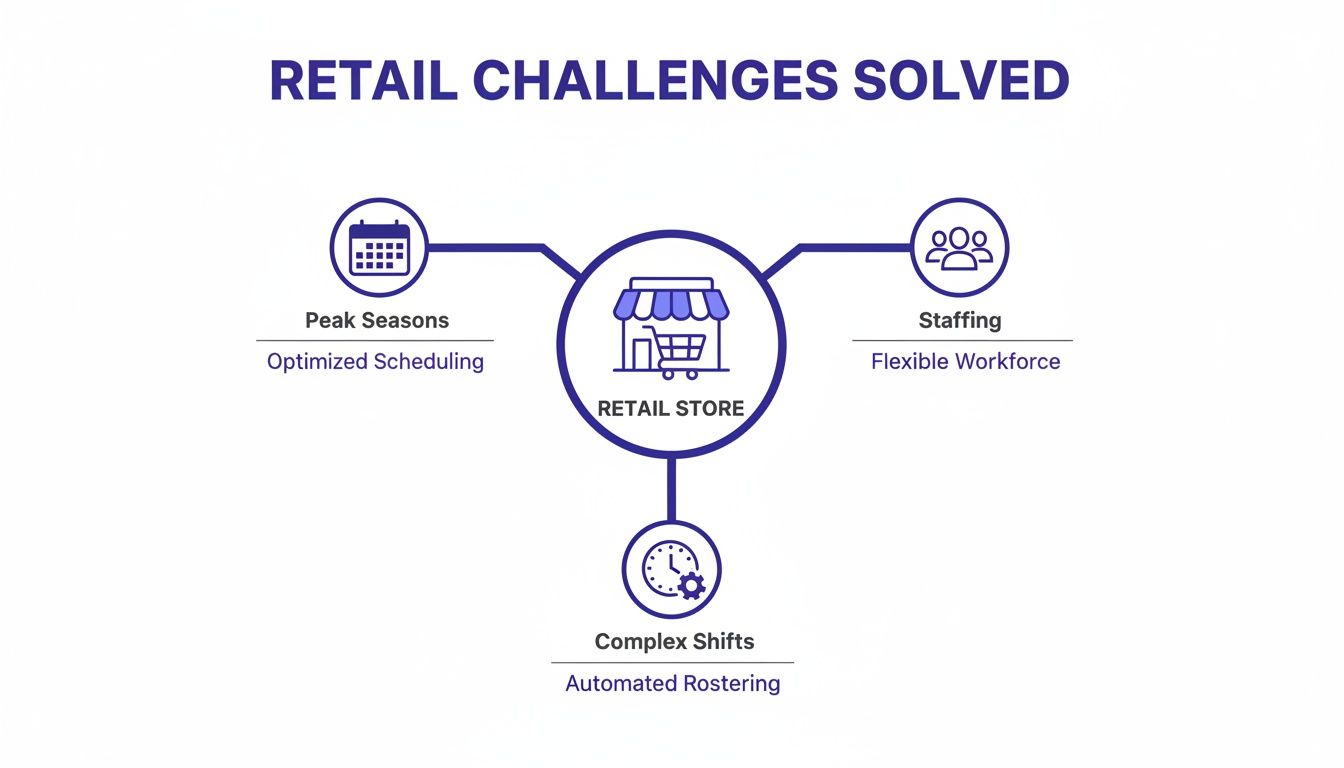
The real insight here is that all these operational headaches are linked. A single, unified platform is the only way to tackle them all at once, effectively.
Turning Headaches into Automated Processes
The right software turns those persistent retail staffing problems into smooth, automated processes. It fills the fundamental gap that generic tools can't, bringing stability right when you need it most—during your busiest sales periods. A system like LeaveWizard is designed to turn chaos into clarity.
For instance, a study revealed that about 75% of businesses start their leave year in January. In retail, this is a nightmare. It creates a mad dash at the end of the year as staff scramble to use up their remaining leave, right in the middle of the Christmas shopping frenzy.
A specialised system lets you set a custom holiday year—say, starting in February after the January sales. This one simple change immediately spreads out leave requests and prevents staffing black holes during your peak seasons.
This isn't a minor tweak; it has a massive impact on how prepared you are. Instead of manually wrestling with clashing requests and risking an empty shop floor, the system automatically enforces your business rules for you.
To see how this works in practice, here’s a quick look at some of the most common retail staffing issues and how modern software directly solves them.
Common Retail Leave Challenges and Modern Software Solutions
This table breaks down some of the most persistent staffing issues in retail and shows exactly how a purpose-built holiday management system addresses them head-on.
| Retail Staffing Challenge | How Specialised Software Solves It |
|---|---|
| Peak Season Staff Shortages | Implements 'leave embargoes' or 'blackout periods' to automatically block holiday requests during critical sales events like Christmas or Black Friday. |
| Unfair Leave Approvals | Uses a transparent, first-come, first-served system with clear rules, which gets rid of any perception of favouritism and gives team morale a real boost. |
| Rota and Holiday Clashes | Integrates directly with shift patterns to show real-time staff availability, preventing mistakes like accidentally approving leave for two keyholders on the same day. |
| Incorrect Part-Time Entitlements | Automatically calculates pro-rata holiday allowances for part-time staff and those on variable hours, ensuring you stay compliant with UK law and your payroll is always accurate. |
Ultimately, it’s about swapping reactive problem-solving for proactive management. The software handles the complex calculations and rule enforcement, freeing up managers to focus on leading their teams and serving customers.
Understanding the Core Features for Retail Operations
So, what is this software, really? Forget the jargon for a moment. A powerful holiday management system is basically the central nervous system for your team's availability. It’s not just a fancy digital wall chart; it’s an active, intelligent tool that helps you run your store.
Let’s break down its key functions with some real-world scenarios you’d find on any high street.
Think about real-time absence tracking. On the surface, it looks like a shared calendar. But in practice, it’s the smart gatekeeper that stops a manager from accidentally approving holiday for two senior keyholders during the same bank holiday weekend. It instantly flags the staffing conflict before it becomes a headache.
This kind of proactive visibility is the bedrock of a stable retail operation. Without it, managers are constantly putting out fires and scrambling to fill staffing gaps, rather than getting ahead of them.
Automated Calculations for a Complex Workforce
Retail teams are rarely simple. You’ve likely got a mix of full-time managers, part-time weekend staff, and temporary seasonal workers, all with completely different holiday entitlements. This is where automated holiday accrual becomes a lifesaver.
The software knows how to correctly calculate leave for a part-timer working 16 hours a week versus a full-time manager on a 40-hour contract. It handles all the pro-rata calculations automatically, wiping out the risk of human error that can lead to costly payroll mistakes and, just as importantly, create feelings of unfairness among the team.
Getting this right shows every staff member they're valued and that their entitlement is being handled correctly and fairly. It’s a massive trust-builder and a cornerstone of legal compliance.
The real goal of these features is to create a reliable, predictable staffing environment. By automating the tricky rules and providing instant clarity, the software frees up your managers to focus on coaching their team and driving sales—not wrestling with spreadsheets.
Key Functions That Drive Retail Success
To truly get a feel for what makes a holiday management system work for retail, let’s see how these specific functions pull together on the shop floor:
- Centralised Request and Approval Workflow: A team member can request leave from their phone using a mobile app, and their manager gets an instant notification. This kills off the nightmare of lost paper forms and messy email chains, creating a single, clear record for every request.
- Team Visibility Calendar: A manager can see at-a-glance who is in, who is on holiday, and who is off sick. This simple, colour-coded view makes spotting potential coverage gaps for the upcoming week incredibly straightforward.
- Custom Leave Policies: You can build your store’s specific rules directly into the system. For instance, you can set a minimum notice period for holiday requests or block out peak trading periods. You can even limit how many people from the same department can be off at once.
These features are the building blocks of a solid system. To see how they all connect, you can explore a wider range of functionalities in our complete guide to employee leave management software. Ultimately, every single feature is designed to bring some much-needed order to the often-chaotic world of retail staffing.
Essential Tools for Peak Season and Holiday Rushes
A retail business's profitability often hangs on its performance during peak seasons. Christmas, Easter, and massive sales events like Black Friday are moments where staffing levels can either make or break your revenue targets. This is precisely where specialised holiday management software shifts from being a ‘nice-to-have’ to an essential operational tool.
It gives you the features needed to stop holiday planning from descending into chaos, ensuring you have the right people on the floor at exactly the right time. Think of it as your strategic command centre for workforce availability.
Without the right setup, managers are left fighting fires, manually cross-referencing rotas with scattered paper request forms. The right software flips this dynamic completely, allowing for proactive planning instead of reactive problem-solving. It's about building a resilient staffing plan that can withstand the intense pressure of your busiest trading periods.
Blocking Out Critical Sales Periods
The most powerful tool in your arsenal for peak season is the leave embargo, often called a 'blackout period'. This feature allows a manager to proactively block all holiday requests during specific, high-stakes weeks. For retail, it's a non-negotiable.
Instead of manually denying a flood of requests for the two weeks leading up to Christmas, you simply set the embargo in the system once. The software then automatically prevents staff from booking time off during that period. This guarantees you have all hands on deck when customer footfall is at its absolute highest.
Preserving Key Skills on the Floor
Beyond all-out embargoes, you need more nuanced control. This is where custom leave rules come into play. They act as automated gatekeepers, protecting the stability of your operations and ensuring skilled staff are always present.
Imagine you have two visual merchandisers. Their role is absolutely critical for maintaining store standards during a big sale. A custom rule can be set up to enforce a simple policy like "no more than one visual merchandiser can be off at a time."
This simple rule, enforced automatically by the software, prevents a scenario where both merchandisers are on holiday simultaneously. It preserves critical skills on the floor without requiring constant manual oversight from the store manager.
This level of control is vital. It means that even when staff are on leave, the core functions of the business remain covered—a key reason why specific holiday management software is recommended for retail businesses. This also provides the foundation you need if you're managing teams across different locations. You can find out more by reading our guide on holiday management solutions with multi-location support.
Aligning Leave with the Master Rota
Finally, the most effective systems offer shift pattern integration. This feature connects holiday requests directly to the master staff rota, providing a single, unified view of who is truly available to work.
When an employee requests a day off, the manager can instantly see how that absence impacts the planned shift coverage for the week. This integration eliminates the dangerous guesswork of comparing a leave spreadsheet to a separate rota, preventing understaffing and making sure every single shift is adequately covered.
Maintaining UK Compliance and Staff Fairness
Staying on the right side of UK employment law isn't just about ticking boxes and avoiding trouble; it’s about building a fair, positive workplace that makes your best people want to stick around. This is a massive challenge in retail, where you're often juggling a mix of full-time, part-time, and temporary staff. The right holiday management software is your secret weapon here, making sure the rules are applied the same way for everyone, every single time.
Trying to manually work out pro-rata holiday entitlement is a headache waiting to happen. It's incredibly easy to make a small slip-up, which can lead to underpaid holiday pay, disputes, and even a trip to an employment tribunal. Automation simply wipes that risk off the table by crunching the numbers based on the rules you’ve set.
What this means in practice is that a weekend team member’s allowance is calculated with the exact same precision as a full-time store manager's. No guesswork, just guaranteed fairness and compliance.
Creating an Indisputable Record
When a dispute pops up, solid records are your best defence. A proper software system gives you a complete audit trail for every single leave request. This digital history shows you who asked for the time off, when they asked for it, who said yes or no, and the reason behind the decision.
This digital paper trail is worth its weight in gold. If an employee challenges a denied request, a manager can simply point to a clear, timestamped record showing that, for instance, approving it would have dropped the team below minimum staffing levels.
By ditching informal chats or messy email chains, the software establishes a single source of truth. This level of transparency protects the business from legal claims and shields employees from what might feel like arbitrary decisions, creating a real foundation of trust.
Ensuring Fairness and Boosting Morale
Beyond the legal stuff, the biggest win is creating a culture of fairness. When holiday requests are handled by a transparent, rule-based system, the perception of favouritism vanishes. The process is no longer about who gets on best with the manager.
Instead, approvals hinge on objective criteria that are clear for all to see:
- First-Come, First-Served: The system can be set to prioritise requests in the order they were submitted.
- Minimum Staffing Levels: Rules can automatically block any request that would leave the shop floor short-staffed during a busy period.
- Fair Rotations: It helps ensure that popular times, like school holidays or the Christmas rush, are shared out fairly over the years.
This systematic approach does wonders for team morale. When everyone, from the stockroom team to the cashiers, trusts that the process is equitable, it cuts down on friction and lets people focus on their jobs, confident that the system is the same for everyone.
Of course, here is the rewritten section with a more natural, human-written tone, following the provided examples and requirements.


