Unpaid leave. Just the phrase can cause a bit of a headache for small business owners. It’s that grey area of time off that isn’t part of an employee’s paid holiday or any other statutory paid leave. Sometimes it’s a legal right, like time off to care for a dependant, and other times it’s an informal chat about taking a career break. Knowing the difference is absolutely crucial.
Decoding Unpaid Leave in the UK
Trying to get your head around unpaid leave can feel like you're assembling a puzzle without the picture on the box. It’s not simply about someone being off work without pay; it’s a tricky mix of legal obligations and the culture you've built in your company. At its heart, though, every single request for unpaid leave in the UK fits into one of two buckets, and each has its own rulebook.
A good way to think about it is this: statutory leave is the non-negotiable stuff, the legal baseline you have to provide. Discretionary leave, however, is where you get to decide. It’s the part you build on top, reflecting your company’s values and how you want to support your team. Getting this right isn't just about compliance; it's about being fair, transparent, and building a workplace on solid ground. You can dive deeper into this in our guide on the basics of unpaid leave.
Statutory vs Discretionary Leave
The very first step is to draw a clear line between what the law says you must do and what you can choose to do.
- Statutory Unpaid Leave is a legal right. If an employee is eligible, you can't refuse their request. This covers things like time off for dependants or unpaid parental leave. It's written in law.
- Discretionary Unpaid Leave is entirely up to you, the employer. This is for requests like taking an extended holiday, going on a sabbatical, or pursuing a personal project. How you handle these should be guided by your company policy.
This chart breaks it down simply.
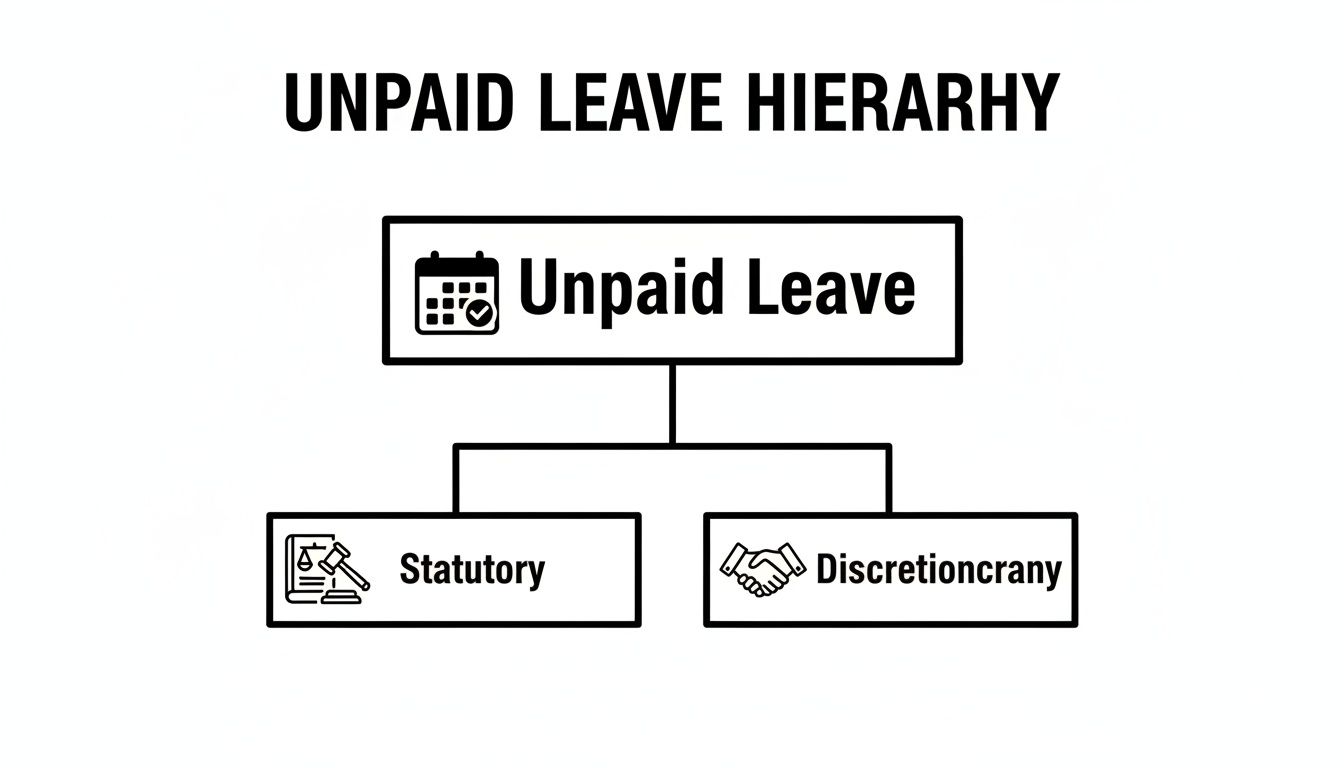
As you can see, it's a straightforward split. Understanding which category a request falls into is the foundational concept for managing any kind of leave.
To make it even clearer, here's a quick side-by-side comparison.
Statutory vs Discretionary Unpaid Leave at a Glance
| Feature | Statutory Unpaid Leave | Discretionary Unpaid Leave |
|---|---|---|
| Legal Status | A legal entitlement for eligible employees. | Granted at the employer's discretion. |
| Obligation | Employers are legally required to grant it. | No legal obligation to grant it. |
| Examples | Time off for dependants, unpaid parental leave, jury service. | Sabbaticals, extended holidays, career breaks, study leave. |
| Refusal | Cannot be refused if the employee meets the legal criteria. | Can be refused based on business needs and company policy. |
| Policy Role | Policy outlines the process but must meet legal minimums. | Policy dictates the rules, eligibility, and process entirely. |
This table shows that while one is a matter of law, the other is a matter of company culture and policy. Getting both right is key.
Why a Clear Policy Is Essential
A solid unpaid leave policy isn't just more admin. It's a vital tool for managing your team fairly and protecting your business from risk. It creates consistency, stops any accusations of favouritism, and makes the whole process clear for you and your staff. Winging it is a recipe for disaster, leading to inconsistent decisions that can kill morale or, even worse, land you in legal hot water.
The reality is, unplanned absences hit small businesses hard. The latest figures show that economic inactivity due to long-term sickness—which often includes long periods of unpaid leave in the UK—now affects a staggering 2.8 million people. For a small business trying to manage its resources, this creates a huge and constant staffing challenge.
By setting out clear guidelines, you take unpaid leave from being a potential headache and turn it into a managed, structured part of how you support your employees. It lets you balance the needs of your team with the demands of the business, building a culture of trust and respect along the way.
Navigating Your Legal Duties with Statutory Leave
When an employee asks for time off, your very first job is to figure out if their request falls under a statutory right. This isn't the same as discretionary leave, which is all down to your company's own policies and goodwill. Statutory leave is a legal must-do.
Think of it as the baseline of support you’re legally required to provide, all set out in UK employment law.
These rights exist to help people handle specific, often stressful, life events without the added worry of losing their job. As an employer, you need to know these rights inside out, recognise when a request fits the bill, and manage it by the book. Get it wrong, and you could be facing serious legal trouble, including a trip to an employment tribunal.
Time Off for Dependants
This is probably the most common type of statutory unpaid leave you'll come across. It gives an employee the right to take a reasonable amount of time off to deal with an unforeseen emergency involving someone who depends on them.
So, who counts as a dependant? It could be their spouse, partner, child, or parent. It also covers anyone who lives in the same house (but not a lodger or tenant) or someone who genuinely relies on them for help when things go wrong.
The crucial word here is "emergency". This leave is for the unexpected curveballs life throws, not for things you can plan for.
- What counts as an emergency? A dependant suddenly falling ill or getting injured. It could also be an unexpected collapse in care arrangements, like the childminder calling in sick at the last minute.
- What doesn't count? A routine hospital appointment scheduled weeks ago or wanting to watch a school play. Those are foreseeable events that should be booked as annual leave or managed in another way.
There's no hard-and-fast rule on how much time someone can take. The law just says the time off has to be "reasonable" for the specific situation. In most cases, this means a day or two to sort out the immediate crisis and put longer-term plans in place.
The whole point of Time Off for Dependants is to act as a short-term safety net. It’s about giving an employee the breathing space to handle an urgent problem, not to provide the care themselves long-term. For example, it covers taking a sick child to the doctor, but not staying home with them for the next week.
Unpaid Parental Leave
This one often gets muddled up with Shared Parental Leave or Maternity/Paternity Leave, which are typically paid. Unpaid Parental Leave is a completely separate right for employees to take time off to look after their child’s welfare.
To qualify, an employee needs to have been with your company for at least a year and have parental responsibility for a child who is under 18. This includes birth parents, adoptive parents, and anyone with formal parental responsibility.
Here’s how it breaks down:
- Entitlement: Eligible employees can take up to 18 weeks of unpaid leave for each child before their 18th birthday.
- Usage: The leave has to be taken in blocks of one full week. The only time this is different is if the child is disabled, in which case it can be taken a day at a time.
- Annual Limit: An employee can take a maximum of four weeks of leave for any one child in a single year.
- Notice Period: Your employee must give you at least 21 days’ notice before they plan to start their leave.
Now, while you can't outright refuse a valid request for Unpaid Parental Leave, you can postpone it for up to six months if their absence would seriously disrupt the business. If you need to do this, you must talk it over with the employee and give them the new dates in writing within seven days.
For a closer look at these obligations, our guide on complying with employment laws is a great resource.
Leave for Public Duties
Beyond family needs, employees also have a statutory right to take unpaid time off for certain civic duties. This is to make sure people can play a part in public life without it costing them their job.
The most common examples you'll see are:
- Jury Service: You are not legally required to pay an employee while they're on jury service, but you absolutely must let them have the time off. They can claim an allowance for loss of earnings directly from the court.
- Being a Magistrate: This is also known as a Justice of the Peace.
- Local Councillor Duties: This covers attending council meetings or carrying out other official functions tied to their role.
The amount of time off granted has to be reasonable for the circumstances. Handling these requests properly not only fulfils your legal duty but also shows you support your employees' contributions to the wider community.
Getting Strategic With Discretionary Leave
Once you’ve covered the legal bases, you step into the world of discretionary leave. This is where your company culture really shows its colours. It’s the difference between what the law says you have to do and what you choose to do for your people.
Think of it this way: managing requests for things like sabbaticals or extra compassionate leave isn't just an admin task. It’s a powerful way to show your team you see them as human beings with lives outside of work. Get this right, and you'll build a level of loyalty and support that a pay rise alone can't buy. Let's look at how to handle these common requests in a way that works for everyone.
Compassionate and Bereavement Leave
While the statutory "Time Off for Dependants" covers the initial emergency when someone passes away, it was never designed for the grieving process that follows. Apart from the specific Parental Bereavement Leave for parents who lose a child under 18, there's no legal right to further time off in the UK. This means any extra time is entirely up to you.
This is, without a doubt, one of the most sensitive situations you'll ever navigate as a manager. Trying to make decisions on the fly when an employee is going through a terrible time is a recipe for disaster. A clear, humane, and supportive policy is non-negotiable. Without one, you risk making inconsistent calls that can seriously damage morale and trust.
A solid compassionate leave policy should cover a few key things:
- Who it’s for: Be clear about the scope. Does it cover the death of a close family member? A partner? This clarity ensures everyone is treated fairly.
- What to expect: Outline a typical amount of unpaid time off, maybe up to five days, but build in flexibility for individual circumstances.
- How it works: Keep the process simple. Explain who the employee needs to contact, and make it clear there won't be a mountain of paperwork. The last thing a grieving team member needs is to battle with bureaucracy.
Putting these guidelines in place removes the guesswork and ensures everyone is treated with dignity when they need it most.
Sabbaticals and Career Breaks
In a working world where burnout feels like a constant risk, offering sabbaticals is becoming a real game-changer. It's a form of extended unpaid leave that gives a long-serving employee the chance to step away for a set period—say, three to twelve months—to travel, study, or chase a personal goal.
Don't see a sabbatical as a cost; see it as an investment in your best people. You’re giving them a chance to recharge their batteries, and they often return with fresh ideas, new skills, and a renewed sense of purpose that directly benefits your business.
Offering a career break sends a powerful message. It tells your team that you value their long-term health and contribution more than just their short-term presence at a desk. That's how you hold onto great, experienced staff.
To make this work, you need a clear policy that specifies:
- Who is eligible (e.g., a minimum service length, often five years or more).
- How to apply and the notice period you need.
- The terms of the break, like how their role will be covered and the agreement for their return.
Extended Holidays and Personal Projects
It’s becoming more and more common for employees to ask for unpaid leave for a once-in-a-lifetime trip or to dedicate time to a personal passion project. You're not legally obliged to say yes, but a blanket "no" policy can make you seem inflexible and might just push a great employee to find an employer who is.
The key is to handle these requests fairly by balancing the employee’s wishes with what the business can realistically handle. A good way to assess these requests is to ask three simple questions:
- Can we realistically cover their work? Think about the impact on the team, ongoing projects, and your clients.
- How much notice did they give? The more warning you have, the easier it is to plan around their absence.
- What’s their track record like? This can be a fair and transparent way to reward your most committed team members.
By using a consistent set of criteria for every request, you can make decisions that are fair without setting a precedent you can't maintain. And if you do have to say no, always explain your reasoning clearly. It shows the decision was based on business needs, not personal preference, which goes a long way in keeping that relationship positive.
How to Build a Fair and Compliant Unpaid Leave Policy
Moving from handling unpaid leave requests on the fly to establishing a formal policy is a massive step up for any small business. A written policy isn't just about creating more paperwork; it's your blueprint for fairness. It ensures every request is handled with the same logic, every time, protecting you from claims of favouritism while giving your employees total clarity on where they stand.
When you create a policy, you're forced to think through your approach before you're put on the spot by a tricky request. It's how you balance the real-world operational needs of your business with creating a supportive, flexible culture. Without one, you're basically improvising, which is a recipe for inconsistent decisions, damaged morale, and even serious legal risks. A solid policy is your best line of defence.
Think of the policy as the single source of truth for managers and staff alike. It's about building a system that’s transparent and predictable for everyone, making sure the rules for unpaid leave in the UK are applied correctly, every single time.
Core Components of Your Policy
A strong unpaid leave policy doesn't need to be a fifty-page legal epic. It just needs to be clear, cover all the bases, and stamp out any chance of confusion down the line.
Here’s what you absolutely must include to build a solid foundation:
- Policy Statement and Scope: Kick things off with a simple sentence explaining what the policy is for. Be crystal clear about which types of leave it covers (both statutory and discretionary) and who it applies to (e.g., all permanent staff who have passed their probation period).
- Eligibility Criteria: Spell out exactly who can apply for what. For statutory leave like Unpaid Parental Leave, this will just mirror the legal requirements (like one year of service). But for your own discretionary leave, such as sabbaticals, you get to set the rules (maybe five years of continuous service, for example).
- Request and Approval Process: This is the nuts-and-bolts section. Map out the exact, step-by-step journey for an employee making a request. Who do they send it to? What format should it be in? How long will they wait for an answer? No guesswork allowed.
Essential Elements of an Unpaid Leave Policy
To make sure your policy is airtight, you need to include several key components. This table breaks down the essentials, explaining why they matter and giving you a starting point for your own wording.
| Policy Component | Key Considerations | Example Wording Snippet |
|---|---|---|
| Statement & Scope | Clearly define the policy's purpose and who it applies to. Mention both statutory and discretionary leave. | "This policy outlines the framework for requesting and managing all forms of unpaid leave for permanent, full-time and part-time employees." |
| Eligibility Rules | Specify criteria for each leave type (e.g., length of service). Differentiate between legal minimums and company rules. | "To be eligible for a discretionary sabbatical, employees must have a minimum of 5 years of continuous service with the company." |
| Request Process | Detail the step-by-step process: how to apply, who to notify, and what format to use (e.g., HR software, email). | "All requests for unpaid leave must be submitted via the company's HR portal at least 21 days prior to the requested start date." |
| Notice Periods | Define how much notice is required for different leave types to allow for proper planning and cover. | "For discretionary leave exceeding 10 working days, a minimum of 3 months' notice is required." |
| Documentation | State what evidence, if any, is needed to support a request (e.g., jury summons, dependant's medical note). | "A copy of the official jury duty summons must be provided to your line manager at the time of the request." |
| Impact on Benefits | Be transparent about how extended leave affects holiday accrual, pension contributions, and other perks. | "During unpaid leave, statutory holiday entitlement will continue to accrue, but company pension contributions will be paused." |
Having these elements clearly defined in writing leaves no room for error or misunderstanding, protecting both the employee and the business.
Defining Notice Periods and Documentation
Clarity is king. Your policy absolutely must specify the notice periods for different leave types, as this is your lifeline for resource planning.
For instance, statutory unpaid parental leave legally requires 21 days' notice. But for a discretionary request like an extended trip, you might ask for three months' notice to give yourself enough time to arrange cover. You also need to be explicit about what documentation is needed. It could be a court summons for jury service or a simple written proposal for a sabbatical.
Your policy must also tackle the impact on benefits. It's crucial to explain how extended unpaid leave affects things like holiday accrual, pension contributions, and other perks. Being upfront prevents nasty surprises and arguments later on.
Automation: The Key to Consistency
Creating the policy is step one. Applying it consistently is the real challenge. Trying to track everything on spreadsheets is a recipe for human error and inconsistency, especially as you grow. This is where automation is a total game-changer.
A modern leave management system lets you build your policy rules directly into the software. The system then automatically enforces your eligibility criteria, notice periods, and leave limits. It guarantees every single request is handled by the same logic, removing unconscious bias and admin mistakes from the picture.
For a broader framework to document all your HR policies, consider the value of creating a robust employee handbook. Putting everything in writing is how you protect your business and properly support your team. And for more specific help, check out our UK employee leave policy template for some inspiration.
The True Cost of Unmanaged Unpaid Leave
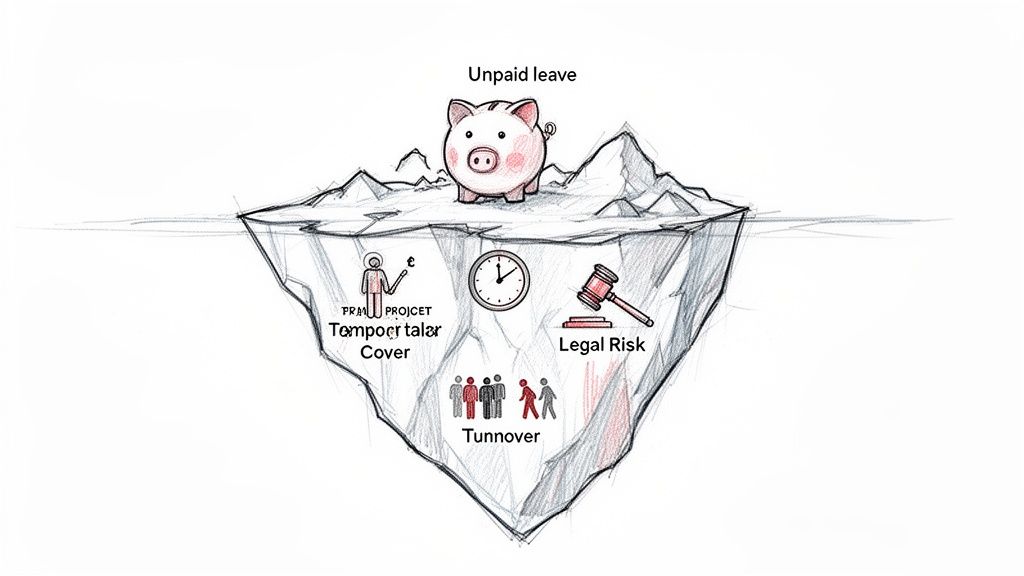
On the surface, unpaid leave sounds like a win for a small business. After all, if an employee is off, you’re not paying their salary. Simple, right? But this is one of the most dangerous misconceptions a business owner can have. The real cost of unmanaged leave goes far beyond the payroll, creating hidden financial drains that can quietly undermine your entire operation.
Thinking unpaid leave has no cost is like assuming a burst pipe is free because you're not paying for the water gushing out. The real expense comes from the widespread damage it causes—to your productivity, your team’s morale, and ultimately, your bottom line. Every unexpected or poorly handled absence creates a ripple effect, and you end up footing the bill one way or another.
The Immediate Financial Hits
When a team member is unexpectedly away, the most obvious problem is the work that simply isn’t getting done. This productivity gap is the first direct hit to your finances. Projects stall, deadlines start to slip, and customer service can take a nosedive, kicking off a chain reaction that can damage client relationships and future income.
If the absence drags on, you might be forced to bring in temporary cover. Hiring a temp is never a cheap fix. You’ve got agency fees to contend with, their hourly rate (which is often higher than a permanent employee’s), and the unseen cost of the time your team spends getting them up to speed.
These direct costs stack up alarmingly fast:
- Lost Productivity: Unfinished tasks have a knock-on effect, impacting the whole team's output and pushing project timelines into the red.
- Temporary Staff Costs: Agency fees and premium rates for short-term cover can blow a hole in your budget.
- Overtime Pay: Your remaining staff might have to work extra hours just to keep things afloat, leading to burnout and a much higher wage bill.
The Ripple Effect on Your Team and Brand
But the financial damage doesn't stop with the obvious expenses. Inconsistent or poorly managed unpaid leave in the UK creates deeper, more corrosive problems that are far more expensive in the long run. When leave is handled on a case-by-case basis without a clear policy, it’s a breeding ground for resentment and kills morale.
Employees who see one colleague granted leave while another is denied for a similar reason will quickly feel undervalued. This perceived unfairness leads to disengagement, a drop in motivation, and ultimately, a higher staff turnover. And as any small business owner knows, replacing a valued employee is one of the biggest and most disruptive costs you can face.
The most significant costs are often the ones you can't see on a balance sheet. A damaged employer brand, plummeting team morale, and the risk of a discrimination claim are all expensive consequences of simply 'winging it' with leave requests.
This isn’t just a hypothetical problem; it’s becoming more critical. In the UK, sickness absence rates hit a 15-year high by 2024—a staggering 50% increase from 2019. For small businesses, where replacing an employee lost to ill-health can cost over £11,000 on average, the pressure is immense. This figure doesn't even touch on presenteeism, which adds the equivalent of four to nine lost productive days per employee annually through reduced focus and spreading illness around the office. You can dig into more of these insights in the UK government's final report on keeping Britain working.
Building the Business Case for a System
When you add it all up—the lost output, temp cover, overtime, recruitment costs, and the looming threat of legal challenges—the idea that unpaid leave is "free" is completely busted. Every poorly handled absence is a direct hit to your business's financial health and its stability.
This is precisely why having a structured, systematic approach isn't a luxury; it's a necessity. By putting a clear policy in place and using a proper leave management system, you transform absence management from a reactive, high-risk headache into a controlled, predictable process. This doesn't just save you money. It protects your company culture, supports your team, and builds a far more resilient business for the future.
Your Unpaid Leave Questions Answered
Even with a solid policy in your back pocket, real-world situations are rarely straightforward. Tricky scenarios will inevitably pop up.
This section tackles the most common—and often challenging—questions we see small business owners and HR managers grapple with when it comes to unpaid leave. We'll give you clear, practical answers to help you handle these moments with confidence.
Can an Employee Take Unpaid Leave for a Pre-Booked Holiday?
This one comes up a lot, especially when an employee has already burned through their paid holiday allowance but has a trip planned.
The simple answer? There's no automatic legal right to unpaid time off for a holiday. This kind of request falls squarely into the discretionary leave category. That means the ball is in your court.
Your decision should be guided by your company policy and what the business can handle at that moment. It's a balancing act. You have to weigh the impact on the business against the employee's desire for a break. A blanket "no" can really dent morale, but always saying "yes" might set a precedent you can't sustain.
To keep things fair, run every request through a consistent set of criteria:
- Business Impact: Can the team genuinely manage the workload without this person?
- Notice Given: Did they ask far enough in advance for you to plan cover?
- Timing: Does the request clash with your busiest season or a major deadline?
Whatever you decide, clear communication is key. If you approve it, get it in writing. If you have to say no, explain your reasoning based on business needs. It shows the decision wasn't personal and helps maintain a good working relationship.
Does Holiday Entitlement Accrue During Unpaid Leave?
This is a critical one for getting your payroll right, and the answer hinges entirely on the type of leave being taken.
When an employee is on a period of statutory leave—like Unpaid Parental Leave or maternity leave—their contract of employment technically continues. This means their statutory holiday entitlement of 5.6 weeks per year keeps building up, just as if they were still at work.
But for longer stretches of discretionary unpaid leave, like a sabbatical, the rules can change. Here, it all comes down to what's written in the employee's contract or your specific sabbatical policy. It is absolutely vital to have this documented clearly to sidestep any arguments later on.
Key Takeaway: For statutory unpaid leave, holiday pay keeps accruing. For discretionary leave, it depends on the terms you've agreed in the employment contract or leave policy.
How Do We Handle Frequent Unpaid Leave Requests from One Person?
When the same employee keeps asking for unpaid time off, it can feel like a headache. But it's often a sign that something bigger is going on, and it calls for a more thoughtful approach than just a simple yes or no.
Instead of reacting to each request as it comes, it's a good idea to open up a supportive conversation to find out what's really happening.
The frequent need for time off might be linked to an ongoing personal issue, like caring for a family member or a persistent health problem. The 2021 Census, for instance, revealed that nearly one in ten people in England—a staggering 4.7 million individuals—provide unpaid care for a loved one. That’s a situation that almost always leads to repeated absence requests.
Start by arranging a private, informal chat. The goal isn't to discipline, but to listen and explore solutions together. You might discuss things like:
- Exploring flexible working arrangements.
- A temporary reduction in hours.
- Pointing them towards relevant support services or employee assistance programmes.
If the absences aren't related to a protected characteristic and are genuinely causing major disruption, you may eventually have to enforce your policy more strictly. But the first step should always be a supportive one, balancing empathy with your business needs.
Can We Refuse a Request for Statutory Unpaid Leave?
The short answer is no—you can't just refuse an eligible employee's right to take statutory unpaid leave.
If an employee meets the legal criteria for something like Time Off for Dependants or Unpaid Parental Leave, they are legally entitled to take it. Penalising them for doing so is a fast track to an employment tribunal claim.
However, there's a crucial difference between refusing and postponing.
While you can't deny the right to the leave itself, the law does allow you to postpone Unpaid Parental Leave for up to six months, but only under very specific circumstances. You can only do this if you have a genuine belief that the employee's absence would cause serious disruption to the business.
If you do need to postpone the leave, you must discuss it with the employee, provide a written explanation within seven days of their original request, and suggest new dates for them to take it. This ensures you're acting within the law while still protecting your operations.