
Taking time off work for family reasons in the UK is a statutory right, there to help you juggle your professional life with your personal responsibilities. These rights cover everything from unexpected emergencies, like a sick child needing to be picked up from school, to happier, planned events like the birth of a baby.
Getting your head around the different types of leave available is the first, most important step to handling these situations without any added stress.
Understanding Your Rights to Family Leave

Figuring out your rights to family leave can feel a bit like trying to solve a puzzle without the picture on the box. UK law gives you a solid framework of support, but it's usually a mix of what's legally required and what your specific company offers. Your first job is to understand the basic building blocks.
Think of your leave options as a toolkit. You've got different tools for different jobs. Some are for those sudden, out-of-the-blue events, while others are for longer periods you can plan for. Each one has its own rules, purpose, and impact on your pay packet.
To give you a clearer picture, here’s a quick rundown of the main types of statutory leave you'll come across.
Quick Guide to UK Family-Related Leave
This table breaks down the most common types of leave, what they're for, and what you're generally entitled to by law.
| Type of Leave | Primary Purpose | Statutory Entitlement (Typical) |
|---|---|---|
| Maternity Leave | For pregnant employees to take time off for childbirth and to recover and bond with their new baby. | Up to 52 weeks. |
| Paternity Leave | For partners to take time off to support the mother and bond with their new baby. | 1 or 2 consecutive weeks. |
| Shared Parental Leave | Allows eligible parents to share up to 50 weeks of leave and 37 weeks of pay. | Up to 50 weeks. |
| Adoption Leave | For employees adopting a child, providing time to bond and settle in as a new family. | Up to 52 weeks. |
| Dependants' Leave | For dealing with an unforeseen emergency or problem involving a dependant. | A ‘reasonable’ amount of unpaid time. |
Remember, this is just the statutory minimum. Your employer might offer more generous terms, so it's always worth checking your contract.
The Core Types of Family Leave
At its heart, leave for family reasons falls into a few key categories. The one most people run into is time off for sudden emergencies involving a dependant. This is what we're usually talking about when we say we need a day off because a child is sick or an elderly parent has had a fall.
For a deeper dive into this specific right, you can learn more here: https://www.leavewizard.com/what-is-dependants-leave/. Understanding this is vital for handling life's curveballs without putting your job at risk.
Another major category is parental leave, which is all about welcoming a new child into your family. This includes:
- Maternity and Paternity Leave: The traditional leave for new mothers and fathers.
- Shared Parental Leave: A flexible system that lets parents share the time off between them.
- Adoption Leave: Similar rights for parents who are adopting.
As you get ready for this exciting new chapter, practical guides can be a lifesaver. Preparing for a baby is about more than just paperwork; resources on first-time mum essentials can be a huge help.
Paid vs Unpaid Time Off
One of the most important things to get straight is the difference between paid and unpaid leave. Honestly, this is often the deciding factor in how much time you can realistically afford to take.
Statutory leave does not always mean paid leave. While some entitlements like Statutory Maternity Pay provide a basic income, others, such as time off for a dependant's emergency, are fundamentally unpaid rights.
Your employer might offer better terms than the legal minimum. Company policies on things like "compassionate leave" can vary wildly. Some businesses will offer a set number of paid days for a bereavement or serious family illness, while others will only grant unpaid time.
Always, always check your employment contract or staff handbook. That's your source of truth for what your company provides beyond the legal baseline.
A Practical Guide to UK Parental Leave

When you're expecting a new addition to your family, getting your head around your leave entitlements is a huge part of the planning. The law in the UK provides a safety net for parents to take crucial time off, but let's be honest—the details of Maternity, Paternity, and Shared Parental Leave can feel like a maze.
So, let's cut through the jargon. We'll follow an imaginary couple, Sarah and Tom, as they figure out the best way to manage their time and finances after their baby arrives. Their journey should help make sense of the real-world choices and hurdles many new parents face when planning their time off work for family reasons.
Maternity Leave: The Foundation For New Mums
For Sarah, everything starts with Statutory Maternity Leave. The good news is that this is a day-one right, meaning she’s entitled to it from the moment she starts a new job. The total leave available is up to 52 weeks, which is usually broken down into two halves:
- Ordinary Maternity Leave: The first 26 weeks.
- Additional Maternity Leave: The final 26 weeks.
Legally, Sarah has to take at least two weeks of leave right after the baby is born (this goes up to four weeks if she works in a factory). But while the time off is guaranteed, the pay is a different story.
Statutory Maternity Pay (SMP) is paid for up to 39 weeks. For the first six weeks, it's set at 90% of her average weekly earnings. After that, it drops to a standard flat rate for the next 33 weeks (or 90% of her earnings, whichever is lower). This drop-off is a massive financial hurdle for many families and a key reason why lots of mums, despite the 52-week entitlement, head back to work sooner.
Paternity Leave: A Short But Vital Break
Now, what about Tom? As the father, he’s entitled to Statutory Paternity Leave. He can choose to take either one or two consecutive weeks of leave, but it must be taken within 56 days of the birth. This time is designed to let him support Sarah and, crucially, bond with his new baby.
Here's the sticking point for many UK families, though: the pay. Paternity leave in the UK is among the least generous in Europe. Fathers are entitled to just two weeks off, and the statutory pay is a mere 44% of the National Living Wage for someone working a 35-hour week.
It’s no surprise, then, that for many families like Sarah and Tom's, even taking the full two weeks isn't financially realistic. This forces a tough choice between precious time with a newborn and keeping the household afloat.
Shared Parental Leave: Flexible But Complicated
This is where things get a bit more interesting—and a lot more complex. Shared Parental Leave (SPL) was brought in to give parents more flexibility. It allows Sarah to cut her maternity leave short and share the remaining leave and pay with Tom.
Together, they can share up to 50 weeks of leave and up to 37 weeks of statutory pay. The real benefit is how they can take it. They can take it in separate blocks, or even be off at the same time.
For example, Sarah could take the first 20 weeks of maternity leave. Then, she and Tom could take the next 10 weeks off together to find their feet as a family. After that, Tom could go back to work while Sarah uses up the rest of the available leave.
It sounds great in theory, but in practice, the system is so complicated that uptake has been incredibly low. On top of the low statutory pay rate, parents have to meet very specific criteria and give their employers a series of complex notices, which can be a real headache. For a deeper dive into the various leave types, check out our guide on https://www.leavewizard.com/what-you-need-to-know-about-unpaid-and-paid-parental-leave/.
Navigating these early months isn't just about logistics and finances; it's also about emotional wellbeing. For parents on this journey, finding practical advice is key. This article provides some really useful effective strategies for parents and caregivers to prioritise children's mental health, a vital part of building a happy family.
The Reality Check on Parental Leave
Having a policy on paper is one thing. Seeing how it actually works for real families? That’s a completely different story. While the UK offers various ways for parents to take time off work for family reasons, the stats show a massive gap between what people are entitled to and what they actually use. This isn't just bad luck; it's a reality shaped by money worries, confusing rules, and workplace cultures that haven't quite caught up.
To really get to grips with this, you have to look beyond the policy documents. Well-intentioned schemes designed to create more equality at home often miss the mark. It’s not for a lack of trying, but because they run smack into the practical, day-to-day barriers that families can't ignore.
The Shared Parental Leave Puzzle
A classic example of this is the shockingly low take-up of Shared Parental Leave (SPL). When it was introduced, the idea was to give families more choice and get more dads involved in the early days of childcare. A great ambition. But the numbers tell us it's an opportunity very few people are grabbing.
The scheme allows parents to share up to 50 weeks of leave, but a recent government evaluation found that only a tiny 5% of eligible fathers actually used it. It’s a sobering figure. Paternity Leave does a bit better, with about one in three eligible fathers taking it, but even then, money is the number one reason dads either skip leave or cut it short. Throw in a system that many have called overly complex, and you’ve got a recipe for low engagement. For a deeper dive into the government's findings, you can get more insights on parental leave policies.
This is where planning becomes so important. A smooth handover at work can make the decision to take leave much less stressful for everyone involved.
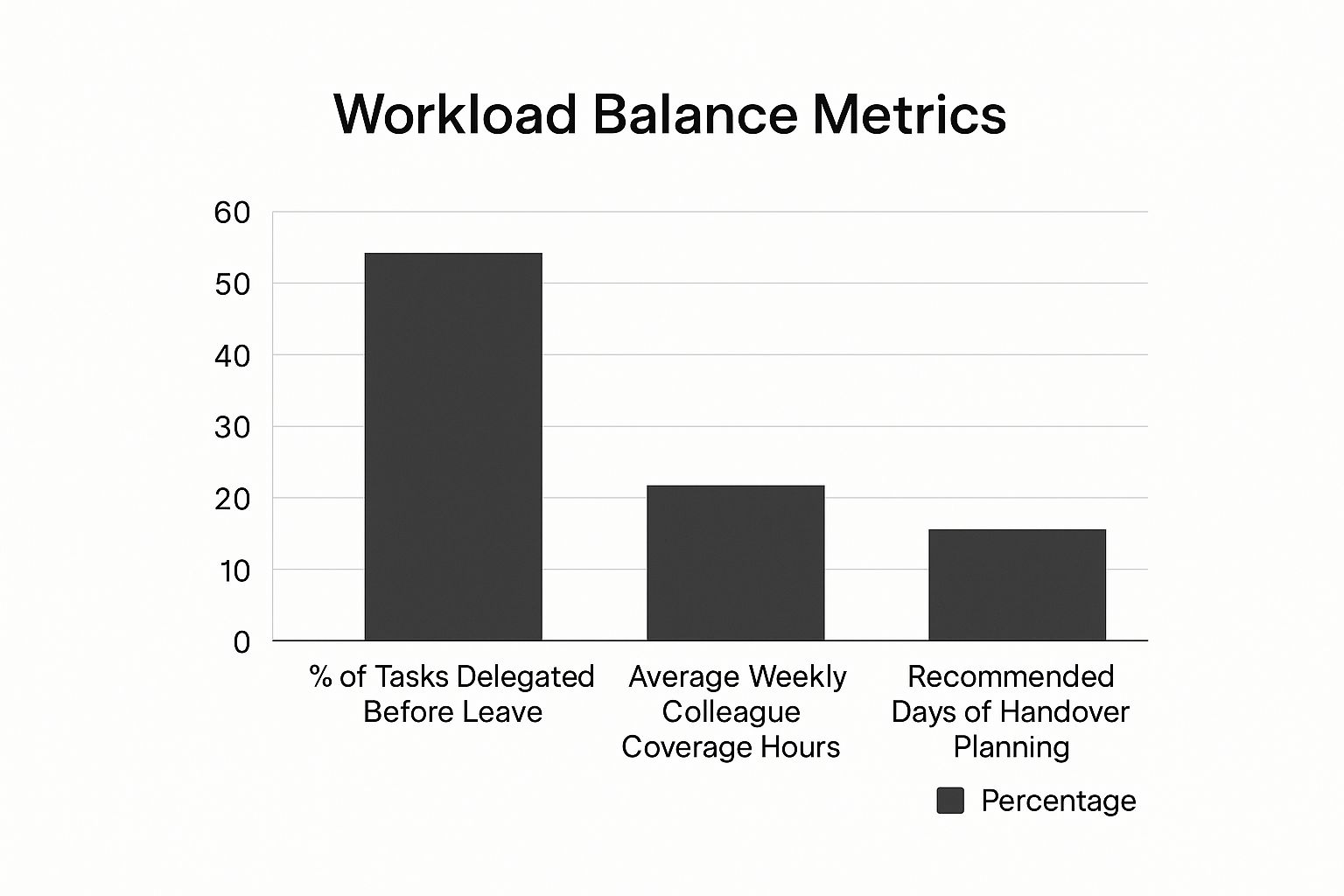
As you can see, thinking ahead about delegating tasks and arranging cover isn’t just good practice—it’s essential for making extended family leave work without causing chaos back at the office.
Financial and Cultural Hurdles
So, why are the numbers so low? It almost always comes down to money. The statutory pay for SPL is the same low flat rate you get for Statutory Maternity and Paternity Pay. If one partner—often the father—is the higher earner, the family simply can't take that kind of financial hit.
This financial reality quietly pushes families back into traditional gender roles. A couple might genuinely want to split caring duties down the middle, but the economic penalty makes it a non-starter. It creates a cycle: mothers end up taking most of the leave because it makes financial sense, which in turn reinforces the cultural idea that childcare is mainly a woman's job.
"The decision to take parental leave often boils down to a simple calculation: can we afford it? Until the financial support for fathers and partners matches the ambition of the policy, we will continue to see a stark gender divide in who takes time off."
And this isn't just a private issue for families to sort out. It has a real, lasting impact on women’s career progression, the gender pay gap, and the push for genuine equality in the workplace.
How The UK Stacks Up Globally
When you look at how other countries handle this, the picture becomes even clearer. Many of our European neighbours offer more generous, non-transferable leave specifically for fathers, and they often pay it at a much higher rate. It makes a world of difference.
- Sweden: A pioneer in this space, Sweden reserves 90 days of well-paid leave exclusively for each parent.
- Spain: Offers a generous 16 weeks of paternity leave, paid at 100% of earnings—exactly the same as the mother's entitlement.
- Portugal: Actually makes a portion of the father's leave compulsory.
These "use it or lose it" approaches have been incredibly effective at getting more dads to take leave. By making it well-paid and just a normal part of working life, they break down the financial and cultural barriers we still struggle with in the UK.
A quick look at the average leave taken shows just how different the outcomes can be.
Parental Leave Duration UK vs US Mothers vs Fathers
The table below offers a snapshot of how leave duration plays out for mothers and fathers in the UK and US, highlighting the different patterns shaped by policy and culture.
| Parent | Average Leave Duration UK | Average Leave Duration US |
|---|---|---|
| Mothers | 39 weeks | 10 weeks |
| Fathers | 2 weeks | 1 week |
While the UK offers significantly more time for mothers compared to the US, the disparity between mothers' and fathers' leave in both countries is stark. It underscores how policy can create very different realities for families.
Ultimately, the international view shows us that while flexible policies are a great start, they just aren't enough on their own. To really move the needle, leave has to be financially realistic and culturally accepted. Only then will taking time off work for family reasons become a genuine choice for everyone, not just a theoretical one.
How to Request Time Off Professionally

Knowing your legal rights is one thing, but asking for the time you need is another. Getting this part right is less about quoting employment law and more about having a clear, respectful, and practical conversation with your manager.
Think of it as building a bridge between your family needs and your work duties. A good request ensures everything runs smoothly for you, your manager, and the rest of your team, keeping working relationships strong and avoiding any mix-ups.
Start by Reviewing Your Company's Policy
Before you even open an email or book a meeting room, your first stop should always be your company's own rulebook. Dig out the employee handbook or search the company intranet for anything related to leave, absence, or time off policies.
This document is your specific instruction manual. It will tell you:
- Who to notify: Is it your direct line manager, someone in HR, or both?
- The required notice period: How much of a heads-up do they need for planned time off?
- The correct procedure: Is there a form you need to fill in or an online portal to use?
- Company-specific benefits: Does your employer offer better pay or extra days beyond the legal minimum?
Getting familiar with these details shows you respect the company's process. It also helps you put together a request that’s much more likely to get a quick and easy approval.
Choose the Right Time and Method
When it comes to asking, timing is everything. For planned leave, like for a dependant's scheduled operation, try to give as much notice as you possibly can. This gives your manager a fair chance to arrange cover and manage the team's workload, which positions you as a thoughtful and organised team player.
Of course, family emergencies don't stick to a schedule. If you get a call that your child is sick and you have to leave immediately, the goal is to communicate clearly and quickly. A phone call is almost always better than an email that might sit unread for hours.
Key takeaway: The method should match the urgency. Planned, long-term leave deserves a formal, written request. A sudden emergency needs immediate, direct contact.
Crafting a Clear and Concise Request
When you write down your request, keep it clear and professional. You want to avoid overly emotional language or vague statements. The aim is to give your manager just enough information to understand the situation, without you having to share personal details you'd rather keep private.
Your request should always cover these three things:
- The reason for the leave (briefly): You don't need to give a full medical history. A simple "for a family medical appointment" or "to handle an emergency with a dependant" is perfectly fine.
- The dates you need off: Be specific. Give the exact start date and the date you expect to be back.
- A brief note on your work: A simple sentence like, "I will make sure my urgent tasks are handled before I go," shows you're being responsible and reassures your manager.
Example Request Template for Planned Leave
Here’s a simple template you can adapt for any non-urgent request.
Subject: Time Off Request – [Your Name]
Dear [Manager's Name],
I'm writing to request time off from [Start Date] to [End Date] to handle a family matter. In total, I will need [Number] days away from the office.
I've already started organising my workload to ensure a smooth handover. All my key projects will be in a good place before my leave begins, and I will prepare a detailed handover note for the team.
Please let me know if you need any other information.
Thank you for your understanding.
Best regards,
[Your Name]
This template gets straight to the point professionally and shows you're thinking about the team's needs as well as your own. When you approach the conversation with this kind of clarity and consideration, you make it easy for your employer to say yes and give you the support you need.
Planning a Smooth Handover and Return to Work
Taking time off work for family reasons shouldn’t feel like you’re defusing a bomb. A successful leave period really comes down to smooth transitions—both when you leave and when you come back. A bit of planning ahead is the key to minimising stress for you and your colleagues.
Think of it like passing a baton in a relay race. A sloppy handover means the next runner fumbles and loses momentum. But a clean, well-practised pass? That keeps the team moving forward without a hitch. Your goal is to create that seamless transition so your team feels empowered, not abandoned.
Creating an Effective Handover Document
Your handover document is the most critical tool you've got for a smooth departure. It's essentially a user manual for your job while you’re away, giving your colleagues everything they need to keep things on track. A great handover doesn't just list tasks; it provides the why behind them.
Start by organising your responsibilities into clear, simple categories. For each one, fill in the necessary details.
- Current Projects: Outline the status of each project, what the immediate next steps are, and flag any upcoming deadlines.
- Key Contacts: List the names, roles, and contact details for important clients, suppliers, or internal stakeholders they might need to speak with.
- Daily and Weekly Tasks: Detail your recurring duties, explaining the process and pointing them to where they can find relevant files or tools.
- Login Details and Access: Securely share any necessary passwords or explain how your cover can gain access to essential systems.
This document should be so clear that someone with just a basic understanding of your department could step in and manage the essentials without breaking a sweat.
A thorough handover is an act of professional courtesy. It shows respect for your colleagues' time and demonstrates your commitment to the team's success, even in your absence. This proactive approach helps maintain positive working relationships.
Setting Clear Boundaries for Your Leave
Once you're on leave, your priority is your family. To really protect this time, it’s vital to set clear communication boundaries before you head out. Have a frank chat with your manager about what constitutes a genuine emergency that warrants contacting you.
Agree on a preferred method of contact for these rare situations—perhaps a text message rather than a work email you’re trying to ignore. This manages everyone's expectations and prevents you from being pulled into minor issues that your team is perfectly capable of handling. It ensures your time off work for family reasons is truly restorative.
Managing Your Return to Work
Coming back to work after an extended period can feel overwhelming. The goal isn't to catch up on everything in one day, but to reintegrate smoothly and strategically. Ease yourself back in with a structured approach.
-
Schedule a Catch-Up Meeting: On your first day back, book a brief meeting with your manager and the colleague(s) who covered for you. It’s the quickest way to get up to speed on major developments.
-
Triage Your Inbox: Don't just start at the top and work your way down. Skim for urgent messages from key people first, flag items for later, and archive anything that's already been resolved.
-
Recalibrate Your Workload: It's likely that priorities have shifted while you were away. Work with your manager to review your tasks and create a realistic plan for the first couple of weeks back.
Coming back to the workplace often involves a formal process to ensure everything is in order. To better understand this final step, check out our return to work interview guide for proven strategies that can help make your re-entry a success. By planning your return with the same care as your departure, you ensure a positive and productive transition back into your role.
Your Top Questions About Family Leave, Answered
When you’re trying to balance work with family life, things can get complicated. The rules around time off aren't always crystal clear, and real-life situations rarely fit into a neat little box. This section is here to cut through the confusion.
Think of it as your quick-reference guide. We’re going to tackle some of the most common—and often tricky—questions people have, giving you the clarity you need to handle these conversations with confidence.
Can My Boss Refuse Emergency Dependant Leave?
This is a big one, and thankfully, the answer is straightforward. No, your employer cannot refuse your right to take a reasonable amount of unpaid time off for a genuine dependant emergency. This isn't just good practice; it's a statutory right, meaning it’s baked into the law.
Now, there is a small catch. While they can't flatly deny your request, they are allowed to ask questions to make sure the situation is a true emergency. Your side of the bargain is to let them know what's happening as soon as you reasonably can.
What counts as a dependant emergency? It’s all about the unexpected. Think of a call from your child's school saying they're sick and need picking up, or an elderly parent having a fall. It's not meant for things you can plan for, like a routine hospital appointment.
Is Compassionate Leave Paid in the UK?
There’s a lot of confusion around compassionate leave, especially when it comes to pay. Here’s the critical thing to know: there is no statutory right to paid compassionate leave in the UK.
Whether or not you get paid is entirely down to your employer’s specific policy. Many businesses do offer a few paid days for difficult situations like a bereavement, but this is a contractual perk, not a legal requirement.
- Check Your Contract: The first place you should always look is your employment contract or the company handbook. It should lay out the company's stance on compassionate leave, including how long you can take and whether it's paid.
- Company Discretion: If nothing is written down, it often falls to your manager's discretion. Some companies will approve a few paid days on a case-by-case basis.
- Unpaid Leave: If your employer doesn’t offer paid compassionate leave, you should still be able to take the time off unpaid.
What's the Difference Between Parental Leave and Shared Parental Leave?
They sound almost the same, but these two types of leave are worlds apart. Getting the distinction right is vital for new parents trying to map out their time off.
Unpaid Parental Leave is a long-term option. It gives eligible parents the right to take up to 18 weeks of unpaid leave for each child, anytime up until their 18th birthday. You might use this to help settle a child into a new school or spend more time with them over the long summer holidays. It's usually capped at four weeks per child in any given year.
Shared Parental Leave (SPL), on the other hand, is all about flexibility in the first year after birth or adoption. It lets eligible parents share a pot of up to 50 weeks of leave and 37 weeks of statutory pay. This means parents can take time off together or tag-team, giving them far more options than traditional maternity and paternity leave.
Do I Need a Doctor's Note for Dependant Leave?
When you’re in the middle of a family emergency, the last thing you want to worry about is paperwork. The good news is that for dependant leave, you don’t usually need to provide formal proof like a doctor’s note the moment you call in. The law just asks that you tell your employer why you’re absent and roughly how long you think you’ll be gone.
Your employer is entitled to ask for a bit more detail later on to confirm the leave was necessary, but the emphasis is really on prompt and honest communication. A good relationship with your manager goes a long way here, helping these situations get handled smoothly and without any extra stress.
Why Is There Still a Gender Gap in Parental Leave?
Even with policies designed to create a more level playing field, a major gender gap remains when it comes to who takes time off for family. While things have shifted, the disparity is still stark. Recent data reveals that new mothers took between 10 and 11 weeks (about 74 days) of maternity leave. Fathers, in contrast, took an average of just 8.2 days of paternity leave—a steep drop from 16.5 days the previous year. This means fathers are taking only a fraction of the leave mothers do, even though statutory maternity leave can last up to 52 weeks (with 39 weeks paid). You can read more statistics on the state of annual leave.
So, what's driving this imbalance? It often boils down to two key issues:
- Financial Pressures: Statutory pay for paternity and shared parental leave can be a lot lower than a regular salary. This makes it a tough financial choice for many families, particularly if the father is the higher earner.
- Workplace Culture: Old habits die hard. Traditional expectations and worries about career progression can still discourage men from taking longer breaks, reinforcing outdated ideas about whose job it is to care for children.


