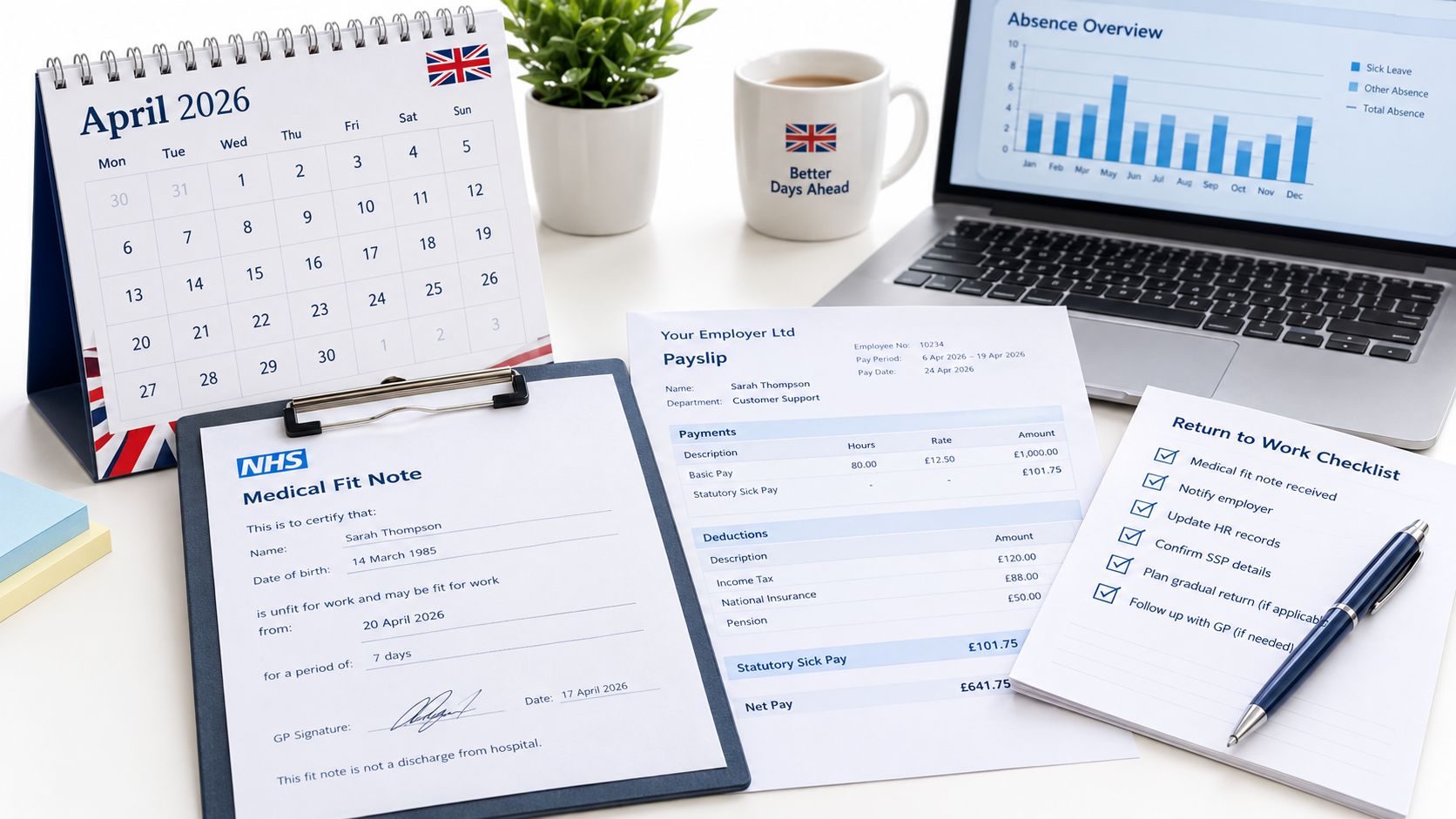
Sickness absence management is the formal process a company uses to handle employee absences due to illness or injury, from the first day off right through to their successful return to work. It’s not just about tracking sick days; it’s a supportive system designed to manage both short-term and long-term absences effectively, ensuring consistency, fairness, and legal compliance across the board.
What Is Sickness Absence Management
Think of sickness absence management as the complete rulebook for navigating employee health issues. It's not simply about logging days off. Instead, it’s the entire framework that supports an employee from the moment they report an illness to their smooth reintegration back into the workplace.
A robust system is built on a few key pillars. Without them, you risk inconsistency, legal headaches, and a breakdown in employee trust. The core of any good approach includes clear policies, open communication, and supportive return-to-work processes. For a deeper dive into the broader concept, you can learn more about absence management and its impact on your business.
Core Components of the Process
Effective sickness absence management can be broken down into three fundamental stages. Each one plays a crucial role in supporting employees and protecting the organisation.
- Prevention and Wellbeing: This is the proactive stage, all about creating a healthy work environment from the start. It involves initiatives like mental health support, ergonomic assessments, and flexible working arrangements to reduce the likelihood of illness in the first place.
- Tracking and Reporting: This is the administrative backbone. It ensures absences are recorded accurately, company reporting policies are followed, and necessary documents like fit notes are collected. This data is vital for spotting trends and potential issues early on.
- Return-to-Work Support: This final stage is all about helping employees transition back smoothly. It includes things like return-to-work interviews, considering a phased return or other adjustments, and making sure the employee feels supported as they get back up to speed.
This infographic shows how these three components connect to form a complete management cycle.
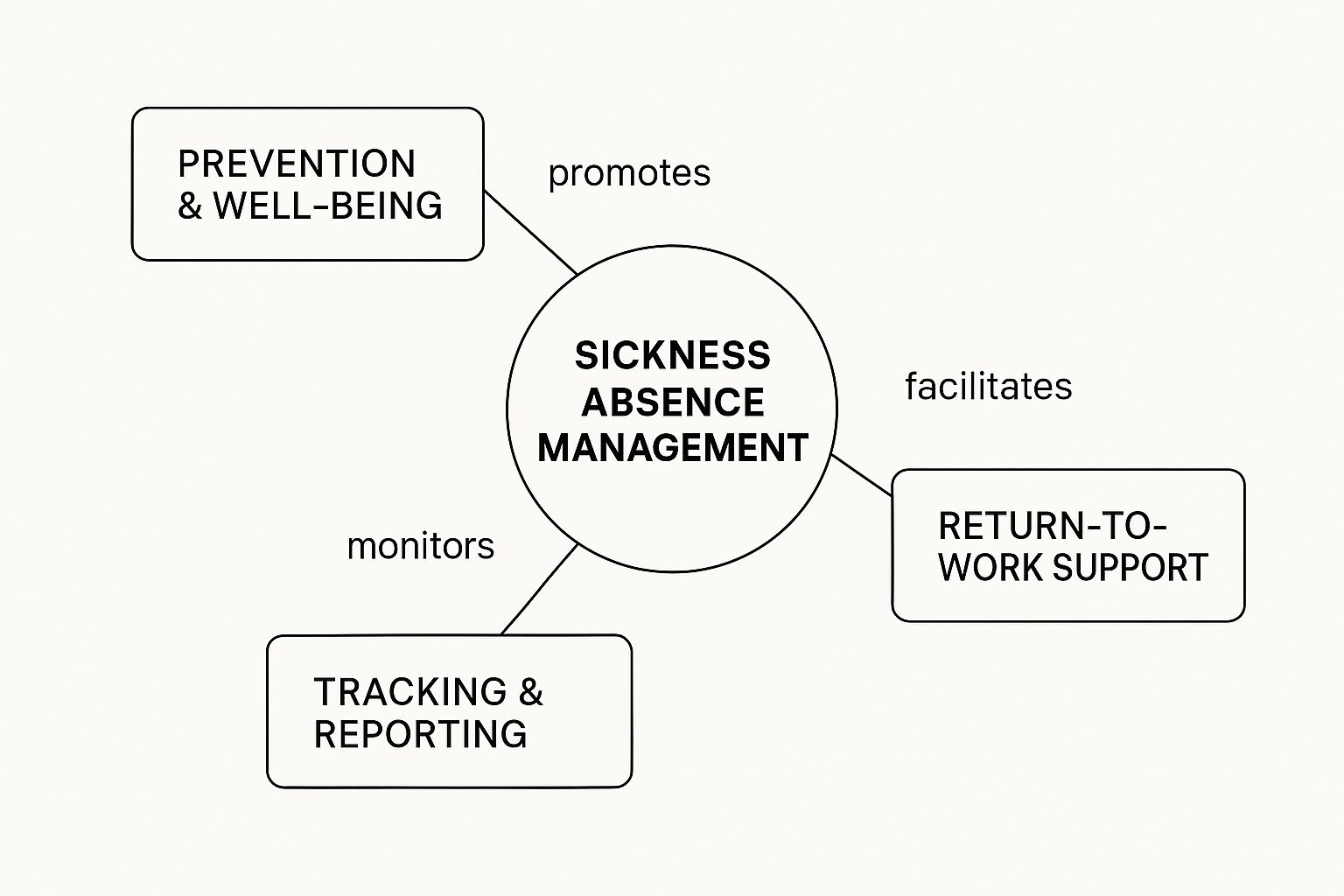
As you can see, each element is interconnected. Proactive wellbeing measures can reduce the frequency of absences, while good reporting provides the insights needed for effective return-to-work support. It’s this integrated approach that forms the foundation of a healthy, productive, and resilient workplace.
Why Effective Absence Management Matters

Managing employee absence is so much more than an admin headache. Think of it as a core business strategy that has a real, tangible impact on your bottom line and your company culture.
When you let absence management slide, it becomes a slow leak, quietly draining resources and morale. But if you get proactive, you can turn what feels like a liability into a genuine strategic advantage.
The cost of absence isn't always what it seems. Sure, there's the sick pay and the price of hiring temp cover—those are easy enough to add up. But that's just the tip of the iceberg. The hidden costs are often what cause the real damage, sending ripples across the entire business.
Unpacking the Financial Burden
The financial hit from sickness absence is massive for UK businesses, and it's only getting bigger. The hidden cost of employee sickness was recently pegged at a staggering £103 billion—that’s up by £30 billion since 2018.
It's not hard to see why. Recent research shows UK employees were off for an average of 7.8 days a year, a big jump from the pre-pandemic figure of 5.8 days. For employers, that’s a heavy burden to carry. You can find more detail on the true cost of absenteeism in the UK.
These indirect costs show up in all sorts of disruptive ways. Managers get pulled away from their actual jobs to shuffle schedules, reassign work, and deal with paperwork. All that firefighting distracts them from hitting strategic goals and moving projects forward.
"Ignoring the hidden costs of absence is like trying to sail a ship while ignoring the small holes below the waterline. Eventually, the vessel will start to sink. Effective sickness absence management is about patching those holes before they become a crisis."
And it’s not just managers who feel the heat. The disruption puts a heavy strain on the rest of the team, too.
The Impact on Productivity and Team Morale
When someone is off sick unexpectedly, their colleagues have to pick up the slack. That extra workload quickly leads to stress, burnout, and a drop in the quality of their own work as they try to juggle multiple roles. Deadlines get missed, customer service slips, and suddenly, business performance takes a hit.
Over time, that pressure really starts to wear on morale. People can become resentful, especially if they feel absence issues aren't being handled fairly or effectively. This is where you see engagement drop and loyalty start to fade.
A lack of proper sickness absence management creates an environment of uncertainty. It can seriously damage the psychological contract—that unspoken agreement of mutual commitment between you and your employees. Once that trust is broken, you’ll likely see higher staff turnover as your best people leave for more stable, supportive workplaces.
The Benefits of a Proactive Approach
On the flip side, getting this right delivers powerful results that strengthen your business from the inside out. When people see that their health is taken seriously and that fair, supportive processes are in place, it builds a real sense of security and value.
This positive culture brings tangible rewards:
- Improved Employee Engagement: When people feel supported, they're more loyal and committed to the company's success.
- Higher Staff Retention: A fair and positive environment means people are less likely to leave, saving you a fortune in recruitment and training costs.
- Enhanced Productivity: With clear systems in place, disruption from absence is kept to a minimum, letting teams stay focused and efficient.
- Stronger Workplace Culture: A compassionate and consistent approach shows you care about your people. That builds a culture based on trust and mutual respect.
Ultimately, effective sickness absence management isn't about policing your staff. It’s about building a resilient, supportive, and productive organisation where both the business and its people can flourish.
How to Build Your Sickness Absence Policy
Your sickness absence policy is the essential playbook for your business. Think of it as the rules of the game—it makes sure everyone understands their responsibilities, feels treated fairly, and knows exactly what to do when illness strikes.
A well-crafted policy isn’t just a dusty legal document; it’s a tool that builds trust, prevents misunderstandings, and protects your organisation. Crafting one from scratch might seem daunting, but it really boils down to a few core, non-negotiable parts.
Let's break down the essential elements your policy must include to be effective and compliant in the UK. By focusing on clarity and practicality, you can create a document that supports your team while keeping things running smoothly.
Start with Clear Reporting Procedures
The very first step in any absence is communication. Your policy needs to spell out precisely how an employee should report that they are unwell. Any ambiguity here is a recipe for confusion and frustration for both employees and managers.
Your procedure should answer these key questions:
- Who to Contact: Should the employee call their direct line manager, a central HR number, or use a specific system?
- When to Contact: Must they report their absence before their shift starts? Be specific, for example, "at least one hour before your normal start time."
- How to Contact: Is a phone call mandatory, or are text messages or emails acceptable? A phone call is often best as it allows for a direct conversation.
Getting this right ensures managers receive timely information, allowing them to arrange cover and manage workloads without a last-minute panic. It also sets a professional standard for communication from day one.
Define Your Rules on Fit Notes
In the UK, the rules around medical evidence for sickness are quite specific, and your policy must reflect these legal requirements to stay on the right side of the law. For the first seven calendar days (including non-working days), an employee can self-certify their illness.
After that seven-day mark, you are entitled to ask for medical evidence. This usually comes in the form of a fit note (officially a 'Statement of Fitness for Work') from a registered healthcare professional. Your policy should clearly state that a fit note is required for any absence lasting more than seven consecutive days.
A fit note is a crucial document. It not only confirms an employee's illness but can also provide valuable advice on what they can do, suggesting adjustments like a phased return or altered duties that can help them get back to work safely.
Clarify Your Sick Pay Entitlements
Let's be honest: money is often a primary concern for an employee who is off sick. Your policy must be totally transparent about what they will be paid, distinguishing between the legal minimum and any extra benefits your company offers.
-
Statutory Sick Pay (SSP): This is the government-mandated minimum you must pay to eligible employees. Your policy should simply confirm that the business complies with all SSP regulations.
-
Contractual (or Company) Sick Pay: This is any pay you offer above and beyond SSP. If you have a company scheme, your policy must detail it clearly. Include how much is paid (e.g., full pay or half pay) and for how long it lasts, which might be based on length of service.
Being upfront about sick pay prevents disputes and manages expectations from the get-go. When designing your policy, it's also important to consider comprehensive employee support, including details about disability insurance benefits and their tax implications.
Structure Your Return to Work Interviews
The final piece of the puzzle is the return to work interview. This isn't a disciplinary meeting; it's a supportive, informal conversation that should happen after every single instance of sickness absence, no matter how short.
Its purpose is twofold: to welcome the employee back and to understand the reason for their absence. This simple chat helps you identify any underlying health issues, workplace concerns, or patterns of absence that might need addressing.
Your policy should state that these interviews are a standard part of the process. This reassures employees that you are taking their wellbeing seriously while also demonstrating a consistent and fair approach to managing attendance across the whole organisation.
Putting Your Absence Management Policy into Practice
A well-written policy is a fantastic starting point, but it's just words on a page until your managers and employees bring it to life. Putting your sickness absence policy into practice is where the theory meets the day-to-day reality of running a business. It’s all about turning that document into consistent, fair, and supportive actions that build trust and keep things running smoothly.
This process covers the whole journey, right from that first phone call reporting an absence to the conversation that welcomes an employee back. The real key to making it all work? Equipping your line managers with the confidence and tools they need to handle these situations properly. Let’s walk through the practical steps that turn your policy from a document into a dynamic management tool.
From Initial Report to Successful Return
The second an employee calls in sick, your policy springs into action. The first step is for their line manager to have a brief, supportive chat. This isn't an interrogation; it's about showing empathy, getting a rough idea of how long they might be off, and figuring out any urgent work that needs handing over.
This initial contact really sets the tone for everything that follows. A supportive response makes the employee feel valued, while having a clear process means work can be reorganised quickly to minimise disruption. For fairness, it's vital that every manager across every team handles this first step in the same way.
After that first call, your policy's rules on certification and staying in touch will guide what happens next. This systematic approach ensures nothing falls through the cracks and that every absence is managed with the same level of care.
The Role of the Return to Work Interview
The return to work interview is, without a doubt, one of the most powerful tools in active sickness absence management. It’s a structured but informal conversation held by the line manager on the employee’s first day back. It should happen every single time, whether they were off for one day or one month.
The main goals of this chat are to:
- Welcome the employee back: It makes them feel like a valued part of the team.
- Confirm they are fit for work: You need to be sure they’ve fully recovered and aren’t pushing themselves to come back too soon.
- Discuss the reason for absence: This can help you spot any patterns or underlying issues that might need more support.
- Provide key updates: A quick catch-up on any important business news they might have missed is always helpful.
This interview is your chance to listen. It can bring to light things like workplace stress, previously undisclosed health conditions, or personal difficulties that might be contributing to absences. It shifts the focus from just recording sick days to actively supporting your team's wellbeing.
Managing Short-Term vs Long-Term Sickness
Your approach to sickness absence management needs to flex depending on how long someone is away. Short-term and long-term sickness bring very different challenges and require their own distinct strategies.
Short-term absences, usually from minor illnesses, are best managed by consistently applying your policy—especially those return to work interviews. This is how you spot recurring patterns that might point to a deeper problem.
Long-term absence, which is typically defined as four weeks or more, calls for a much more involved and supportive approach. Keeping in regular, sensitive contact is essential to stop the employee from feeling isolated from the workplace. This is also where you might start thinking about extra support. To really put your policy into practice, it’s also important to consider things like effective workplace accommodations for neurodivergent employees, creating a supportive environment for everyone.
For longer absences, you should:
- Maintain Regular Contact: Agree on how often and in what way you'll communicate. This keeps the employee in the loop and shows you care.
- Consider Occupational Health: A referral to an occupational health specialist can give you expert advice on the employee’s fitness for work and suggest reasonable adjustments.
- Plan a Phased Return: Bringing someone back gradually, perhaps with reduced hours or lighter duties, is an incredibly effective way to ease them back into their role after a long illness.
By tailoring your approach, you provide the right support at the right time. Our in-depth guide offers more practical tips on managing sickness absence effectively for all kinds of situations.
Understanding Current Sickness Absence Trends
To really get a grip on sickness absence, you first need to understand the ‘why’ behind it. Think of it like a doctor diagnosing a patient before writing a prescription; a business needs to understand the health landscape of its workforce before it can offer the right support. Looking at the data gives you that crucial context, helping you move beyond a generic, one-size-fits-all approach.
When you analyse national trends, you start to see the real-world health challenges affecting your employees. This isn’t just an academic exercise—it’s a strategic tool. It allows you to benchmark your own company’s performance and ask the important questions. Are the reasons for absence in your business similar to the national picture, or are there unique pressures at play within your own four walls?
This perspective lets you tailor your wellbeing strategies and sickness absence management processes to tackle the root causes, not just the symptoms.
The National Picture of Workplace Health
The UK's sickness absence rate gives us a clear snapshot of the ongoing challenges in workplace health. Recent figures from the Office for National Statistics (ONS) show that the overall rate was 2.0% of working hours lost. The data also tells a story about why people are off sick.
So, what are the main culprits behind these absences? The ONS provides a helpful breakdown that shows where the biggest health challenges lie for UK employees.
Top Reasons for Sickness Absence in the UK Workforce
| Reason for Absence | Percentage of Total Absences |
|---|---|
| Minor illnesses | 30% |
| Musculoskeletal issues | 15.5% |
| Mental health conditions | 9.8% |
| Respiratory illnesses | 7.3% |
As the table shows, while common colds and bugs still top the list, deeper issues around physical and mental wellbeing are significant contributors to lost workdays. For a more detailed breakdown, you can explore the latest sickness absence rate revealed.
Understanding these national statistics is your starting point. It helps frame the conversation internally and shifts the focus from simply tracking days off to proactively supporting employee health in targeted ways.
What does this all mean for your business? It’s a clear signal that a solid sickness absence management plan needs to be multifaceted. It must account for everything from the seasonal flu to the long-term support required for conditions like back pain or anxiety.
Sector and Size: What the Data Shows
Absence rates aren't the same everywhere; they vary quite a bit depending on the industry and the size of the company. You'll typically find that public sector organisations report higher absence rates than those in the private sector. This can be down to a range of factors, including the nature of the work, different reporting cultures, and sometimes more generous sick pay schemes.
Similarly, larger companies often see higher rates of sickness absence than smaller businesses. In a tight-knit team, the impact of one person's absence is felt much more keenly, which can create pressure to come to work even when unwell—a problem known as presenteeism.
Here’s a quick look at what these differences imply:
- Public Sector vs. Private Sector: The variation highlights how organisational culture and job demands can shape health outcomes.
- Large vs. Small Companies: Smaller businesses might have lower absence figures but could be at a higher risk of presenteeism, where sick employees drag themselves into work, leading to longer recovery times and tanking productivity.
By figuring out where your business fits into this landscape, you can set realistic benchmarks for your own absence rates. After all, an engineering firm with 50 employees shouldn't be comparing its numbers to a huge NHS trust. Context is everything when you want to turn data into meaningful action and build a fair, effective approach to sickness absence management.
Proactive Ways to Reduce Sickness Absence
Let’s be honest, the best way to manage sickness absence is to stop it from happening in the first place. Instead of just reacting when someone phones in sick, a smarter approach is to build a workplace that actively supports health and wellbeing. It's about shifting your mindset from reactive problem-solving to proactive support.
This change really starts with your line managers. They're on the front line every day and are usually the first to spot when a team member isn't quite themselves. Equipping them to notice the early signs of stress, burnout, or mental health struggles is one of the most powerful investments you can make. When a manager can step in early with a quiet, supportive chat, it can often stop a small issue from snowballing into a long-term absence.
Fostering a Culture of Wellbeing
A workplace that genuinely champions health doesn't just happen by magic. It takes real, intentional effort and putting tangible support systems in place—systems that show your team you care about them as people, not just for their output. This is about creating an environment where people feel safe, supported, and truly valued.
Here are a few initiatives that can make a real difference:
- Mental Health Support: Access to an Employee Assistance Programme (EAP) or trained mental health first aiders provides a vital safety net for when people are struggling.
- Flexible Working Options: Things like flexible hours or hybrid working can be game-changers. They help people juggle life's commitments, massively reducing stress and improving their overall health.
- Wellness Programmes: Simple initiatives that encourage healthier habits, like subsidised gym memberships or healthy snacks in the office, all add up.
For employees who might be dealing with more complex issues, like co-occurring mental health and substance use disorders, even just being aware of programmes like integrated dual diagnosis treatment can be a crucial part of a supportive company strategy.
The Impact of Your Company Culture
The gap that persists between public and private sector absence rates is a clear sign that things like company culture, job security, and the type of work people do all play a huge role. Closing this gap means looking at everything from manager training and early intervention to simply having better ways to monitor absence and investing in workplace health.
A proactive approach to wellbeing isn't just a 'nice to have'—it's a core part of a successful business strategy. By fostering a supportive environment, you not only reduce sickness absence but also boost productivity, engagement, and retention.
Ultimately, building a healthier workplace is the most sustainable way to manage sickness absence. When your team feels supported, they're more resilient, more engaged, and far less likely to need time off for health issues that could have been prevented.
For more practical ideas, check out our guide on proven strategies to reduce employee absenteeism. By investing in your people's health, you’re making a direct investment in the health of your business.
Common Questions About Sickness Absence Management
Let's be honest: navigating the rules around sickness absence can feel like walking through a minefield. It’s full of legal jargon, specific timelines, and processes that have to be just right. To help you handle these situations with more confidence, we’ve put together some clear, straightforward answers to the questions we hear most from UK business owners and HR managers.
Getting these details right isn't just about ticking boxes; it's about being fair to your team while staying firmly on the right side of the law. So, let’s cut through the complexity and get to the practical advice you need for effective sickness absence management.
What Is the Difference Between SSP and Contractual Sick Pay?
Think of sick pay as having two potential layers. The first is the legal baseline that everyone must follow, and the second is an optional, often more generous, layer a company chooses to offer.
- Statutory Sick Pay (SSP): This is the legal minimum. If an employee is eligible, you must pay it. SSP kicks in after an employee is off sick for four or more days in a row (including non-working days), and the government sets the payment rate, which changes most years.
- Contractual Sick Pay: This is an enhanced benefit written into an employee's contract. It's much more generous than SSP, typically paying a higher rate—often full or half pay—for a set period. This entitlement might grow the longer someone works for you.
Your sickness absence policy must be crystal clear about what an employee is entitled to and under what conditions. No ambiguity!
When Can We Ask an Employee for a Fit Note?
There are firm rules here, so you can't just ask for a doctor's note from day one. For the first seven calendar days of sickness (and yes, that includes weekends), an employee can self-certify. This means they simply tell you they are unwell without needing to see a doctor.
Once their absence stretches beyond that initial seven-day period, you can then legally require them to provide a fit note—officially called a 'Statement of Fitness for Work'—from a healthcare professional.
A fit note is more than just proof of illness. It can offer valuable advice, stating if an employee 'may be fit for work' with certain adjustments, such as altered duties or a phased return, helping you support their recovery.
How Should We Handle Frequent Short-Term Absences?
A pattern of short, frequent absences can be tricky. The key is to have a consistent and supportive process to figure out if there's an underlying issue. Don't let it drift.
Start by holding a return-to-work interview after every single absence, no matter how short. It can be a brief, informal chat, but it helps you understand the reasons behind the absence and spot potential patterns before they become a real problem.
Your policy should also have clear trigger points—for example, three absences in a three-month period. Hitting a trigger doesn't mean jumping straight to disciplinary action. Instead, it prompts a more formal review meeting to discuss their attendance, offer support, and explain what could happen if things don't improve.