
Before you even think about booking that dream holiday, it’s crucial to get a handle on your rights as an employee. Knowing what you're entitled to isn't just good practice—it's the foundation for planning your time off effectively and making sure your request gets a smooth approval.
In the UK, the law has your back. Nearly all workers are legally entitled to 5.6 weeks of paid annual leave. This isn't just a company perk; it's a statutory right designed to promote a healthy work-life balance.
Understanding Your UK Holiday Entitlement

Getting to grips with your exact holiday allowance is the very first step. It prevents any awkward conversations or misunderstandings with your manager down the line and ensures your request is fair and compliant right from the start.
At its core is the statutory holiday entitlement. For someone working a typical five-day week, this translates to 28 days of paid holiday each year (that’s 5.6 weeks x 5 days). This is the absolute legal minimum, and many employers offer more generous packages to attract and retain staff.
If you want to dive deeper into the specifics, our guide on UK holiday entitlement rules covers all the finer details.
How Different Work Patterns Affect Your Leave
Of course, not everyone works a standard 9-to-5, Monday to Friday. Your working pattern directly impacts how your total leave is calculated, even though the 5.6-week rule is the universal starting point.
- Part-time workers: Your entitlement is calculated on a pro-rata basis. So, if you work three days a week, your minimum allowance would be 16.8 days (5.6 x 3). Simple as that.
- Irregular hours: For those on zero-hour contracts or with varying shifts, things are a bit different. Your holiday entitlement is typically calculated as 12.07% of the hours you've worked.
To give you a clearer picture, here's a quick breakdown of the statutory minimums.
UK Statutory Holiday Entitlement at a Glance
This table offers a quick summary of the minimum paid leave entitlement based on the number of days you work each week.
| Days Worked per Week | Minimum Paid Holiday Days per Year |
|---|---|
| 5 | 28 |
| 4 | 22.4 |
| 3 | 16.8 |
| 2 | 11.2 |
| 1 | 5.6 |
Remember, this is the legal floor. Your actual entitlement might be higher, so always double-check your contract.
What's the Deal with Bank Holidays?
This is where things can get a bit confusing. A common question we see is whether bank holidays are included in your statutory leave. The short answer is: it depends on your employer.
Companies can choose to include the eight UK bank holidays as part of your minimum 28 days.
Your employment contract is the ultimate source of truth here. It will clearly state whether bank holidays are counted within your statutory 28 days or if they are provided as additional paid days off. Always, always check your contract first.
For example, a contract stating "28 days holiday including bank holidays" means you'll use eight of those days for public holidays. On the other hand, if it says "20 days holiday plus bank holidays," you get the public holidays on top, giving you 28 days off in total. Getting this clear from the outset is essential for accurate planning.
How To Craft a Professional Holiday Request
Asking for a holiday isn't just a case of firing off an email with a list of dates. Think of it as a professional courtesy – a way of showing respect for your team and the business. When you put a bit of thought into it, your request demonstrates foresight and responsibility, which makes a quick 'yes' from your manager far more likely. The idea is to frame your time off not as a sudden demand, but as a well-planned part of your work life.
This means doing a little more than just finding a template online. A truly effective request takes your company's needs and your team's schedule into account. Before you even think about writing anything, a bit of prep work is essential.
This infographic breaks down the three core things you should do before you even hit 'send'.
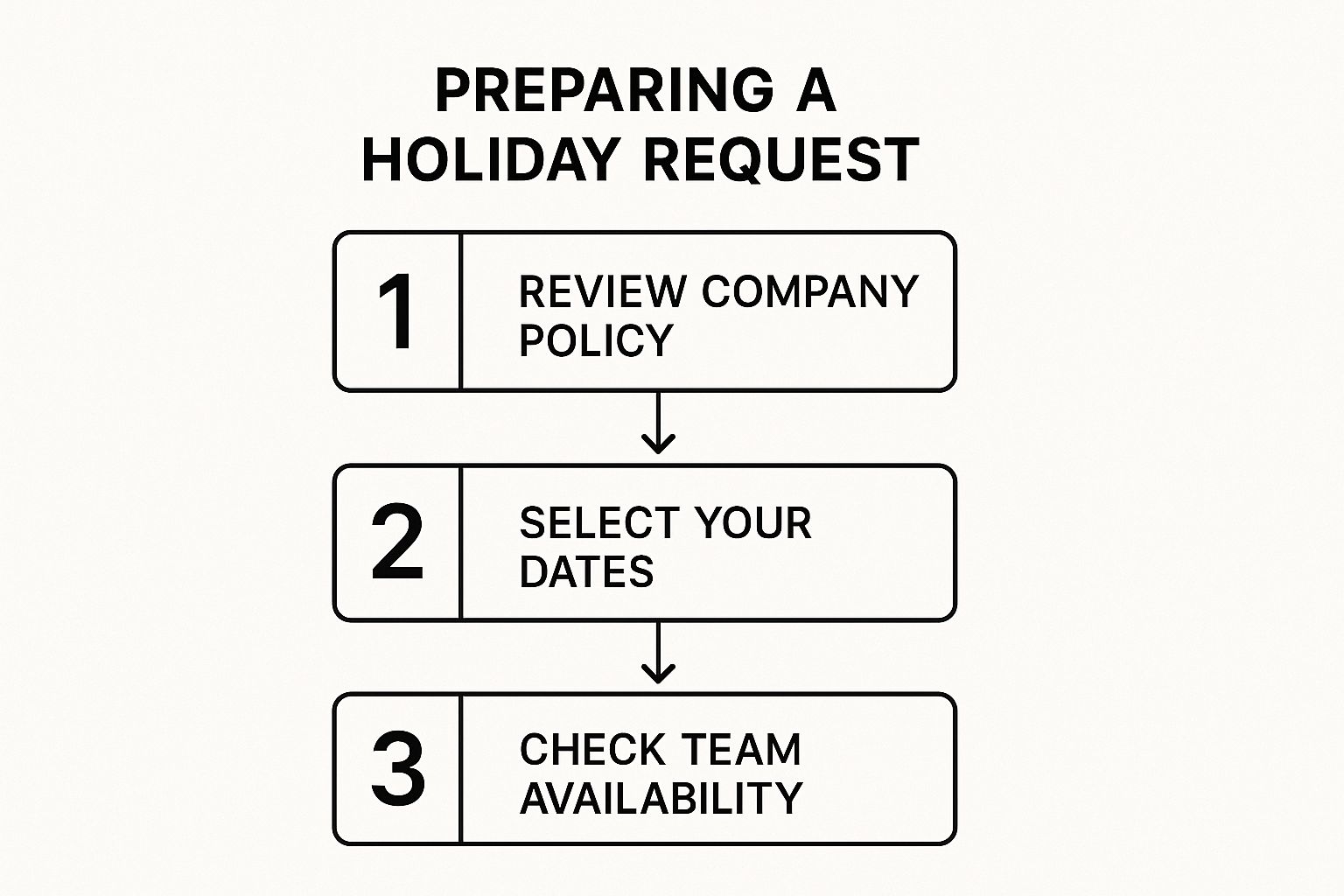
As you can see, a successful request starts with doing your homework: knowing the policies, picking your dates wisely, and checking who else is off. It’s all about avoiding disruption.
Writing a Request That Gets Approved
Once you’ve done the groundwork, the actual message needs to be crystal clear and concise, with all the necessary details upfront. Ambiguity is your enemy here; the last thing you want is your manager having to chase you for basic information.
To make the whole experience frictionless for everyone, make sure you include:
- Specific Dates: Be explicit about your start and end dates. For example, "I would like to request holiday from Monday, 11th August to Friday, 22nd August, returning to work on Monday, 25th August."
- A Brief Handover Plan: This is a game-changer. It shows you’ve thought about your responsibilities. Something as simple as, "I'll make sure all my critical tasks are completed and prepare a full handover for Sarah before I leave," works wonders.
- Polite Phrasing: It sounds obvious, but tone matters. "I would like to request…" or "Please let me know if these dates are suitable" comes across much better than "I am taking my holiday."
An effective holiday request is proactive, not reactive. It anticipates potential questions and provides solutions upfront, showing your manager that you're organised and considerate of the team's workflow. This simple shift in approach can make all the difference.
Ultimately, a thoughtful holiday request makes the process smoother for everyone. If you're curious about what it looks like from the other side of the desk, have a look at our effective guide to managing employee time off requests. Understanding your manager's perspective helps create a much better system for booking leave. By providing clarity and a clear plan, you respect their time and help keep the wheels turning while you're away.
Navigating Company Policies and Busy Periods

Before you even start dreaming of your holiday, your first port of call should always be your company's official policy. You’ll usually find this tucked away in the employee handbook or on the company intranet. Think of this document as your rulebook; it lays out the exact procedures you need to follow.
It's packed with critical information you can't afford to miss, like the required notice period—basically, how far in advance you need to put in your request. Having an effective internal communications strategy is a huge help here, as it means companies can make these policies easy for everyone to find and understand.
Finding the Key Details
When you're scanning the policy, you’re on the hunt for a few key details that will make or break your holiday plans. Pay close attention to any rules about how many people from the same team can be off at once.
You also need to keep an eye out for blackout periods. These are specific times of the year, like the frantic end of a financial quarter or a major project deadline, when holiday requests are pretty much an automatic "no" due to business needs.
Honestly, planning your holiday around these peak times is one of the smartest things you can do. Submitting a request for a known quiet period shows you're thinking about the business, and it massively boosts your chances of getting a quick thumbs-up.
Planning Around Popular Holiday Seasons
Everyone wants time off during the popular seasons, like the summer holidays or over the Christmas break. This means you need some extra foresight. If you're hoping for a week off in August, you should be thinking about that request months in advance, because you'll be competing with half the office.
The same goes for bank holidays, which can sometimes throw a spanner in the works. For instance, the 2024–2025 leave year is a bit of an odd one in the UK. Because Easter falls so late in 2025, there will only be seven bank holidays within the typical leave year (1st April 2024 to 31st March 2025), not the usual eight.
Being aware of little quirks like this, alongside your company’s specific rules, puts you in a much stronger position when you're ready to book that well-deserved break.
Using Leave Management Tools to Your Advantage
Are you still relying on messy email threads and paper forms for your holiday requests? Those days are quickly becoming a thing of the past. Modern companies are now turning to digital tools to manage leave, which makes the whole process more transparent and straightforward for everyone involved. A dedicated system really puts you in the driver's seat of your own holiday planning.
These platforms take all the guesswork out of booking time off. Instead of having to ping HR to ask about your remaining balance, you can see it instantly with a single click. This is a game-changer when you're trying to plan multiple trips throughout the year.
If you're curious about how your entitlement translates into pay, you can find out more about simple methods for calculating holiday pay here: https://www.leavewizard.com/how-to-calculate-holiday-pay-simple-methods-that-work/
Streamline Your Holiday Request
One of the biggest perks of these tools is the shared team calendar. Before you even think about submitting a request, you can see who else has already booked time off. This immediately helps you avoid obvious clashes that would just lead to a rejection anyway, giving you a strategic advantage to pick dates that are far more likely to get the green light.
Here’s a peek at what a typical dashboard looks like in a system like LeaveWizard. It gives you a crystal-clear overview of all your leave information.

This kind of visual layout gives you all the crucial data you need in one place, like your remaining allowance and any pending requests. Submitting your holiday request becomes as simple as picking your dates on the calendar and hitting a button.
The real power of a leave management system is the clarity it provides. It transforms the holiday request process from an administrative chore into an empowered, self-service action. This lets you focus on planning your actual trip, not the paperwork.
To truly overhaul how holiday requests are handled, many HR teams are leveraging specialized employee leave management software that simplifies everything from start to finish. Once these systems are in place, booking time off becomes completely effortless.
Why Taking Your Annual Leave Is Essential
It might sound strange, but one of the most productive things you can do for your career is to step away from your desk and stop working. All too often, we treat our annual leave as a nice-to-have rather than a must-have, letting precious holiday days go unused because of workload anxiety or a nagging culture of ‘presenteeism’.
But skipping breaks is a fast track to burnout. Taking time off isn’t just about sipping a cocktail on a beach; it's a vital part of maintaining your long-term performance, creativity, and overall mental health.
Worryingly, a recent trend shows that fewer and fewer people are actually taking the leave they're entitled to. UK data from 2023 revealed a 7.67% drop in annual leave taken compared to 2022. Since 2020, the average number of days taken has plunged by almost 12%—a huge shift that points to a growing risk of widespread burnout. You can dig into the specifics in this UK annual leave report.
Reframe Holiday As A Performance Tool
Start thinking of your holiday as an essential part of your job strategy, and your entire perspective will shift. Properly disconnecting gives your brain a chance to reset, which often leads to better problem-solving and genuinely fresh ideas when you return.
Your annual leave is not a reward you earn; it is a vital recovery period you require. Just like professional athletes need rest days to perform at their peak, you need holidays to sustain high-level professional performance and avoid exhaustion.
Putting in a proper request for holiday is really an investment in your own success. It allows you to come back to work feeling genuinely refreshed, more focused, and ultimately, more engaged with what you do.
To get the most out of it, think about what kind of trip would truly rejuvenate you and explore travel-related insights to spark some inspiration for your next break. Trust me, your career will thank you for it.
Got Questions About Holiday Requests? We've Got Answers
Navigating the rules around time off can feel a bit tricky sometimes. Even with a clear company policy in place, unique situations pop up that can leave you wondering what the official line is.
Getting your head around the common queries helps you plan and book your holidays with confidence. Let's clear up a few of the most frequent questions we hear.
Can My Employer Actually Refuse My Holiday Request?
In short, yes, they can. An employer can legally turn down a holiday request, but they can't just do it on a whim—they need a solid business reason. This isn't about being difficult; it's purely about keeping the business running smoothly.
Some common reasons a request might be denied include:
- Peak Business Periods: Your request might fall during a critical time, like the run-up to Christmas for a retail business or the end of the financial year.
- Too Many People Off: If several team members have already booked the same dates, letting you go as well could leave the department short-staffed.
- Not Enough Notice: You might not have given the minimum notice required by your company's holiday policy.
Even if they have to say no to your specific dates, your employer is still legally required to make sure you can take your full statutory holiday entitlement at some point during the leave year.
What’s the Minimum Notice I Need to Give?
The legal baseline in the UK is that you need to give notice that's double the length of the time you want off. So, for one week of leave, you'd need to give two weeks' notice.
But here’s the crucial bit: your company's own policy is the one that really matters.
Always check your employee handbook or contract first. That document will spell out the specific notice period for your workplace. As a professional courtesy, it’s always a good idea to give as much notice as you possibly can—it makes life much easier for your manager and the rest of the team.
What Happens to My Unused Holiday Days?
This one is completely down to your employer's policy. UK law is clear that the statutory 5.6 weeks of annual leave can't be paid out instead of being taken, unless you're leaving the company.
Beyond that, companies have different approaches. Some operate a strict "use it or lose it" system where any untaken days disappear at the end of the leave year. Others are more flexible and might let you carry over a certain number of days into the next year.
Your contract is the source of truth here, so give it a read to make sure you don't accidentally lose any of your well-earned time off.


