
Asking for annual leave might seem simple, but a bit of thoughtful planning can make the whole process smoother for you and your team. A successful request really comes down to three things: knowing your company's policy, picking the right time to ask, and communicating your plans clearly.
The Anatomy of an Effective Annual Leave Request
Getting your time off approved without any fuss begins long before you even think about writing an email. It’s a straightforward process, but it does involve a little forward-thinking and consideration for your colleagues and the business. When you break it down, the whole thing becomes much less daunting for everyone.
This visual flow shows the simple, three-stage journey of a well-planned annual leave request.
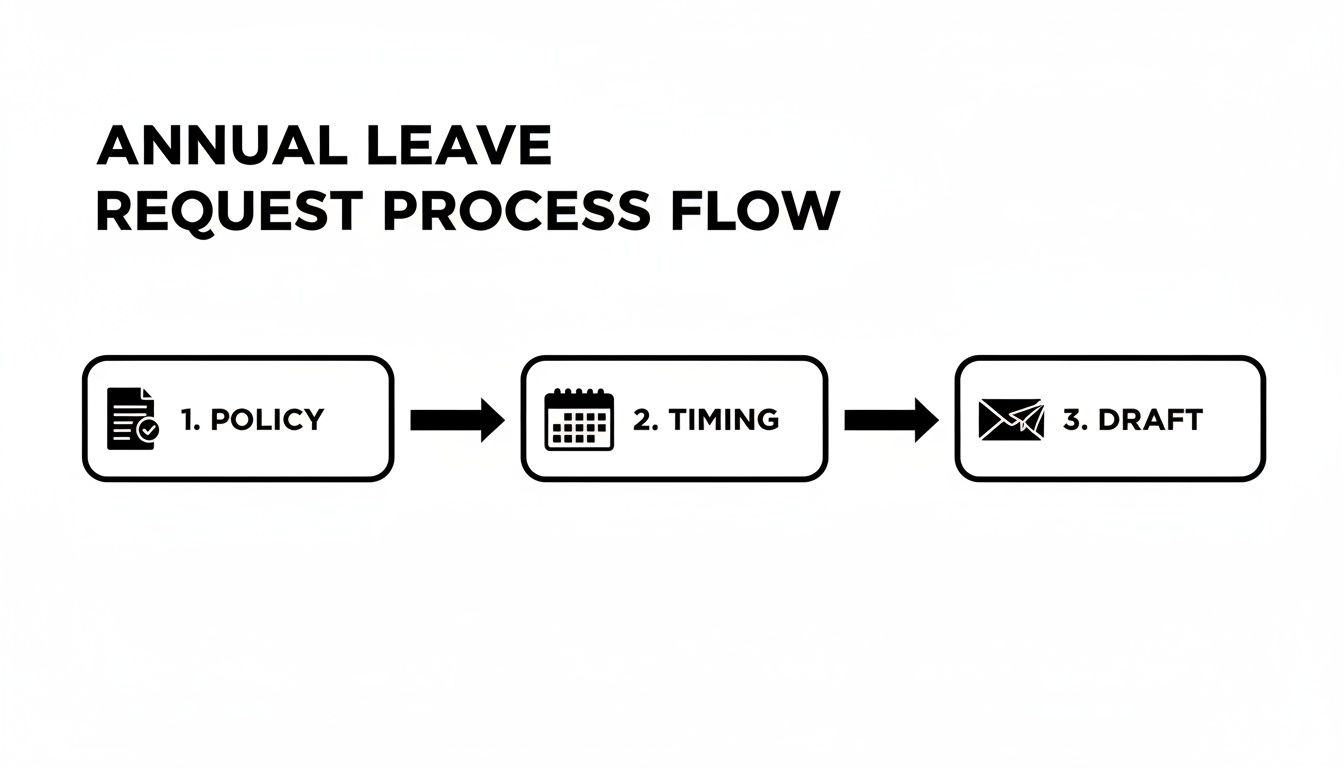
As the infographic shows, a good outcome is built on solid preparation. It starts with checking the company policy and thinking strategically about timing before you even begin to communicate.
Your Pre-Request Checklist
Before you formally submit anything, running through a quick mental checklist can seriously boost your chances of getting a swift "yes". This isn't just about ticking boxes; it's about showing you're a professional who respects the team's shared goals.
A great request for annual leave considers three main areas:
- Policy Awareness: Are you up to speed on your company's required notice period? Do you know if there are any "blackout" periods where leave is off-limits due to busy seasons?
- Team Coordination: Have you glanced at the shared calendar to check for clashes with key team members? A quick chat with a colleague whose work overlaps with yours can prevent a lot of headaches down the line.
- Workload Planning: What critical tasks need wrapping up or handing over before you go? Having a rough plan shows your manager you’re thinking ahead to minimise disruption.
By thinking through these points beforehand, you transform your request from a simple ask into a well-considered proposal. This proactive approach shows your manager you're not just thinking about your holiday, but also about the team's continued success in your absence.
Ultimately, the goal is to make it as easy as possible for your manager to approve your request.
The table below gives you a quick-reference summary of these essential actions.
Your Annual Leave Request Checklist
| Action Item | What to Do | Why It's Important |
|---|---|---|
| Review Company Policy | Find the HR handbook or intranet page and read the rules on notice periods, blackout dates, and request procedures. | This ensures your request is compliant from the start and avoids an immediate rejection based on a technicality. |
| Check Team Calendars | Look at shared calendars for potential overlaps with colleagues, especially those in your immediate team or on key projects. | Prevents resource shortages and shows you’re considerate of your team's workload and deadlines. |
| Plan Your Handover | Make a brief list of your key responsibilities and who could cover them. Note any urgent tasks to be completed before you leave. | This demonstrates professionalism and assures your manager that your absence won't create chaos. |
| Choose the Right Time | Avoid asking during a crisis, a major project launch, or right after a difficult company announcement. | Timing is everything. A well-timed request is more likely to be met with a positive response. |
| Draft Your Request | Put together a clear, concise email or fill out the official form with all necessary details (dates, reason if needed). | Clear communication prevents back-and-forth questions and makes the approval process much faster. |
Following this checklist helps you cover all your bases, making the entire process smoother and more professional.
Mastering the Art of Timing Your Holiday Request
When you ask for time off is just as critical as how you ask. Simply following the official notice period is only half the battle; the unwritten rules of office etiquette and strategic foresight often play a far bigger role in getting your request for annual leave approved without friction.
Getting the timing right isn't just about your convenience. It's a key way to help reduce workplace stress and maintain a healthy work-life balance for everyone on the team. This means looking beyond your own calendar to consider the bigger picture. It’s about being considerate and proactive.

Analyse the Business Calendar
Before you set your heart on specific dates, take a moment to get a feel for the company’s rhythm. Every organisation has its peaks and troughs. Being aware of them is absolutely essential for a successful leave request.
A classic misstep is asking for two weeks off smack in the middle of the annual financial audit or the busiest sales quarter. Sure, your manager understands you need a break, but approving leave during an "all-hands-on-deck" period puts immense pressure on everyone else. It can unintentionally signal a disregard for shared responsibilities.
Think about these critical periods:
- Project Deadlines: Are there any major project milestones or launches happening around your desired dates?
- Seasonal Peaks: Does your industry have a predictable busy season, like retail before Christmas or accounting at the end of the financial year?
- Company Events: Are there important conferences, team-building events, or client meetings scheduled that you shouldn't miss?
Your request is much more likely to be seen as reasonable and professional when it's clear you’ve considered the business's operational needs. It shows you're not just an employee, but a team player invested in collective success.
Coordinate With Your Colleagues
Your absence doesn’t happen in a vacuum—it directly impacts your colleagues. The goal is to minimise disruption, and the best way to do that is through a bit of open communication and coordination.
A quick look at the shared holiday calendar can prevent a common headache: overlapping leave with a key team member whose skills mirror your own.
For instance, if you and another designer are the only two people who can approve final proofs, taking holiday at the same time could grind an entire workflow to a halt. A simple chat beforehand allows you to stagger your time off, ensuring continuous cover and a smoother process for everyone. This proactive step shows respect for your colleagues’ workload and fosters a collaborative spirit, making them more willing to support you during your absence. Being mindful of your team's capacity is a fundamental part of a considerate request for annual leave.
How to Write a Clear and Professional Request Email
So, you’ve checked the company leave policy and picked the perfect dates. Now it’s time to actually write the request. A well-written request for annual leave is your best friend here—it’s clear, professional, and makes it incredibly easy for your manager to just say "yes."
The trick is to give them all the information they need in one go, avoiding that annoying back-and-forth that can delay your approval.
We're going to move past the generic, copy-paste templates. The aim is to put together a message that not only works but also fits right in with your company’s culture. Whether your office is super formal or pretty laid-back, the important bits of a great request email are always the same.
The Essential Components of Your Email
Every single leave request needs to cover a few key points. If you miss one, you're likely to cause confusion or delays. Your manager has to think about team coverage and deadlines, so giving them the specifics helps them plan around your absence.
Think of your email as a mini-proposal. You're not just asking for a holiday; you're showing you’ve already considered the impact on the team and have a plan. This little bit of forward-thinking goes a long way in building trust.
Make sure your email always includes:
- A Crystal-Clear Subject Line: Don't make your manager guess. A simple subject like "Annual Leave Request – [Your Name]" works perfectly. It’s direct and easy to spot in a busy inbox.
- The Exact Dates: Specify your first and last day of leave. It’s also a good idea to mention when you'll be back, for example, "returning on Monday, 22 July". No ambiguity.
- A Brief Handover Plan: Just a sentence or two is all it takes to show you’re on top of your workload. Mentioning you’ll clear any urgent tasks or prepare handover notes shows you’re being responsible.
The best request emails are short but packed with all the necessary details. They respect your manager's time and are easy to scan, making a quick approval the most logical next step for them.
Adapting Your Tone to the Workplace Culture
How you phrase everything can change a lot depending on your office vibe. A quick "Heads-up, I'd like to book some time off" might be totally fine in a casual startup, but it would probably fall flat in a traditional corporate firm. There, you'd need something more structured, like, "I am writing to formally request annual leave."
The key is to match the tone that’s already been set. If you're ever in doubt, it’s always safer to lean towards being slightly more formal. You can find more specific examples and tips in our detailed guide on how to craft the perfect annual leave request email.
To give you a clearer idea, here's how you can adjust your phrasing for different work environments.
Comparing Request Phrasing for Different Workplace Cultures
This table breaks down how you can tweak key parts of your email to suit formal or more casual company cultures.
| Email Section | Formal Phrasing | Casual Phrasing |
|---|---|---|
| Opening | "Dear [Manager's Name], I am writing to formally request annual leave from [Start Date] to [End Date]." | "Hi [Manager's Name], I'd like to request some time off from [Start Date] to [End Date]." |
| Handover Offer | "I will ensure all my urgent responsibilities are completed and a detailed handover is prepared before my departure." | "Happy to make sure everything's covered before I go. I'll get all my urgent work done." |
| Closing | "Thank you for your consideration. I look forward to your approval." | "Let me know if those dates work for you. Thanks!" |
No matter what tone you use, the goal is always the same: communicate clearly, show you’ve thought about your team, and make the whole approval process as smooth as possible for everyone involved.
Navigating UK Leave Policies and Your Legal Rights
Putting in a holiday request is simple enough, but really getting to grips with the legal side of things gives you the confidence that you're on solid ground. In the UK, every full-time employee has a legal right to a minimum of 5.6 weeks of paid holiday each year. This is your statutory entitlement, and it’s the bedrock of any company’s leave policy.
Of course, this is usually adjusted pro-rata for part-time team members. For instance, if you work three days a week, your entitlement is calculated as 3 days × 5.6 weeks, which gives you 16.8 days of paid leave. Knowing the basics of how to calculate the number of working days in a year can give you a better sense of how your own allowance stacks up.
Common Policy Clauses to Look For
Beyond the legal minimum, your employer’s specific policy is where the real detail lies. When you’re looking through your company handbook or HR portal, keep an eye out for a few common clauses that will directly impact your holiday plans.
Most companies will have clear guidelines covering:
- Carrying Over Unused Days: The policy should tell you if you can roll unused leave into the next holiday year and, if so, how many days are allowed.
- Blackout Periods: It's common for businesses, especially in sectors like retail or hospitality, to have blackout periods during their busiest times (like the Christmas rush) where leave requests are rarely approved.
- Approval Procedures: Your policy will spell out the exact process for submitting requests, including how much notice you need to give and who needs to sign off on it.
Getting familiar with these details helps you plan better and ensures your request ticks all the right boxes from the get-go. For a much deeper dive, check out our complete guide on statutory holiday entitlement in the UK.
The Financial Side of Unused Leave
For business owners and managers, handling annual leave correctly isn't just a matter of compliance—it's a financial necessity. When employees don't take their allocated time off, it creates a "leave liability" on the company's books. Essentially, this is a debt that has to be paid out if an employee leaves the company with unused holiday time.
Recent trends suggest that UK employees are taking fewer days off. The average dropped from 38 days in 2020 to just 33.9 days by early 2024, a significant 12% decline. This growing pile of unused leave can create real financial headaches for small businesses if it isn't managed proactively.
Knowing your rights and your company’s policies puts you in control. For employers, it means running a fair, transparent, and legally sound system that builds trust. A clear policy is the cornerstone of a healthy work-life balance for everyone involved.
How LeaveWizard Automates Your Time Off Requests
If you’re still juggling holiday requests through spreadsheets and endless email chains, you know the pain. It’s a recipe for mistakes, wasted time, and a whole lot of frustration. For a small business where every minute is precious, this old-school approach quickly becomes a massive administrative headache.
It’s time for something better.
LeaveWizard was built to solve this exact problem by automating the entire annual leave process. From an employee putting in their request to a manager signing it off, every step is handled in one simple, clean system. What was once a messy, paper-heavy task becomes a matter of a few clicks.
As you can see below, the LeaveWizard dashboard gives managers a crystal-clear, at-a-glance view of who’s in and who’s out.
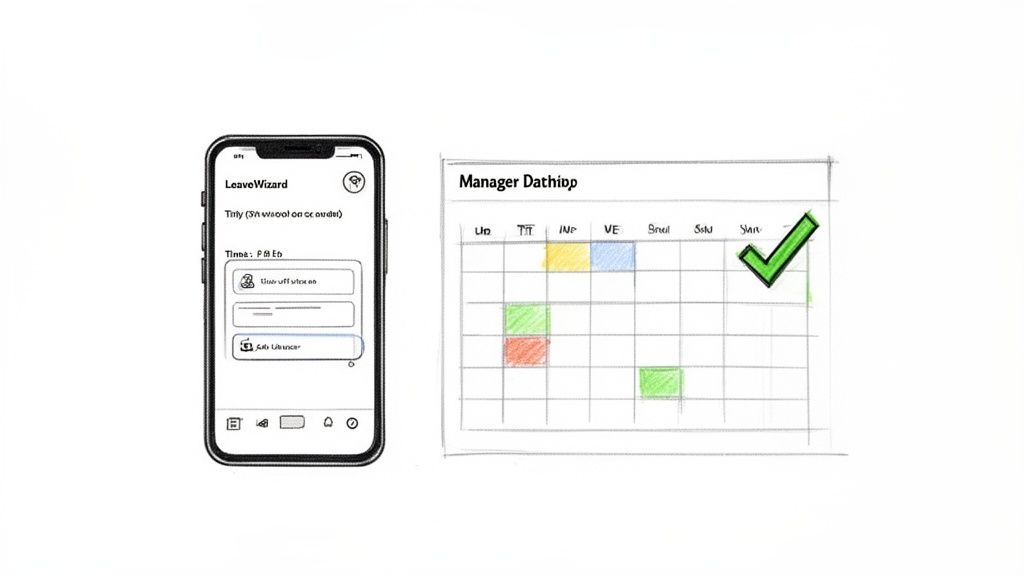
This central hub makes it easy to spot potential scheduling clashes long before they become a real issue.
Empowering Employees with Self-Service Tools
A smooth request for annual leave process begins by giving your team the right tools for the job. LeaveWizard’s self-service smartphone app and web portal lets employees manage their own time off, cutting out the constant back-and-forth with HR or their manager.
This gives them immediate access to the information they need, right when they need it. They can:
- Check Leave Balances: No more guessing or asking how many days they have left. Employees can see their remaining holiday entitlement in real-time.
- View Team Calendars: Before they even submit a request, they can check the shared team calendar to see who else is already off. This helps them pick dates that are far more likely to get approved.
- Submit Requests on the Go: The mobile app means your team can request time off from anywhere, at any time, sending all the details straight to their manager.
This kind of transparency doesn't just make life easier for your staff; it also takes a huge administrative weight off your managers' shoulders. You can learn more about how LeaveWizard saves businesses time and makes everyone more efficient.
Simplifying Approvals for Managers
For managers, the biggest win is the clarity LeaveWizard brings. The system pulls all requests into a single, straightforward dashboard. Gone are the days of digging through a chaotic inbox to find a request.
With real-time calendars and automated notifications, nothing ever falls through the cracks.
Managers can approve or deny requests with one click, knowing they have all the context they need to make the right call. It prevents accidental overlaps and makes planning ahead feel effortless.
This is more important than you might think. A recent UK trend shows that unused holiday days have plummeted by 71% per employee, dropping from 18.5 days in 2019 to just 5.3 in 2024. People are finally taking their well-deserved breaks.
While that's great for wellbeing, it also means managers are handling more requests than ever. For a small firm, a tool that automates tracking and gives gentle nudges to use up leave is a game-changer.
At the end of the day, LeaveWizard tackles the real-world challenges of manual leave management head-on. It gives employees the autonomy they want and provides managers with the oversight they need, creating a fair and efficient system that just works.
Common Questions About Annual Leave Requests
Even when you think you have the annual leave process down, a few tricky questions always seem to pop up. Whether you're an employee trying to nail down that long-awaited holiday or a manager juggling team schedules, getting clear answers is key to keeping everything running smoothly.
Let's tackle some of the most frequent queries to clear up any lingering confusion.
Can My Employer Refuse My Holiday Request?
In short, yes, your employer can refuse a request for annual leave, but they can't do it on a whim. They need a solid business reason.
Common justifications include hitting a peak business period, potential staff shortages, clashing with major project deadlines, or overlapping with leave already approved for other team members. Your company's policy should spell out the potential grounds for refusal.
Crucially, there are rules around how they tell you. Your employer must give you as much notice for the refusal as the length of the leave you requested. So, if you asked for a week off, they have to let you know at least a week beforehand.
What Happens If I Get Sick While on Annual Leave?
It’s the worst-case scenario: you’ve finally switched on your out-of-office, only to come down with the flu. The good news is that if you become ill during your pre-booked holiday, you’re entitled to take that time as sick leave instead.
This means you can "reclaim" the holiday days you were sick for and use them another time.
To make it happen, you must follow your company's normal sickness reporting procedure. This isn't something you can decide after the fact. You’ll need to notify your manager as soon as you can and likely provide a doctor's note if you're ill for more than a few days, just as you would if you were working.
Key Takeaway: Your right to paid holiday is protected, even if illness gets in the way. As long as you follow the correct reporting procedure at the time, you can get those days back for a proper, well-deserved break later on.
Can My Employer Force Me to Take Annual Leave?
This one surprises a lot of people, but yes, an employer can require you to take your statutory holiday on specific dates. This is most common during company-wide shutdowns, like the period between Christmas and New Year.
They can't just spring it on you, though. The rule of thumb here is that they have to give you notice that's at least double the length of the leave they're making you take. If they want everyone to take a week off, they must let you know at least two weeks in advance.
What if I Can't Use All My Leave Before the Year Ends?
This really comes down to your employment contract and company policy. The law states that the 5.6 weeks of statutory leave should be taken within the designated leave year.
Some employers are flexible and allow you to carry over a limited number of days into the next year, but they aren't legally required to do so for the full statutory amount. Never assume you can just roll your days over—you could end up losing them. Always check your employee handbook to know exactly where you stand.


