
Let’s cut through the jargon and get straight to it. Every single worker in the UK is legally entitled to 5.6 weeks of paid holiday each year. For a typical full-time employee, that works out to 28 days.
Think of this as the absolute baseline—a non-negotiable safety net guaranteed by law to make sure everyone gets a proper break from work.
Understanding Your Core Holiday Entitlement in the UK
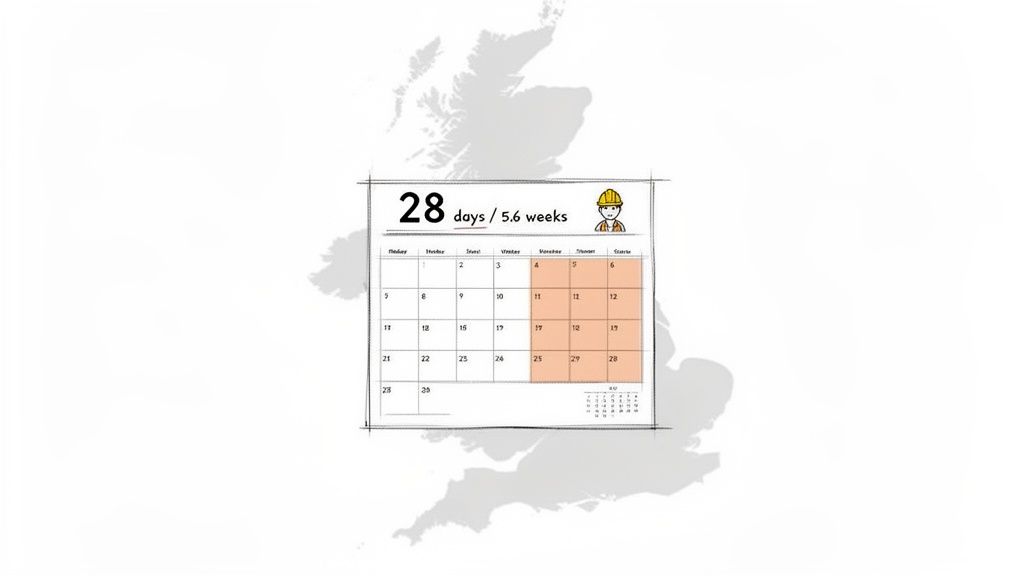
At its heart, the legal holiday allowance is a simple concept. It establishes a mandatory minimum amount of paid time off that every employer must provide. This statutory right covers almost all workers, whether they're full-time, part-time, on zero-hour contracts, or working for an agency.
Imagine it as a foundational layer of employee wellbeing. Just as a building needs a solid foundation, every employment contract needs a baseline of guaranteed rest to prevent burnout and keep people performing at their best. This isn't a perk or a bonus; it’s a legal right.
The Evolution of UK Holiday Rights
This right hasn’t always been so generous. The original statutory minimum, set by the Working Time Regulations 1998, was just 20 days. It was then bumped up to 24 days in October 2007, before finally landing on the current 28 days (or 5.6 weeks) in April 2009.
These changes reflect a growing understanding of just how vital work-life balance is. If you want to dig into the legislative nitty-gritty, you can explore the official guidance on holiday entitlement rights.
Key Takeaway: The 5.6 weeks is a universal minimum. An employer can always offer more than this—often called contractual or enhanced holiday—but they can never legally offer less. This protects workers and sets a clear, consistent standard for all businesses.
It's also crucial for business owners to know that this figure is capped. Even if an employee works six days a week, their statutory entitlement maxes out at 28 days. Anything beyond that would need to be part of their specific employment contract.
How Entitlement Translates into Days
Using "5.6 weeks" as the standard provides a flexible and fair way to calculate holiday for different working patterns. For someone on a standard five-day week, the maths is simple: 5.6 weeks multiplied by 5 days equals 28 days.
But this pro-rata approach works for everyone. An employee who only works three days a week is still entitled to their fair share of those 5.6 weeks. This ensures part-timers receive a holiday allowance that's directly proportional to the hours they put in.
To make this crystal clear, here’s a quick-reference table showing the minimum entitlement for common work patterns.
Statutory Minimum Holiday Entitlement by Work Pattern
| Days Worked Per Week | Calculation (5.6 x Days) | Minimum Annual Leave (Days) |
|---|---|---|
| 5 Days | 5.6 x 5 | 28 Days |
| 4 Days | 5.6 x 4 | 22.4 Days |
| 3 Days | 5.6 x 3 | 16.8 Days |
| 2 Days | 5.6 x 2 | 11.2 Days |
| 1 Day | 5.6 x 1 | 5.6 Days |
This simple breakdown instantly shows what you or your employees are legally owed, taking the guesswork out of complying with UK holiday regulations.
Figuring out holiday for a full-time, Monday-to-Friday employee is pretty simple. But let's be honest, the modern workplace is a lot more complex, and this is where many businesses get tangled up. The rules for part-time, irregular, and zero-hour workers demand a different approach to keep things fair and, crucially, legal.
Think of the statutory 5.6 weeks as the magic number everyone is entitled to. The real trick is applying this figure proportionally, making sure every worker gets their fair slice of paid time off, no matter their working pattern. Nailing this is fundamental to upholding the legal holiday allowance UK regulations.
Calculating for Part-Time Employees
The most common scenario you'll face is the part-time worker with a fixed schedule. Thankfully, the calculation is a straightforward pro-rata adjustment. You just multiply the number of days they work each week by the statutory 5.6 weeks.
Example Calculation:
Let's say you have a team member, Sarah, who works a consistent three days every week. Her holiday calculation looks like this:
- 3 days (her working week) × 5.6 weeks (statutory entitlement) = 16.8 days of paid annual leave.
It's vital that you don't round this figure down. Sarah is legally entitled to the full 16.8 days. In practice, you’ll likely manage the 0.8 as a portion of a day, often broken down into hours. For a deeper dive into this, you can learn more about the specifics of holiday calculation for part-time workers.
Calculating for Irregular and Zero-Hour Workers
This is where things can feel a bit more complicated, as there’s no neat and tidy work pattern to base calculations on. For these workers, including those on zero-hour contracts or people who work variable shifts, you can't just use a simple weekly multiplier.
Instead, the law says you need to look back at their recent work history to figure out their average pay.
For workers with irregular hours, holiday entitlement is based on the average pay they received over a 52-week reference period. Only the weeks in which they were actually paid count towards this calculation.
If there's a week where they didn't work and weren't paid, you have to skip it and go back another week to find one where they did earn money, looking back up to a maximum of 104 weeks. This process ensures their holiday pay accurately reflects what they typically earn when they are working. Getting these calculations spot on often requires specialized payroll training to stay compliant and pay your team correctly.
This method is designed to be fair, preventing workers from being penalised for periods of inactivity that are just part of their flexible working arrangement.
Handling Leavers and Starters Mid-Year
When an employee joins or leaves part-way through your company's holiday year, they're entitled to a pro-rata portion of their annual leave. Their entitlement builds up for each month they're on your payroll.
The simplest way to work this out is to calculate what fraction of the year the employee has worked and apply that to their total annual entitlement.
Example for a Leaver:
Imagine your holiday year runs from January to December, and a full-time employee (entitled to 28 days) leaves at the end of June. They've worked for 6 out of 12 months.
- Calculate the fraction of the year worked: 6 months ÷ 12 months = 0.5
- Apply this to their full entitlement: 28 days × 0.5 = 14 days
- Work out the final payment: Next, you’d check how many days of leave they’ve already taken. If they've used 10 days, you owe them payment for the remaining 4 days in their final salary. If they’ve taken 15, you may be able to reclaim the value of one day, depending on what their contract says.
The same logic applies to new starters, making sure they begin accruing their holiday from day one. By using these clear, methodical approaches, you can confidently manage the legal holiday allowance for every member of your team, no matter how they work.
How Bank Holidays Affect Your Annual Leave
Bank holidays always seem to stir up a bit of confusion for both employers and employees. There's a common belief that they're automatically paid days off, but the reality of the legal holiday allowance UK is a little more complex than that. The surprising truth? There’s no statutory right for an employee to take bank holidays off.
Ultimately, whether your staff get a bank holiday as paid leave comes down to one crucial document: their employment contract. The contract is king here. It sets out exactly how bank holidays are treated and whether they count towards the statutory 5.6 weeks of annual leave.
Clarifying Contract Wording
Many businesses phrase their holiday offering as '20 days plus bank holidays'. On the surface, this seems straightforward enough, but it can create some unexpected headaches down the line. While this usually covers the minimum entitlement, the actual number of bank holidays can change from one year to the next.
This wording can be risky. For example, a recent holiday year had nine bank holidays—thanks to an extra one for the King's Coronation—bumping these packages up to 29 days in total. Great. But another year only had seven because of when Easter fell, which would leave a '20 days plus bank holidays' package at 27 days, one day short of the legal minimum. This constant fluctuation means small businesses have to stay vigilant.
A much safer approach is to state the total entitlement clearly from the outset.
Best Practice: Specify in the employment contract that the total holiday entitlement is "28 days (or 5.6 weeks), inclusive of bank holidays." This wording provides crystal-clear clarity and protects your business from accidentally falling short if the number of bank holidays dips below eight in a particular year.
This simple tweak ensures you always meet your statutory obligations, no matter how many bank holidays fall within the leave year.
Managing Bank Holidays for Part-Time Workers
Handling bank holidays for part-time employees needs a careful touch to ensure everyone is treated fairly and to avoid any claims of discrimination. If a part-timer’s usual working day happens to be a bank holiday (Monday is a classic example), they shouldn't be put at a disadvantage compared to colleagues who don't work that day.
To keep things fair, part-time holiday entitlement should be calculated on a pro-rata basis for the entire statutory minimum, bank holidays included.
Here’s a quick look at the basic steps for calculating a part-time worker's total holiday allowance.
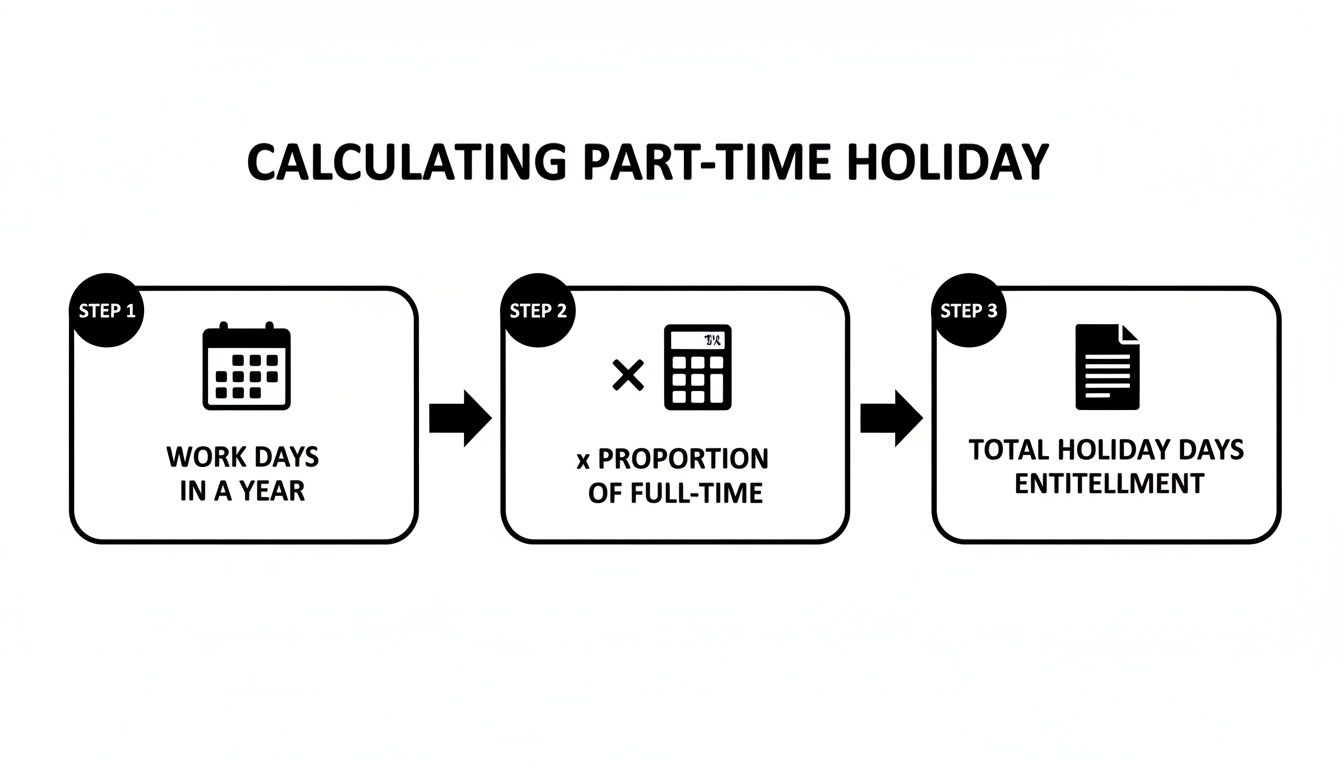
This method ensures the total number of paid days off is proportional, regardless of which specific days the employee is scheduled to work.
If a bank holiday lands on a day the part-timer would normally work, it simply gets deducted from their total pro-rata allowance. If it falls on one of their non-working days, their allowance isn't touched, and they can book their leave on other days instead. This approach guarantees that all part-time staff receive their full, legally mandated entitlement without any fuss.
When Working on Bank Holidays Is Necessary
For many industries—think hospitality, retail, and healthcare—staying open on bank holidays is just part of the job. In these cases, it's perfectly legal to require staff to work, as long as their contract allows for it. If you want to dive deeper into this, you might find our guide on if you need your staff to work on public holidays helpful.
When an employee does work on a bank holiday, they don't lose that day of leave. Instead, they should be given a day off in lieu to take at another time. This makes sure they still receive their full statutory holiday entitlement of 5.6 weeks. Clear communication and a solid system for tracking these days in lieu are absolutely vital to manage this process smoothly and without errors.
Managing Leave Carry Over, Accrual, and Final Pay
What should you do with unused holiday at the end of the year? And how do you handle it when an employee leaves the business? These are two of the trickiest areas of leave management, and a misstep can easily land you in hot water.
The rules around carrying over annual leave and calculating final pay are strict for a good reason: they make sure employees either get the rest they're entitled to or are paid fairly for it. The core idea is that holiday is for rest, so the law isn't keen on people "banking" huge amounts of leave. But there are some key exceptions and very specific rules for settling up when someone moves on.
The Rules on Carrying Over Unused Leave
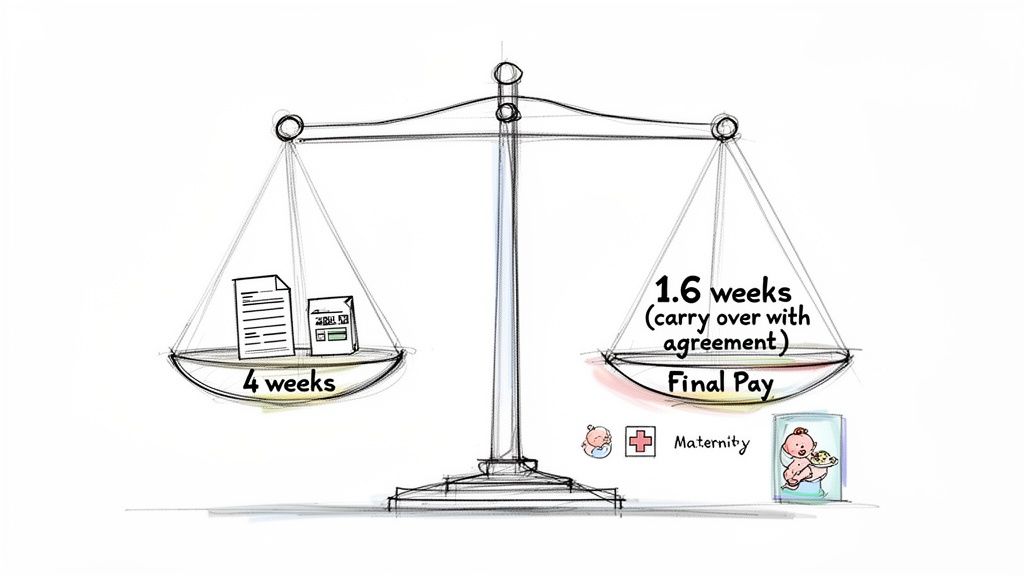
For carry-over purposes, the UK’s legal holiday allowance is split into two different pots, and it's crucial to know which is which.
The first four weeks of statutory leave come from European law and are primarily about health and safety. Because of this, this block of holiday generally cannot be carried over into the next leave year. It has to be taken.
The extra 1.6 weeks are UK-specific, and this portion can be carried over, but only if you have a clear, written agreement with your employee. This is something you’d normally spell out in an employment contract or company handbook. If there's no agreement, the default is that all 5.6 weeks must be used up in the year they're accrued.
But, as with most rules, there are some important exceptions.
- Long-Term Sickness: If an employee is on long-term sick leave and simply can't take their holiday, they must be allowed to carry over up to four weeks of their statutory leave into the next year.
- Family-Related Leave: It's a similar story for anyone on maternity, paternity, adoption, or shared parental leave. If they can't take their holiday because they're on family leave, they must be allowed to carry it over.
These rules ensure people aren't penalised for being unable to take time off due to circumstances they can't control. For a deeper dive into specific scenarios, our article on whether you can carry over leave for an employee has more detail.
Calculating Pay for Untaken Leave on Termination
When an employee leaves your company, you are legally required to pay them for any statutory holiday they've earned but haven't used. This calculation is a fundamental part of getting their final pay right.
The process itself is quite simple and is based on how far through the holiday year the employee has worked.
The Calculation in Three Steps:
- Figure out accrued leave: First, calculate the fraction of the year they worked. For someone leaving after three months, that's 3 ÷ 12 = 0.25. Then multiply this fraction by their full annual entitlement. For example, 28 days × 0.25 = 7 days accrued.
- Subtract leave already taken: Check your records to see how many days they've already used during the current leave year.
- Calculate the final payment: If they've accrued 7 days but only taken 5, you must pay them for the remaining 2 days in their final salary.
Worked Example: An employee with a 28-day entitlement leaves after 9 months. They have worked 75% of the year (9 ÷ 12), so they've accrued 21 days of leave (28 × 0.75). If they have already taken 18 days, you owe them payment for 3 days.
Following this method helps prevent disputes and keeps you on the right side of the law.
Handling Employees Who Have Taken Too Much Leave
But what if the opposite happens? It’s not uncommon for an employee to leave after having taken more holiday than they’ve actually accrued for the year.
In this situation, you might be able to reclaim the difference from their final pay. However, you can only do this legally if there's a specific clause in their employment contract that clearly allows for such deductions.
Without that contractual right, you can't lawfully deduct the overpayment. This really underscores the importance of having a well-drafted contract and keeping meticulous, up-to-date records of all leave taken.
Avoiding Common Holiday Allowance Pitfalls
Navigating the rules around legal holiday allowance UK can sometimes feel like walking a tightrope. One small misstep in your calculations or policies can lead to unhappy employees, a dip in morale, and even a costly employment tribunal. Getting this right isn't just a box-ticking exercise in compliance; it's about building trust and showing your team they're valued.
Many businesses, especially smaller ones without a dedicated HR department, fall into the same predictable traps. These errors are rarely deliberate but can snowball into serious problems. This section is your preventative guide, shining a light on the most common mistakes and giving you clear, actionable ways to keep your business safe and your team treated fairly.
Think of it as a health check for your leave policies. By spotting and fixing these potential issues now, you can sidestep major headaches down the road and make sure your processes are robust, compliant, and fair for everyone involved.
Miscalculating Pay for Variable Hour Workers
One of the most frequent slip-ups is getting holiday pay wrong for staff whose hours and pay aren't fixed. It’s easy to see the temptation – just pay them their standard hourly rate for a day off. But legally, that’s not the right way to do it, and it often means you’re underpaying them.
The law is crystal clear on this: holiday pay must reflect what a worker would have normally earned if they’d been at work. This means you have to calculate their average pay over a 52-week reference period, looking only at the weeks they actually got paid. Crucially, this calculation needs to include things like regular overtime, commission, and certain types of bonuses.
How to get it right:
- Use the 52-week reference period: Diligently track an employee’s earnings over the previous 52 paid weeks to find their true average weekly pay.
- Factor in all relevant earnings: Make sure your payroll system is set up to include overtime, commission, and any other payments that form part of their normal pay packet.
- Automate wherever possible: Doing this manually is a recipe for mistakes. Using payroll or dedicated leave management software can automate this complex process, guaranteeing accuracy and freeing up your time.
Unfair Bank Holiday Treatment for Part-Time Staff
Here’s another classic pitfall: mishandling bank holidays for part-time workers. If your business shuts down on bank holidays (which often land on a Monday), a part-timer who doesn't work Mondays can easily lose out. They effectively miss a paid day off that their full-time colleagues automatically get.
This can quickly be seen as unfair treatment. The proper way to handle it is to give all part-time employees a pro-rata entitlement to bank holidays, no matter which days of the week they happen to work.
Key Principle: A part-time worker's total holiday entitlement, bank holidays included, should be proportional to a full-time worker's. They shouldn't be penalised just because their work schedule doesn't line up with the public holiday calendar.
Ambiguous Policies on Carrying Over Leave
Failing to have a clear, written policy on carrying over unused annual leave is a guaranteed way to cause confusion and disputes. While the first four weeks of statutory leave generally can't be carried over, the extra 1.6 weeks can be—but only if you have a formal agreement in place saying so.
Without a clear policy, employees might assume they can bank their leave indefinitely, leading to some awkward conversations at the end of the year. Recent data shows a huge shift in employee habits, with unused holiday days dropping by 71% since 2019. People are more determined than ever to take their breaks. For business owners, this trend makes having clear rules and accurate tracking essential for managing workloads and expectations, as you can discover more insights about annual leave statistics.
How to get it right:
- Formalise your policy: Put it in writing. State clearly in employment contracts and your company handbook how much leave (if any) can be carried over, along with any deadlines for using it.
- Communicate regularly: Don't wait until December. Remind staff about the carry-over rules well before the end of your holiday year to encourage them to get their time off booked.
To help you give your own procedures a quick audit, we’ve put together a simple checklist to make sure you’re on the right track.
Holiday Allowance Compliance Checklist for Small Businesses
A quick run-through of this checklist can help you spot any gaps in your current approach to managing annual leave. It’s a simple way to ensure your policies are not just compliant, but also clear and fair for your whole team.
| Compliance Checkpoint | What to Verify | Common Mistake to Avoid |
|---|---|---|
| Correct Entitlement | All workers receive at least 5.6 weeks' statutory leave, calculated pro-rata for part-timers. | Assuming the minimum is 20 days plus bank holidays, which can fall short depending on the setup. |
| Accurate Holiday Pay | Pay for variable-hour workers is based on a 52-week average of all normal earnings. | Paying only the basic contractual rate without including regular overtime or commission. |
| Fair Bank Holidays | Part-time workers receive a pro-rata share of bank holidays, regardless of their work pattern. | Only giving a day off if the bank holiday falls on their scheduled workday, disadvantaging others. |
| Clear Carry-Over Rules | A written policy exists that specifies rules for carrying over the additional 1.6 weeks of leave. | Having no formal policy, which leads to confusion, inconsistency, and employee disputes. |
| Termination Payments | Final pay correctly includes payment for all accrued but untaken statutory holiday. | Miscalculating accrued leave or simply forgetting to pay it out when an employee leaves. |
By regularly reviewing these points, you can feel confident that you’re meeting your legal obligations and fostering a positive, transparent work environment where everyone knows where they stand.
Your Holiday Allowance Questions Answered
Even when you feel you’ve got a solid grip on the rules, certain questions about legal holiday allowance in the UK pop up again and again. These are the practical, real-world problems that crop up in the day-to-day running of a business. This section is your quick-reference guide, with clear, direct answers to the most common head-scratchers.
Think of it as your troubleshooting manual for those tricky scenarios. From figuring out pay for your most flexible workers to managing leave during life’s big events, we've got you covered.
How Is Holiday Pay Calculated If My Pay Varies?
This is a big one, and it catches a lot of people out. For workers with irregular hours or pay that fluctuates—maybe because of commission, bonuses, or overtime—holiday pay has to reflect what they normally earn. Just paying them their basic rate for a week off isn't just unfair; it's against the law.
The rule is that you have to look back over the previous 52 paid weeks. You then calculate their average weekly pay from this period, and this average is what they should receive for each week of holiday they take.
Key Insight: This 52-week reference period is all about fairness. It smooths out the peaks and troughs of variable pay, giving a holiday wage that’s a true reflection of their typical earnings, not just a snapshot from a quiet week.
To get it right, the calculation must include a range of earnings:
- Overtime: Any regular, compulsory, and even some types of voluntary overtime.
- Commission: Payments directly linked to the work they do.
- Bonuses: Certain performance-related bonuses.
Getting this calculation right is crucial for keeping your team happy and staying on the right side of the law.
Can My Employer Tell Me When to Take My Holiday?
In a word, yes. Employers absolutely have the right to tell staff when they must take their annual leave. This is pretty common in industries that have a company-wide shutdown, like over the Christmas period or for annual maintenance.
But, and it's a big but, this right comes with a condition: you have to give the proper amount of notice. The rule is simple and designed to give people enough time to plan.
The notice you give must be at least twice as long as the period of leave you're requiring them to take.
- Example 1: If you want someone to take one day off, you must tell them at least two days in advance.
- Example 2: For a full week (five days) of mandatory leave, you need to give at least ten days' notice.
- Example 3: For a two-week Christmas shutdown (ten working days), you must give a minimum of twenty days' notice.
This rule also works in reverse. An employer can refuse a holiday request, but they must give notice that is at least as long as the leave requested. So, to turn down a two-week holiday request, you have to do it at least two weeks before the holiday was due to start.
What Happens to Holiday During Sick or Maternity Leave?
This is another area where the law protects employees from being penalised for things outside their control. Someone’s statutory holiday entitlement continues to build up (or accrue) as normal while they are off work on certain types of leave.
This protection kicks in during:
- Sick Leave: Both short-term and long-term.
- Maternity Leave: Throughout the entire statutory maternity period.
- Paternity Leave: During their allocated time off.
- Adoption Leave: For the duration of their statutory leave.
Think of their holiday pot like a savings account; it keeps growing even when they aren't actively at work. If an employee is on long-term sick leave and can’t take their holiday during the leave year, they have the right to carry it over.
Specifically, they can carry forward up to four weeks of their statutory leave into the next holiday year. The same goes for someone on maternity leave who might return to work with a full year's worth of holiday entitlement ready and waiting for them. It ensures they don’t miss out on the rest and recuperation that annual leave is for.


