
So, is Saturday officially a working day? The short answer is: it depends.
In the UK, there's no single law that stamps Saturday as a non-working day. Its status almost always comes down to what's written in an employee's contract. While the Monday-to-Friday workweek feels like a cultural given, the employment contract is the ultimate source of truth.
This is a critical point for both businesses and their teams to get right, as it touches everything from pay and overtime to calculating annual leave.
What Decides if Saturday is a Working Day?
Ultimately, three main things determine whether Saturday is part of the standard working week:
- The Employment Contract: This is the most important document of all. It should clearly outline specific working days and hours.
- Industry Standards: In some sectors, Saturday work is just part of the deal. Think of retail, hospitality, or healthcare, where weekend operations are standard.
- Legal Frameworks: While no one law covers it, various regulations around working hours and rest periods can influence how weekend work is handled.
This decision tree helps visualise how these key factors—the contract, the industry, and the law—come together to determine if Saturday work is required.
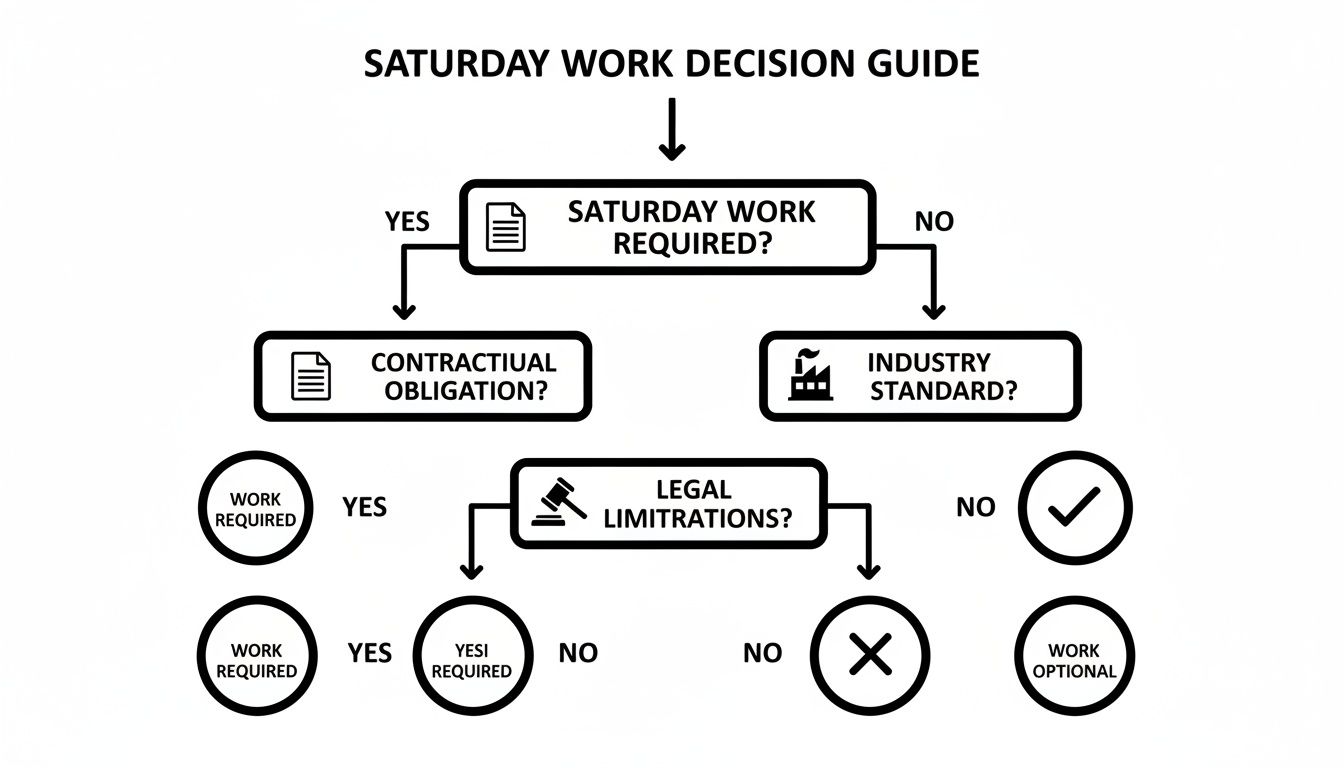
As the flowchart shows, the first and most critical checkpoint is always the employment contract. To really get to grips with this, it helps to understand the legal frameworks that define working hours and pay, like reviewing foundational labor laws like the FLSA. It's also useful to know the total number of UK working days per year to get the full picture for scheduling and leave calculations.
To make things even clearer, here's a quick summary of the factors that determine if Saturday is on the clock.
Quick Guide to Classifying Saturday as a Working Day
| Factor | When Saturday IS a Working Day | When Saturday is NOT a Working Day |
|---|---|---|
| Employment Contract | The contract explicitly states Saturday as a regular workday or part of a shift rota. | The contract specifies a Monday to Friday work schedule. |
| Industry Norms | Common practice in the sector (e.g., retail, hospitality, emergency services). | The industry traditionally operates on a standard business week. |
| Company Policy | The employee handbook or internal policies clearly define weekend work expectations. | The company culture and policies reinforce a weekend break. |
| Verbal Agreement | A clear, though less formal, understanding was reached during hiring about weekend work. | No mention of weekend work was made during recruitment or onboarding. |
This table boils it down, but remember: the written contract almost always has the final say.
The Story of How the Weekend Was Won
To really get why the Monday-to-Friday workweek feels so normal in the UK, we need to jump back in time. For most of the 19th century, the idea of a "weekend" as we know it simply didn't exist for the average person. The standard was a tough six-day grind, with Sunday usually being the only day off.
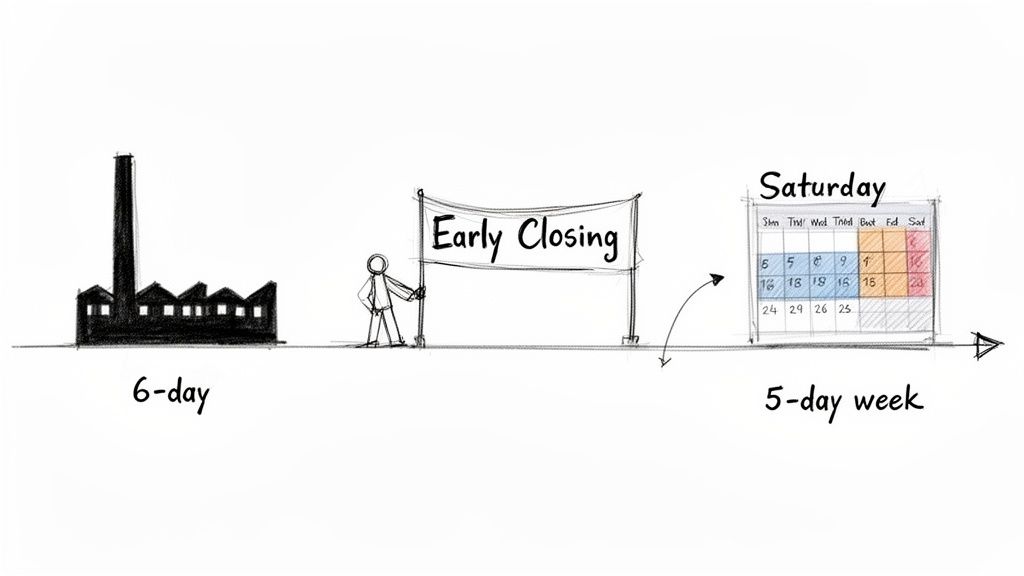
This relentless schedule only started to change because of long, hard campaigns for better working conditions. The story of how Saturday’s status evolved is a huge moment in UK labour history. A real turning point was the 1867 Factory Act, which made a Saturday half-day a legal must for workers in factories and mills. But this change didn't just happen overnight; it was the fruit of decades of struggle by groups like the Early Closing Association, founded way back in 1842. It's fascinating to read about how workers won the weekend and appreciate the full story.
The Rise of the Five-Day Week
That Saturday half-day was just the start. The dream of a full two-day weekend really started to pick up steam in the early 20th century, as both companies and unions began to see that a well-rested workforce is a more productive one.
The shift was not just about time off; it was a fundamental change in the relationship between work and life. It established a cultural expectation that weekends are for personal time, family, and rest.
By the time the post-war era rolled around, the five-day, 40-hour week had become the norm across most industries. This whole history is the reason why, even without a specific law stating it, most of us just assume Saturday isn't a working day. It's a powerful cultural standard, forged over a century of social change, and it shapes the expectations every employee brings to a new job. This context is vital when you're deciding is Saturday classed as a working day in your own business.
Why Your Employment Contract Is the Final Word
We all tend to think of the working week as Monday to Friday, but that's just a cultural habit. When it comes to what's official, your employment contract is the only document that really matters. Think of it as the ultimate rulebook for the job; what it says goes, trumping any assumptions or industry norms.
This legal document is where the precise terms and conditions of your employment are laid out, and it’s the place your working days should be explicitly defined. If the contract states that the workweek runs from "Monday to Friday," then Saturday is clearly not a standard working day. Any work you do on a Saturday would almost certainly be classed as overtime.
On the other hand, if a contract specifies a work pattern like "any five days out of seven" or mentions a rota system, then the answer to is Saturday classed as a working day is a definite 'yes' for that employee.
Defining Work Days with Clarity
Vague language in a contract is a recipe for disaster down the line. Ambiguous phrases like "flexible hours" or "weekend work may be required" without any further explanation are just asking for trouble.
For instance, a poorly worded clause could easily lead to arguments over holiday pay calculations, overtime rates, or even whether an employee has the right to refuse a weekend shift. These aren't just minor admin headaches; they can seriously erode trust and even lead to costly legal challenges.
At its core, the working hours clause in a contract is there to get rid of any grey areas. It creates a clear, mutual understanding that protects both you and your employee from future conflict.
To head off these problems, contracts need to be drafted with absolute precision. It's not enough to just hint at the possibility of weekend work.
Your contract clauses should spell out:
- Standard Working Days: List the days crystal clear, e.g., "Monday to Friday" or "Tuesday to Saturday."
- Working Hours: Define the total hours per week and the typical start and finish times.
- Overtime Provisions: Detail how extra hours are requested, approved, and paid for.
- Flexibility and Variation: If schedules might change, include a clause explaining how that process works, making sure it’s fair and reasonable.
By being meticulous from the start, you create a contract that isn't just legally sound but also builds a transparent and fair working relationship from day one.
How Different Industries See the Working Week
The idea of a "standard working week" really isn't one-size-fits-all. It has to bend and flex to meet the unique needs of each industry. Just picture it: a finance firm in the City of London and a popular café on the Brighton seafront operate on completely different schedules. One runs on a classic Monday-to-Friday rhythm, while the other absolutely depends on the weekend crowds to stay in business.
This context is everything. For businesses in retail, hospitality, logistics, and the emergency services, the question of is Saturday classed as a working day usually gets a straightforward "yes." Their entire business model is built around being available when most of the population is off, so weekend work isn't just common—it's a standard part of the job description.
On the flip side, you have sectors like public administration, education, finance, and most traditional office jobs. These industries have long established the Monday-to-Friday workweek. It's a structure that grew out of the historical fight for the weekend, creating a powerful cultural expectation that Saturday is a day for rest, not work.
Of course, what’s common practice in different sectors can vary. Here’s a quick look at how Saturday work is typically viewed across the UK.
Saturday Work Status Across UK Industries
| Industry Sector | Common Practice for Saturday Work | Contractual Considerations |
|---|---|---|
| Retail & Hospitality | Standard working day, often the busiest. | Usually included as a regular day in employment contracts. |
| Healthcare (NHS & Private) | Essential 24/7 service; Saturday is a normal rostered day. | Shift patterns and weekend work are standard contractual terms. |
| Logistics & Distribution | Very common, driven by e-commerce and delivery demands. | Often part of a rotating shift schedule defined in the contract. |
| Manufacturing | Varies; some operate 24/7 shifts, others stick to weekdays. | Depends on production cycles; may be optional overtime or standard. |
| Finance & Professional Services | Generally not a working day; work is an exception. | Saturday work is rare and typically handled as paid overtime. |
| Education (State Schools) | Not a working day for teaching staff. | Contracts are based on term-time, Monday to Friday. |
| Public Sector (Admin) | Almost always a non-working day. | Firmly established Monday-to-Friday contractual hours. |
As you can see, there’s no single rulebook. It all comes down to the operational realities of the business.
Weekend Work Is More Common Than You Might Think
Despite the traditional "9-to-5, Monday-to-Friday" ideal, weekend work is a reality for a huge chunk of the UK workforce. In fact, on any given Saturday or Sunday, over 20% of the UK’s labour force is on the job. Dig a little deeper, and you'll find that more than half of all working adults say they work on a weekend at least occasionally. You can find more detail on this in studies about weekend working patterns in the UK.
Getting a handle on these industry norms is a must for any business owner. It helps you set realistic work patterns, attract the right kind of talent, and make sure your company's rhythm aligns with what your customers and the wider sector expect.
Ultimately, whether Saturday is just another day at the office or a well-earned day off comes down to the world your business lives in. Checking your policies against what’s standard for your sector is the first step toward creating fair and effective work schedules that work for everyone.
Navigating Payroll and Holiday Pay Rules
Deciding to classify Saturday as a standard workday isn’t just a scheduling choice—it sends financial and administrative ripples through your entire payroll process. Getting this wrong is a fast track to incorrect pay, compliance headaches, and seriously unhappy employees.
When Saturday is written into an employee's contracted hours, it has to be treated just like any other working day for payroll. That means their basic pay calculation includes Saturdays, which then forms the foundation for things like holiday pay. Simple enough, right?
Well, the real complexity kicks in with overtime. If Saturday is not a standard day, any hours they clock in must be paid at the overtime rate you've set out in their contract. But if it is a standard day, overtime only begins after the employee has worked their contracted hours for that day or week. It's a subtle but crucial difference.
Calculating Holiday Entitlement Correctly
Holiday pay is where so many businesses stumble. An employee's statutory holiday entitlement is based on the number of days they work each week. So, if someone works a regular five-day week from Tuesday to Saturday, their holiday entitlement is calculated in exactly the same way as a Monday-to-Friday colleague.
Things get a bit trickier with part-time staff. Picture an employee who works three days a week, and one of those days is always a Saturday. Their pro-rata holiday entitlement must reflect this three-day working week. Your calculations have to be accurate and fair. For a detailed breakdown, you can learn more about simple methods to calculate holiday pay that will keep you compliant.
The core principle is consistency. If Saturday is contractually a working day, it must be treated as such across all pay and leave calculations. Any deviation creates risk and administrative chaos.
Juggling these different pay structures can feel like a real challenge. For deeper insights into managing the complexities of payroll and varied working day payments, you might find valuable resources from payment solutions from payments-experts. Accurately answering is Saturday classed as a working day on a contractual level is the first step to flawless payroll and holiday administration.
How to Automate Complex Work Schedules
Let's be honest, manually juggling different work patterns is a massive administrative headache. It's the kind of task that's just begging for costly mistakes. When you're trying to track who works when—especially when you’re asking is Saturday classed as a working day for some staff but not others—things can get messy, fast. It’s simply not a sustainable way to operate.
This is exactly where automation steps in to save the day.
Modern systems let you build custom work patterns that clearly define any day, including Saturday, as an official working day for specific employees or entire teams. This completely removes the administrative guesswork and the all-too-common risk of human error. Automation ensures that every leave request, holiday calculation, and payroll run is spot-on, because it's always based on the correct schedule.
For instance, you can easily configure settings for different groups of employees. A team in retail might work every Saturday, while your office staff works Monday to Friday. Setting this up becomes a simple, one-time task.

As you can see, it's straightforward to set specific days and hours. The system knows precisely which days count and which don't, without you having to lift a finger.
By putting these rules in place, you create a process that's transparent and reliable for everyone. This is a core feature of an effective time and attendance system, freeing you up to focus on what really matters—growing your business instead of untangling scheduling mix-ups.
Got Questions? We’ve Got Answers
Even when you think you’ve got contracts and industry norms figured out, specific questions always seem to pop up. Let’s tackle some of the most common queries we see from both employers and employees.
Can My Employer Change My Work Days to Include Saturdays?
Generally, no. An employer can't just change your contracted working days without your agreement. Shifting your schedule to include Saturdays is a significant change to your terms of employment.
Unless your contract has a specific clause allowing for this kind of flexibility, they need to consult with you properly and get you to agree to a formal change in your contract. Trying to force it through without your consent could land them in hot water for breach of contract.
Do Bank Holidays on a Saturday Count as a Day Off?
This one comes down entirely to what’s written in your employment contract. Believe it or not, there’s no automatic legal right to have bank holidays off.
If Saturday is a normal working day for you, your employer isn’t legally required to give you the day off just because it’s a bank holiday. That said, many reasonable employers will offer a day off in lieu to make up for it.
Key Takeaway: To avoid any confusion, your contract should always be crystal clear about how bank holidays are handled, especially if you work a non-standard shift pattern.
If My Contract Says 'Monday to Friday,' Can I Be Forced to Work on a Saturday?
Absolutely not. If your contract explicitly states your working days are ‘Monday to Friday,’ that’s the deal. Your employer can't compel you to come in on a Saturday.
They can certainly ask you to work, but it would be classed as overtime. It would need to be paid according to your company’s overtime policy or whatever is specified in your contract.


