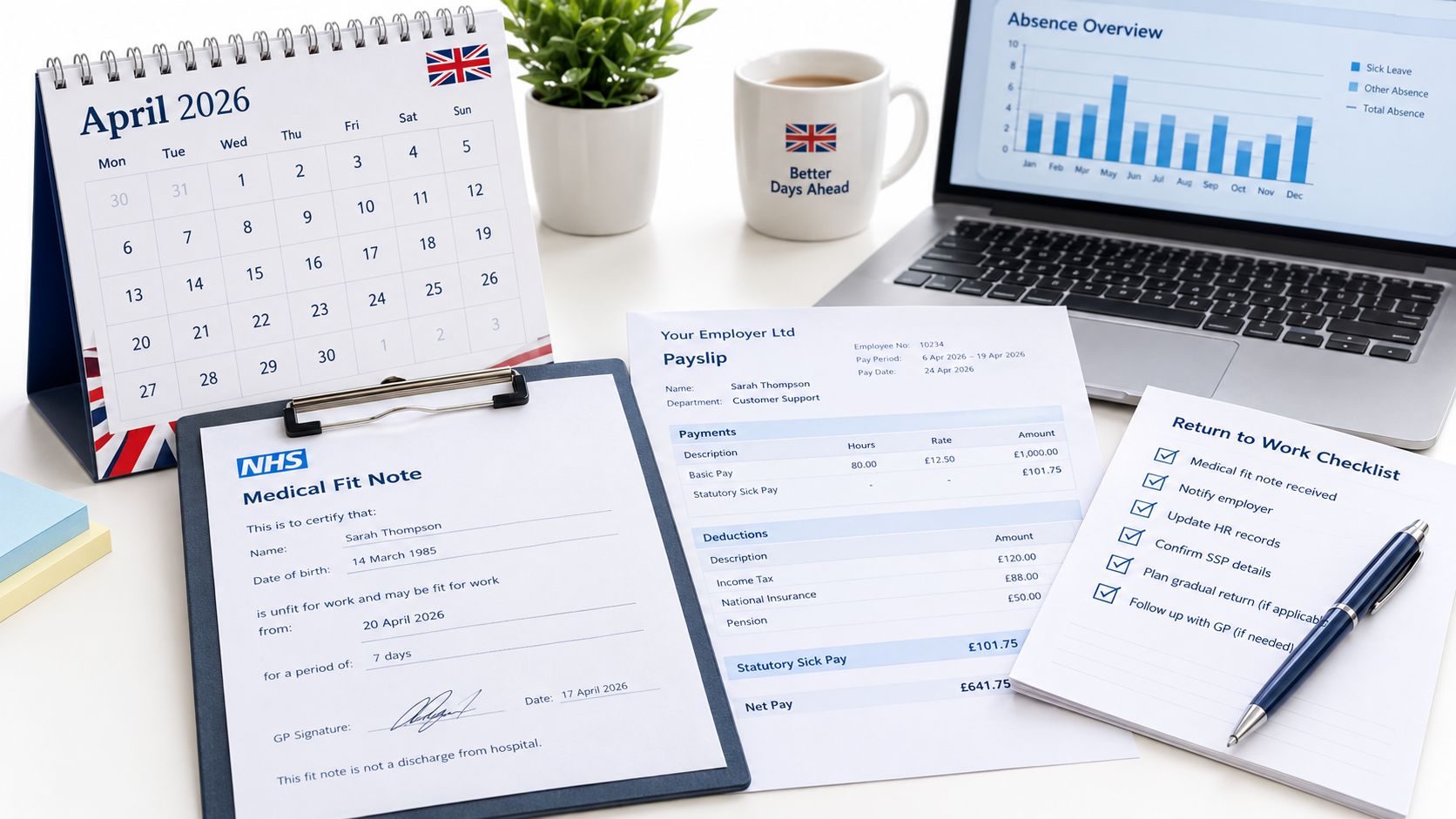
If you run a small business, HR paperwork rarely looks dramatic from the outside. It just sits there. A contract in someone’s inbox. A sick note on a desk. A signed policy saved with the wrong file name. A leave approval recorded in one system, then copied into a spreadsheet later.
That quiet mess is where problems start.
An hr document management system gives you one controlled place for employee records, policy documents, signed forms, absence evidence, and compliance files. It also helps you manage who can see them, how long you keep them, and what happens when someone needs them fast.
For UK employers, that matters for two reasons. First, time. Small teams can’t afford to waste hours hunting for records. Second, compliance. Employee files contain sensitive personal data, and UK rules around security, retention, and access aren’t forgiving if your processes are loose.
The HR Paperwork Nightmare in Small Businesses
Sarah runs a growing business with a small office team and a handful of field staff. She doesn’t have a large HR department. Many others in her position don't have this luxury. HR admin gets split between the owner, an office manager, and whoever knows where the forms are kept.
A new starter asks for a copy of their contract. A manager needs last year’s absence record before a return-to-work meeting. Payroll wants confirmation of a change to working hours. Then an auditor asks for historical records.
None of these requests is unusual. The stress comes from where the information lives.
Some files are in paper folders. Some are in shared drives. Some were emailed over months ago and never saved properly. A doctor’s note may be attached to an absence email, while the approval itself sits in a leave calendar. The employee handbook exists in three versions, and nobody is fully sure which one was current when a policy dispute started.
This is the true paperwork nightmare. It isn’t only clutter. It’s uncertainty.
Small businesses often feel this most sharply because there isn’t a dedicated records team keeping everything tidy. The same person approving annual leave may also be checking payroll changes, answering employee questions, and handling onboarding packs. When documents are scattered, every task slows down.
Security worries sit underneath all of it. HR files include addresses, bank details, medical information, disciplinary notes, and emergency contacts. If those records are left in unsecure cabinets, forwarded through email, or shared too broadly on a drive, the risk grows.
Practical rule: If you can’t say exactly where an employee record lives, who can access it, and which version is current, your process isn’t under control.
That’s why businesses move to a proper hr document management system. It replaces guesswork with structure. It gives you a single place to organise records, apply rules, and stop paperwork from becoming a daily source of friction.
What Exactly Is an HR Document Management System
An hr document management system is a secure digital environment for storing, organising, controlling, and tracking HR records throughout their lifecycle.
Think of it as a smart filing cabinet. A normal cabinet holds papers. A smart one knows what each document is, who should see it, when it should be reviewed, and whether an older version has been replaced.

It does more than cloud storage
A shared folder in Google Drive or Dropbox can hold documents, but storage alone isn’t management.
A proper HR DMS adds controls that general file storage usually lacks:
- Searchable structure: Contracts, policies, right-to-work evidence, payroll letters, and absence documents can be organised by employee, document type, or process.
- Permission layers: A line manager might view fit notes and leave records, while payroll can access pay-related documents, and only senior HR staff can open disciplinary files.
- History and accountability: The system can show who uploaded, viewed, changed, or approved a document.
- Retention rules: Files can be flagged for review, archiving, or deletion according to policy.
If you’re building a broader compliance framework around records and controlled information, Safety Space’s guide to an effective document management program is a helpful reference point for thinking beyond simple file storage.
The three core jobs of a good HR DMS
Most confusion disappears when you break the system into three jobs.
Storage and retrieval
The first job is obvious. It keeps documents in one place and makes them easy to find. That includes scanned paper files, digital forms, signed agreements, and supporting evidence.
If you’re weighing whether built-in employee file storage is enough for your needs, this overview of document storage options is useful: https://www.leavewizard.com/do-you-need-document-storage/
Security and access control
HR records are not ordinary business files. They contain personal and sometimes special category data. A good system limits access by role, not by convenience.
That means people only see what they need to see.
Compliance and lifecycle management
This is the part many small businesses miss. Documents have a lifespan. Some need signatures. Some must be retained. Some should no longer be accessible after a certain point. Some should trigger alerts before they expire.
A strong HR DMS doesn’t just hold files. It applies rules to them.
That’s what turns a digital folder into a working HR control system.
Key Benefits for Small Business Compliance and Efficiency
The strongest argument for an hr document management system isn’t that it feels modern. It’s that manual handling wastes time and increases risk.
According to Foxit, inefficient document management contributes to a 21.3% productivity loss, and employees spend an average of 2 hours per day searching for files. The same source notes that 80% of information remains paper-based in many settings, which creates delays and avoidable risk for small businesses handling contracts, leave records, and compliance paperwork (Foxit document management statistics).
Faster answers to everyday HR questions
Most HR document requests are routine.
An employee wants their signed contract. A manager needs proof of a policy acknowledgement. Finance needs a letter confirming a pay change. Without a proper system, each request turns into detective work.
With a central DMS, staff search once and retrieve the correct record. That cuts wasted effort and makes your business look organised rather than reactive.
Better control over versions
Version confusion causes quiet but serious problems.
A manager downloads an old sickness policy. Someone sends a previous handbook to a new starter. A form gets amended locally, then reused without approval. This is how small admin errors become disputes.
A good system keeps one current version visible and preserves the document history in the background. You don’t need everyone to remember which file is final. The system does that job.
Fewer bottlenecks in approvals
Paper forms and email attachments slow down simple decisions.
A holiday request may be approved quickly, but the supporting paperwork sits in an inbox. A contract amendment gets signed, but nobody files it in the employee record. A return-to-work form is completed, then forgotten until someone asks for it months later.
When document workflows are standardised, approvals and filing happen together rather than as separate tasks.
More confidence during audits and disputes
When a business handles HR records properly, it can answer questions clearly.
You can show:
- What document was in force: Useful when a policy dispute arises.
- Who signed or acknowledged it: Important for contracts, handbook updates, and employee notices.
- When it was changed: Critical for internal reviews.
- Where the supporting evidence sits: Especially helpful for sickness, leave, and disciplinary matters.
That kind of order reduces stress even before any regulator, insurer, or adviser gets involved.
A more scalable way to run HR
Manual methods often feel manageable until the team grows.
A ten-person business may cope with folders and email chains. A twenty-person business starts to feel strain. Add multiple managers, hybrid working, or several sites, and the cracks become obvious fast.
Here’s a simple comparison:
| Process | Manual setup | HR DMS setup |
|---|---|---|
| Contract retrieval | Search desk, inbox, shared drive | Search employee file |
| Policy updates | Email latest version and hope it’s used | Publish controlled current version |
| Sick note storage | Saved in inbox or printed | Filed to employee record |
| Leaver file review | Manual checklist | Structured file archive process |
Small businesses don’t need more admin. They need fewer moving parts.
That’s the practical benefit. A DMS reduces repeat effort, cuts the chance of missing something important, and gives you a cleaner foundation for compliance.
Mastering HR Compliance and Security in the UK
UK employers handle some of the most sensitive data in the business. Employee records can include health information, salary details, disciplinary notes, next-of-kin contacts, and identification documents. Storing that data casually is no longer defensible.

What UK GDPR means in practice
Under UK GDPR, an HR DMS must provide encryption, role-based access, and full audit trails. The same source notes that failure can lead to fines of up to £17.5 million, and that a proper DMS can automate retention schedules and enforce security policies, reducing manual errors by up to 70% (UK GDPR requirements for HR document systems).
For a small business owner, those terms can sound technical, so it helps to translate them.
Encryption
Encryption means the information is protected so that unauthorised people can’t read it if they gain access to the file or the storage environment. Think of it as locking the contents, not just the cupboard door.
Role-based access
This means permissions follow job responsibility. A supervisor may need access to absence records but not salary adjustment letters. Finance may need payroll-related documents but not disciplinary notes. Access should be deliberate, not open by default.
Audit trails
An audit trail records actions around a document. Who uploaded it. Who opened it. Who changed it. When that happened. This matters when you need to show internal control, investigate a mistake, or respond to a dispute.
Retention is a legal issue, not a filing preference
In the UK, retention rules matter because employers can’t keep everything forever and they can’t delete records randomly either.
The verified data shows that HR departments must retain employee records for at least 6 years post-employment under UK rules highlighted in the source material, and that manual handling makes this harder when businesses rely on mixed paper and digital systems. That same context is why retention automation matters. It helps ensure documents are kept for the required period and reviewed when their retention point changes.
A small business often gets stuck in two bad habits:
- Keeping records indefinitely: This increases exposure if sensitive files remain accessible without a clear reason.
- Deleting or losing records too early: This leaves gaps when HMRC, an adviser, or a dispute requires evidence later.
A solid DMS applies retention schedules consistently. Staff don’t have to rely on memory or handwritten archive labels.
Security failures usually start with ordinary habits
Most document security problems don’t begin with dramatic cyber incidents. They begin with normal shortcuts.
Common examples include:
- Shared folders with broad access: Everyone can open more than they need.
- Email attachments passed around internally: Copies multiply, and nobody knows which one is controlled.
- Paper files left in unsecured storage: Physical security is still data security.
- Scanned documents with vague names: A file called “note final new.pdf” is not a controlled record.
If you want a practical starting point for privacy-focused HR systems, this guide on secure-by-design thinking is worth reading: https://www.leavewizard.com/gdpr-are-you-secure-by-design/
The cost of getting it wrong
Compliance risk often feels abstract until a business has to respond to an incident.
The legal and financial exposure is real. The verified data includes the example of British Airways receiving a £20 million penalty in 2020 after a major breach, used in the source to illustrate how weak data security can escalate into regulatory and reputational damage. Small firms may not face headlines of that scale, but they can still face serious disruption, investigation, and cost when employee data is mishandled.
A short explainer can help ground the issue before you assess your own controls.
The features that matter most for UK employers
A compliant HR document setup should support these basics:
| Requirement | Why it matters in practice |
|---|---|
| Access controls | Limits exposure of confidential staff data |
| Audit history | Helps prove who did what and when |
| Retention rules | Supports lawful record keeping and review |
| Searchability | Helps answer employee, payroll, or audit queries quickly |
| Document history | Preserves prior versions for disputes and accountability |
If your records system can’t show access history, apply permissions, and support retention rules, it may store HR documents, but it doesn’t manage them safely enough.
For UK businesses, that’s the shift in mindset that matters. An hr document management system is not just about tidiness. It’s part of your compliance control environment.
Connecting Your DMS with Leave and Absence Management
Significant power of an hr document management system appears when it connects to another HR process instead of sitting off to one side.
Leave and absence management is a strong example because it generates both decisions and documents. You don’t just record that someone is away. You may also need the request, approval history, supporting evidence, fit notes, return-to-work documents, or policy acknowledgements linked to that absence.

What integration changes day to day
Without integration, teams often split the process in two.
The leave request sits in one tool or spreadsheet. The evidence sits in email. The signed form is scanned later and stored somewhere else. If anyone wants the full story, they have to reconstruct it.
When the systems connect, the process becomes much cleaner:
- An employee submits a leave or absence request.
- A manager approves or rejects it in the workflow.
- Supporting documents are attached to the employee record.
- The business keeps a clearer audit trail of both the decision and the evidence.
That creates a single source of truth instead of several partial ones.
A simple example
Take sickness absence.
An employee reports off sick. They later provide a note. A manager holds a return-to-work discussion. Under a fragmented process, each piece may be handled by a different person and stored in a different place.
Under an integrated process, the absence timeline and the related documents stay connected. When HR reviews attendance later, they aren’t searching inboxes or asking managers to resend attachments.
Why this matters for compliance as well as admin
Absence records often contain sensitive information. That means the business needs to know not only that a document exists, but also where it sits, who can access it, and how long it should be retained.
Integration helps because it reduces manual handoffs. Fewer handoffs usually mean fewer filing mistakes.
For small businesses, this also helps managers do the right thing consistently. They don’t have to remember a separate filing step after each approval. The workflow supports the recordkeeping.
A good integration removes duplicate admin. A great integration also improves control.
That’s why businesses often pair document management with operational HR tools. One example is LeaveWizard, which includes employee information and document storage alongside leave and absence management. In practice, that means a business can keep records tied more closely to the people and events they relate to, rather than splitting them across disconnected systems.
How to Choose and Implement the Right HR DMS
Buying software is the easy part. Choosing the right system, setting it up sensibly, and getting staff to use it properly takes more thought.
For UK small businesses, cost matters. The verified data shows that average annual savings can reach £12,500, while setup costs for cloud-based systems can fall in the £2,000 to £5,000 range. The same source notes that avoiding non-compliance fines, which average over £10,000 per HR-related breach in the cited ICO-based data, often changes the value calculation (ROI and costs of HR document systems for small businesses).

What to look for before you buy
Not every system suits a small business. Some are overbuilt. Some are too loose for HR records.
Use these criteria to narrow the shortlist.
Security that fits HR records
Look for:
- Role-based permissions: Not everyone should see every file.
- Audit logs: You need visibility into document activity.
- Retention controls: The system should support document lifecycle decisions.
- Secure storage practices: Especially for contracts, medical information, and payroll-linked files.
Integration with your existing tools
A document system should reduce duplicate work, not create it.
Check whether it connects with:
- Payroll software
- Onboarding tools
- Leave and absence systems
- Core employee record platforms
If automation is part of your wider HR improvement plan, this overview of HR process automation helps frame what should be connected and what should stay tightly controlled: https://www.leavewizard.com/hr-process-automation/
Usability for non-technical teams
A strong system still fails if staff avoid it.
Ask practical questions:
- Can managers find what they need quickly?
- Is uploading simple?
- Can you apply document categories without complex training?
- Does the interface make obvious what is current and what is archived?
A phased implementation works better than a big-bang launch
Small businesses usually do better when they roll out in stages.
Phase 1, audit what you already have
Start by listing your document types. Contracts, policy acknowledgements, right-to-work evidence, payroll letters, sickness records, training records, leaver files.
Then identify where they currently live.
Phase 2, clean before you migrate
Don’t move junk into a new system.
Remove duplicates, flag outdated versions, and agree naming conventions. If your old files are messy, a new platform won’t magically fix that by itself.
Phase 3, design permissions and structure
Decide:
- Who needs access to what
- Which documents belong in each employee file
- What managers can upload
- What only HR or finance can edit
At this stage, many businesses either become organised or recreate the same chaos digitally.
Phase 4, migrate in batches
Move one document group first. Contracts are often a sensible place to begin. Then add policies, absence documents, and other record types.
A staged rollout helps you catch mistakes early.
Phase 5, train people on real tasks
Training works best when it follows actual scenarios.
Show managers how to find a contract, upload a fit note, view a policy acknowledgement, and check whether they have permission to open a file. Keep it practical.
Start with the documents that create the most friction or risk. Early wins build confidence faster than a massive migration plan.
Questions worth asking vendors
Before signing, ask these directly:
| Question | Why it matters |
|---|---|
| Can we set document access by role? | HR records need tight controls |
| Can the system show a full activity history? | Important for accountability |
| How does it handle retention and archiving? | Supports compliance processes |
| Can it integrate with other HR tools? | Reduces duplicate admin |
| What does implementation involve for a small team? | Helps avoid a stalled rollout |
A good hr document management system should make your processes clearer within weeks, not more confusing.
Maximising Your Investment for Long-Term Success
A new system won’t stay tidy on its own. Businesses get the best return when they treat document management as an ongoing discipline, not a one-off setup task.
According to Dynafile, annual audits can cut document redundancies by 30%. The same source notes that 72% of companies still use mixed paper and digital workflows, while 83% of workers lose time to versioning issues, which shows why an organised and maintained system matters long after launch (HR DMS best practices and version control risks).
Run a yearly document health check
An annual audit gives you a practical reset.
Review:
- Duplicate files: Remove copies that confuse users.
- Outdated policies and templates: Archive them properly.
- Permission settings: Check that leavers and role changes haven’t left the wrong access in place.
- Missing records: Spot gaps before an employee issue exposes them.
This doesn’t need to be complicated. A simple review calendar and ownership list is often enough.
Keep training alive
Most document problems come from ordinary user behaviour.
People save files with vague names. They upload to the wrong folder. They download a document and re-share it instead of linking to the controlled version. New managers often don’t realise the difference between viewing a record and owning it.
Short refresher training helps. So do quick guides for common tasks.
Measure outcomes, not just system usage
Don’t stop at “people are logging in”. Track whether the system is improving work.
Useful measures include:
- Time to retrieve common documents
- Number of duplicate or outdated files found in audit
- Percentage of records stored in the approved system
- Internal compliance issues caused by missing or misfiled documents
- Reduction in paper handling and manual chasing
Review your process when the business changes
A document setup that works for one office may struggle after expansion, new managers, hybrid working, or a restructure.
Review your rules when:
- You grow headcount
- You add new locations
- You change payroll or HR systems
- You introduce new leave or policy processes
The system creates value when staff trust it enough to use it as the first place they look, not the last place they check.
That’s the long-term goal. Not just digital storage, but dependable day-to-day control.
From Paper Chaos to Digital Clarity
Most small businesses don’t plan to create messy HR records. It happens gradually. A few paper files stay in circulation. A few emails become unofficial storage. A few versions of the same document start floating around. Then one day, finding the right file feels harder than it should.
A proper hr document management system changes that. It gives your business a controlled place for employee records, clearer access rules, better document history, and a more reliable way to support UK compliance obligations.
That matters for efficiency, but it matters even more for peace of mind. When a manager needs an absence record, when an employee asks for paperwork, when payroll needs evidence, or when a compliance issue appears, you want a process that’s calm and defensible.
For businesses moving further into digital HR, signed forms are often part of the next step. This guide to ensuring the validity of electronic signatures in HR forms is useful if you’re reviewing how documents are approved and stored in a legally sound way.
Paper chaos doesn’t disappear because a business gets busier. It disappears when someone puts a better system in place.
If your current process depends on memory, shared folders, and crossed fingers, this is not optional anymore. It’s infrastructure.