
Figuring out your team's holiday entitlement doesn't have to be a headache. It all boils down to one key number: 5.6 weeks. That's the rock-solid minimum paid holiday most workers in the UK are legally entitled to each year.
For someone working a standard five-day week, this translates cleanly into 28 days of paid leave.
Understanding Your Core Holiday Rights in the UK
Before diving into specific calculations, it’s crucial to get a handle on the basic rights that protect every worker. UK holiday law is designed to ensure everyone gets paid time off to rest and recharge—it's not just a nice-to-have, but a legal must-have for employee wellbeing.
The rules are surprisingly far-reaching. Nearly all workers in the UK are legally entitled to 5.6 weeks of paid holiday annually. This right, known as statutory entitlement, comes from the Working Time Regulations and applies across the board to full-time staff, part-timers, agency workers, and even those on zero-hour contracts.
Statutory vs Contractual Leave
Your holiday allowance will be defined in one of two ways. Getting the difference is the first real step to working out holiday entitlement correctly.
-
Statutory Entitlement: This is the legal floor—the 5.6 weeks (28 days for a full-timer) that an employer must provide. Think of it as the non-negotiable baseline.
-
Contractual Entitlement: This is any extra holiday your employer offers on top of the statutory minimum. If a contract promises 30 days of holiday, that's your contractual entitlement, which is more generous than what the law demands. A contract can always offer more, but never less.
It’s always worth checking the employment contract to see which applies. If the contract is silent on holiday or offers less than 5.6 weeks, the statutory minimum automatically kicks in. For a much deeper dive into the specifics, you can check out our detailed guide on statutory holiday entitlement in the UK.
The official government advice backs this up, clearly outlining the basic rights for most workers.
As you can see, the guidance confirms that statutory entitlement is capped at 28 days, even if an employee works six days a week.
To help you see the differences more clearly, here’s a quick comparison.
Statutory vs Contractual Holiday at a Glance
This table breaks down the key differences between the legal minimum holiday and what an employment contract might offer.
| Feature | Statutory Entitlement | Contractual Entitlement |
|---|---|---|
| Source | Set by UK law (Working Time Regulations). | Defined in the employee's employment contract. |
| Amount | 5.6 weeks per year (capped at 28 days). | Can be more than 5.6 weeks, but never less. |
| Flexibility | Cannot be reduced or signed away. | Can be negotiated and is specific to the employer. |
| Bank Holidays | Can be included within the 5.6 weeks. | The contract specifies if bank holidays are included or are additional. |
Ultimately, the employment contract is your source of truth, but the statutory entitlement is your safety net.
Who Is Entitled to Paid Holiday?
It's a common myth that these rights only cover permanent, full-time staff. The law is actually much broader, covering a wide range of working relationships. To get this right, you need to be clear on the difference between employees and contractors, a distinction often clarified by legislation like IR35. For more context, you can review details about IR35 Changes: What Contractors and Businesses Need to Know.
Key Takeaway: The term 'worker' is broader than 'employee'. If someone has a contract to do work personally, they are very likely classified as a worker and are therefore entitled to paid holiday. This brings many people on casual or zero-hour contracts into the fold.
The Role of Bank Holidays
Bank holidays are another regular source of confusion. In England and Wales, there are typically eight bank holidays a year. An employer is perfectly within their rights to include these as part of the 28-day statutory entitlement.
For example, a contract might state holiday is "20 days plus bank holidays." This adds up to 28 days, meeting the minimum requirement.
Crucially, there’s no automatic legal right to take bank holidays off. If your business is open on a bank holiday, your employer can require people to work, as long as it's written into their contract. If they do work, they must still get their full 28 days of paid leave to take at other times during the year.
Calculating Leave for Part-Time and Irregular Hours
Once you move beyond the standard five-day work week, calculating holiday for part-time and irregular hours staff can feel a bit daunting. I’ve seen plenty of managers worry about getting it wrong, but the principles are actually quite straightforward once you get the hang of them.
The golden rule is that everyone gets the same amount of holiday, just adjusted for the time they work. This ensures part-time workers receive their statutory minimum of 5.6 weeks off, proportional to their hours, keeping things fair across the board.
Pro-Rata Holiday for Part-Time Staff
For employees with a consistent part-time schedule, the calculation is refreshingly simple. All you need to do is multiply the number of days they work each week by 5.6.
Let's walk through a common scenario. Imagine you have an employee, Sarah, who works a fixed three-day week.
- Her calculation: 3 days per week × 5.6 weeks = 16.8 days of paid holiday per year.
It’s always good practice to round up any fractions to the nearest half or full day. This small gesture avoids confusion and potential disputes down the line. In Sarah’s case, you’d likely round her entitlement up to 17 days.
For a deeper dive with more examples, check out our in-depth guide on the specifics of holiday calculation for part-time workers.
This process flow chart breaks down the foundational elements that build up to these calculations.
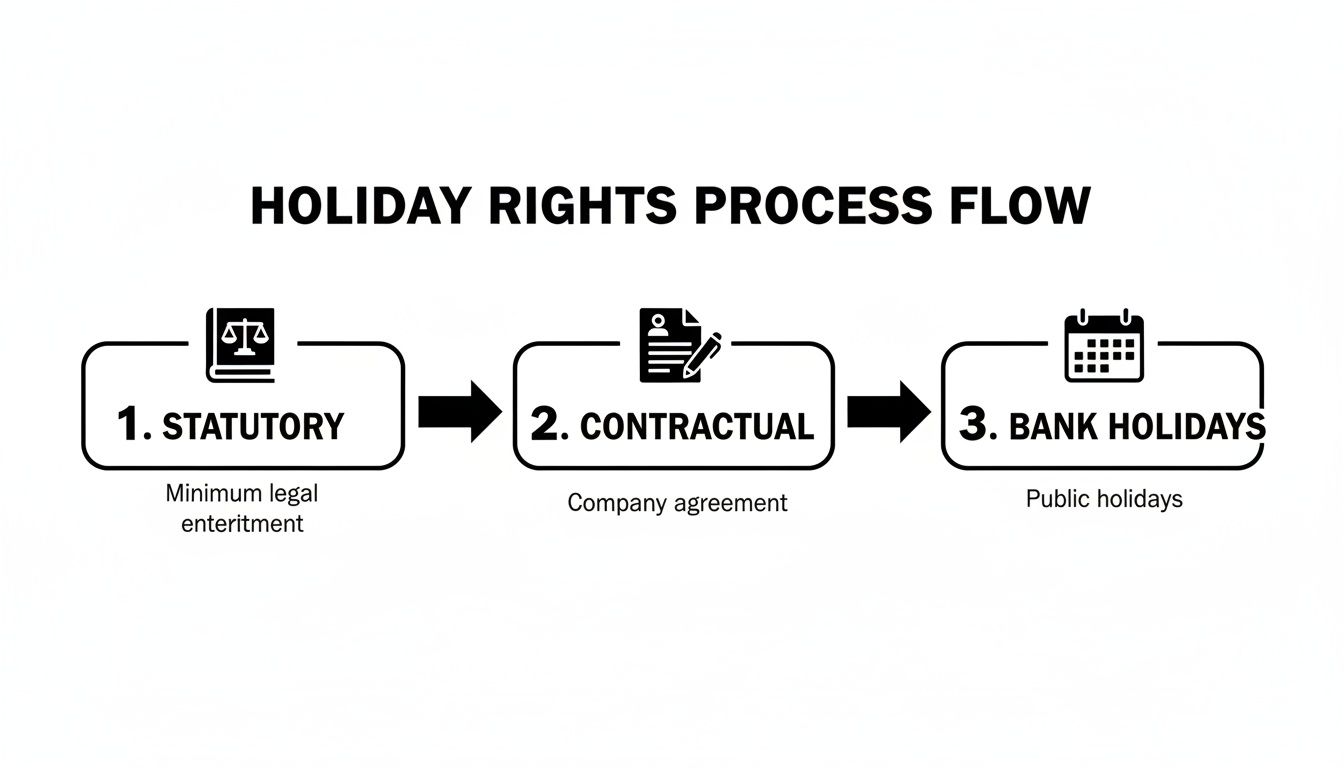
As you can see, every worker's entitlement starts with statutory rights, which are then shaped by their employment contract and the company's approach to bank holidays.
Calculating for Irregular and Zero-Hour Contracts
But what about staff whose hours change week by week, like casual workers or those on zero-hour contracts? A fixed-day calculation just won't work here. You need a method that flexes with the hours they actually put in.
This is where the accrual method comes in. It uses a specific percentage to calculate holiday entitlement as it’s earned.
For workers with variable hours, holiday is accrued at a rate of 12.07% of the hours they work. This is the standard, government-endorsed figure for calculating statutory leave.
Ever wondered where that seemingly random number comes from? It's derived by taking the 5.6 weeks of statutory leave from the 52 weeks in a year, which leaves 46.4 working weeks. Then, you divide 5.6 by 46.4, giving you 0.1207, or 12.07%.
This means for every hour someone works, they earn just over seven minutes of paid leave.
Let's apply this to a real-world example. Say a casual worker, Tom, logs 80 hours in a month.
- His holiday accrual: 80 hours × 12.07% = 9.65 hours of holiday.
This method directly ties their leave entitlement to the hours they’ve worked, making it the fairest system for everyone involved.
Working with Rolled-Up Holiday Pay
You may have come across 'rolled-up' holiday pay, where an extra amount is added to an employee's hourly rate instead of them taking paid time off. For a long time, this was unlawful because it was seen to discourage people from actually taking a break.
However, recent changes in legislation have brought it back into play for irregular-hours and part-year workers for leave years starting on or after 1st April 2024. Under the new rules, holiday pay can be calculated at 12.07% of a worker's total pay in a pay period and paid out with their wages.
For instance, if a worker earns £500 in a month:
- Rolled-Up Holiday Pay: £500 × 12.07% = £60.35
- Total Pay for the Month: £500 + £60.35 = £560.35
If you do go down this route, it's critical that this amount is listed as a separate, clearly marked item on the worker's payslip. While it offers immediate compensation, it requires meticulous administration to stay compliant with the new regulations.
Holiday Calculations for New Starters and Leavers
Knowing how to work out holiday entitlement gets a bit more interesting when someone joins or leaves part-way through your company’s leave year. It’s a common scenario, and both situations call for a pro-rata calculation to make sure the employee gets exactly what they’re owed—no more, no less. It’s all about being fair and staying on the right side of the law.
Holiday entitlement is earned, or accrued, as the year goes on. The standard way to think about it is that an employee accrues one-twelfth of their annual entitlement for each full month they work. So, if someone leaves halfway through the year, it stands to reason they’re entitled to half of their total annual leave.
This simple principle protects both the employee and you as the employer, ensuring everything is settled cleanly and accurately in their final pay.
Calculating Accrued Holiday When Leaving
Let's break down the calculation for an employee who's on their way out. The first thing you need to do is figure out exactly how much holiday they’ve earned right up to their last day.
The simplest formula to get you started is:
(Total annual entitlement / 12) × Number of full months worked = Accrued holiday
Imagine David, a full-time employee with the statutory entitlement of 28 days. His company's leave year runs from January to December, and he hands in his notice to leave at the end of June.
- He has worked 6 full months of the year.
- The calculation is: (28 days / 12) × 6 months = 14 days.
So, David has earned 14 days of holiday by the time he leaves. The next step is to check this against the holiday he's actually taken.
Handling Untaken or Overtaken Leave
Once you have that accrued figure, you'll land in one of two places. Each one has a different impact on the employee's final payslip.
-
Payment in Lieu of Untaken Holiday: If David has only taken 10 days of leave, he has 4 days left over (14 days accrued – 10 days taken). His employer must pay him for these 4 days in his final salary. This is often called a 'payment in lieu'.
-
Deduction for Overtaken Holiday: What if David took a two-week holiday early in the year and has used 15 days? In this case, he’s taken one more day than he actually earned. An employer can legally deduct the cost of this extra day from his final pay, but only if this is clearly stated in his employment contract.
Key Takeaway: The employment contract is absolutely crucial here. It must contain a clause that allows for deductions from final pay for any holiday taken in excess of entitlement. Without this, you could struggle to legally reclaim the money.
Calculations for New Employees
The exact same idea of accrual applies when someone joins your company. Their holiday entitlement for what’s left of the leave year is calculated on a pro-rata basis.
Working this out accurately can be a common sticking point for managers, but our guide on pro-rata holiday for new starters is a great resource for navigating any tricky situations.
Let's look at another example. A new employee, Maria, joins a company on 1st October. The leave year ends on 31st December, and her full-time entitlement is 28 days.
- She will work for 3 full months in that leave year (October, November, December).
- Her pro-rata entitlement is: (28 days / 12) × 3 months = 7 days.
Maria is therefore entitled to 7 days of paid holiday between her start date and the end of the leave year. It's a straightforward calculation that ensures she gets her fair share of leave right away, without having to wait for the next leave year to kick in.
Getting to Grips with Holiday Accrual and Carry-Over Rules
Understanding how holiday entitlement builds up over time is just as crucial as knowing the total annual allowance. Your full holiday entitlement isn’t just handed to you on day one of the leave year; instead, it accrues, or builds up, as you work. This system keeps things fair for everyone, especially when people join or leave part-way through the year.
The most straightforward way this works is through monthly accrual. Put simply, for every full month you’re employed, you earn one-twelfth of your total annual holiday. For a full-timer with the statutory 28 days entitlement, that works out to about 2.33 days earned each month.
This gradual build-up is a practical safeguard for any business. It stops a new starter from, say, taking their entire year's leave in their first month and then handing in their notice. It’s a clear, transparent way of tracking exactly what leave has been earned at any given point.
The Annual Question: What About Unused Leave?
As the end of the leave year looms, one question always pops up: what happens to any untaken holiday? This is where carry-over rules come into play, and the specifics nearly always come down to company policy. You should find the details clearly laid out in your employment contract or staff handbook.
Many businesses have a "use it or lose it" policy for contractual leave. This means any holiday not taken by the end of the leave year is simply lost. This approach encourages people to take regular breaks, which is vital for preventing burnout and keeping everyone healthy and productive.
But in reality, a lot of people struggle to use their full allowance. Recent studies on UK holiday patterns found that a massive 65% of employees left some leave untaken in 2024, and 17% ended up forfeiting five or more days. It’s a persistent challenge in a lot of workplaces. You can dig into more insights on how leave usage is changing over at Moorepay.co.uk.
When Carrying Over Holiday Is a Must
While employers can set their own rules for carrying over extra contractual leave, the law is much stricter when it comes to your statutory entitlement. In certain situations, an employer must let an employee carry over their holiday.
The main scenarios where carry-over is a legal requirement are:
- Long-Term Sickness: If an employee has been on sick leave for a long time and physically couldn't take their statutory holiday, they must be allowed to carry it over to the next year.
- Family Leave: Holiday entitlement continues to accrue as normal during maternity, paternity, or adoption leave. Any untaken statutory leave from that year has to be carried forward.
Important Takeaway: The first four weeks of statutory leave (which come from the original EU Working Time Directive) have the strongest legal protection for carry-over. The extra 1.6 weeks of UK statutory leave have slightly more flexible rules, but the best approach is always to have a clear, consistent policy for all types of leave.
How Companies Typically Handle Carry-Over
Beyond the legal minimums, many companies offer a more flexible carry-over policy as a staff perk. It’s a good way to acknowledge that sometimes, work pressures or personal circumstances just get in the way of using up all your leave.
Here are a few common approaches you're likely to see:
- Limited Carry-Over: A very popular policy is to allow employees to carry over a set number of days, usually up to 5 days, into the new leave year.
- Use-By Dates: Carried-over leave often comes with a deadline. For instance, you might be required to use those days within the first three months of the new leave year before they expire.
- Manager's Discretion: Some companies handle it on a case-by-case basis, where you need to get approval from your line manager to carry any days forward.
To give you a clearer picture, here’s how different situations often play out.
Holiday Carry Over Scenarios and Rules
| Scenario | Legal Requirement | Common Employer Policy |
|---|---|---|
| Untaken Contractual Leave | None. Employers can enforce a "use it or lose it" policy. | Often allow a limited number of days (e.g., up to 5) to be carried over with a deadline. |
| Employee on Sick Leave | Must allow carry-over of up to 4 weeks of statutory leave if employee was unable to take it. | Will follow legal minimums. Carried-over leave must usually be taken within 18 months. |
| Employee on Family Leave | Must allow all untaken statutory leave (5.6 weeks) to be carried over to the next leave year. | Will follow legal requirements, ensuring no statutory leave is lost. |
| Business Needs Prevent Leave | No specific legal rule, but preventing leave could breach contract terms. | May allow carry-over as a gesture of goodwill, often with manager approval. |
Ultimately, these policies can vary quite a bit from one company to the next. The best way to know exactly where you stand is to check your employment contract. It should clearly state your company’s leave year dates and its specific rules on carrying holiday forward.
How to Calculate Your Correct Holiday Pay
Knowing your holiday entitlement is one thing, but making sure you're getting paid the right amount for it is a whole different ball game. It’s not always as simple as just getting your basic salary, especially if your pay packet changes from week to week.
The law is actually very clear on this: your holiday pay should reflect what you would have normally earned if you were at work. This is a crucial point, because it means you shouldn't be financially worse off for taking a well-deserved break.
A few key court rulings have really shaped this, establishing that things like regular overtime, commissions, and certain bonuses have to be included – at least for the first four weeks of your statutory leave.

Defining a Week's Pay
The first step in getting this right is figuring out what counts as a 'week's pay'. If you're on a fixed salary and work the same hours every week, it’s nice and simple – it’s your weekly salary. But for anyone with variable hours or fluctuating pay, there’s a bit more to it.
For these situations, your employer has to use a 52-week reference period. They need to look back at the last 52 weeks where you actually worked and earned money to calculate an average weekly pay.
It’s important to know that any weeks where you didn’t work and therefore earned nothing should be skipped. If necessary, your employer can look back as far as 104 weeks to find a full 52 weeks of pay data to use for the average.
Factoring in Overtime and Commission
This is where many businesses trip up. Your holiday pay shouldn't just be based on your contracted hours if you regularly work more. The whole principle is that your pay during leave shouldn't put you off taking it in the first place.
So, what exactly needs to be included in the calculation?
- Compulsory Overtime: If your contract requires you to work overtime, it absolutely must be included.
- Voluntary Overtime: This one is key. If you have a regular pattern of working voluntary overtime, this should also be included. A one-off shift probably won't count, but a consistent pattern of extra hours definitely should.
- Commission Payments: If you earn commission and it’s directly linked to the work you do, this has to be factored into your holiday pay.
- Performance-Related Bonuses: Bonuses tied to your performance should also be part of the calculation.
A Crucial Point: These rules about including extra payments typically apply to the first four weeks (that's 20 days for a full-timer) of your statutory holiday entitlement. The remaining 1.6 weeks (8 days) can legally be paid at your basic rate, though many employers just pay the enhanced rate for all statutory leave to keep things simple.
Putting It All Together: A Worked Example
Let's look at a real-world scenario. Meet Alex, who works irregular hours and often picks up overtime shifts. To calculate his holiday pay for a week's leave, his employer needs to use that 52-week reference period.
Here’s a simple breakdown of how they’d do it:
- Gather the Data: The employer pulls Alex's payslips from the last 52 weeks he actually worked. Looking through them, they find he earned a total of £18,200 over that time, including all his overtime.
- Calculate the Average: Next, they divide his total earnings by the number of weeks.
- £18,200 (total pay) / 52 weeks = £350
- Determine Holiday Pay: Alex’s average weekly pay comes out at £350. This is the amount he should be paid for each week of holiday he takes.
Now, if Alex had taken a couple of weeks of unpaid leave during that period, his employer would need to skip those weeks with zero earnings and go further back until they had 52 full weeks of pay data. This ensures his holiday pay is a fair reflection of what he actually earns, including all the extra bits and pieces that make up his normal income.
Streamlining Calculations with Automation
After wrestling with pro-rata percentages, accrual rates, and 52-week reference periods, it’s easy to see how quickly these calculations can become a massive administrative headache. A single slip-up on a spreadsheet could mean an employee is paid incorrectly, creating a compliance nightmare and damaging trust.
This is exactly where modern leave management software comes in.
Imagine a system that takes human error completely out of the equation. These tools are built to automate every single calculation we’ve walked through. They can instantly figure out holiday entitlement for part-time staff, manage accruals for zero-hour workers, and adjust allowances for starters and leavers—no calculator required.
The Power of an Automated System
Dedicated software like LeaveWizard acts as a central hub for absolutely everything leave-related. Instead of juggling messy spreadsheets and paper forms, you get a clean, real-time overview of everyone's entitlements.
The benefits are pretty immediate:
- Accuracy: Every calculation, from pro-rata allowances to holiday pay, is handled automatically. This keeps you compliant and ensures everyone is treated fairly.
- Transparency: Employees and managers can see remaining holiday balances with a quick glance, cutting down on all those back-and-forth emails and questions.
- Efficiency: The system effortlessly manages different work patterns, leave years, and carry-over rules, freeing up hours of valuable admin time.
The dashboard gives you a clear, visual breakdown of all leave, making it simple to manage team availability and spot any potential clashes.

This kind of immediate insight helps you move away from confusing manual tracking and towards a much more organised, professional process.
By automating these complex calculations, you not only save hours of work but also build a fairer, more transparent system for your entire team. It turns a difficult administrative task into a smooth, reliable background process.
While our focus here is on holiday entitlement, the principle of using digital tools to simplify complex employment rules is becoming more common. You can see a similar logic in resources like an online severance calculator, which aims to make another tricky area of employment law more accessible. Ultimately, adopting automation is a practical step towards better accuracy and efficiency across all your HR tasks.
Let's face it, even when you think you've got the main rules down, holiday entitlement can throw up some curly questions. It's those specific, real-world situations that often cause the most confusion.
Here are some quick answers to the questions I hear most often, helping you handle these tricky scenarios with a bit more confidence.
What Happens to My Holiday During Maternity Leave?
This one comes up all the time. The good news is that your holiday entitlement, both statutory and any extra contractual leave, keeps building up as normal throughout your entire maternity leave. It's as if you were still at work.
So, if you're on maternity leave for a full year, you'll still accrue your entire annual holiday allowance. Of course, you can't take holiday and maternity leave at the same time. Many people choose to take their built-up leave either before their maternity leave starts or tack it onto the end before they officially return to work.
Can I Take Holiday While on Sick Leave?
This is another area where things can get a bit tangled. If you're off on sick leave, you can choose to take paid holiday instead. This can be particularly useful if your company sick pay has run out and you're only on Statutory Sick Pay.
The crucial point here is that if you're too ill to use your statutory holiday during the leave year, your employer must let you carry it over. They can't force you to take annual leave while you're signed off sick; the choice is always yours.
Can My Employer Tell Me When to Take My Holiday?
In short, yes. An employer can dictate when you take some of your leave. The most common example of this is a company-wide shutdown, like over the Christmas and New Year period.
For this to be lawful, they have to give you the correct amount of notice. The rule is pretty straightforward: they need to give you notice that's at least twice as long as the period of leave they're making you take. So, for a one-week shutdown, they must give you at least two weeks' notice.


