
Working out just how much holiday an employee has built up over time – or ‘accrued’ – is a fundamental part of running a business. At its simplest, it involves figuring out the paid leave they've earned up to a certain point.
You'll usually do this by dividing their total yearly holiday allowance by twelve to get a monthly figure. Then, you just multiply that by how many months they've worked. It’s a crucial calculation, especially for ensuring staff are paid correctly for any untaken leave when they move on.
Understanding UK Holiday Entitlement Basics
Before you can get your calculator out, you need a firm grip on the legal framework here in the UK. The rules are pretty clear, giving every employer a solid baseline to work from. Nailing this foundation is the essential first step to managing leave fairly and accurately.
The core idea is that employees earn their holiday entitlement gradually as they work throughout the year. We call this process accrual. If you want to dig deeper into the specifics, our detailed guide explains the full accrued leave meaning. This principle is in play from an employee's first day right up until their last.
Statutory Minimum Leave
Every calculation starts with the legal minimum entitlement. Think of it as the non-negotiable floor for paid time off.
- The 5.6 Weeks Rule: Every full-time worker in the UK is legally entitled to at least 5.6 weeks of paid annual leave. It's the law.
- Translating to Days: For someone on a standard five-day week, this works out to 28 days (5.6 weeks x 5 days).
- Including Bank Holidays: It's common practice for this 28-day pot to include the 8 UK public or bank holidays, but you can offer them on top if you wish.
Contractual vs Statutory Leave
While the law sets the minimum, your employment contracts can always be more generous. In fact, many businesses offer extra days as a perk to attract and keep great people.
Just remember, any holiday you offer above the statutory 28 days is 'contractual leave'. The rules for how this extra leave is accrued, carried over, or paid out when someone leaves can be set by your own company policy. Just make sure it's all clearly defined in the employment contract.
Calculating Holiday Accrual for Full-Time Staff
When it comes to your salaried, full-time employees, working out accrued holiday is usually the most straightforward part of leave management. In the UK, the go-to method is a simple monthly accrual system. It’s a fair, predictable way to ensure leave builds up steadily throughout the year.
The whole idea is that employees earn their holiday entitlement in equal chunks for each month they work. This is especially crucial when someone joins part-way through your leave year, as it guarantees they get a fair, pro-rata allowance right from their start date.
This visual breaks down the simple process of turning annual figures into monthly accruals.
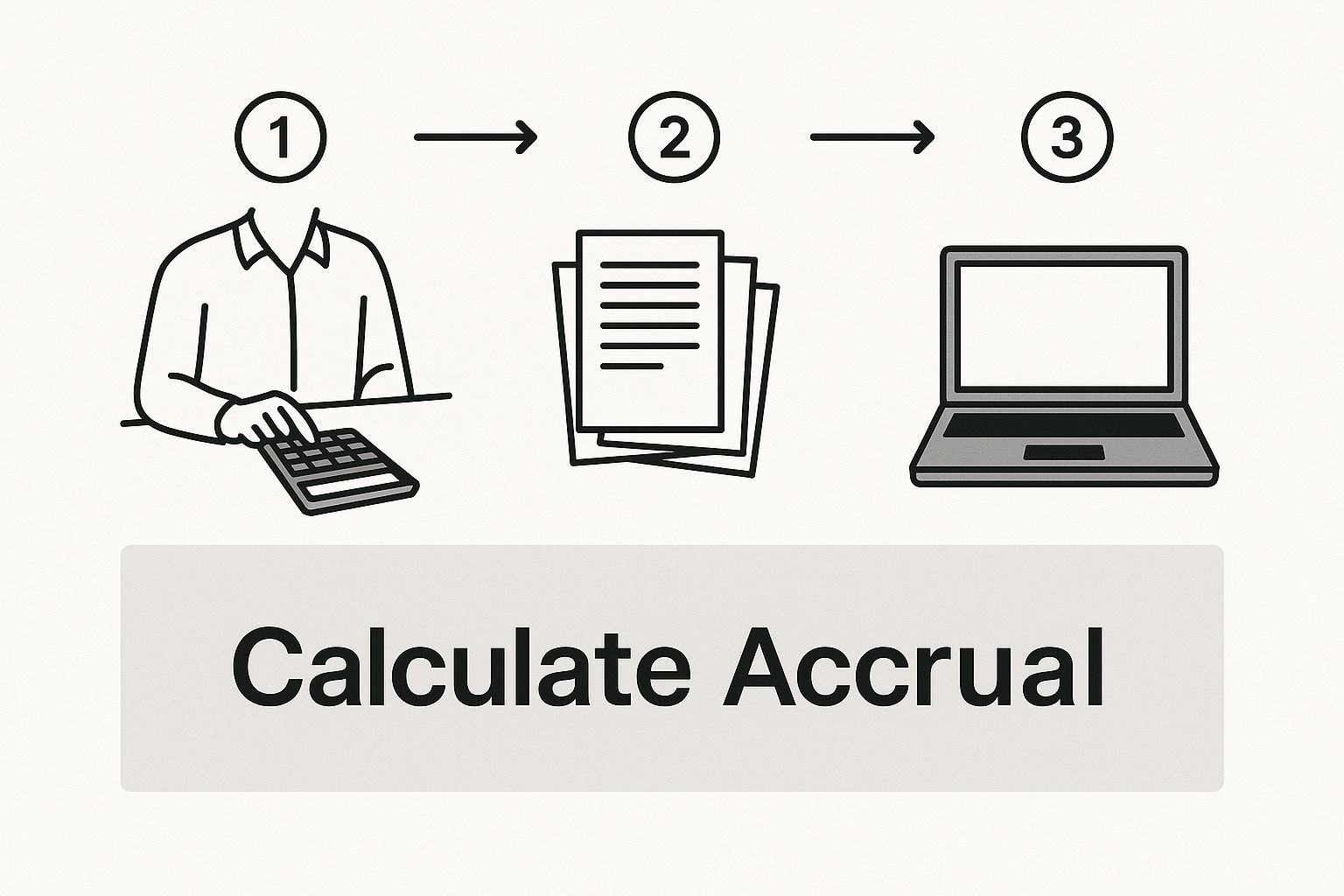
As you can see, the core of the calculation is just about breaking down the total annual entitlement into manageable monthly pieces.
The Monthly Accrual Method in Action
The standard approach is pretty simple: just divide the total annual leave by twelve. With this method, a team member earns one-twelfth of their total annual leave for each full month they've worked.
So, if an employee is entitled to 28 days per year, after three months on the job they would have accrued 7 days of leave (28 ÷ 12 × 3). This system is a lifesaver for accuracy, particularly for those mid-year starters. The government has some official guidance you can check out on calculating leave entitlement on GOV.UK.
The Core Formula for Monthly Accrual
(Total Annual Holiday Days ÷ 12) x Number of Complete Months Worked = Total Days Accrued
Let’s put this into practice. Imagine a new marketing manager, David, starts on 1st July. Your company’s leave year runs from January to December, and he gets the statutory 28 days.
By the end of September, David has completed three full months of service. Using our formula:
- (28 days ÷ 12) = 2.33 days accrued per month.
- 2.33 days x 3 months = 6.99 days. You'd typically round this up to 7 days.
Monthly Holiday Accrual for a Full-Time Employee (28 Days Entitlement)
To see how this builds up over a year, here’s a quick table showing the cumulative holiday days earned each month by a full-time employee.
| Month Worked | Days Accrued This Month | Total Days Accrued |
|---|---|---|
| January | 2.33 | 2.33 |
| February | 2.33 | 4.66 |
| March | 2.33 | 6.99 |
| April | 2.33 | 9.32 |
| May | 2.33 | 11.65 |
| June | 2.33 | 13.98 |
| July | 2.33 | 16.31 |
| August | 2.33 | 18.64 |
| September | 2.33 | 20.97 |
| October | 2.33 | 23.30 |
| November | 2.33 | 25.63 |
| December | 2.37 (rounding) | 28.00 |
This clear, month-by-month progression helps both you and your employees see exactly where they stand at any point in the year.
Handling Final Pay for Leavers
Getting this calculation right becomes absolutely critical when an employee leaves. You are legally required to pay them for any statutory holiday they’ve accrued but haven't taken.
If David resigned and his last day was 30th September, and he hadn't taken any holiday, you'd owe him payment for those 7 days in his final payslip.
Trying to keep track of these figures manually can quickly become a headache. It's why so many small businesses now use specialised software to calculate annual leave accrual automatically. It’s the easiest way to guarantee accuracy and stay compliant without the stress.
Figuring out holiday pay for your part-time staff can feel a bit like wrestling with a tricky maths problem, but the core idea is actually pretty simple. The law in the UK is very clear: part-timers must get the same treatment as your full-time people. This means their holiday entitlement is calculated on a proportional basis, or pro-rata.
This isn't about complicated formulas; it's about fairness. If someone works fewer days than a full-time employee, their holiday allowance is simply a fraction of the full-time pot. So, if an employee works three days a week, they're working 60% of a standard five-day week. It follows that they should get 60% of the full-time holiday allowance. Simple as that.

The Pro-Rata Calculation in Practice
Let’s get down to brass tacks. The most straightforward way to work out holiday for a part-time team member is to calculate their entitlement in days.
The trick is to multiply the number of days they work each week by the statutory minimum of 5.6 weeks of leave.
The Pro-Rata Formula
(Number of Days Worked Per Week) x 5.6 = Total Annual Holiday Entitlement (in days)
Using this calculation keeps things fair, compliant, and easy to explain, ensuring your part-time staff get exactly what they're entitled to.
A Real-World Example
Let's say you've just hired Sarah, a fantastic designer who works a set pattern of three days a week. Your full-time staff, who work a five-day week, get the statutory 28 days of annual leave (which includes bank holidays).
Here’s how you'd work out Sarah's holiday allowance:
- Her working week: She works 3 days.
- The calculation: Multiply her working week by the statutory figure: 3 days x 5.6 weeks.
- The result: This gives her 16.8 days of paid holiday for the year.
So, Sarah is entitled to 16.8 days of annual leave. This number correctly accounts for her share of bank holidays on a pro-rata basis. Whenever she takes a day off—whether it's for a planned holiday or a bank holiday that lands on one of her usual workdays—it just gets knocked off this 16.8-day total.
The 12.07% Method for Zero-Hours and Casual Staff
Figuring out holiday entitlement for workers on zero-hours or casual contracts can feel like a bit of a puzzle. When staff don't have fixed hours, the standard monthly accrual approach just doesn't cut it. That's where the 12.07% method comes in, giving you a fair and legally sound way to calculate leave based on the hours they actually work.
Why 12.07%?
So, where does this very specific number come from? It isn't just plucked out of thin air. It's calculated directly from the statutory holiday calendar.
A standard year has 52 weeks. Since employees are entitled to 5.6 weeks of paid leave, that leaves 46.4 working weeks in the year.
If you divide the holiday weeks by the working weeks (5.6 ÷ 46.4), you land on 12.07%.
This means for every single hour an employee works, they accrue 12.07% of that hour as paid holiday. It’s a simple but effective way to ensure their holiday entitlement is perfectly proportional to the hours they’ve put in.
Putting the Percentage Into Practice
Applying this is more straightforward than it might seem. You just multiply the total hours someone worked in a pay period by 12.07% to find out how many hours of holiday they’ve earned.
Let's say you run a small events company and hire weekend staff casually. One of your team members, Ben, worked 60 hours last month.
Here’s how you’d work out his accrued holiday:
- Total Hours Worked: 60 hours
- The Calculation: 60 hours x 0.1207 (the decimal for 12.07%)
- Holiday Accrued: 7.24 hours
So, Ben has earned just over seven hours of paid leave for his work last month. This total gets added to his holiday balance, ready for him to use when he requests time off. For a deeper dive into the rules, our essential guide to zero-hour contract holiday calculation has you covered.
Staying Compliant With Irregular Hours
For your irregular-hours or part-year workers, this is the go-to method. You calculate their leave entitlement as 12.07% of the hours they worked, rounding to the nearest hour if you need to.
Imagine an irregular-hours worker logged 30 hours in a pay period. They would accrue roughly 4 hours of paid leave (30 × 12.07% = 3.6 hours, which you can round up). They can then take this leave from the next pay period onwards. You can find more detail on this in the official government advice on GOV.UK.
This method is the standard for managing leave in sectors where flexible staffing is common, like hospitality, retail, and events. Using it consistently ensures you're being fair to your casual team and, just as importantly, keeping your business compliant.
Common Holiday Accrual Mistakes to Avoid
Knowing the formulas is a great starting point, but it's avoiding the common pitfalls that really keeps your business compliant and your team happy. Even with the best intentions, small errors in working out accrued holiday can quickly spiral into disputes and legal headaches.
Messing Up Part-Timer & Bank Holiday Entitlements
One of the most frequent slip-ups we see is mismanaging leave for part-time workers, especially when it comes to bank holidays. A part-timer is entitled to a pro-rata share of bank holidays, just like any other leave.
It's not enough to just give them the day off if a bank holiday happens to fall on their normal working day. Their total allowance needs to be calculated correctly from the very beginning to make sure they get their fair share.
Getting New Starter and Leaver Calculations Wrong
Another classic mistake involves new starters and leavers. It’s absolutely crucial to calculate their entitlement based on the precise portion of the leave year they’ve actually worked.
Simply rounding to the nearest month won't cut it and can lead to problems. Getting this right prevents you from underpaying people when they leave or accidentally giving new joiners too much holiday upfront.
Enforcing Unfair Leave Policies
Rigid "use it or lose it" policies can also land you in hot water. While you can certainly set rules about carrying over leave from one year to the next, you can't enforce a policy that stops an employee from taking their statutory minimum entitlement.
Forcing staff to forfeit their statutory holiday is unlawful. Your policies should encourage employees to take their well-earned breaks, not penalise them if operational demands make it difficult.
This is a bigger issue than you might think. Despite an average allowance of 22-23 days plus bank holidays, UK employees often leave around 5 days of holiday unused each year. If you want to dive deeper into this trend, you can read the full research about annual leave statistics.
Finally, poor record-keeping is often the root of all evil here. Without a clear, accurate log of leave taken and accrued, even the simplest calculation becomes pure guesswork. This not only puts you at risk of non-compliance but also chips away at the trust you have with your team.
Your Holiday Accrual Questions Answered
Even when you've got the formulas down, there are always those tricky, real-world situations that pop up and leave you scratching your head. Knowing how to navigate these is essential for managing leave fairly and, crucially, staying on the right side of UK employment law.
We’ve pulled together some of the most common questions we hear from business owners to give you clear, straightforward answers.
What Happens to Holiday Accrual During Sick Leave?
This is a big one. An employee’s statutory holiday entitlement continues to build up even when they are on sick leave, no matter how long they're off work. It’s a common misconception that the clock stops, but legally, their right to paid annual leave is protected.
What's more, an employee can actually ask to take their accrued holiday while they're off sick. If their illness prevents them from using their holiday allowance within the leave year, you must let them carry over a minimum of four weeks (20 days for a full-timer) into the next one.
Can We Pay Staff Instead of Them Taking Holiday?
In short, no. Paying an employee for their untaken statutory holiday — often called 'payment in lieu' — is only permitted when their employment with you comes to an end. It is unlawful to pay out the statutory 5.6 weeks of holiday while they are still working for you.
The only exception? Any contractual leave you offer above the statutory minimum. Your employment contract can set out different rules for this extra portion, but the core 5.6 weeks must be taken as time off.
How Do We Calculate Holiday Pay for Staff on Variable Pay?
This is a crucial one for any business with commission-based roles or staff who work regular overtime. For workers whose pay fluctuates, their holiday pay has to reflect their typical earnings, not just a basic rate.
To get this right, you need to calculate their average pay over the previous 52 weeks where they actually earned money. It's important to ignore any weeks where they received no pay at all. This 52-week reference period ensures their holiday pay is a fair reflection of what they would have normally earned.


