
For any UK business running on a standard Monday-to-Friday week, the magic number is 253 working days in a typical year. This figure is your starting block for just about everything – payroll, project planning, and figuring out how much you can actually get done. In leap years, like 2024, that number nudges up to 254.
Your Quick Answer to UK Working Days in a Year
Knowing precisely how many working days you have in a year isn't just a bit of trivia; it’s fundamental to running your business smoothly. This number touches everything from calculating annual leave entitlement and managing project deadlines to forecasting your labour costs.
Get it wrong, and you risk inaccurate payroll runs or chaotic scheduling, creating the kind of administrative headaches that small businesses really don't need.
While this quick calculation gives you a solid baseline, it's important to see it as just the beginning. The final, true number for your business can shift based on things unique to your operations.
Understanding the Standard Calculation
At its heart, the calculation is pretty straightforward. You just take the total number of days in the year and subtract all the non-working days.
For an employee in the UK on a Monday-to-Friday schedule, a standard year has 253 working days. We get to that figure by taking the 365 days in a year and then subtracting 104 weekend days and the 8 public bank holidays in England and Wales. You can find a more detailed look at the UK working day calendar on leavetrackapp.com if you want to dig deeper.
To give you a clearer picture, here’s how the numbers stack up for a standard year versus a leap year.
UK Working Days At a Glance (England & Wales)
This table breaks down the calculation for both a standard year and a leap year, showing exactly where that extra day comes from.
| Component | Standard Year | Leap Year |
|---|---|---|
| Total Days in Year | 365 | 366 |
| Weekend Days (Sat/Sun) | – 104 | – 104 |
| Bank Holidays (England/Wales) | – 8 | – 8 |
| Total Working Days | 253 | 254 |
As you can see, the leap year has an immediate impact. That one extra day on February 29th translates directly into an additional working day, as long as it doesn't land on a weekend. It might seem like a small detail, but it’s critical for accurate long-term planning and financial forecasting.
The Building Blocks of Calculating Working Days
Figuring out the number of working days in a year is a bit like putting together a puzzle. You have to start with the big, obvious pieces first before you can slot in the smaller, trickier ones that give you the final picture. Nailing these core components is the key to getting your planning right.
The starting point is always the total number of days in the calendar year. This is your first constant: 365 days in a standard year, or 366 if it's a leap year. From that total, you immediately start taking away the days most people don’t work.
Next up, you pull out all the weekend days. For a typical Monday-to-Friday business, that means removing every single Saturday and Sunday. Since there are 52 weeks in a year, this almost always comes to 104 weekend days (52 Saturdays + 52 Sundays).
The Simple Workday Formula
With just those two elements, you've already got the foundation of your calculation. The basic formula is refreshingly straightforward and serves as the starting block for pretty much any scenario you’ll face.
Total Days in Year – Weekend Days – Bank Holidays = Total Working Days
This simple equation gives you a clear path to follow. It’s that final piece of the puzzle—bank holidays—where things get a bit more interesting, turning a simple sum into a more nuanced task.
This process flow shows how all these core components fit together to give you the total working days.
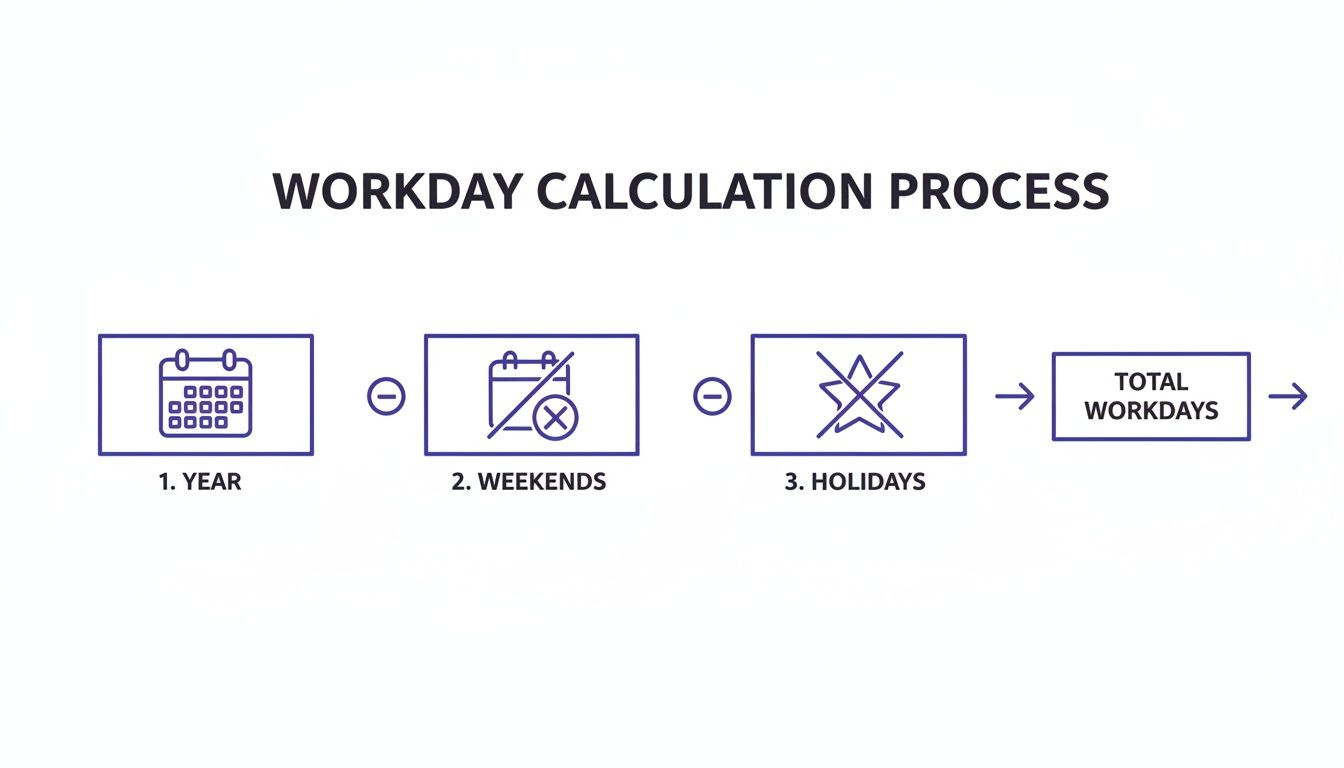
This visual breakdown really simplifies the process. It shows that by systematically removing weekends and official holidays from the calendar year, you can quickly arrive at a solid baseline number.
The Key Variables to Consider
While the total number of days and weekends are pretty much fixed, other factors introduce a bit of variability. These are the elements you absolutely must account for to get a number that's genuinely useful for your business operations.
- Public Bank Holidays: This is the biggest variable by far, as the number of holidays changes depending on which UK country you're based in.
- Employee Leave: Individual annual leave is another crucial subtraction. A huge part of calculating working days is understanding how to correctly work out your holiday entitlement in the UK.
- Company-Specific Closures: Some businesses might have extra non-working days, like shutting down completely over the Christmas period.
Once you get a handle on these building blocks, you can confidently calculate the working days for any year or any employee. And if you need a more granular view for your planning, you can always dive deeper into the specific number of UK working days in each month.
How UK Bank Holidays Impact Your Final Count
While our basic calculation for working days seems straightforward, things get a lot more interesting the moment you cross a border within the United Kingdom. It’s a common—and often costly—mistake to assume one set of bank holidays applies to all your staff. This oversight can quickly lead to payroll errors and operational headaches.
The truth is, the UK doesn't have a single, unified list of public holidays. Each of the four nations—England, Wales, Scotland, and Northern Ireland—marches to the beat of its own drum with a unique holiday calendar. What this means for you is that the final tally of working days in a year depends entirely on where your business, or your individual employees, are based.
Regional Differences in Holiday Calendars
This isn't just a minor detail for the HR department; it has a real, tangible impact on your operational calendar and staffing levels. A day that is business-as-usual for your team in England could very well be a public holiday for your colleagues in Scotland or Northern Ireland.
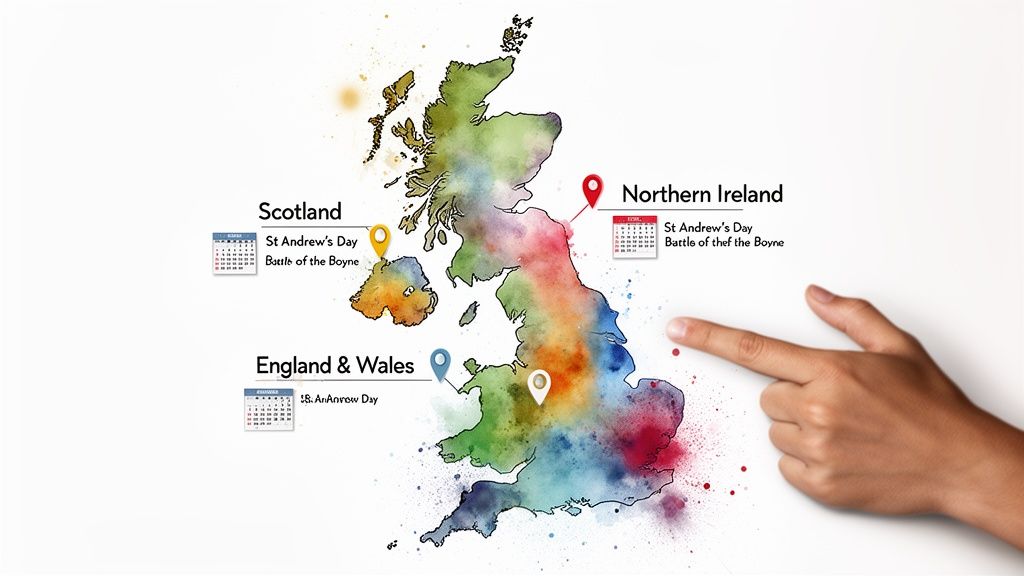
Take St. Andrew's Day on 30th November. It’s a bank holiday in Scotland, but it’s just another working day for staff in England and Wales. Likewise, Northern Ireland has two of its own holidays: St. Patrick's Day in March and the Battle of the Boyne (Orangemen's Day) in July.
These regional variations chip away at the total number of available workdays in those specific locations. The differences really add up.
- In England and Wales, the standard 8 bank holidays result in 253 working days in a typical year.
- Scotland, however, gets 9 bank holidays, bringing its total down to around 252 working days.
- Northern Ireland observes 10 bank holidays, reducing its count to about 251 days.
A one-size-fits-all approach to leave management just doesn't work for a multi-location UK business. Getting regional holidays right is essential for staying compliant, running accurate payroll, and planning your resources effectively.
Why This Matters for Your Business
Ignoring these nuances can cause genuine problems. Imagine scheduling a mandatory all-hands meeting on St. Andrew's Day, only to find your entire Scottish team is off enjoying a public holiday. Or worse, miscalculating payroll because you forgot about a bank holiday in Belfast.
These scenarios aren't far-fetched, and they highlight the absolute need for a system flexible enough to handle different holiday calendars at the same time.
Comparison of UK Bank Holidays and Working Days by Country
Here’s a quick comparison that clearly shows how the numbers stack up across the UK in a standard year.
| Country | Number of Bank Holidays | Approximate Working Days |
|---|---|---|
| England & Wales | 8 | 253 |
| Scotland | 9 | 252 |
| Northern Ireland | 10 | 251 |
This table neatly illustrates the challenge. For any business with a distributed workforce across the UK, manually tracking these differences is not just time-consuming—it's an open invitation for errors.
You can get a head start on next year by checking out our guide to the top public holidays in 2025. This complexity is exactly where automated systems prove their worth, ensuring every employee’s working year is calculated correctly, no matter where they log in from.
Calculating Working Days for Part-Time Staff
Many small businesses thrive on the flexibility and skills that part-time employees bring to the team. But while this agility is a huge plus, it often creates a tricky administrative headache: how do you fairly calculate their working days and holiday entitlement? The standard 253 working days in a year just doesn't work for them.
This is where the term pro-rata comes in. It’s a Latin phrase meaning 'in proportion', and it's the key to making sure your part-time staff get their entitlements fairly, relative to their full-time colleagues. Getting this wrong isn't just a minor admin error; it can lead to underpaid staff, compliance headaches, and a real dip in team morale.
Understanding the Full-Time Equivalent
Before you can work out any pro-rata entitlements, you first need to figure out an employee’s Full-Time Equivalent (FTE). FTE is a simple but powerful way to express a part-timer's hours as a fraction of a full-time role.
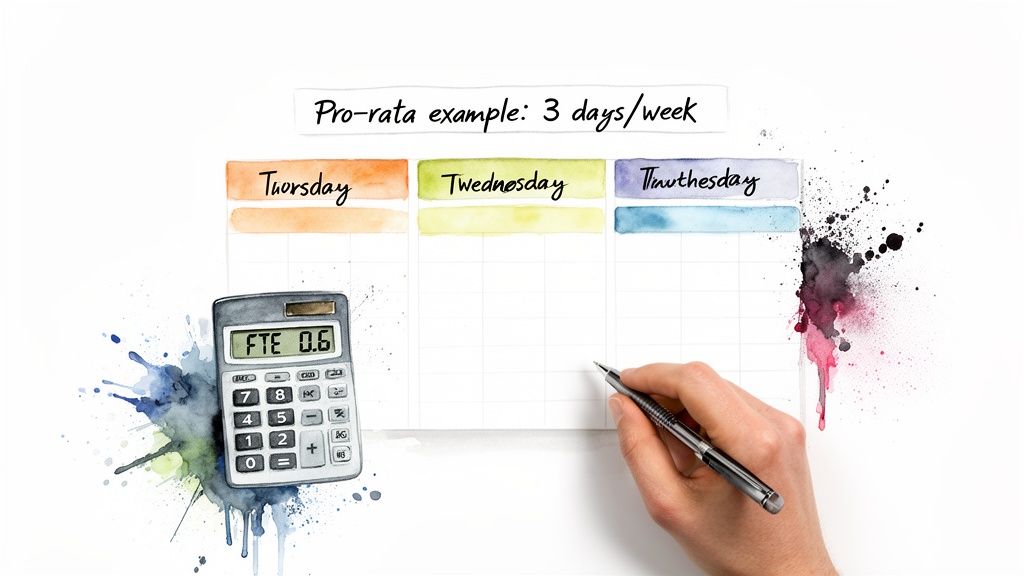
For example, if your company's standard full-time week is five days, an employee working three days a week has an FTE of 0.6. The calculation is straightforward: divide their working days by the full-time standard.
- Employee's Days per Week / Full-Time Days per Week = FTE
- 3 / 5 = 0.6 FTE
This FTE figure is the magic number for all their pro-rata calculations, from annual leave to bank holiday pay. It’s all about scaling full-time benefits down proportionally to ensure fairness.
Calculating pro-rata entitlements isn't just about ticking a box for legal compliance. It's about demonstrating fairness and valuing the contribution of every team member, regardless of their working pattern.
Putting Pro-Rata into Practice
Once you have the FTE, you can accurately calculate a part-time employee's total working days in a year and, from there, their holiday allowance.
Let's stick with our employee who works three days a week (0.6 FTE). If a full-time employee has 253 working days in a typical year, here’s how you’d calculate it for the part-timer:
- Start with the full-time working days: 253 days
- Multiply by the employee’s FTE: 253 x 0.6
- Result: 151.8 working days per year
The exact same logic applies to their holiday allowance. In the UK, a full-time employee gets a minimum of 28 days of paid leave. For our 0.6 FTE employee, their entitlement would be 16.8 days (that's 28 x 0.6). Nailing these calculations is fundamental to managing a flexible workforce. For a deeper dive, check out our guide on the holiday calculation for part-time workers.
To put this in perspective, the average UK full-time employee works around 36.5 to 36.6 hours a week, which adds up to roughly 1,850 working hours over 253 days. This is a key benchmark for finance teams budgeting for labour costs and really underlines why getting pro-rata calculations right is so critical for financial planning.
How to Automate Your Working Day Calculations
Let's be honest: calculating working days manually is more than just a bit of a headache. It's a minefield. You're juggling regional bank holidays, trying to get pro-rata entitlements right for every single part-timer, and hoping you haven't missed a leap year.
Each spreadsheet formula and manual tweak is a chance for a mistake to slip through. And those little errors can quickly snowball into inaccurate payroll, compliance headaches, and genuinely frustrated staff. It’s a huge administrative burden, pulling your HR team away from strategic work like recruitment or team development and bogging them down in calendars and calculators. This is exactly where automation steps in, turning a high-risk, time-sucking process into something seamless and reliable.
The Power of Automated Systems
Modern leave management software is built specifically to tame this complexity. Instead of treating every calculation as a fresh problem to solve, these systems use a rule-based approach. The result? Consistency and accuracy, every single time.
Imagine a system that already knows the bank holiday calendars for England, Scotland, and Northern Ireland. When you hire someone in Glasgow, it automatically applies the correct holiday schedule. Right from day one, their total working days for the year are calculated perfectly, no manual input needed.
This smart automation covers every variable we’ve talked about:
- Working Patterns: Whether someone works a standard five-day week, a compressed four-day week, or completely irregular shifts, the system calculates their available days accordingly.
- Pro-Rata Entitlements: The software instantly figures out the correct leave for part-time staff based on their FTE, wiping out the risk of manual miscalculation.
- Leap Years: The system automatically factors in the extra day in a leap year, adjusting total working day counts without anyone having to remember.
Here’s a glimpse of what a modern leave management dashboard looks like. It’s all about providing a clear, real-time overview of who is available.
This kind of visibility pulls managers out of the administrative guesswork and lets them see who’s working and when, at a glance.
More Than Just Accurate Numbers
The benefits of switching to automation go way beyond just getting the sums right. It builds a more transparent and efficient workplace for everyone.
Employees can check their own leave balances in real-time through a self-service portal or app. This empowers them to plan their time off without the constant back-and-forth with HR. Managers get an immediate snapshot of team availability, making project scheduling and resource planning far more effective. The system becomes the single source of truth, ending debates over leave entitlement and ensuring policies are applied fairly to everyone.
By automating working day calculations, you’re not just saving time; you're building a reliable operational foundation. This allows you to maintain compliance effortlessly, improve planning accuracy, and give your team the clarity they need.
To get an even sharper picture of workforce management, many businesses find that integrating time tracking software is a powerful next step. Ultimately, automation turns the complicated question of "how many working days in a year?" into a simple, accurate, and instantly available answer for every single person on your team.
Your Essential Working Day Calculation Checklist
When you pull all these details together, it becomes obvious that calculating the exact number of working days isn't just simple subtraction. It needs a bit of precision. To keep your payroll, project planning, and leave management running smoothly, a clear, actionable checklist is your best friend.
Don't think of this as just a summary. See it as a practical tool you can use to audit your current methods and spot any gaps. Following these steps helps you move from a rough guess to a reliable figure that actually reflects how your business works.
Your Step-by-Step Accuracy Checklist
To get a solid count of the working days in a year for your business, run through these essential checks. Each one tackles a key variable that can shift your final number, making sure nothing gets missed.
Start with the Calendar Basics: First things first, check if it’s a leap year. You'll start with 365 days for a standard year or 366 for a leap year. From there, subtract the weekends. For a typical Monday-to-Friday business, that's almost always 104 days.
Confirm Your UK Region’s Official Bank Holidays: This is where mistakes often creep in. Double-check the correct bank holiday calendar for each UK nation where you have staff. The dates for England, Wales, Scotland, and Northern Ireland are all slightly different.
Standardise Your Pro-Rata Calculation Method: For any part-time staff, you need a clear and consistent formula for working out their days based on their Full-Time Equivalent (FTE). Get this process documented to ensure everything is fair and compliant across the board.
Account for Company-Specific Shutdowns: Does your business close for a few extra days over the Christmas period or for an annual event? Make sure these additional non-working days are subtracted from your total.
Using a checklist like this turns the tricky task of figuring out working days into a methodical, error-free process. It gives you a solid foundation for all your operational and financial planning, ensuring you're accurate from the very beginning.
By ticking off each of these points, you can be confident that your answer to "how many working days in a year" is more than just an estimate—it's a precise figure tailored to how your business actually operates. This careful approach prevents payroll headaches and makes resource planning a whole lot easier.
Frequently Asked Questions
Once you get your head around the main calculation, a few specific situations will almost certainly pop up. What about the new team member who joined last month? Or when you need all hands on deck during a bank holiday?
Getting these details right is crucial for keeping things fair and making sure your resource planning is spot on. Let's look at a couple of the most common questions we see from managers and business owners.
How Do You Calculate Leave for New Starters?
When an employee joins part-way through the year, you don't use the standard full-year holiday allowance. Instead, their leave is calculated on a pro-rata basis, starting from the day they walk through the door.
Think of it this way: if someone starts exactly halfway through the calendar year, they’re entitled to half of the full annual leave pot. The key is to figure out how many working days are left in the year for that specific employee and then work out their holiday entitlement from there.
What if an Employee Works on a Bank Holiday?
Sometimes, business needs mean someone has to work on a bank holiday. Your company policy is king here, but the usual practice in the UK is to offer a day off in lieu. This means they simply take another working day off instead, so their total time off for the year stays the same.
Another option, often written into contracts, is to offer enhanced pay for that day. Either way, the total number of working days in the year for that employee doesn't change – you're just shifting when they take their non-working day.
It's really important to distinguish between two separate things: the total working days in a year for planning, and an employee's statutory annual leave entitlement. The first is your baseline for operations. The second is the specific benefit an employee gets, which is then deducted from that baseline.
Knowing your total working days is the foundation for managing your team's capacity. Individual leave allowances are then managed within that bigger picture.


