
For a standard 40-hour work week, the magic number you’re looking for is 173.3 hours a month, on average. This isn't just a handy estimate; it's a critical baseline for getting payroll right, managing leave, and planning your resources. Nailing the simple formula behind it can help you sidestep some common—and costly—business mistakes.
The Simple Answer to Monthly Work Hours and Why It Matters
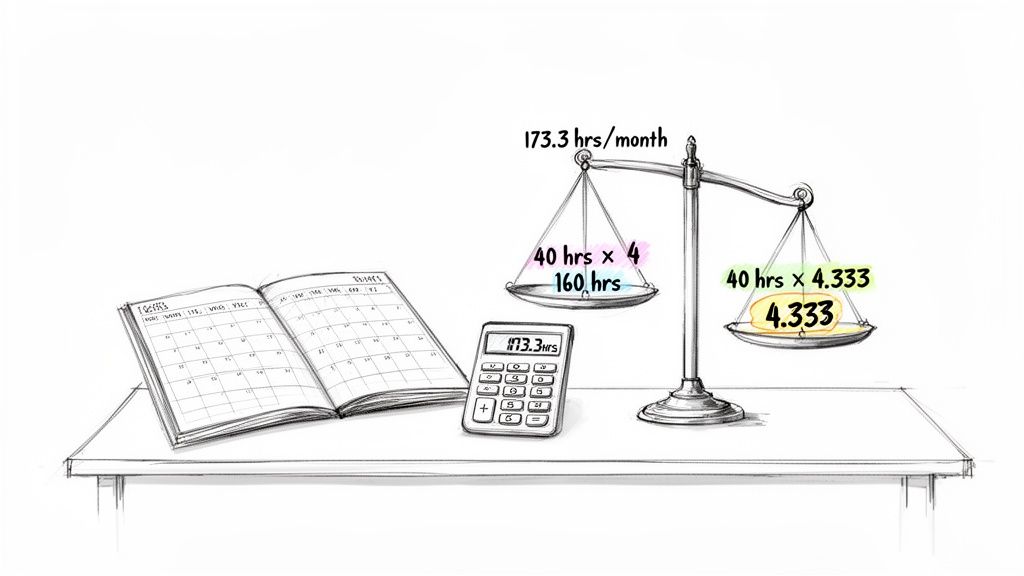
When you first ask, "how many work hours are in a month?", it's tempting to just multiply weekly hours by four. A 40-hour week times four weeks equals 160 hours. Simple, right? Unfortunately, this approach is a bit too simple and overlooks a key fact: no month (apart from February in non-leap years) is exactly four weeks long.
This small inaccuracy can snowball into bigger problems, from underpaying your hourly staff to miscalculating annual leave entitlements. When the numbers are off, you risk compliance issues and, just as importantly, you can erode employee trust.
The Standard Industry Formula
To fix this, businesses lean on a standardised formula that neatly accounts for the different month lengths. It gives you a consistent average you can rely on for smooth planning and payroll processing.
Here’s the formula: Weekly Contracted Hours x 4.333
So, where does that magic number 4.333 come from? It’s simply the average number of weeks in a month. We get it by dividing the 52 weeks in a year by 12 months. That little ‘.333’ on the end is what makes all the difference, ensuring your calculations are fair and accurate over the long haul.
Using the 4.333 multiplier is the key to consistency. It smooths out the monthly bumps between a short 28-day February and a long 31-day March, giving you a stable figure for payroll, budgeting, and leave accrual.
Why This Consistency Is Crucial
Relying on this average figure is about more than just good maths; it’s about building a robust and fair HR process. Getting it right helps you achieve a few key things:
- Accurate Payroll: It ensures hourly employees are paid correctly and that salaried staff calculations are based on a consistent, defensible standard.
- Fair Leave Calculations: You can accurately work out leave accrual, which is essential for meeting UK statutory requirements.
- Simplified Budgeting: It allows for much more predictable forecasting of labour costs, taking the guesswork out of monthly fluctuations.
This foundational concept of using an average is the first step toward building a streamlined, compliant, and efficient system for managing your team’s time.
How to Calculate Work Hours for Any Employee
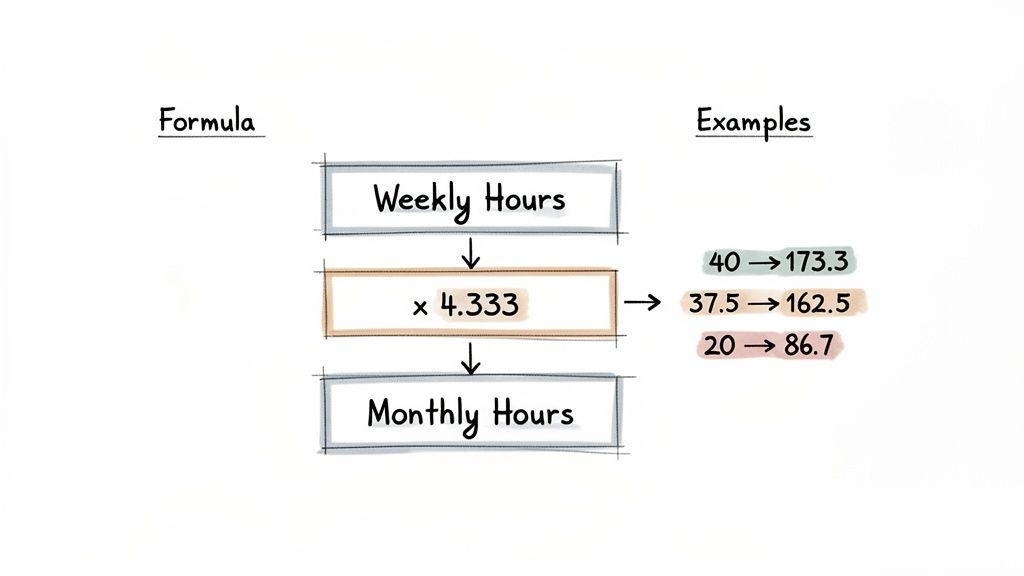
Figuring out an employee's monthly work hours shouldn't feel like guesswork, regardless of their contract. The good news is, there's a straightforward way to get a consistent, reliable figure for everyone in your organisation.
It all boils down to one "magic" number: 4.333. As we mentioned earlier, this is the average number of weeks in a month (simply 52 weeks in a year divided by 12 months). Using this multiplier smooths out the bumps between shorter months like February and longer ones like July, giving you a stable average.
The Key Formula for Monthly Hours
To get the average monthly work hours for any employee, just plug their weekly hours into this simple formula:
Contracted Weekly Hours × 4.333 = Average Monthly Work Hours
This little equation is your best friend for accurate payroll and leave management. Let's see how it works in practice for the most common UK work schedules.
Calculating for Full-Time Employees
In the UK, most full-time roles are built around either a 40-hour or a 37.5-hour week. Applying the formula to these is dead simple.
For a 40-hour work week:
40 hours × 4.333 = 173.32 hours per monthFor a 37.5-hour work week:
37.5 hours × 4.333 = 162.49 hours per month
These averages give you a solid baseline for salaried staff, making sure their pay stays consistent even when the number of working days in a month changes. It’s absolutely essential for setting up payroll and forecasting your annual labour costs. If you want to dig deeper into how this impacts your overall staffing, check out our guide on how to calculate full-time equivalent.
Calculating for Part-Time Employees
The exact same logic works perfectly for your part-time team members, giving you an accurate monthly average for them, too. This is crucial for things like calculating pro-rata holiday entitlement and making sure anyone on an hourly contract is paid correctly.
Let's look at a couple of common part-time setups:
An employee on a 24-hour contract (maybe three 8-hour days):
24 hours × 4.333 = 103.99 hours per monthAn employee on a 20-hour contract (working four 5-hour days, for example):
20 hours × 4.333 = 86.66 hours per month
Sticking to this method across every contract type is the best way to prevent payroll errors and keep things fair for everyone. This approach aligns perfectly with wider UK work trends. For instance, data from the Office for National Statistics showed that full-time workers averaged 36.5 hours per week. Pop that into our formula (36.5 x 4.333), and you get about 158 hours per month—right in line with our standard calculations.
Accounting for Monthly Variations and Bank Holidays
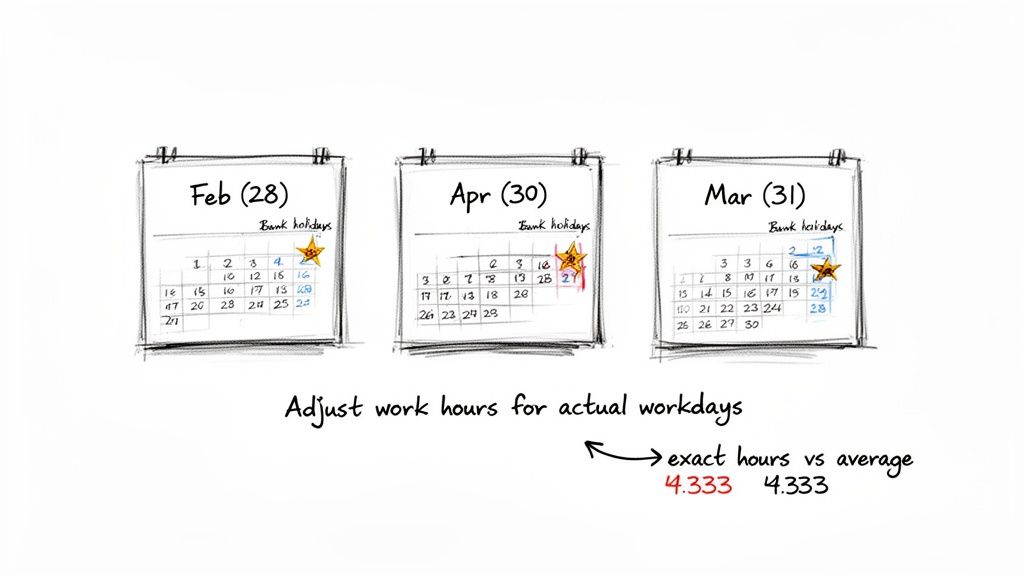
While using the 4.333 multiplier is a neat trick for getting a solid monthly average, real-world planning doesn’t work on averages. We all know that months aren’t created equal.
A short February has far fewer working days than a long March, and that difference directly impacts everything from project timelines and resource allocation to your monthly payroll forecast.
When you're in the trenches of short-term management, you need precision, not just a good guess. Imagine you're budgeting for a project kicking off in April—you can't rely on an average. You need to know exactly how many productive hours your team has on the clock. This is where we need to get granular.
Calculating Hours for a Specific Month
Figuring out the exact work hours for any given month is actually quite straightforward. You just count up the working days (typically Monday to Friday) for that specific month and multiply by the employee's daily contracted hours.
The Specific Month Formula:
(Number of Weekdays in the Month) × (Daily Contracted Hours) = Total Work Hours
For example, an employee on an 8-hour day contract in a month with 22 weekdays will have 176 available work hours (22 x 8).
This month-by-month approach gives you a true picture of your team's capacity. It highlights that a month with 23 working days offers significantly more output than one with only 20, a detail that average calculations completely miss. For a deeper dive, check out our guide on the number of business days per month in our article.
To help with this, here is a quick reference table showing the typical number of working days in each month of a non-leap year.
Working Days Per Month in a Typical Year
| Month | Total Days | Typical Weekdays (Mon-Fri) | Monthly Hours (8-hour day) |
|---|---|---|---|
| January | 31 | 22 | 176 |
| February | 28 | 20 | 160 |
| March | 31 | 23 | 184 |
| April | 30 | 21 | 168 |
| May | 31 | 22 | 176 |
| June | 30 | 22 | 176 |
| July | 31 | 21 | 168 |
| August | 31 | 23 | 184 |
| September | 30 | 21 | 168 |
| October | 31 | 22 | 176 |
| November | 30 | 22 | 176 |
| December | 31 | 21 | 168 |
This table gives you a starting point for planning, but remember, there's another crucial factor to consider, especially in the UK.
Factoring in UK Bank Holidays
Now we get to the next layer of real-world complexity: bank holidays. For any UK business, these are non-negotiable. They reduce the total number of available workdays, and forgetting to account for them can throw your entire resource plan into chaos.
Take April and May, for example. They often have bank holidays for Easter and May Day. If a month has 21 weekdays but one of them is a bank holiday, your actual workdays drop to 20. For an employee on an 8-hour day, that simple change reduces their available hours from 168 to 160.
This is a common headache for small businesses trying to forecast hours manually. While full-time UK employees work around 1,867 hours a year (averaging about 155.7 hours per month), that figure already accounts for statutory leave. It's then further reduced by the 8 bank holidays in England and Wales, which makes precise monthly calculations an absolute must.
This is exactly where an automated system like LeaveWizard becomes a lifesaver. It’s built to handle these fiddly details, automatically adjusting for bank holidays to give you a clear, real-time view of who's available and when. It removes the manual guesswork and risk of error, ensuring your planning is always built on solid, accurate data.
Connecting Work Hours to Payroll, Leave and Overtime
Figuring out the number of work hours in a month is much more than a simple maths problem. This single number is the bedrock of your entire payroll and HR operation, with a direct line to employee pay, legal compliance, and your company’s bottom line.
Getting it wrong can cause some serious headaches. For your hourly employees, an accurate monthly count is the only way to process payroll correctly. Any slip-up could mean underpaying your staff, which quickly erodes trust and opens the door to legal challenges.
The Impact on Leave Accrual
Accurate monthly figures are also vital for managing statutory annual leave. In the UK, most workers are entitled to 5.6 weeks of paid holiday each year, and how this leave is accrued is directly tied to the hours they put in. This is especially true for part-time staff or new starters.
By tracking hours consistently month-on-month, you ensure that leave entitlements are calculated fairly and precisely, keeping you on the right side of employment law. This has become even more important as work patterns shift. Recent ONS data reveals a subtle change in UK work habits, with average weekly hours for full-timers now at 36.5, which works out to about 158 monthly hours.
By linking monthly work hours to leave accrual, you turn a simple number into a powerful compliance tool. It guarantees every employee gets what they're entitled to, protecting your business from disputes and potential penalties.
Staying Compliant with Working Time Regulations
Beyond just leave, precise hour tracking is your best defence against breaching the UK's Working Time Regulations. These rules are clear: on average, employees should not work more than 48 hours per week. This is usually averaged out over a 17-week period.
If you don’t have a firm grip on the work hours in a month for each team member, it's all too easy to lose sight of overtime. Unchecked extra hours can quietly push an employee over that legal limit, exposing your business to significant risks. To get a handle on this, businesses often rely on sophisticated tools to manage salary, leave, and overtime. For those looking at their options, guides that review the best payroll software in Australia and other regions can offer some valuable pointers.
This is why regular monitoring isn’t just good practice—it's a legal must-do. For a deeper dive into managing those extra hours, you might find our essential UK guide to calculating overtime helpful. Ultimately, when you shift your monthly hour calculation from a reactive payroll task to a proactive management tool, you gain both financial stability and solid legal protection for your business.
Managing Complex Work Schedules and Scenarios
The standard formulas are great for fixed 9-to-5 roles, but let's be honest, the modern workforce is a lot more varied than that. Many businesses find themselves grappling with how to calculate hours for shift workers, people on flexible contracts, or those on zero-hour agreements, where weekly totals can swing wildly.
These non-standard schedules make a simple monthly calculation pretty much impossible. A hospitality worker, for example, might clock 15 hours one week and then 45 hours the next, all depending on seasonal demand. For these employees, you can't just use a simple formula; UK regulations actually require you to average their hours out over a longer "reference period" to ensure everything is above board and they're paid fairly.
Getting this first step right—calculating the hours—is critical. It's the foundation for a whole chain of HR compliance duties, leading directly into payroll, leave management, and tracking overtime.
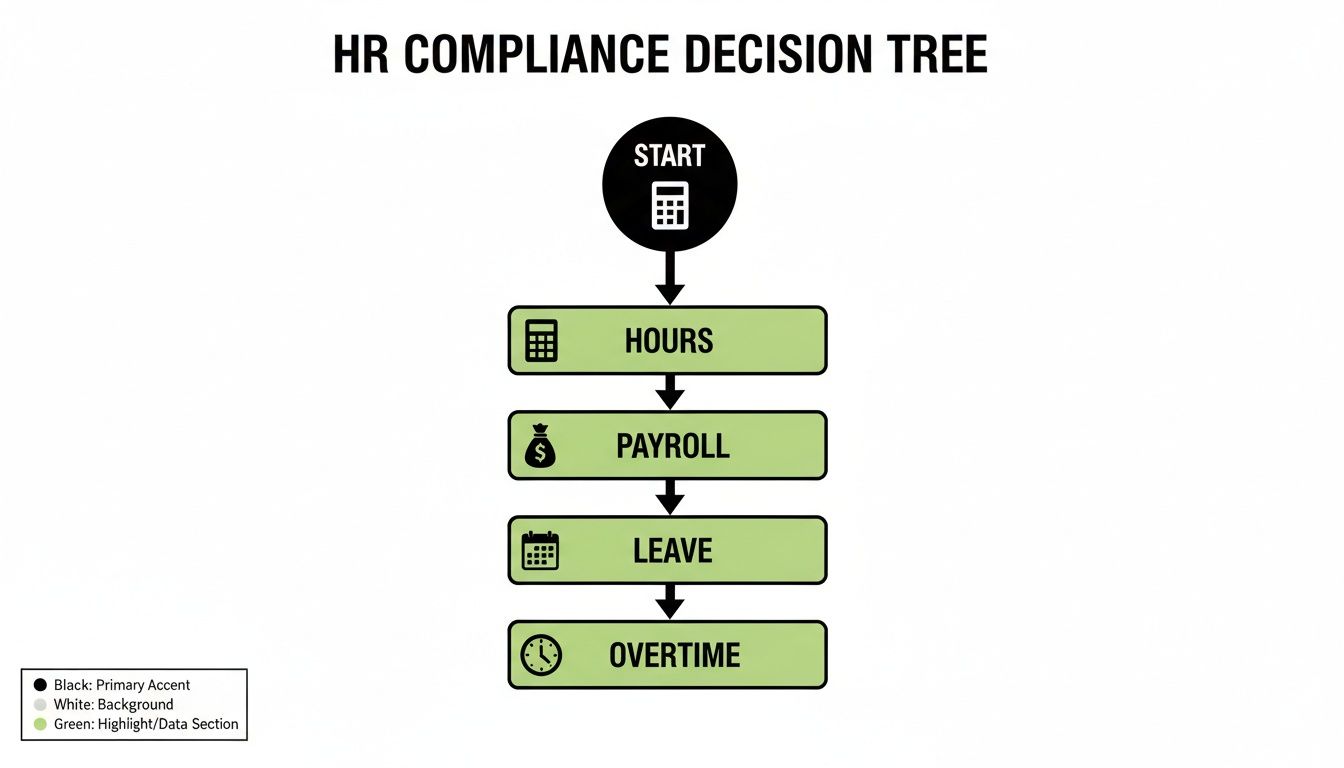
As you can see, accurate hour tracking isn't some isolated task. It’s the bedrock for maintaining financial and legal integrity across all your people operations.
Averaging Hours Over a Reference Period
For employees with hours that go up and down, you need to zoom out and look at the bigger picture to find their average. The standard reference period is 17 weeks, although this can be extended to 52 weeks in certain sectors.
The process is straightforward: you add up all the hours worked during that entire period and then divide by the number of weeks. This gives you a stable, average weekly figure you can rely on. From there, you can calculate monthly pay and, just as importantly, make sure you aren't accidentally breaching the 48-hour weekly limit.
Example: A Hospitality Worker
Let's say an employee works a total of 340 hours over a 17-week period. To find their average, you'd calculate:
340 hours ÷ 17 weeks = 20 hours per week
Now you have a reliable average. You can use this 20-hour figure to work out their average monthly hours for payroll (20 x 4.333 = 86.66 hours).
Tools for Managing Variable Schedules
Trying to track these fluctuations manually is a recipe for mistakes and a mountain of admin work. For businesses with different employee needs, getting comfortable with a good staffing schedule template is a solid first step for efficient resource planning.
But for true accuracy and compliance, automated systems are a game-changer. A platform like LeaveWizard can handle complex schedules, track hours as they happen, and automatically calculate the averages over the correct reference periods. This eliminates the risk of human error and frees up valuable time, ensuring every single employee is paid correctly and fairly, no matter how complex their schedule might be.
Frequently Asked Questions About Monthly Work Hours
Even with the right formulas in hand, it's natural for specific questions to pop up when you're trying to calculate monthly hours. Let's tackle some of the most common queries we see from UK businesses.
How Many Working Days Are in a Month on Average?
On average, you can expect about 21.67 working days (or weekdays) in any given month. We get this number by taking the typical 260 working days in a year and simply dividing it by 12.
Of course, the actual number of working days swings from month to month – you might see as few as 20 or as many as 23. This is exactly why using a precise count of the actual days in a month is much better for short-term planning and scheduling.
What Is the Formula to Calculate Monthly Hours?
For things like payroll and leave accrual, the most reliable and consistent formula you can use is: (Contracted Weekly Hours) × 4.333.
Why that odd number? Well, 4.333 is the average number of weeks in a month (calculated as 52 weeks per year / 12 months). Using this average gives you a stable, consistent figure that smooths out the bumps between longer and shorter months.
Do Bank Holidays Count as Working Hours?
For your salaried employees, the answer is usually yes – paid bank holidays are typically counted as part of their contracted hours. For hourly workers, however, it all comes down to what's written in their employment contract.
It's worth remembering that UK law allows employers to include bank holidays as part of an employee's statutory 5.6 weeks of paid annual leave. The most important thing is to make this crystal clear in every employment agreement to avoid any confusion down the line.
How Do I Calculate Hours for Part-Time Employees?
You use the exact same logic as you would for your full-time staff. Just take their contracted weekly hours and multiply by 4.333 to find their average monthly total.
For instance, an employee on a 20-hour week would have an average of 86.66 working hours per month (20 hours × 4.333). Keeping the calculation consistent like this helps ensure fairness for everyone in your organisation, regardless of their contract type.


