
For anyone in the UK working a typical Monday-to-Friday job, the year starts with around 260 potential working days. Think of this as your baseline – it's the number you get when you take the full 365 days of the year and strip out all the weekends. But, as anyone managing a team knows, that's far from the full story.
Your Quick Guide: How Many Working Days in a Year?
Figuring out the true number of working days is essential for everything from running payroll accurately to planning projects. While 260 is the common starting point, it doesn't quite capture reality. It represents the maximum number of days a full-time employee could possibly work before you account for bank holidays or their own annual leave.
The actual number of days an employee is at their desk is always lower. To get a realistic figure, you have to start subtracting those statutory entitlements. This is where the calculation gets a bit more specific to your business and even whereabouts in the UK you are.
Breaking Down the Baseline Calculation
Let's start from the top. The initial maths is pretty straightforward and just involves removing the biggest chunk of non-working time from the calendar.
- Total Days in a Year: A standard year has 365 days.
- Total Weekends: With 52 full weeks in a year, you have 104 weekend days (52 Saturdays + 52 Sundays).
- Initial Working Days: 365 total days – 104 weekend days = 261 working days. You'll often see this rounded down to 260, as the 52-week cycle doesn't perfectly align with 365 days.
This initial figure of 260 or 261 is what we call the "potential" working year. The next, crucial step is to subtract the UK bank holidays. For England and Wales, there are typically 8 bank holidays a year, which brings the total available working days down to around 253.
To make this easier to see, here's a quick summary for a standard, full-time employee in the UK.
UK Working Year at a Glance
This table breaks down the typical calculation for a full-time, Monday-to-Friday employee in a non-leap year in the UK.
| Component | Number of Days |
|---|---|
| Total Days in a Year | 365 |
| Less: Weekend Days | -104 |
| Potential Working Days | = 261 |
| Less: Bank Holidays (Eng/Wal) | -8 |
| Actual Working Days | = 253 |
This gives you a much more realistic number to work with before you even consider an individual's personal holiday allowance.
Key Takeaway: The number of working days isn't a single, fixed figure. It’s a calculation that starts with 365 days and gets smaller as you subtract weekends, bank holidays, and finally, personal annual leave.
Understanding the difference between potential and actual working days is fundamental. If you'd like to dig deeper into the terminology, you can learn more by reading our guide on working days vs business days. Once you've got this foundation sorted, you'll find it much easier to forecast team availability and plan your resources effectively.
The Core Formulas for Calculating Working Days
Having a rough idea of the working days in a year is a decent starting point. But to really get a grip on your resources, you need a few solid formulas. These calculations are the engine room for accurate payroll, sensible project planning, and fair holiday management. They turn abstract calendar dates into hard numbers you can actually use to make smart business decisions.
Let's kick things off with the most common setup: a full-time employee working a standard Monday to Friday week. This is the bedrock calculation that everything else is built on. The logic is just simple subtraction – starting with the total days in a year and peeling away all the non-working periods.
This flowchart shows the basic journey from 365 days down to the potential working days, once you strip out weekends and public holidays.
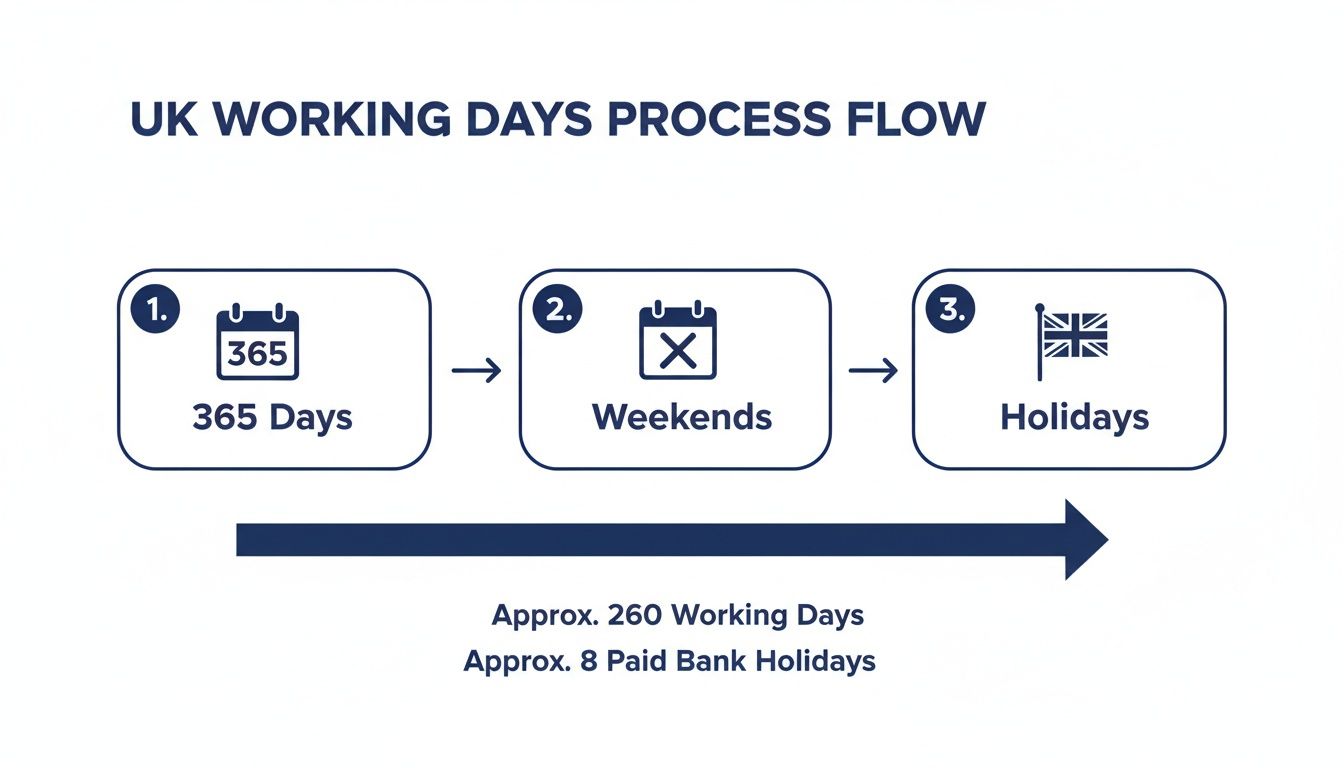
It’s a clear illustration of how much the calendar year shrinks before we even think about personal leave, which really underlines why getting these initial numbers right is so important.
The Standard Five-Day Work Week Formula
For a typical full-time employee in the UK, the calculation is pretty straightforward. You just take the total days in the year and subtract weekends and bank holidays.
Here’s how it breaks down:
- Start with Total Days: This is 365 (or 366 in a leap year).
- Subtract Weekend Days: There are usually 104 weekend days in a year (52 Saturdays and 52 Sundays).
- Subtract Bank Holidays: In England and Wales, there are typically 8 bank holidays.
Formula: Total Days (365) – Weekend Days (104) – Bank Holidays (8) = 253 Available Working Days
This magic number, 253, represents the total days an employee is available to work before you factor in their annual leave entitlement. It's the most critical figure for initial capacity planning and understanding your team's potential output for the year. To dive deeper into the specific methods and variables, this guide on how to calculate working days per year in the UK is a great resource.
Adapting Formulas for Different Work Patterns
Of course, the classic Monday-to-Friday, 9-to-5 schedule isn't everyone's reality. Modern work patterns are far more varied, especially in sectors like retail, hospitality, and healthcare. To stay accurate, your formulas need to be flexible enough to handle these different scenarios.
Example 1: The Six-Day Work Week
Imagine someone in hospitality who works Tuesday to Sunday. For them, the "weekend" is just Monday.
- Total Days: 365
- Days Off: 52 (for all the Mondays)
- Bank Holidays: Let's say they work most bank holidays but get 5 days off in lieu.
- Calculation: 365 – 52 – 5 = 308 Available Working Days
You can see this results in a much higher number of potential working days, which has a direct knock-on effect on everything from payroll to leave calculations.
Example 2: The Part-Time Employee
Now, think about a team member who works three days a week – say, Wednesday, Thursday, and Friday. We need to work out their available days fairly.
- Total Weekdays in a Year: 261 (365 days – 104 weekend days)
- Pro-Rata Calculation: (3 days worked / 5 total weekdays) = 0.6
- Potential Working Days: 261 * 0.6 = 156.6 Potential Working Days
This calculation ensures their work schedule is reflected accurately. From there, you'd subtract any bank holidays that fall on their specific working days, also on a pro-rata basis.
Converting Hours into Full-Time Equivalent Days
Another vital piece of the puzzle is converting total hours worked into a Full-Time Equivalent (FTE) figure. This is absolutely crucial for fair resource planning, especially when you have team members on various hourly contracts. The FTE calculation helps standardise all these different work patterns into one comparable metric.
The formula is based on what your company defines as a standard full-time week, which is often 37.5 or 40 hours in the UK.
FTE Formula: (Employee's Weekly Hours / Standard Full-Time Weekly Hours) = FTE Value
For example, an employee working 24 hours a week in a company where full-time is 40 hours would have an FTE of 0.6. This tells you they represent 60% of a full-time employee's capacity – a key insight for budgeting and staffing decisions.
Getting these core formulas right moves you from guesswork to precision, ensuring fairness and accuracy right across your entire team.
Factoring in Bank Holidays and Annual Leave
Once you’ve stripped out the weekends, your working year calculation is off to a good start, but it’s far from finished. The next crucial step is to subtract all the other days your team will be away from the office—namely bank holidays and their personal annual leave. This is where a broad number like 253 working days starts to get refined into something that actually reflects your business reality.
Think of that initial calculation as a rough block of marble. You've knocked off the big, obvious chunks (the weekends), but now it's time for the detailed work. Chiselling away the bank holidays and statutory leave is what truly shapes an employee’s available time, and getting it right is vital for planning your resources properly.
This isn’t just a "nice-to-have" calculation; it's a legal necessity that has a direct impact on payroll, project timelines, and your overall operational strength.
Navigating UK Bank Holidays
The UK has a set number of bank holidays each year, but here’s a common tripwire for businesses: the exact number changes depending on where you are. For companies with staff scattered across the country, this regional quirk can be a real headache.
- England and Wales: Typically get 8 bank holidays per year.
- Scotland: Usually has 9 bank holidays, adding St Andrew's Day and an extra day at New Year.
- Northern Ireland: Comes out on top with 10 bank holidays, including St Patrick's Day and Battle of the Boyne (Orangemen's Day).
If you’re running a business across the UK, keeping track of these different schedules for each employee is a tedious manual task. You can delve deeper into this by exploring some interesting facts about UK bank holidays and their history.
Key Consideration: Don't forget what happens when a bank holiday falls on a weekend. A substitute weekday, or a day "in lieu," is always designated. Forgetting to account for these is a classic mistake that can throw project planning way off course, especially for long-term schedules.
Calculating Statutory Annual Leave
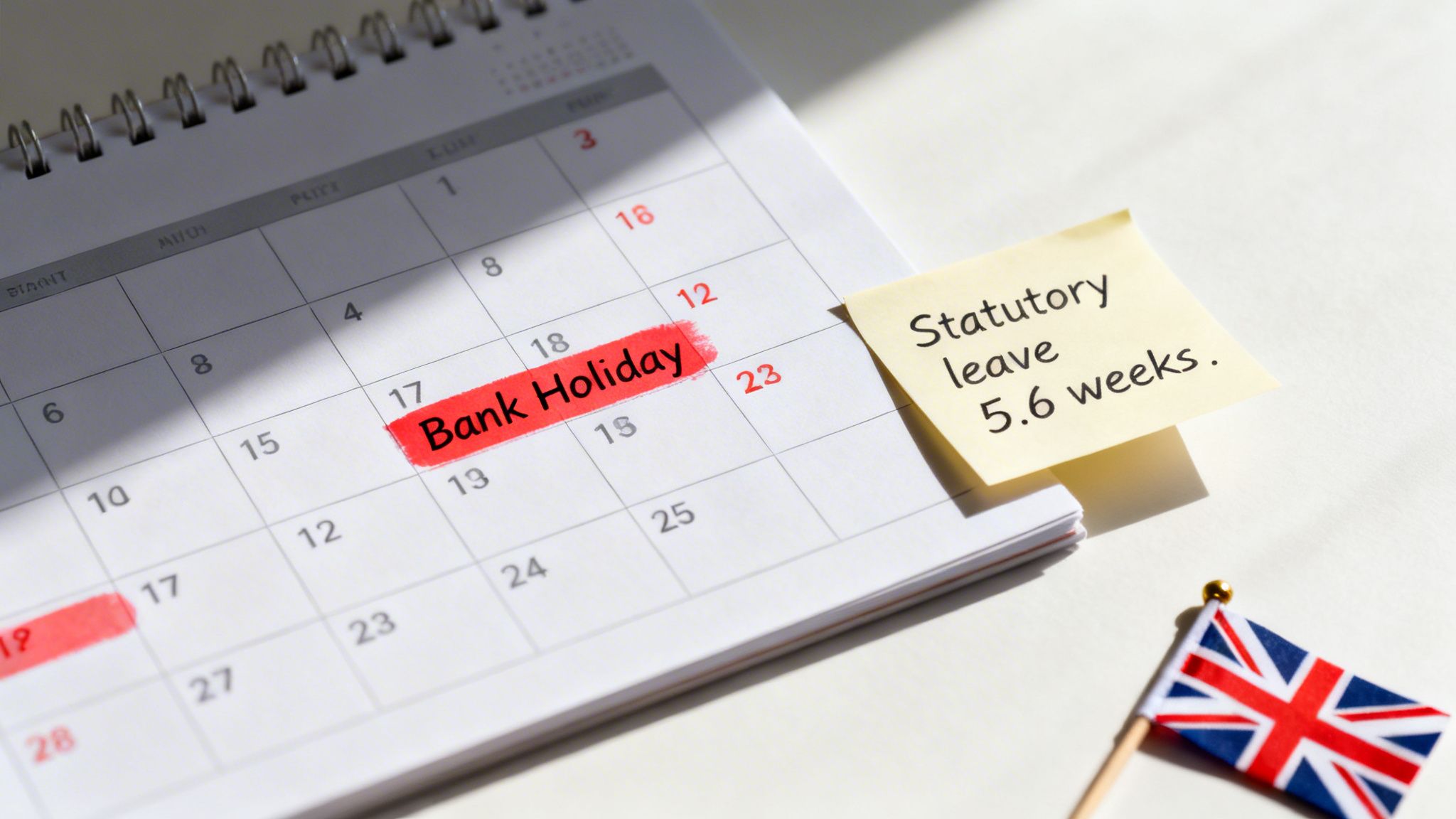
On top of public holidays, every full-time employee in the UK has a legal right to 5.6 weeks of paid annual leave. This is the statutory minimum and a non-negotiable part of UK employment law.
For someone on a standard five-day week, the maths is pretty straightforward:
5.6 weeks x 5 days per week = 28 days of statutory leave
Now, that figure of 28 days can either include bank holidays or be offered on top of them. It all comes down to the employment contract. For instance, one contract might state 20 days of leave plus the 8 bank holidays, while another offers a flat 28 days from which bank holidays are then taken. Clarity in your contracts on this point is absolutely essential.
The Challenge of Pro-Rata Leave for Part-Time Staff
Things get trickier when you have part-time staff. Their leave entitlement is calculated on a pro-rata basis, meaning they get a fair proportion of the full-time allowance based on how many days they work.
Let’s take someone who works three days a week. Here's how you'd work it out:
- Start with the full-time equivalent: 28 days.
- Calculate their pro-rata percentage: (3 days worked ÷ 5 full-time days) = 0.6.
- Find their entitlement: 28 days x 0.6 = 16.8 days of annual leave.
This system ensures everyone is treated fairly and you remain legally compliant. But, as you can see, it adds yet another layer of individual calculation for every part-time member of your team.
The very definition of a working year is also changing. Globally, new regulations like Australia's Right to Disconnect laws are starting to redraw the boundaries of what counts as non-working time. This just highlights the growing need for systems that are both accurate and adaptable.
When you start combining regional bank holidays with different work patterns and pro-rata leave calculations, the job of manually figuring out how many days are in a working year for each person quickly becomes a massive administrative drain—and one that’s wide open to human error. It’s exactly this kind of fiddly, complex puzzle that an automated leave management system is built to solve without breaking a sweat.
Of course. Here is the rewritten section, crafted to sound completely human-written and match the style of the provided examples.


