
Ever wondered how many working days are actually in a year? It’s a question that trips up plenty of managers and HR pros, but getting it right is the foundation for everything from holiday planning to payroll.
So, let's get straight to it. Before you even think about bank holidays or annual leave, a standard year in the UK has approximately 260 working days. This is your baseline, calculated by simply taking the 365 days in a year and removing the 104 weekend days (that’s 52 Saturdays and 52 Sundays).
Your Quick Answer to UK Working Days Per Year
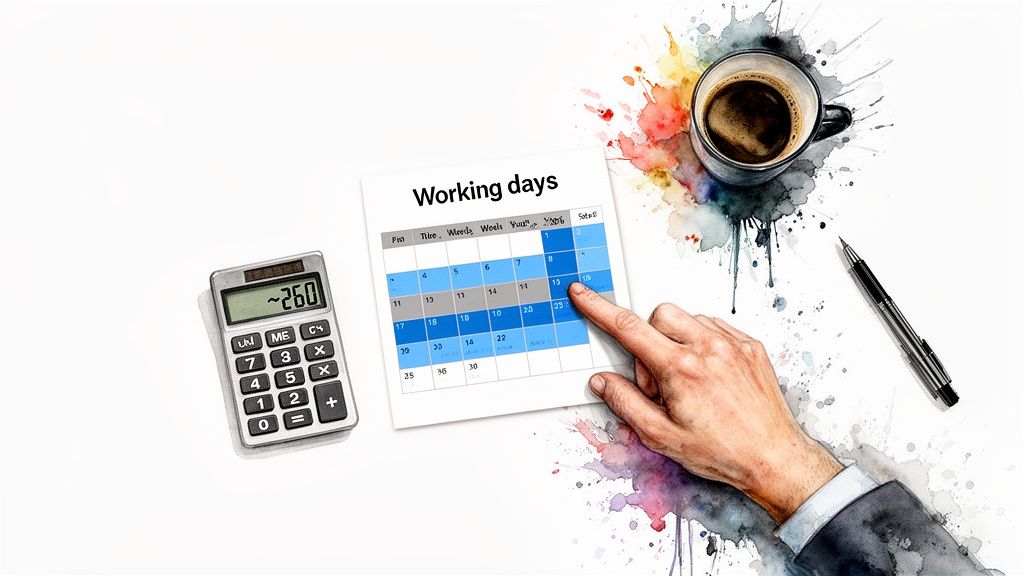
Figuring out the number of days in a working year isn't about plucking a number out of thin air; it’s a simple, logical calculation. This figure is absolutely vital for setting up payroll, allocating resources, and managing your team's annual leave. For anyone running a business or managing a team, this number is the first step towards accurate and fair planning.
Think of the 365 days in a year as your starting block. From there, you just start chipping away at the days people don't work—like weekends and public holidays—to reveal the total potential time your team has available. This simple process demystifies annual planning and gets everyone on the same page.
The Standard Calculation Breakdown
Before we get into the details of leap years, statutory leave, or part-time contracts, let’s nail down that foundational number. This basic calculation strips away the weekends and the standard bank holidays for England and Wales to give us a clear starting point.
Here’s a quick look at how we get to that number in a typical, non-leap year.
Standard UK Working Year At a Glance
This table breaks down the calculation for potential working days in a typical non-leap year before statutory leave is deducted.
| Component | Number of Days |
|---|---|
| Total days in a standard year | 365 |
| Minus weekend days (52 weeks x 2) | -104 |
| Minus bank holidays (England & Wales) | -8 |
| Total Potential Working Days | 253 |
So, there you have it. That total of 253 days is the maximum number of days a full-time employee could work before taking any of their personal annual leave. This is the cornerstone figure that supports all your more complex calculations for payroll, project forecasting, and capacity planning.
Next, we'll explore how to adjust this number for different situations, because as any manager knows, it's rarely this straightforward
The Core Formula for Calculating Working Days
So, how do you actually figure out the number of working days in a year? It's less complicated than you might think. We need a simple, reliable formula that takes the guesswork out of the equation.
Imagine starting with a solid block of marble—that's your full calendar year. Our job is to chip away the bits that aren't working days, like weekends and holidays, to reveal the final number. This simple approach gives you a clear, logical foundation for all your HR planning.
The starting point is always the total number of days in the year. From there, we subtract the biggest chunks of non-working time: the weekends. Since there are 52 weeks in a year, this first step is pretty straightforward but absolutely essential.
Breaking Down the Calculation
Let's separate the weekdays from the weekends. A standard year has 365 days, and with 52 full weeks, we can quickly work out how many of those are weekend days.
- Total Days: 365
- Weekend Days: 52 Saturdays + 52 Sundays = 104 days
Subtracting those weekends from the total gives us our first important figure: 365 – 104 = 261 weekdays. This is your maximum number of potential working days before we even think about holidays.
The next step is to account for public holidays. In England and Wales, for example, there are typically 8 bank holidays a year. These are fixed days off, so we need to deduct them from our weekday total.
The Core Formula:
(Total Days in Year – Weekend Days) – Bank Holidays = Total Potential Working Days
Applying this to a standard year in England gives us a clear baseline: (365 – 104) – 8 = 253 potential working days. This number is the total available workdays for a full-time employee before they take any of their personal annual leave.
A Historical Perspective on the Working Year
It's interesting to remember that the idea of a standard working year has changed dramatically over time. The 253-260 potential days we're used to today is a fairly modern concept.
Historians suggest that before the Industrial Revolution, work was much more irregular, and many people only worked around 200-220 days each year. It was really the post-WWII legislation that helped standardise the 40-hour week and shape the work-life balance we now recognise. This just goes to show how laws and society constantly redefine what "a working year" actually means. You can explore more about the history of the English work year and its changes over the centuries.
Getting a grip on this core formula is the first crucial step. Next up, we’ll look at how things like annual leave and regional differences in bank holidays tweak this calculation for real-world accuracy.
Factoring in Bank Holidays and Annual Leave

So, we've got our baseline figure, but let's be honest—it doesn't tell the whole story. To get to the actual number of days an employee is at their desk, we need to subtract two major variables: bank holidays and their personal annual leave. These adjustments are what turn a theoretical number into a genuinely useful tool for business planning.
Think of our initial count of 261 weekdays as the maximum possible working time available in a year. Bank holidays are the first scheduled deductions from this total, representing nationwide days off that apply to most of the workforce. They’re a fixed, predictable part of the working year.
Navigating UK Bank Holidays
One of the most important details for any UK business to remember is that bank holidays aren't the same across the country. While England and Wales share the same public holidays, Scotland and Northern Ireland each have their own unique dates. Forgetting this is a classic mistake, especially for companies with a distributed workforce.
Here’s a quick rundown of the typical number of bank holidays:
- England and Wales: 8 bank holidays
- Scotland: 9 bank holidays
- Northern Ireland: 10 bank holidays
Overlooking these regional differences can easily lead to payroll errors and scheduling mix-ups. If your business operates across multiple UK nations, you have to apply the correct number of bank holidays for each employee based on where they live. To get a better handle on this, you can explore some interesting facts about UK bank holidays and their history.
The Role of Statutory Annual Leave
After we’ve accounted for bank holidays, the final piece of the puzzle is statutory annual leave. This is the legal minimum amount of paid holiday that almost every worker is entitled to. In the UK, this is set at 5.6 weeks per year under the Working Time Regulations 1998.
For a full-time employee working five days a week, this translates to 28 days of paid leave (5 days × 5.6 weeks). This is where the distinction between "potential" and "actual" working days becomes crystal clear. It's up to the employer to decide whether to include bank holidays within this 28-day entitlement or offer them on top of it.
Key Takeaway: The statutory 5.6 weeks of annual leave is the final, crucial deduction needed to calculate the true number of working days for a full-time employee. It's what takes us from a general figure to a specific, actionable one.
So, how does this all come together? In the UK, a standard working year often starts with 261 weekdays. Subtract the 8 bank holidays for England, and you’re left with 253 days. Once you deduct the statutory 28 days of annual leave, the total drops to around 225 days. This final number is far more realistic for capacity planning and forecasting.
Calculating Leave for Your Part-Time Staff

Full-time employees are usually straightforward, but what happens when it comes to your part-time staff? Calculating their holiday entitlement on a pro-rata basis is a legal must, yet it’s a massive source of confusion and errors for so many businesses.
Getting this right isn't just about ticking a compliance box; it's fundamental to fairness and keeping your team's morale high.
The core idea is simple. Part-time workers are entitled to the same 5.6 weeks of statutory annual leave as their full-time colleagues. The key difference is that the number of days this represents is proportional to the days they actually work. This ensures everyone gets the same amount of time off relative to their schedule.
The Pro-Rata Holiday Formula
To cut through the confusion, there’s a simple and reliable formula you can lean on. All you need to know is how many days a week the employee works.
The Pro-Rata Formula:
(Number of Days Worked Per Week) x 5.6 Weeks = Total Annual Leave Days
This quick calculation translates the statutory 5.6-week entitlement into a solid number of days for any part-time schedule. Think of it as the cornerstone of fair holiday calculation, as it directly links their leave to their working pattern.
A Worked Example Step by Step
Let's make this real. Imagine you have a team member, Alex, who works three days a week. How many paid holiday days is Alex actually entitled to?
Let's break it down:
- Step 1: Identify Weekly Work Days: Alex works 3 days per week.
- Step 2: Apply the Statutory Multiplier: The legal entitlement is 5.6 weeks.
- Step 3: Do the Maths: 3 days × 5.6 weeks = 16.8 days of annual leave.
So, Alex is entitled to 16.8 paid holiday days each year. Because dealing with fractions of a day can be messy, UK government guidance allows you to round this up to the nearest half or full day. In this case, you'd round it up to a clean 17 days.
To illustrate this clearly, here's how the calculation looks in a table.
Example Pro-Rata Calculation for a 3-Day Week Employee
| Calculation Step | Formula / Value | Result |
|---|---|---|
| Employee's Weekly Working Days | 3 days | N/A |
| Statutory Leave Entitlement | 5.6 weeks | N/A |
| Pro-Rata Calculation | 3 days x 5.6 weeks | 16.8 days |
| Rounded Entitlement (as per UK gov guidance) | Round up to the nearest half or full day | 17 days |
This simple process ensures Alex receives the correct holiday time, preventing any payroll headaches or feelings of unfairness.
Understanding this is essential for any manager or business owner. For a deeper dive, our guide on the holiday calculation for part time workers offers even more examples and tackles common questions. Accurately managing how many days are in a working year for every employee—regardless of their contract—is the key to a happy, valued team.
Translating Working Days into Productive Hours

Knowing the number of working days in a year is a great start, but to really get a grip on your team's capacity, you need to start thinking in hours. This is where the numbers become truly useful. Converting days into productive hours gives you a much sharper picture for everything from project forecasting to resource planning and making sure workloads are genuinely balanced.
Think of it like planning a road trip. Knowing you have ten days to travel is one thing, but knowing you can comfortably drive for eight hours each day tells you exactly how far you can realistically go. It’s the same logic for your business operations; hours provide the granular detail you need for effective, day-to-day management.
From Days to Annual Working Hours
In the UK, a standard full-time contract is typically built around an 8-hour day. Using our earlier calculation of roughly 225 actual working days (after bank holidays and statutory leave), the maths is straightforward:
225 days x 8 hours/day = 1,800 productive hours per employee, per year.
This figure gives you a solid baseline for what you can expect from each full-time member of your team. Of course, the real challenge is making those hours count. If you're looking to get the most out of that time, it’s worth exploring ways to increase team productivity without stretching your people too thin.
The Hidden Impact of Unpaid Overtime
Here’s the thing, though: official figures often don't tell the whole story. Data from the Office for National Statistics (ONS) shows that UK full-time workers actually log an average of 1,898 hours annually, which works out to a consistent 36.5 hours per week.
But even that number can be misleading. It frequently overlooks the significant impact of unpaid overtime, which can easily push the real weekly total closer to 43 hours for many professionals.
This "hidden" time is a critical factor. While it might look like a short-term productivity win, consistent unpaid overtime is a fast track to burnout, lower engagement, and higher staff turnover.
Accurately tracking hours isn't just a box-ticking exercise for compliance; it’s a strategic necessity for building a healthy, sustainable workplace. It gives you the visibility needed to spot overloaded team members and redistribute tasks before burnout becomes a serious problem. That insight is the foundation of smart, modern workload management.
How to Automate Calculations and Prevent Errors
After diving into the details of annual leave, pro-rata days, and bank holiday quirks, one thing becomes crystal clear: tracking this stuff manually is a minefield. Relying on spreadsheets to manage how many working days are in a year for each employee isn’t just slow; it’s a serious business risk.
Think about it. A single typo in a formula can throw off holiday pay. Misinterpreting a regulation could land you in hot water with compliance. The admin burden alone is huge, pulling HR managers and business owners away from the strategic work that actually pushes the company forward. This is where costly mistakes creep in and employee morale can take a hit.
The Shift to Smart Automation
The modern, and frankly, much safer solution is to step away from error-prone spreadsheets and embrace automation. A proper leave management system is built from the ground up to handle these complex calculations with total precision, wiping out the risk of human error.
It can juggle complicated pro-rata entitlements for part-timers, keep track of different leave types, and make sure every calculation is perfectly in line with current UK regulations. This shift does more than just save a massive amount of time. It gives you a clear, real-time picture of your team’s availability, which is absolutely vital for planning resources and keeping projects on track.
Here’s a glimpse of an HR dashboard that gives you that kind of at-a-glance visibility.
This kind of visual clarity means managers can approve requests with confidence, knowing they have the full picture of who’s in and who’s out.
Automation isn’t just about being more efficient; it’s about being accurate and gaining strategic oversight. When you remove the administrative headache of manual calculations, you create a more supportive and organised workplace for everyone.
For businesses looking to make their operations even smoother, integrating the right tools is key. To ensure every hour is accounted for accurately, consider using dedicated time tracking software. It’s the perfect partner to a leave management system, giving you a complete and reliable picture of employee time.
And if you want to learn more about how automation can completely change your processes for the better, check out our in-depth guide to employee leave management software.
Frequently Asked Questions
Even with the formulas laid out, real-life scenarios can still throw up a few curveballs. Let's tackle some of the most common questions we hear from managers and business owners trying to get their heads around the working year.
How Do Leap Years Affect Working Days?
A leap year pops up every four years, adding an extra day to February and making the year 366 days long. If that extra day—the 29th of February—happens to fall on a weekday, it nudges the total number of working days up by one.
For instance, a standard year might have 261 working days. But if 29th February lands on a Monday in a leap year, that total becomes 262. It might seem like a tiny detail, but for things like pro-rata salaries and leave calculations, that single day really does matter.
Are Bank Holidays Included in Statutory Annual Leave?
This is a classic point of confusion, and the answer isn't a simple yes or no—it all comes down to the employment contract. In the UK, the statutory minimum holiday entitlement is 5.6 weeks. How bank holidays fit into this is up to the employer.
There are two ways this usually plays out:
- Inclusive: The contract might state that the 28 days of leave (for a full-time employee) include the 8 bank holidays. This leaves the employee with 20 days to book off whenever they like.
- Exclusive: A more generous setup might offer 28 days of annual leave plus the 8 bank holidays, giving the employee a total of 36 days off.
Clarity is everything here. The employment contract must spell out exactly which approach the company takes to prevent any mix-ups or frustration down the line.
What Is the Formula for Part-Time Holiday in Days?
Calculating holiday for part-time staff doesn't have to be complicated. You can figure it out in days without getting bogged down in converting everything to hours. The logic is simple and fair.
To get the right number, just multiply the number of days the employee works each week by the statutory entitlement of 5.6 weeks.
Let's say you have an employee who works two days a week. The calculation would be 2 days x 5.6 weeks = 11.2 days. It's common practice—and legally fine—to round this up to the nearest half or full day, giving them 11.5 or 12 days of paid leave.


